
ART & CULTURE · VAREDO
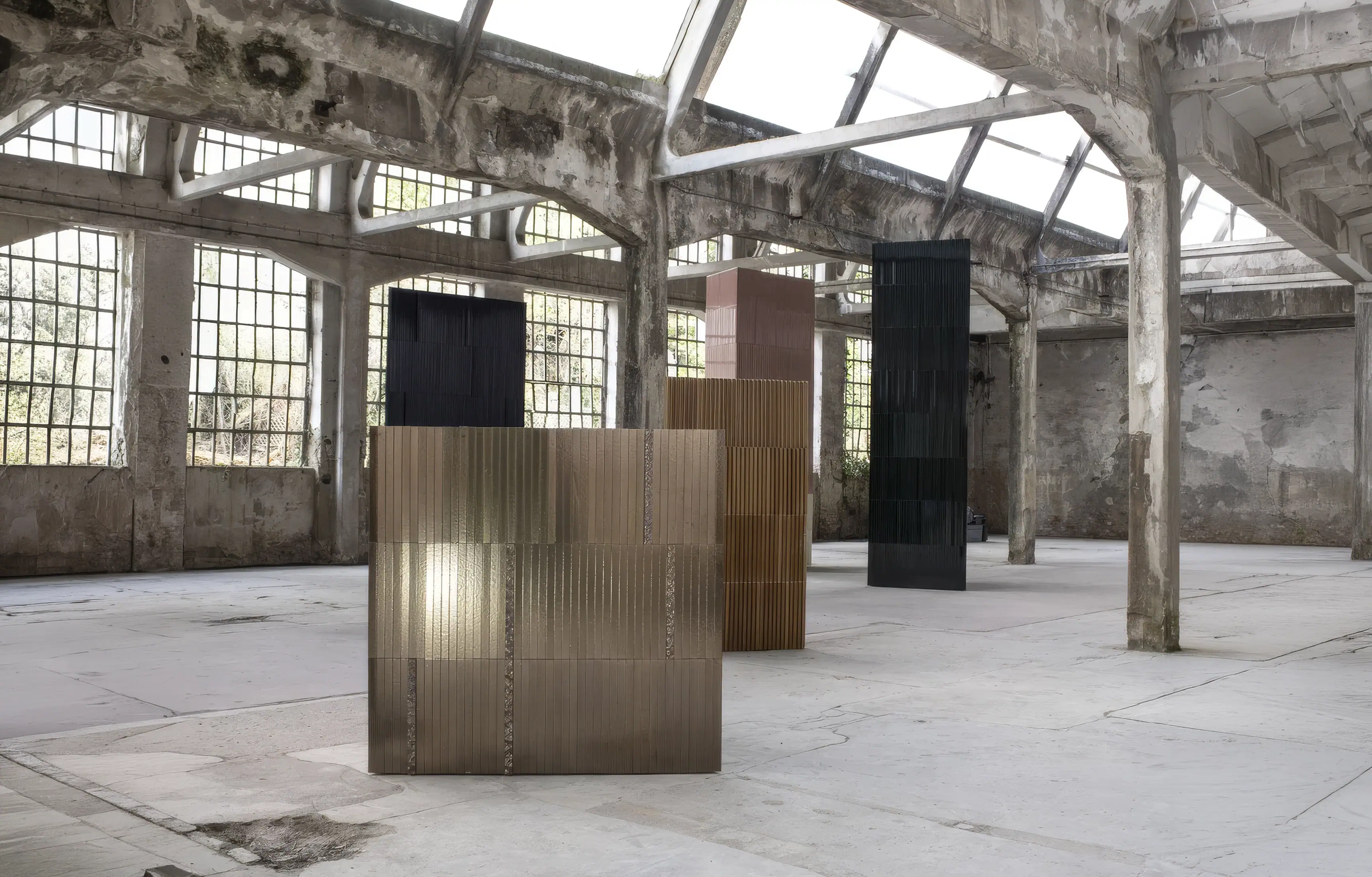
Reading time: 7 minAlcova’s ninth edition ran from 7 to 13 April 2025 across four sites in Varedo, on Milan’s northern edge. Its anchor venue was the former SNIA Viscosa factory, a rationalist industrial complex that once produced roughly a ninth of the world’s artificial fibre and then sat contaminated and empty for more than two decades before Alcova’s designers were let back inside.
Alcova’s 2025 edition ran from 7 to 13 April, spread across four venues in Varedo, a town roughly fifteen kilometres north of central Milan: the returning Villa Borsani and Villa Bagatti Valsecchi, alongside two newly activated sites, the Pasino Glasshouses and the former SNIA Viscosa factory. Of the four, the SNIA site carried the most weight, both physically and historically. It was, for decades, one of Italy’s most significant industrial sites, and its closure left behind a scale of contamination that took the better part of twenty years to even begin addressing before any exhibition could take place inside it at all.


Alcova, founded in 2018 by Valentina Ciuffi and Joseph Grima, has built its identity on exactly this kind of site: not conventional trade fair halls, but raw, disused buildings, abandoned factories, former hospitals, decommissioned military complexes, that briefly host contemporary design before returning to dormancy. The former SNIA factory is arguably the most extreme example of that formula the platform has used to date, both in the scale of its industrial history and in how long it sat unused before Alcova’s ninth edition was allowed inside.


Nine editions, and a formula that keeps expanding
Ciuffi brings a curatorial background from her time as editor of Abitare and her own Studio Vedèt; Grima brings an architect’s eye from his time as editor-in-chief of Domus and his ongoing work leading the studio Space Caviar. Together they built Alcova as a deliberate counterpoint to the trade fair halls that dominate the rest of Milan Design Week: rather than booths inside a convention centre, exhibitors are given raw, often structurally compromised buildings and asked to respond to them directly, with the site’s own condition treated as part of the design brief rather than a problem to be minimised.


The format has expanded well beyond Milan since 2018. Alcova launched a Miami edition during art week in 2023, ran it again in 2024 and 2025, and has announced plans to bring the same model to Mexico City in 2026. The 2025 Milan edition, its ninth, marked the platform’s move into Varedo specifically, having used sites closer to central Milan in earlier years; the former SNIA factory and the Pasino Glasshouses were both new additions to the roster that year, joining the returning Villa Borsani and Villa Bagatti Valsecchi.


What SNIA Viscosa actually was
The factory was established around 1922 as a joint venture between the Italian company SNIA and the British firm Courtaulds, built to manufacture viscose rayon, one of the first commercially significant artificial fibres. By 1925 it was producing roughly 24,000 kilograms of artificial filament a day, accounting for around 68 per cent of Italy’s national output and an estimated 11 per cent of global production. Output peaked in 1929 at 9.5 million kilograms of rayon for the year. The plant kept expanding through the mid-twentieth century: continuous filament spool production was introduced between 1948 and 1952, and in 1954 the site launched Italy’s first Nylon 6 production line, marketed under the brand name Lilion. By 1965 the factory employed around 6,000 people directly, with a further 1,000 in indirect roles, making it one of the dominant employers in the wider Milan hinterland.


The building itself is a substantial example of Lombard industrial rationalism, constructed across the 1920s to 1950s in reinforced concrete and exposed brick, with shed-roofed production halls lit by rows of large windows and a symmetrical main entrance anchored by a tall smokestack that still functions as a landmark visible across Varedo. It was built, in other words, exactly like a factory designed to be looked at as well as worked in, a piece of civic architecture as much as an industrial shed, its modular structural bays and repeated window rhythm doing the same organisational work a production line would have needed: consistent light, consistent span, consistent floor loading, regardless of which part of the rayon or nylon process happened to occupy a given hall in a given decade.


Production at the site declined through the early 1980s and formally ceased in 1982, as demand for the plant’s output fell and environmental concerns around its processes mounted. The factory did not close outright at that point; parts of the complex continued limited operation before the site was definitively shut down in 2003. What it left behind was severe: an estimated 2,500 tonnes of waste accumulated on site, including chemical residues and other hazardous material, requiring extensive remediation work before the buildings could safely host the public again. Alcova’s 2025 exhibition, more than two decades after the plant’s final closure, was one of the first substantial public uses of the site since then.


What Alcova actually put inside it
Against that backdrop, the installations staged inside the former factory leaned directly into the site’s own raw material history rather than working around it. Ranieri, a lava stone specialist, presented Under the Volcano, a multisensory installation built from blocks of lava stone shaped by robotic arm following digital erosion patterns devised by the artist Quayola, alongside architectural towers clad in lava stone tile designed by Francesco Meda and David Lopez Quincoces, with a soundscape composed by the musician Rodrigo D’Erasmo. The installation’s own framing treated the volcano as a metaphor for transformation, something rough and unstable reshaped into something considered, staged inside a building whose own concrete and brick were themselves the product of an equally industrial, high-heat, high-pressure manufacturing process a century earlier.


Elsewhere in the same factory, Warm Weekend, a collaboration between the designers Mathias Palazzi and Robinson Guillermet, installed 18 Drops of Sweat, an inflatable hammam built to function as an actual shower facility for young migrant men, constructed from recycled bricks, tiles and textiles, paired with a tea salon furnished with mid-century pieces supplied by the Paris gallery Boketto. Design students from Germany’s Burg Giebichenstein University, working under the designer Philipp Witte, presented Toys, a series of sculptural seating pieces built entirely from cotton sheets and recycled mattress-cover stuffing, reworked through a range of upholstery techniques into forms that owed nothing to conventional furniture construction.
The range across those three installations, molten stone architecture, functioning migrant welfare infrastructure disguised as an art installation, and furniture built from landfill-bound bedding, is a genuinely wide spread for one exhibition floor, and it is difficult to imagine any of the three reading the same way inside a conventional white-box gallery. Set inside a former rayon factory whose own manufacturing process turned wood pulp into thread through a comparably industrial and chemically intensive process, all three installations end up in quiet conversation with the building’s own history of transforming raw material into something else entirely, whether that something else was rayon fibre in 1925 or a shower stall in 2025.


18 Drops of Sweat is worth dwelling on specifically, because it did more than most Design Week installations ever attempt: it functioned as genuine, usable infrastructure for a population, young migrant men, who are rarely the intended audience for anything shown during Milan Design Week at all. Building a working shower facility from recycled brick, tile and textile inside a former industrial hall, and pairing it with a tea salon rather than treating it as a purely symbolic gesture, put a design fair’s usual concerns, material, form, craftsmanship, in direct service of a basic civic need rather than keeping them at the level of metaphor. That the factory itself once employed thousands of people in physically demanding industrial work only sharpens the pairing: a building built for one kind of labour hosting an installation built to serve people currently outside the labour market altogether.


Final thoughts
The former SNIA factory reopened to the public in April 2025 for the first extended period since its 2003 closure, and it has since gone quiet again, waiting for whatever comes next in Varedo’s slow redevelopment of the site. What Alcova’s ninth edition demonstrated, in the meantime, is that a building’s working history does not need to be softened or hidden to host contemporary design well. The factory’s exposed concrete, its scale, and its own century of transforming raw material into manufactured product gave three very different installations a shared context none of them could have found inside a conventional exhibition hall.

Whether the site hosts another Alcova edition, or moves on into whatever redevelopment eventually follows its remediation, April 2025 will likely stand as one of the very few moments the public was let back inside a building that spent eighty years defining Varedo’s economy and then spent more than twenty sitting exactly as its last shift left it.
Can I still visit the former SNIA factory in Varedo?
The site is not generally open to the public outside organised events such as Alcova. Its future use remains tied to the wider redevelopment and remediation of the former industrial complex.
What did the SNIA Viscosa factory produce, and when did it close?
It manufactured viscose rayon from around 1922, later adding nylon production from 1954. Output declined through the early 1980s, with production effectively ceasing in 1982 and the site definitively closing in 2003.
Where is Varedo, and why did Alcova hold its 2025 edition there?
Varedo is a town roughly fifteen kilometres north of central Milan. Alcova has used sites there since at least 2024, expanding to four venues for its 2025 edition: Villa Borsani, Villa Bagatti Valsecchi, the Pasino Glasshouses, and the former SNIA factory.
Who founded Alcova, and how long has it been running?
Alcova was founded in 2018 by Valentina Ciuffi, former editor of Abitare and founder of Studio Vedèt, and Joseph Grima, an architect and former editor-in-chief of Domus. The 2025 Milan edition was its ninth.
What installations were shown inside the former SNIA factory in 2025?
Highlights included Ranieri’s Under the Volcano, a lava stone installation involving the artist Quayola and architects Francesco Meda and David Lopez Quincoces; Warm Weekend’s 18 Drops of Sweat, a functioning inflatable hammam for young migrant men; and Toys, sculptural seating built from recycled bedding materials by students at Germany’s Burg Giebichenstein University.


Leave a Reply