
ART & CULTURE · MIAMI
Reading time: 9 minThirty years earlier, Art Miami had opened as a single fair with a fraction of its eventual reach. By December 2019 it filled a waterfront pavilion on Biscayne Bay with more than 170 galleries from nearly seventy cities, run alongside two sister shows built in its own image. The anniversary landed only months after the fair changed hands entirely, and the programme did not so much as pause to notice.
Art Miami marked its thirtieth anniversary edition from 3 to 8 December 2019, at One Herald Plaza on NE 14th Street in Downtown Miami, the waterfront site on Biscayne Bay between the Venetian and MacArthur Causeways that the fair had occupied for three consecutive years. More than 170 galleries travelled from close to seventy cities across some twenty countries to fill the pavilion, arranged alongside CONTEXT Art Miami, the fair’s showcase for younger galleries and emerging artists, held in an adjoining structure on the same site for its eighth edition. A third sister fair, Aqua Art Miami, opened its fifteenth edition a short distance away in South Beach, at 1530 Collins Avenue, with its own preview on 4 December ahead of public days running to the 8th.

Eternity Gallery
The three fairs share a history and, increasingly, a programme, but they do not share a remit. Art Miami is the anchor: modern and postwar masters shown alongside galleries working at the current edge of contemporary practice. CONTEXT gives that same edge more room to move, built specifically for galleries under a certain age and artists earlier in their careers. Aqua, smaller and more intimate by design, runs from a converted motel in South Beach rather than a purpose-built pavilion, and has built its own reputation for spotting the artists that later turn up on bigger stands elsewhere.
What distinguishes the 2019 edition, beyond the arithmetic of a thirtieth year, is what had happened to the fair only months before it opened, and how little that change showed on the floor.

Liquid Art System
Thirty years, and a fair that had just changed hands
Nick Korniloff became Art Miami’s director in 2008 and bought the fair outright the following year with two partners, having spent the previous six years running fine art fairs for the Daily Mail Group in London. Under his ownership the operation grew from a single December fair into a small portfolio: CONTEXT Art Miami, Aqua Art Miami, Art Wynwood, Art New York and Palm Beach Modern + Contemporary all followed.

Galeria Casa Cuadrada
In July 2019, five months before the thirtieth anniversary edition opened, Korniloff sold the entire portfolio to Informa Markets, the exhibitions arm of the London-headquartered international events group. Korniloff stayed on with his existing team to run the fairs day to day, and described the sale publicly as a positive step for the business rather than an exit from it.

Donghwa Odé Gallery
That timing is worth sitting with. A fair does not usually change owners five months before its biggest anniversary date, and a new parent company does not usually inherit a milestone edition it had no hand in building. Art Miami’s thirtieth anniversary was, in effect, a stress test for the sale: the same director, the same waterfront site, the same roster of returning galleries, now backed by a company that runs hundreds of trade events worldwide rather than a small independent operator. The edition that resulted, drawing on the record attendance the fair had set the year before, suggests the transition was absorbed rather than felt. For a fair built on three decades of continuity, that is precisely the outcome worth having.

Connect Contemporary
Faces rebuilt, one segment at a time
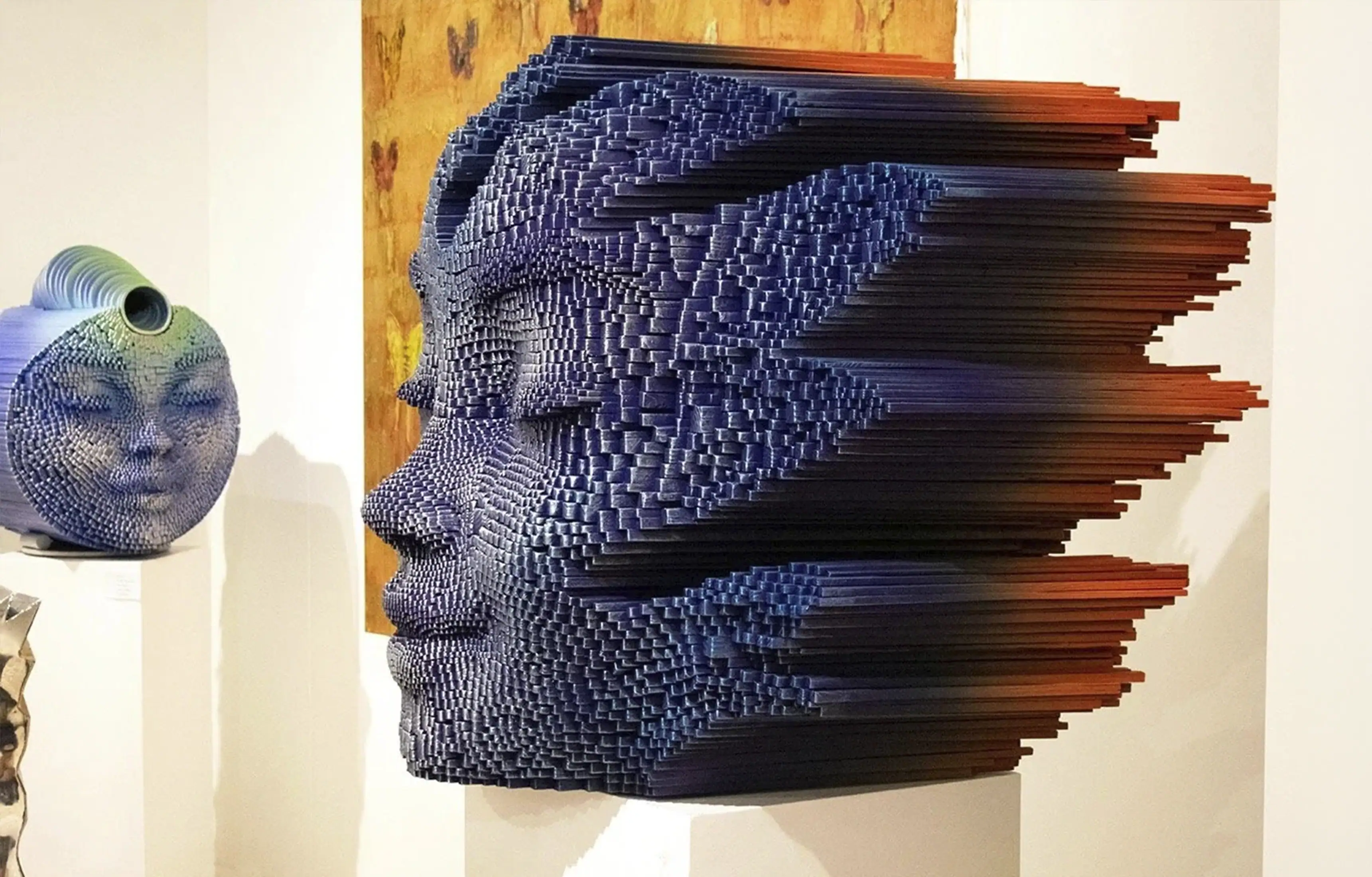
Paris gallery Galerie Frederic GOT brought a booth built around the idea of the human face as something constructed rather than fixed. Gil Bruvel’s Bending the Lines series renders faces and figures from coloured wooden segments, cut and assembled so the surface reads as a grid of pixels up close and resolves into a portrait only from a distance, a technique Bruvel has developed across sculpture, painting and printmaking. Jacques Le Bescond’s bronze Trinidad took the opposite route to the same subject, reducing a face to a minimal, abstracted form finished in black patina, closer to a study in silhouette than a likeness. Between them sat Stallman’s Robot Heart, a hybrid of canvas and sculpture built from twisted, colour-saturated materials that refuses to sit flat against the wall it hangs on.

Galerie Frederic GOT
Sculptures that need light to finish them
At Connect Contemporary, several artists worked with the idea that a piece is not complete until something happens to it after it leaves the artist’s hands. J.P. Goncalves de Lima’s Silhouette series pairs sculptural forms with cast light and shadow, so that the shadow itself becomes part of the composition, a technique that nods toward Magritte’s interest in the gap between an object and its image. Phoria Pezhman’s black-and-white photographic series Rozo builds texture from lace and wax laid over the image, so the surface reads as much as a physical object as a picture. Craig Alan, working under the name Populace, showed Andy’s Factory, a polaroid self-portrait of Warhol assembled from a crowd of tiny painted figures, and Echo, a chrome sphere ringed with hand-painted figures that catches and distorts whatever stands in front of it. All three artists are, in their own way, asking the viewer to finish the work.

Connect Contemporary
Bronze and portraiture from Milan
Liquid Art System, based in Milan, brought a programme built around figurative sculpture and portraiture in bronze and mixed media. Marco Cornini’s bronze pieces and Paolo Medici’s portrait series anchored the booth, shown alongside work by Giacinto Bosco, Raffaele Minotto, Giuseppe Tirelli and Christian Verginer, a group that has exhibited together at Art Miami and CONTEXT across multiple editions and represents one of the more established figurative programmes travelling from Italy to the fair.

Liquid Art System
What gets remade from what is discarded
Galería Casa Cuadrada, the Bogotá gallery, gave over part of its stand to the Portuguese textile artist Vanessa Barragão, whose work turns the waste stream of the rug industry into something closer to landscape painting. Barragão works entirely by hand, using crochet, latch hook, hand tufting, embroidery, felting and knitting rather than any mechanised process, and sources her raw material from recycled industrial textile offcuts and deadstock wool from artisanal rug factories that would otherwise go to landfill. Her Coral Garden pieces render reef structures in dense, sculptural wool relief, and several works are built to be read from both sides: one face in the saturated, layered colour of a healthy reef, the reverse in muted, bleached tones, so the same tapestry carries two states of the same ecosystem within a single object.

Galeria Casa Cuadrada
The gallery’s stand also carried work by the Colombian painter Martín Mancera, who trained under Armando Villegas and developed a scraping and burnishing technique, worked with blades, burins and worn brushes, that he applies to mixed-media pieces incorporating found materials: coins, banknotes, keys, invoices and matchboxes worked into paintings and collage on wood. The two practices, shown together, make a coherent argument about where a gallery’s material comes from before it becomes art: one artist reclaiming an industry’s offcuts, the other folding the residue of daily transactions into portraiture and historical subject matter.

Galeria Casa Cuadrada
Charcoal lines and layered canvas
Eternity Gallery’s stand centred on two distinct approaches to figuration. George Morton-Clark, the British artist known for building loose, cartoon-derived characters out of charcoal and paint, showed work that keeps the immediacy of a quick sketch even at a large scale, a quality that has built him a following well beyond the gallery circuit. Jason Hallman’s contribution took a more constructed route, building what the gallery describes as sculptural canvases from layered material rather than a single painted surface, so the works read with genuine depth rather than illusionistic depth.

Eternity Gallery
Paper rolled into landscapes
Donghwa Ode Gallery, based in New York, filled its booth with work that treats humble material as the entire subject. Kyung Youl Yoon’s compositions are built from discarded aluminium containers, cut and reassembled into surfaces that catch light the way the metal never did in its original form, while Yong R. Kwon works with reflections of light and colour across the picture plane. The strongest single body of work on the stand belonged to Ilhwa Kim, the Seoul-based artist whose Seed Universe series is built from hanji, the traditional handmade Korean mulberry paper, which she dyes in saturated colour before rolling it into tight cylindrical forms she calls seeds. She leaves those seeds unglued until an entire composition is resolved, which allows her to keep rearranging the piece almost up to the point of completion, and arranges thousands of them into dense, undulating fields that read less like paper and more like satellite images of a landscape no one has mapped yet.

Donghwa Odé Gallery
Three fairs, one week in Downtown Miami and South Beach
Visiting Art Miami properly means treating it as one leg of a three-part circuit rather than a single stop. Art Miami and CONTEXT share a roof at One Herald Plaza, so moving between the fair’s modern anchors and its younger galleries is a matter of walking from one hall to the next. Aqua, across the bay in South Beach, asks for a deliberate trip but rewards it: the fair’s converted-motel format keeps booths small and conversations with gallerists easy to have, a different register from the scale of the main pavilion. Taken together, the three fairs cover a wider stretch of the market, by geography and by career stage, than any single one of them could alone, which is precisely the reason Korniloff built them as a set rather than leaving Art Miami to stand on its own.

Eternity Gallery
Final thoughts
The easy version of this story is a number: thirty years, one anniversary, a fair old enough to have outlasted most of its original competitors on the Miami calendar. That number is true, and it undersells what actually happened in December 2019. A fair that had just been sold to an international events group, five months earlier, opened its milestone edition without a visible ripple, on the same site, with the same director, drawing the galleries and the crowds that had set an attendance record the year before.

Donghwa Odé Gallery
What the booths themselves argued, edition after edition, was a version of the same continuity in miniature. Vanessa Barragão builds landscapes from a textile industry’s waste. Ilhwa Kim rolls handmade paper into forms that read as new geography. Gil Bruvel reassembles a face from hundreds of separate wooden segments. Each practice takes something already made, in a different form, and remakes it into something else entirely, which is not a bad description of what Art Miami itself had just done with its own structure.

Liquid Art System
Thirty years in, with two sister fairs built from the same instinct and a new parent company that chose continuity over disruption, Art Miami’s 2019 edition was less a milestone to be celebrated than a demonstration of the thing being celebrated: a fair, and the galleries that fill it, built to survive a change of hands without losing the plot.

Connect Contemporary
When did Art Miami 2019 take place?
Art Miami’s thirtieth anniversary edition ran from 3 to 8 December 2019, at One Herald Plaza in Downtown Miami.
How many galleries exhibited at Art Miami 2019?
More than 170 international galleries took part, travelling from nearly seventy cities across roughly twenty countries.
What is the difference between Art Miami, CONTEXT and Aqua?
Art Miami shows modern and contemporary work from established and mid-career galleries. CONTEXT Art Miami, held alongside it, is dedicated to younger galleries and emerging artists. Aqua Art Miami, in South Beach, runs on a smaller scale from a converted motel format and has its own history of showcasing artists early in their careers.
Who owns Art Miami?
Art Miami has been owned by Informa Markets, the exhibitions arm of the London-headquartered international events group, since July 2019, when it acquired the fair from Nick Korniloff, who remains its director.
Where was Art Miami 2019 held?
The fair was held at One Herald Plaza on NE 14th Street, Downtown Miami, on Biscayne Bay between the Venetian and MacArthur Causeways, the site the fair had occupied for three consecutive editions by 2019.
What was Vanessa Barragão showing at Art Miami 2019?
Vanessa Barragão showed hand-made textile works, including pieces from her Coral Garden series, built by hand from recycled wool and industrial textile waste to depict reef ecosystems, with Galería Casa Cuadrada.
What is Ilhwa Kim’s Seed Universe series made from?
The series is built from hanji, traditional handmade Korean mulberry paper, which Kim dyes and rolls into cylindrical forms before arranging thousands of them, unglued until the composition is finished, into large sculptural landscapes.

Galerie Frederic GOT
Leave a Reply