

ART & CULTURE · LONDON
Reading time: 10 minFifteen galleries filled Chelsea Harbour’s glass-roofed Design Avenue for eight days in June 2021, showing work built for a public audience to buy directly. Artefact opened a building known for trade appointments to anyone who wanted to browse and buy on the spot, or watch a QEST scholar demonstrate their craft, or ask Nicholas Lees how cobalt finds its way to the edge of a bowl. The fair returned twice more, each edition timed a little more deliberately into London’s craft calendar, and it began by treating contemporary craft as something worth explaining as well as something worth selling.
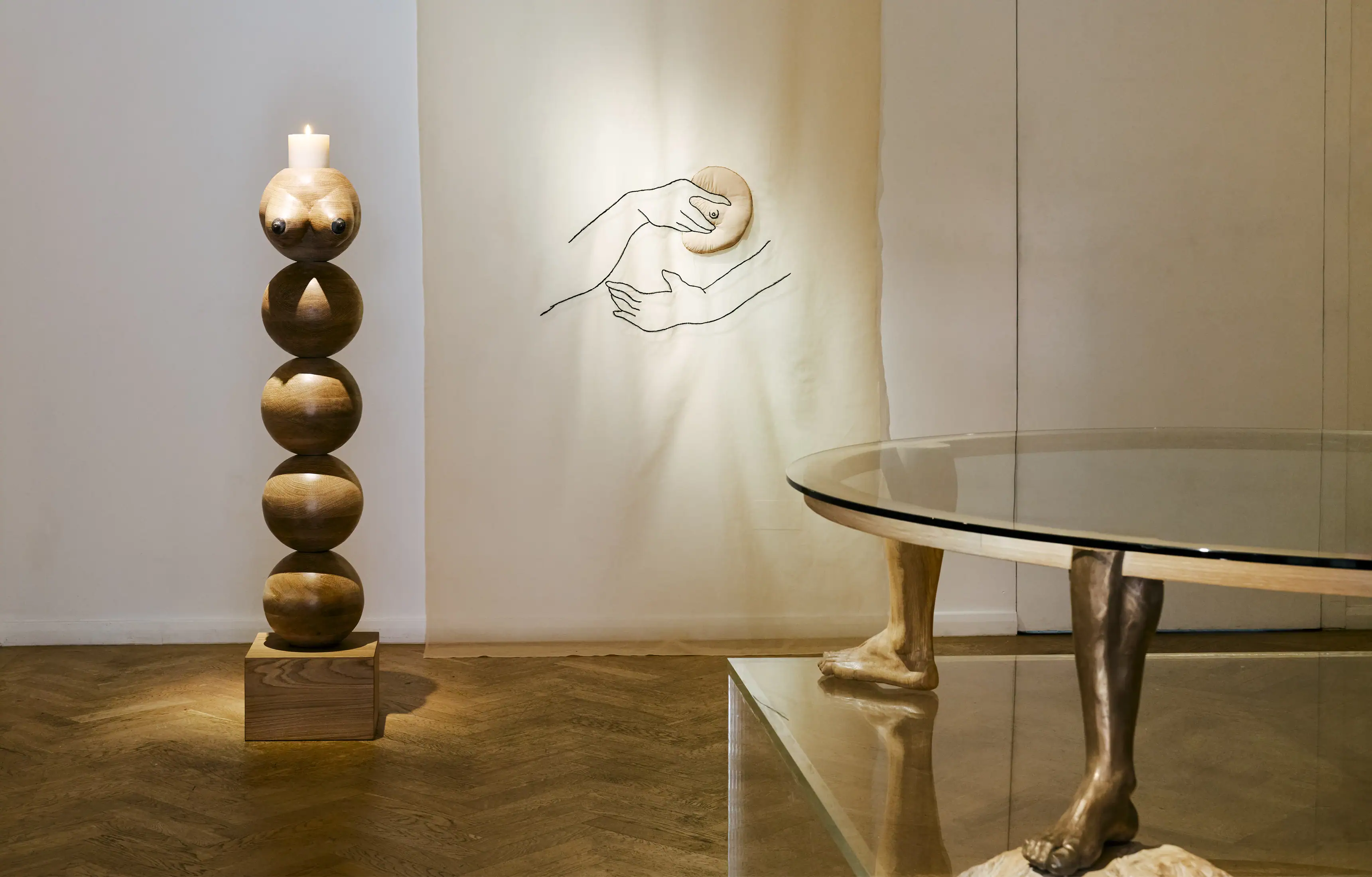
Artefact opened at the Design Centre, Chelsea Harbour on 22 June 2021 and ran for eight days, closing on 29 June. It was the venue’s first contemporary craft fair, and it brought fifteen galleries into the Design Centre’s Design Avenue to show glassware, ceramics, carvings and sculpture from makers working in London, across Britain and internationally.
The premise was straightforward and, for the venue, unusual. The Design Centre is where more than 140 showrooms sell furniture, fabric and lighting to architects, interior designers and specifiers rather than to browsing visitors. Artefact filled the same glass-roofed avenue with work that anyone could walk in and buy, and paired the selling with a programme of talks and live demonstrations that treated the makers, not just the objects, as the point.
What follows is a walk through what was actually on show, gallery by gallery and maker by maker, and the case for why a design district built around the trade found a public craft fair worth staging in the first place.

Fifteen galleries under a four storey glass roof
The Design Centre’s original building, known as the Domes, was designed by the architects Moxley Jenner & Partners and opened in 1987 as part of the redevelopment of a former coal yard into Chelsea Harbour. Its defining feature is a four storey glass ceiling that floods the Design Avenue below with daylight, and it was under that roof that Artefact’s fifteen galleries set up. Furniture, fabric and lighting showrooms line the same avenue on an ordinary trading day, so for eight days in June 2021 the building’s usual traffic of architects and specifiers moved past a very different kind of stand, one built around single, unrepeatable objects rather than fabric runs and product lines.

The scale of the roster was, by the standards of a first edition, considerable. Cavaliero Finn arrived with twelve artists. Ting Ying Gallery brought a spread of ceramics, textiles and glass. MADEINBRITALY showed Italian porcelain and earthenware. Jaggedart filled its stand with grasses, paper, wood and textile alongside ceramics. Vessel Gallery, established in Notting Hill, brought contemporary art glass, and Cube Gallery came from Marylebone with porcelain by a South Korean ceramicist. Between them, the work on show ranged from a single vessel thrown and turned by hand over the course of a day to sculptures built from digital files and printed before they were ever touched.
Cavaliero Finn’s twelve: colour that finds its own edges
Cavaliero Finn’s stand was the largest single presence at Artefact, gathering twelve artists including Nicholas Lees, Soledad Christie and Cecilia Moore.

Lees works in Parian, a fine, unglazed porcelaneous clay body developed in the nineteenth century and prized for the smooth, faintly translucent surface it takes straight from the kiln, without the need for a glaze. His Floating Bowls begin on the wheel as deliberately thick walled forms, dried slowly over several weeks and turned by hand on a lathe, a single piece taking up to six hours to finish. The colour is where the technique becomes genuinely distinctive. Lees applies a solution of cobalt sulphate to the inside of the fired, unglazed bowl and then saturates the piece with water. As it dries, evaporation happens faster at the bowl’s thinnest edges, and the drying draws the cobalt outward with it, so the colour concentrates precisely along the rim rather than sitting flat across the surface. It is closer to how ink migrates across wet paper than to conventional glazing, and it means no two bowls take their colour the same way twice.

Christie’s Llamas Siluetas translates the silhouette of the llama, a recurring motif in South American craft, into worked ceramic form, while Moore’s Balancing Act I is built in metal around the physics of a poised, off centre weight. Both sit alongside newer work Cavaliero Finn brought to the fair specifically, including Katharine Swailes’ Colourfield tapestries and Björk Haraldsdóttir’s ceramics, developed in the run up to the fair rather than pulled from stock.

Ting Ying Gallery: porcelain, ocean plastic and glass together
Ting Ying Gallery’s stand made the case for craft as a single conversation across very different materials. British ceramic artist Alice Walton showed Pink Wall Ribbons, a wall based piece built from thrown and altered porcelain forms. Jinya Zhao brought glasswork to the same stand, and the Dutch ceramicist Babs Haenen showed porcelain vessels built up in layers and then cut and sculpted after firing, a technique that turns a functional form into something closer to a worked landform.

The most pointed piece was Cork based textile artist Helen O’Shea’s Bi-Valve, made from ocean waste plastic gathered and reworked into sculptural form. Placed a few feet from Lees’ Parian and Haenen’s porcelain, it made the same argument in a different material: that what a maker chooses to work with is itself part of the finished piece’s meaning, not just its manufacture. Ting Ying’s own co-founder, Peter Ting, would go on to speak in the fair’s talks programme, giving the gallery’s presence at Artefact a second layer beyond the stand itself.

MADEINBRITALY: from the seabed to the 3D printer
MADEINBRITALY brought Italian ceramics to the fair, anchored by two very different bodies of work. Martha Pachon Rodriguez showed her Sea Urchins collection, porcelain forms built around the spiked, radial geometry of the sea creature that gives the series its name. Andrea Salvatori showed Composizione 40100#12, part of a body of work in which digitally modelled forms are 3D printed and then finished as glazed earthenware, a process that starts on a screen and ends, as any ceramic piece does, in a kiln.

The pairing was a useful one for a fair making an argument about the range contemporary craft now covers. Rodriguez’s work is built by hand around a natural reference; Salvatori’s is designed digitally and realised through additive manufacturing before the glaze and the fire take over. Both count as ceramics. Neither looks much like the other.

Jaggedart: grasses, paper and porcelain flowers
Jaggedart’s stand was built around three dimensional work in ceramic, grasses, wood, paper and textile, and it included Kazuhito Takadoi’s compositions of grass, gold leaf and beech branch worked onto Japanese handmade paper, alongside two ceramic bodies of work with very different registers. Lucas Ferreira’s Faded collection explores muted, worn surface finishes across a group of vessels, while Valéria Nascimento’s hand made porcelain floral displays translate the fragility of a cut flower into a fired and permanent material.

The gallery’s presence at Artefact underlined a point the fair made across several stands: that a contemporary craft fair now sits comfortably next to natural materials that most galleries would once have filed under design or botany rather than craft.

Vessel Gallery and Cube Gallery: glass and porcelain as sculpture
Vessel Gallery, which has traded from Notting Hill since well before Artefact, brought contemporary art glass to Chelsea Harbour, including Karin Mørch’s Big Reddish Line, a unique cast glass sculpture in which the Danish artist works with the contrast between straight and tilted forms, and Bethan Laura Wood’s Chemical Elements collection, part of the London designer’s long running work in richly coloured, hand finished glass.

Cube Gallery, based in Marylebone, showed the South Korean ceramicist Myung Nam An’s Eye Series, a body of porcelain work built around pierced and perforated white forms, in which openings cut into the vessel’s surface change how it reads depending on where a visitor is standing. Seen together with the glass on Vessel’s stand, the two galleries made a case for sculpture as a category that runs straight through both materials, with light doing very different work in each. Glass bends and holds it; porcelain, pierced and opened, lets it pass through in patterned fragments.

Placing a Notting Hill glass specialist next to a Marylebone ceramics gallery was itself a small piece of curatorial logic. Neither gallery trades from Chelsea Harbour day to day, and Artefact’s real function, for exhibitors as much as for the design district hosting them, was to put stands that would ordinarily never share a wall in the same glass-roofed room for a week.

Why a trade address opened its doors
The Design Centre, Chelsea Harbour has always been open to the public, even though its business is built around the design trade. Its 140 plus showrooms across three buildings, the original Domes, Design Centre East, added in 2010, and Design Centre North, added in 2019, sell to architects, interior designers and specifiers working on projects from private houses to hotels and superyachts, and most of a showroom’s trade happens by appointment rather than passing footfall.

That gap, a public building with a trade audience, is what a fair like Artefact was built to close. It gave the Design Centre a reason for a general audience to walk through its doors on their own terms, browsing and buying directly rather than through a design professional, while filling the same glass roofed avenue that ordinarily displays furniture and fabric with work that made an equally strong case for craftsmanship. It is the same logic behind the Design Centre’s WOW!house, an annual showhouse that turns entire trade showrooms into fully designed rooms the public can walk through: both events ask a building designed for professional sourcing to explain itself, and its contents, to everyone else.

More than a marketplace
Artefact was not simply a selling fair with a good address. Its 2021 programme, called Conversations in Craft, put Annie Warburton, chief executive of Cockpit Arts, Peter Ting of Ting Ying Gallery, the furniture designer Sebastian Cox and the ceramic artist Kate Malone on stage to talk about the state of British craft, rather than to sell it. Alongside the talks ran an Artisan Trail of live demonstrations through the Design Centre’s showrooms and a partnership with the Queen Elizabeth Scholarship Trust, the charity that funds training for British craftspeople, whose scholars demonstrated their skills to visitors across the eight days. The fair’s opening exhibition also carried work by graduates of the Crafts Council’s Hothouse Programme, the organisation’s own scheme for developing early career makers.

Put together, that is a fair that used its commercial platform to do the real work of a craft development pipeline: training, early career support and public conversation, built directly into the business of selling. It is also, in hindsight, a formula that held. Artefact returned in May 2022, deliberately timed to fall within London Craft Week, the established annual showcase for craft across the city, with its own Conversations in Craft series chaired by the design writer Grant Gibson and a Meet the Makers programme of QEST demonstrations. A third edition followed in May 2023. Three consecutive years, each one folding a little more of London’s wider craft calendar into the Design Centre’s own, is a stronger case for the format than a single well attended launch would have been.

Final thoughts
It would be easy to read Artefact as a straightforward piece of venue marketing: a trade building borrowing a weekend’s worth of public interest in craft to bring new faces through its doors. What actually happened over those eight days in June 2021 was more specific than that. Fifteen galleries brought work built on real technical range, from Nicholas Lees’ cobalt finding its own path to the rim of a Parian bowl to Andrea Salvatori’s forms starting life inside a 3D printer, and the fair put makers and craft leaders on stage to talk about the work rather than simply sell it.
That combination, a commercial fair carrying a genuine development programme inside it, is what gave Artefact the shape of something built to last rather than a one-off. It returned twice, moved deliberately into London’s established craft calendar by its second year, and used the Design Centre’s public access, a building otherwise built for the trade, to put contemporary craft directly in front of people who might never have booked a trade appointment to see it.
The Design Centre has used the same instinct since, most visibly in WOW!house, which asks the same glass-roofed buildings to explain themselves to a public audience on a different scale. Artefact was the earlier version of that idea, built around vessels, glass and sculpture instead of whole rooms, and it is worth remembering as the moment a trade address first opened itself to craft on the public’s own terms.

What was Artefact?
Artefact was a contemporary craft fair held at the Design Centre, Chelsea Harbour in London, bringing together galleries showing glassware, ceramics, carvings and sculpture from British and international makers.
When did Artefact 2021 take place?
Artefact’s inaugural edition ran for eight days, from 22 to 29 June 2021, at the Design Centre, Chelsea Harbour.
How many galleries exhibited at Artefact 2021?
Fifteen galleries took part, including Cavaliero Finn, Ting Ying Gallery, MADEINBRITALY, jaggedart, Vessel Gallery and Cube Gallery.
What is Parian, the material Nicholas Lees uses for his Floating Bowls?
Parian is a fine, unglazed porcelaneous clay body developed in the nineteenth century, valued for the smooth, faintly translucent surface it takes directly from firing without a glaze.
Did Artefact happen again after 2021?
Yes. Artefact returned in May 2022, timed to coincide with London Craft Week, and again in May 2023, making it a three year run at the Design Centre.
Is the Design Centre, Chelsea Harbour open to the public?
Yes. Although its 140 plus showrooms sell primarily to the design trade, the Design Centre itself is open to the public and hosts public facing events including Artefact and the annual WOW!house showhouse.
Where is the Design Centre, Chelsea Harbour?
The Design Centre is on the Chelsea Harbour development in west London, accessible from Lots Road, and comprises three linked buildings known as the Domes, Design Centre East and Design Centre North.

Leave a Reply