
Design Travel · Talloires
Reading Time: 8 minutes
Four generations of one family ran the Auberge du Père Bise before Jean Sulpice took it on in 2017. The interiors of its newest chapter, the suites and the restaurant Le 1903, are by Émilie Bonaventure, a Paris decorator-scenographer who was raised near the same lake the hotel has looked out on since 1903.
Introduction
L’Auberge du Père Bise sits on the shore of Lake Annecy at Talloires-Montmin, in the French Alps, where it has operated continuously since 1903. It is a Relais & Châteaux property with 22 rooms and suites, a two Michelin star restaurant run by chef Jean Sulpice, a bistro called Le 1903, and a bar named Marius, after the family that built the place. Sulpice and his wife Magali bought the hotel from the Bise family in 2017. The interiors of its most recent phase, the deluxe suites and Le 1903, are by the Paris-based Émilie Bonaventure, working with the project management agency Crea Design and photographed throughout by Nicolas Mathéus.

That is the version of the story most coverage settles for: a storied hotel, a new chef, a fresh interior. What it tends to leave out is that Bonaventure was raised near this same lake before she left for Paris, which means the person redesigning one of Savoie’s most historically significant dining rooms grew up looking at roughly the same view the hotel has sold to guests for over a century. It also leaves out how closely the new restaurant’s menu still echoes the dish that made the family’s reputation in the first place.

A guinguette that became one of France’s most decorated dining rooms
The Auberge began in 1903, when François and Marie Bise opened an inn on the shore at Talloires. In 1928, their son Marius and his wife Marguerite took over. It is Marguerite who turned the family inn into a genuine landmark: by 1951 she had earned three Michelin stars, becoming only the third woman in France to reach that rank, after Eugénie Brazier and Marie Bourgeois, both in 1933. Her signature dishes, a crayfish gratin and Bresse chicken with tarragon, drew guests that reportedly included Winston Churchill and Jean-Paul Sartre.

Marguerite died in 1965. Her son François Bise, trained under Fernand Point, took over the kitchen in 1968 and held three stars through the 1970s, before his own death from cancer in 1983. The restaurant lost one of its stars as he was dying, and it was his daughter Sophie Bise who helped win it back in 1985, before formally taking over the kitchen in 1987 after training in New York, Venezuela and Brazil. She published a cookbook of the family’s recipes in 2013. Four generations of one family, more than a century, and the Auberge never left their hands until 2017, when Sophie and her mother Charlyne sold it to Jean and Magali Sulpice.

The new chef kept the family’s own name on the door
Sulpice’s own path to Talloires ran through the mountains rather than the lake. Born in Aix-les-Bains in 1978 to a family of hoteliers, he trained under Marc Veyrat from 1998, then with Pierre Gagnaire and Édouard Loubet, before taking the kitchen at L’Oxalys in Val Thorens, at 2,300 metres, in 2002. He earned his first Michelin star there in 2006 and a second in 2010, at 32, making him the chef of Europe’s highest Michelin-starred restaurant at the time. He is also a competitive ski mountaineer and cyclist, which is not incidental to how he has talked about the Bise takeover: a mountain chef moving down to lake level, taking on a kitchen with three generations of documented history behind it rather than building a reputation from nothing.

The hotel closed for six months of renovation and reopened in May 2017. The Michelin Guide awarded it two stars in February 2018, and Gault&Millau named Sulpice its Chef of the Year for 2017. He named the property’s new bistro Le 1903, after the year the Bise family opened the original inn, and it is not a passing gesture. The tasting menu at Le 1903 includes a crayfish tail gratin, which sits close enough to Marguerite Bise’s original signature dish that it reads as a deliberate echo rather than a coincidence of a lake known for its crayfish. A new owner naming his bistro after the founding year and putting a version of the founder’s own dish on its menu is choosing continuity over erasure, in a trade where a change of hands more often means a clean break.

The designer redrew the dining room around the shoreline itself
Émilie Bonaventure was raised near Lake Annecy before training as an art historian at the École du Louvre in Paris, specialising in twentieth century decorative arts, and building a career that runs through the Frenchie restaurant group, the Rose Bakery cafés inside several Paris museums, and Denny Imbroisi’s Epoca. She founded her studio, be-attitude, in 2005, and describes her own method as that of a scenographer as much as an interior architect. At the Auberge, that biography is not incidental. It is a Paris-trained specialist in twentieth-century French decorative history returning to redesign the most historically decorated dining room on the lake she grew up beside.

Her work at the Auberge ran in two phases for Sulpice: deluxe suites in 2019, then a second phase of suites alongside the full Le 1903 restaurant fit-out in 2022, the latter opening on 4 March 2022. Le 1903 replaced the property’s previous bistro, built around a curved glass structure that follows the line of the shore, which Bonaventure has described as a winter garden opening onto the lake. Where the hotel’s original Belle Époque architecture gave her fixed points, she worked in wood, limestone and ceramic, with enamelled lava and turned wood tables, terracotta, walnut, raffia and lime through the material palette, and a soft, landscape-drawn colour range of linden, sage and cobalt, accented with carmine. The chairs are corded, a direct reference to the ropework of Talloires’ own working port, set against vintage Danish chairs reupholstered in linen velvet, an unexpected pairing of Alpine craft and Scandinavian modernism that neither fights the other. Tableware is by Bernardaud, designed specifically for the restaurant and carrying the lake’s own motifs onto the table.
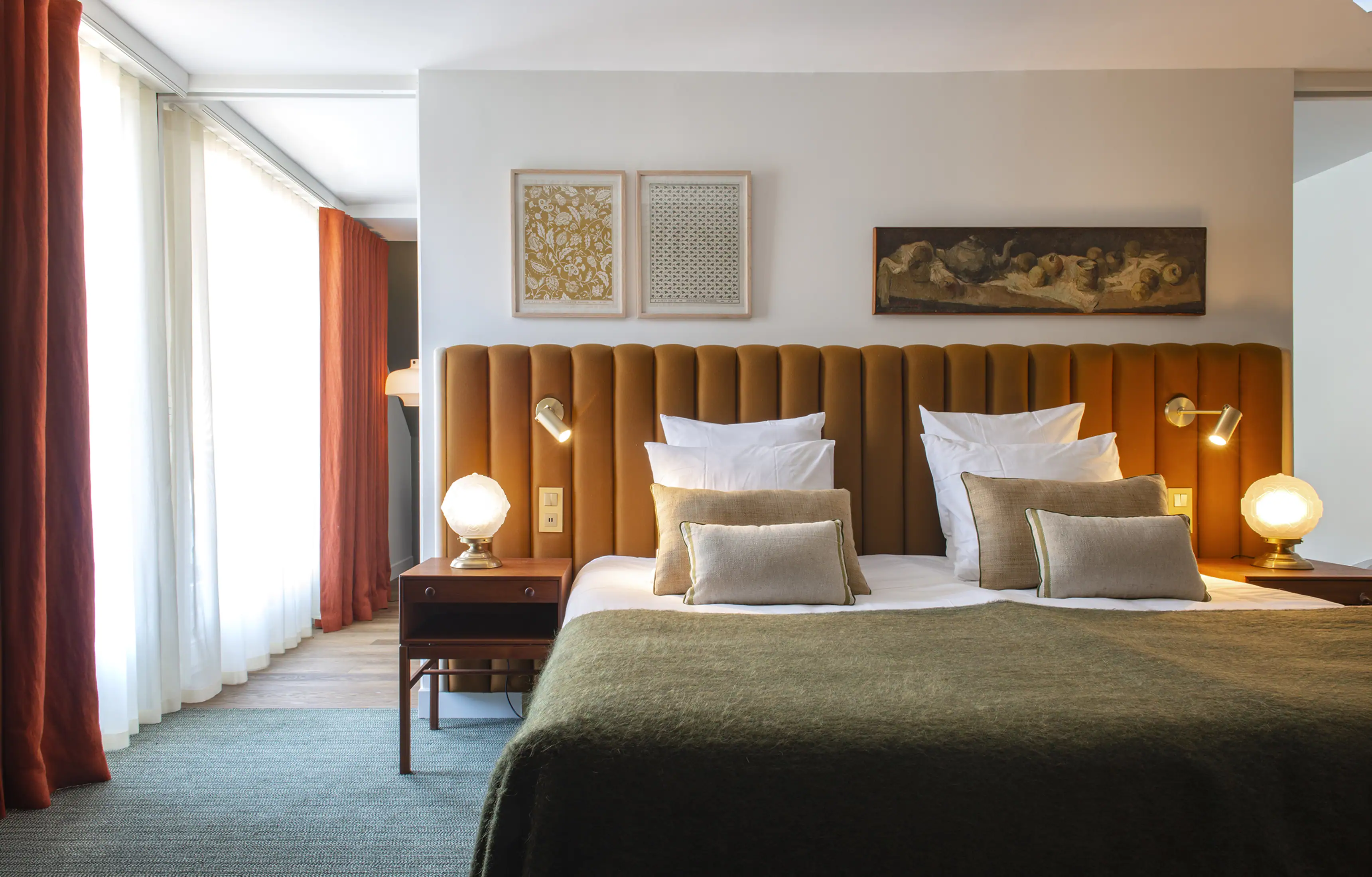
In the guest suites, the language continues rather than resets. Pierre Frey textiles, custom furniture, and a natural, warm palette carry the restaurant’s material logic upstairs, with each suite built around a single art acquisition rather than a repeated decorative scheme. The largest, the Exceptional Suite, runs to 60 square metres with a private 80 square metre terrace and a jacuzzi, and a genuinely rare thing for a hotel of this size: 360 degree views across the bay rather than a single aspect.

A hotel built into a working lake port, not a resort invented for one
Talloires-Montmin sits where three Alpine massifs meet, the Bauges, the Vanoise and the Chamonix-Mont-Blanc valley, on a bay that has been settled since a Benedictine priory was founded there in the eleventh century, long before hospitality had anything to do with the place. The village grew up around fishing and, later, sailing, and the Auberge’s own beach and boat access are a continuation of that working shoreline rather than an amenity invented for tourists. The hotel’s spa, added alongside the Sulpice era, keeps to the same register: an indoor pool, hammam, sauna, cold plunge bath and an outdoor Nordic bath, treatments built around cold water and stone rather than a generic five-star wellness template.
That context matters for reading Bonaventure’s material choices correctly. A port town on an Alpine lake is a specific, narrow category, closer in spirit to a fishing harbour than to a ski resort, and the corded chairs and lake-drawn ceramics only make sense once the place itself is understood as a port rather than as a generic mountain destination. The design is legible as a response to Talloires specifically, not to the Alps in general, which is a distinction most coverage of the property does not bother to make.

What the design argument actually is
Strip away the individual materials and the choice underneath all of them is legible: nothing in Bonaventure’s work at the Auberge tries to compete with the lake. The corded chairs, the raffia, the lime plaster and the muted linden-and-sage palette are all materials that already exist in the region’s own vocabulary, reassembled rather than imported. A designer with a less specific relationship to the place might have reached for a generic Alpine-chic shorthand, reclaimed timber and antler motifs standing in for a mountain identity that has nothing to do with a lakeside town built around fishing and a working port. Bonaventure’s version is quieter and more accurate: rope, not antlers; lake ceramics, not ski-lodge cladding. It reads less like a decorator’s idea of Talloires and more like a description of it.

Frequently asked questions
Where is Auberge du Père Bise and who owns it?
The Auberge sits on Lake Annecy at Talloires-Montmin in Haute-Savoie, France. It has been owned by chef Jean Sulpice and his wife Magali since 2017, after four generations of the Bise family, who founded it in 1903.
Who designed the interiors at Auberge du Père Bise?
Émilie Bonaventure, a Paris-based decorator-scenographer who founded her studio be-attitude in 2005, designed the deluxe suites in 2019 and 2022 and the restaurant Le 1903 in 2022, working with the project management agency Crea Design.
How many Michelin stars does the restaurant have?
The main restaurant, run by Jean Sulpice, holds two Michelin stars, awarded in February 2018. Marguerite and later François Bise held three stars at the same address for decades before Sulpice’s ownership.
What is Le 1903?
Le 1903 is the hotel’s bistro, opened on 4 March 2022 with interiors by Émilie Bonaventure. It is named after the year François and Marie Bise founded the original inn.
How many rooms does the hotel have?
The Auberge has 22 rooms and suites across the main building and a garden house, including an Exceptional Suite with a private terrace and 360 degree lake views.
Is Auberge du Père Bise part of Relais & Châteaux?
Yes, it has been a Relais & Châteaux member since 1973, one of the group’s longer-standing properties.

Final thoughts
The Auberge du Père Bise has changed hands only once in over a century, and the new owner has chosen to keep the family’s name on his bistro and a version of the founder’s own dish on its menu. That is an unusual amount of continuity to build into a takeover, and it sets the terms the design had to answer to.
Émilie Bonaventure’s contribution is to make that continuity physical rather than sentimental. The rope-corded chairs, the lake ceramics and ropework references, and a dining room shaped like the shoreline it looks out on are all decisions rooted in the specific place rather than a generic idea of the Alps, made by someone who grew up looking at that particular water before she ever trained as a designer. A hotel that has spent four generations being genuinely of its lake has, in its newest chapter, found a designer who is genuinely of it too.

Leave a Reply