ART & CULTURE · LONDON
Reading time: 9 minDale Chihuly filled thirteen sites across Kew Gardens with 32 sculptures in 2019, from a nine-metre pendant of blown glass blossoms hanging inside the newly restored Temperate House to a field of coiled glass spines rising from the bluebells. The show paired one of the most labour-intensive studio practices in contemporary glass with a garden that had just finished proving, panel by panel, exactly how much collective hand-work a Victorian glasshouse demands.
For six and a half months in 2019, the Royal Botanic Gardens, Kew, became a design trail as much as a botanic garden. Between 13 April and 27 October, the American glass artist Dale Chihuly installed 32 sculptures across 13 locations, from the Palm House forecourt to the galleries of the Shirley Sherwood Gallery of Botanical Art. The centrepiece stood inside the Temperate House, the world’s largest surviving Victorian glasshouse, which had reopened the previous year after a five-year, £41 million restoration.
The show was called Reflections on Nature, and the title was doing real work. Chihuly’s forms, coiled spines, swirling discs, clustered globes, are abstractions of plant and marine life rather than representations of it, and Kew’s own planting supplied the comparison at every turn: bluebells under blue glass, waterlilies under white glass, a lake edged with glass the colour of the sunset over it. This was Chihuly’s second exhibition at Kew. His first, Gardens of Glass, had run there in 2005 and proved popular enough that its scheduled run was extended into the new year.
What follows is a description of what was actually on site, who made it and how, and the argument that connects the two headline elements of the show: a studio practice built entirely on teams of hands, staged inside a building whose own restoration had just been finished by an equally large team of specialists.

What was actually on the ground
Reflections on Nature was not a single installation but thirteen separate encounters, ten of them outdoors and three inside galleries and glasshouses, arranged as a trail with a printed map to guide visitors between them.
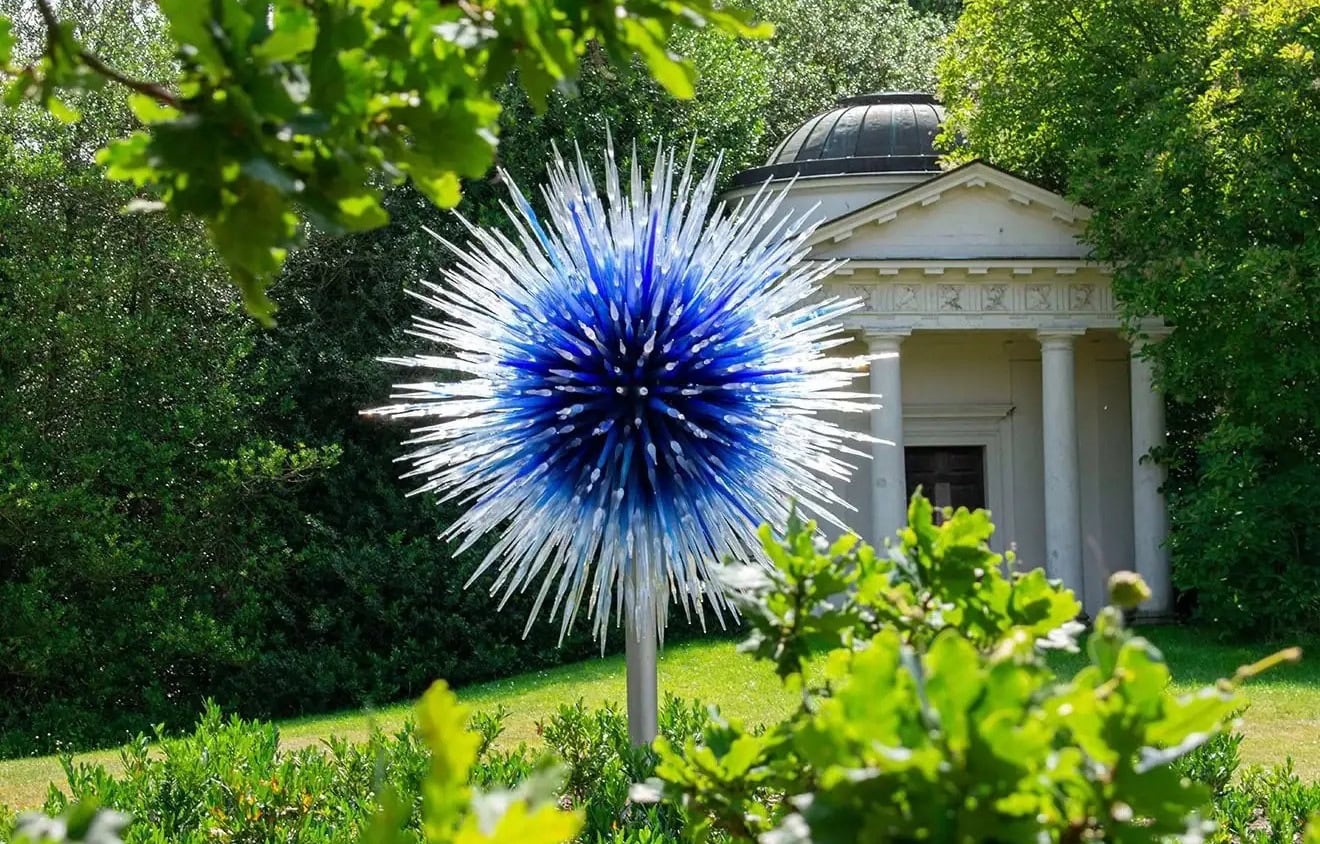
Near the Victoria Gate entrance stood Sapphire Star, a burst of cobalt blue glass spines fading through white to clear tips, planted directly into a bed of bluebells so that the sculpture and the flowers read as one colour event. At the Palm House, Summer Sun met visitors at the entrance: a coiled mass of red and yellow glass built from 1,483 separate elements, sited by the lake so that its reflection doubled the effect across the water. Above the Waterlily House, Ethereal White Persian Pond spread white and clear glass forms across the roof, echoing the white lilies growing in the pools beneath it. At the Japanese Gateway, clusters of Niijima Floats, patterned glass globes in shifting colourways, sat among the planting like oversized seed pods.

Indoors, the Shirley Sherwood Gallery of Botanical Art hosted a different register of the work: pieces from the Drawings and Rotolo series alongside Seaforms, shown alongside a documentary film of Chihuly’s studio in Seattle. Placing sculpture beside working drawings and film footage was a deliberate choice, because it showed visitors the industrial scale of production behind objects that, on the garden trail, could be mistaken for something that grew there.
The centrepiece, though, was inside the Temperate House: Temperate House Persians, a nine-metre pendant of blown glass blossoms in blue, green and yellow, suspended from the glasshouse’s restored roof structure and lit so that its colour repeated in miniature across the polished floor below.

From glassblower to director: the making of the work
Understanding why a Chihuly installation looks the way it does means understanding what happened to Chihuly himself in 1976. Born in Tacoma, Washington, in 1941, he had studied interior design at the University of Washington, enrolled in the first academic glass programme in the United States at the University of Wisconsin, and gone on to help build the glass department at the Rhode Island School of Design, where he taught for more than a decade. A 1968 Fulbright Fellowship took him to the Venini glass factory in Venice, and in 1971 he co-founded the Pilchuck Glass School in Washington State, which became one of the most influential centres for studio glass anywhere in the world.
Then, in 1976, a car accident put him through a windscreen. He lost the sight in his left eye, and with it the depth perception that hands-on glassblowing depends on. Rather than step back from the material, Chihuly changed his relationship to it. He stopped working the blowpipe himself and became a director, sketching forms in fast gestural drawings and overseeing teams of gaffers, the skilled glassblowers who execute each piece, in the same way a choreographer sets movement for dancers rather than performing it themselves.

That shift is the reason a single Chihuly sculpture can be so large and so structurally daring. The Rotolo series, shown at Kew in the Shirley Sherwood Gallery, makes the point clearly: each piece is built by coiling and twisting molten glass upward as it is worked, a technique that can involve up to seventeen team members handling roughly 140 pounds of glass in coordinated stages, followed by several days of controlled cooling before the piece is safe to move. No single gaffer, however skilled, could hold and turn that mass of hot glass alone. The work exists because Chihuly redesigned the production process around a team, not despite the accident but because of it.

The Seaforms, and where the marine reference actually comes from
The Seaforms series, shown alongside the Rotolo pieces at the Shirley Sherwood Gallery, developed in the early 1980s as an extension of Chihuly’s earlier Basket forms. The reference to underwater life is not a marketing gloss added after the fact. Chihuly has described watching how hot glass behaves under gravity and centrifugal force and finding that, left to its own physics, it naturally produces the fluted, undulating profiles of jellyfish, kelp and shells. The technique uses thin-walled, transparent glass shaped over optic moulds, which ridge the surface and strengthen it structurally while producing the ribbed texture associated with the series, often finished with a contrasting colour wrap around the rim.
Seeing Seaforms at Kew, in a gallery dedicated to botanical illustration, made a specific point about technique rather than theme: the forms are not a designer’s idea of what the sea looks like, borrowed and applied to glass. They are what the material does when its own physical behaviour is allowed to lead the design, which is precisely the argument botanical illustration has always made about plant form.

The Temperate House, rebuilt panel by panel
The building that hosted the show’s centrepiece has its own design history, and it is one worth setting out properly. The Temperate House was designed by the architect Decimus Burton, working with the engineer Richard Turner, and built in stages between 1859 and 1899, opening in part in 1863 before being completed four decades later. At 628 feet long, twice the length of Kew’s Palm House, it remains the largest surviving Victorian glasshouse in the world.
Its most recent restoration, completed in the years leading up to a reopening in May 2018, cost £41 million and took 1,731 days. Around 400 staff and contractors worked on the project in phases: 69,000 individual architectural elements were removed, cleaned, repaired or replaced, including 15,000 panes of glass and 116 decorative urns lifted clear by crane. Conservators found thirteen layers of historic paint on parts of the ironwork and replaced them with a new four-coat protective system, adapted from technology used on North Sea oil rigs, designed to survive another century of London weather. Original underfloor heating pipes, installed 158 years earlier, were uncovered during the works and preserved rather than removed.

Two teams of hands
Here is the connection the show made without stating it outright. The Temperate House is not a building one person designed and one person built. It took three phases of construction across forty years to complete in the nineteenth century, and its twenty-first-century restoration took 400 specialists 1,731 days to put right, pane by pane and urn by urn. Chihuly’s studio operates on exactly the same logic, at a different scale and speed. A Rotolo needs up to seventeen gaffers to lift and turn while it is still molten. A show of this size needs a fabrication and installation team large enough to ship the work from Seattle in eleven shipping containers and assemble it on site across thirteen locations.
Both the host building and the visiting sculpture, in other words, are the product of large, coordinated, mostly anonymous teams of specialist hands, working to one person’s design intent. That is not a coincidence of scheduling. It is the reason the pairing worked as well as it did: a restored Victorian glasshouse, whose conservation had just demonstrated exactly how much collective craft goes into a single pane of glass, hosting an artist whose entire post-1976 practice is built on the same principle applied to hot glass rather than cold.

A second visit, fourteen years apart
Reflections on Nature was Chihuly’s return to Kew rather than his introduction to it. His first Kew show, Gardens of Glass, opened on 28 May 2005 and had been due to close that autumn, but demand kept it running into January 2006. Fourteen years is long enough for both sides of the pairing to have changed considerably: Chihuly’s studio had since developed the Rotolo technique and continued to expand the Seaforms and Niijima Floats series, while Kew had completed the Temperate House restoration that gave the 2019 show its indoor centrepiece, a building that was not in the state to host large-scale sculpture in 2005. The second show was not a repeat of the first. It used a decade and a half of development on both sides of the partnership.
Kew itself was established as the national botanic garden in 1840 and has held UNESCO World Heritage Site status since 2003, recognition of both its living collections and its historic glasshouses, the same structures that gave Reflections on Nature its architecture.

Final thoughts
It would be easy to describe Reflections on Nature as decoration, glass ornaments scattered through a well-known garden for a summer season. That description misses what made the pairing work. Chihuly’s studio, since 1976, has been organised around teams of specialist hands executing one person’s design intent at a scale no individual could manage alone. Kew’s Temperate House had just spent five years and 1,731 days proving that a Victorian glasshouse depends on exactly the same principle, pane by pane, urn by urn, layer of paint by layer of paint.
Reflections on Nature put those two facts in the same room. A nine-metre pendant of blown glass, built by a team of gaffers working from Chihuly’s sketches, hung inside a roof restored by four hundred conservators working from Decimus Burton’s nineteenth-century design. Neither object exists because of a single maker’s hands. Both exist because a design intent was strong enough to organise a large team around it, in glass, twice, a century and a half apart.
That is the argument the show made without needing to state it, and it is why a second Kew exhibition, fourteen years after the first, landed harder than a first visit could have. The building had caught up with the artist.
What was Chihuly’s Reflections on Nature at Kew?
It was an exhibition of 32 glass sculptures by the American artist Dale Chihuly, installed across 13 locations at the Royal Botanic Gardens, Kew, in London, running from 13 April to 27 October 2019.
Where was the show held?
At the Royal Botanic Gardens, Kew, in south west London, with works sited across outdoor gardens, the Palm House, the Waterlily House, the Temperate House and the Shirley Sherwood Gallery of Botanical Art.
Who is Dale Chihuly?
Dale Chihuly is an American glass artist, born in Tacoma, Washington, in 1941. He studied at the University of Washington and the Rhode Island School of Design, co-founded the Pilchuck Glass School in 1971, and has directed large-scale glass installations worldwide since losing the sight in one eye in a 1976 car accident.
What was the largest piece in the show?
Temperate House Persians, a nine-metre pendant of blown glass blossoms in blue, green and yellow, suspended inside the restored Temperate House.
Was this Chihuly’s first exhibition at Kew?
No. His first Kew exhibition, Gardens of Glass, ran from 28 May 2005 into January 2006. Reflections on Nature, in 2019, was his second.
What is the Temperate House, and why did it matter to the show?
The Temperate House is Kew’s largest glasshouse, designed by Decimus Burton and built in stages between 1859 and 1899. It reopened in May 2018 after a five-year, £41 million restoration, and its main hall hosted the exhibition’s centrepiece sculpture.
Is Reflections on Nature still on?
No. The exhibition closed on 27 October 2019. Kew continues to host major seasonal exhibitions and events across its glasshouses and gardens.
Reflections on Nature: Dale Chihuly
Go further from here
Read next
NOMAD Abu Dhabi returns to Paul Andreu's Terminal 1 from 18 to 22 November 2026, handing four private departure gates to A2Z, Nilufar, Gallery FUMI and Galerie Gastou, and extending…
Abu Dhabi


