
ART & CULTURE · LONDON
Reading time: 10 minBronze corpses standing in for saints’ bones, meteorites standing in for relics of the cosmos, and a flayed martyr cast at monumental scale and dressed in his own skin. Damien Hirst has filled Gagosian’s Britannia Street gallery with the working parts of a reliquary. It is the second exhibition in his yearlong takeover of the building, and it makes the clearest case yet that his lifelong fascination with death has always really been a fascination with how societies choose to preserve it.
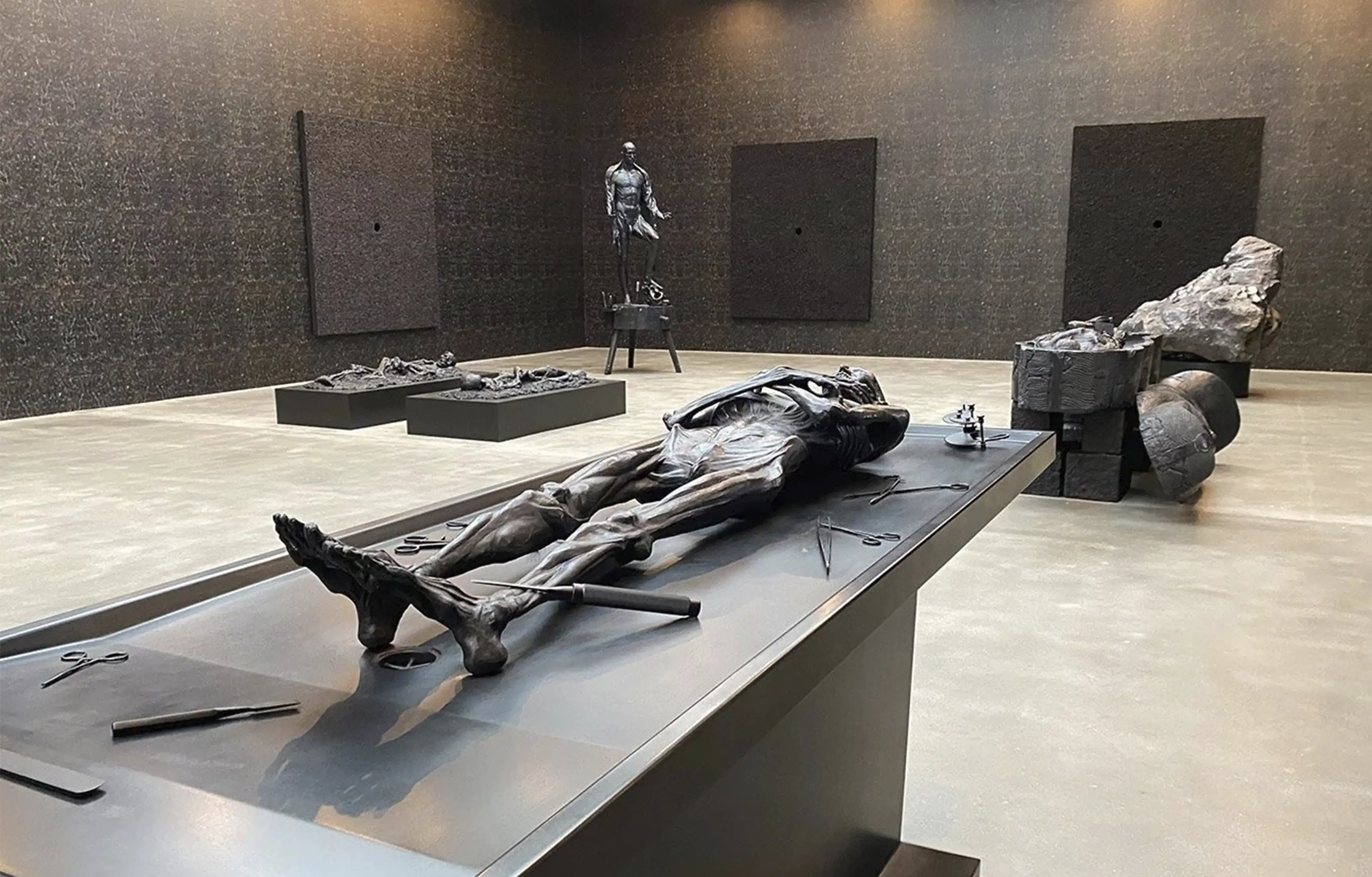
Walk into Gagosian’s Britannia Street gallery in King’s Cross and the first thing that changes is the light. The walls are clad floor to ceiling in a dark, densely patterned wallpaper, a reproduction of Hirst’s 2010 painting Valley of Death, its surface built from thousands of real butterfly wings arranged into a pattern that reads, from a distance, like the tracery of a rose window. It is not a backdrop. It is the room’s argument, stated before a single sculpture comes into view.
Inside that space sit the works that give the show its title. Relics is a body of new bronze sculpture: cast corpses, skeletons and mummified figures, worked with a level of anatomical and material detail that treats decay as something to be studied rather than disguised. Alongside them stand the Meteorites, a family of metallic sculptures in varying scale that continue Hirst’s long-running interest in simulacra, in objects that look like they fell from somewhere else entirely. Dominating the gallery is The Martyr, Saint Bartholomew (2019), a monumental écorché figure, flayed to the muscle, that reads at once as an object of religious devotion and as a piece of anatomical instruction. In a separate room, the Fly Paintings apply a much older Hirst technique, dead flies worked directly into the paint surface, to a new set of canvases.
This is the second exhibition in a yearlong series in which Hirst has effectively taken over the Britannia Street building, and it is worth treating as more than a sequel. Seen together, Relics, the Meteorites, The Martyr and the Fly Paintings are not four separate bodies of work sharing a room. They are four different kinds of relic, religious, cosmic, anatomical and entomological, staged inside a wallpapered interior that behaves like a chapel. The gallery itself becomes the reliquary.

What actually fills the gallery
The Relics are cast in bronze, a material Hirst has returned to repeatedly across his career because it holds fine detail and takes patina the way skin takes age. The figures are corpses, skeletons and mummies, rendered with the meticulous surface work of a conservator rather than the loose gesture typical of memorial sculpture. Fingernails, wrapped linen, exposed bone: the detail is there to be read closely, and it rewards the reader who does.
What keeps the Relics from reading as straightforward horror is the second source they draw on. Hirst combines a morbid, almost forensic realism with material drawn from fantasy, myth and invented history, so that a figure can look simultaneously like something excavated from a real tomb and something imagined for a story that was never told. Art, science, history and religion sit inside the same object rather than in separate rooms, which is precisely the point: a relic, in the traditional sense, has always been where those four categories overlap. A saint’s bone is a religious object, a historical claim, a physical specimen and, eventually, a work of art in its own reliquary casing.
The Meteorites extend that logic outward. Cast in metal at a range of scales, they look, convincingly, like objects that arrived from beyond the atmosphere: pitted, dense, weighted with a material history the eye cannot verify by looking. They are not real meteorites, and they do not pretend very hard to be. That gap, between what an object appears to be and what it actually is, has been one of the most consistent threads in Hirst’s work for two decades, and here it is folded into the same room as the corpses and skeletons: earthly relics and celestial ones, side by side, both authenticated only by the confidence of their own display.

The Martyr, Saint Bartholomew, and the flayed saint
The single largest work in the show, The Martyr, Saint Bartholomew, is an écorché figure, a sculpture stripped to its musculature, standing at monumental scale. Hirst’s own description of the piece balances biblical devotion with reverence for the human body, and the sculpture reads, at first glance, like a robot or a modern anatomical teaching model. That reading is not a coincidence. It is the whole point of choosing Bartholomew.
In Christian tradition, Bartholomew the Apostle was martyred by being flayed alive, and he has been depicted holding his own skin ever since. The most famous version is in Michelangelo’s Last Judgment in the Sistine Chapel, where the saint holds an empty skin whose sagging face is widely read as Michelangelo’s own self-portrait, an artist inserting himself into a scene about judgement through the one figure defined by the removal of skin. A less famous but more directly relevant precedent stands in Milan Cathedral: Marco d’Agrate’s 1562 marble sculpture of Bartholomew, carved to show the saint wearing his own flayed skin draped over his shoulders like a cloak, every visible muscle and tendon rendered with anatomical precision borrowed directly from Renaissance dissection. It is, in effect, the sixteenth century’s version of an anatomical model built to double as an object of worship.
Hirst’s sculpture sits squarely in that lineage. An écorché is, by definition, a figure built to be looked at as both body and specimen, and Bartholomew is the one saint whose entire iconography already asks for that double reading. Casting him at monumental scale in bronze, in a room lined with a reproduction of a painting made from butterfly wings, pushes the anatomical model back toward the reliquary it descended from. The body becomes, once again, a religious object as well as a scientific one, which is exactly what the source imagery has always done.

An echo of Venice
The bronze-casting technique and the “recovered relic” presentation running through this show are not new territory for Hirst. They are, in a fairly direct way, a continuation of Treasures from the Wreck of the Unbelievable, the vast solo exhibition he staged across Palazzo Grassi and Punta della Dogana in Venice in 2017. That show presented itself as the recovered cargo of an ancient shipwreck, an invented history complete with a fictional collector, fabricated provenance and sculptures cast to look coral-encrusted after supposedly centuries underwater. It mixed classical mythology with contemporary pop culture inside the same display logic used by natural history and archaeology museums: labelled specimens, plinths, the visual grammar of things that have been found rather than made.
Relics and the Meteorites draw on the same toolkit, bronze casting, the aesthetics of excavation, objects presented as though authenticated by their own display, but without the invented shipwreck narrative wrapped around them. Where Venice built an elaborate fiction to justify the presence of “ancient” objects in a contemporary gallery, Britannia Street drops the fiction and states the theme directly: these are relics, full stop, and the show does not need a backstory to earn that word. It is a leaner, more direct return to a set of ideas Hirst spent an entire Biennale developing, now applied to death and preservation rather than treasure and myth.

Flies, decay and an old preoccupation
The Fly Paintings work real, dead flies directly into the paint surface, and the technique reaches back to the work that first made Hirst’s name alongside the shark and the sheep. A Thousand Years (1990), the vitrine piece built around a rotting cow’s head, a colony of maggots hatching into flies, and an insect-o-cutor killing them as they emerged, was the work that established flies as one of Hirst’s central devices for showing an entire life cycle, birth, feeding, death, inside a single sealed object. It is widely regarded as the piece that persuaded Charles Saatchi to back him.
More than three decades on, the Fly Paintings return to the same insect and the same underlying argument, fixed this time rather than living. Where A Thousand Years staged decay as an ongoing process the visitor could watch happen in real time, the Fly Paintings preserve the end point, the fly itself, permanently held inside the surface of the work. It is the same material obsession carried from one end of a long career to the other: an insect that exists, in most contexts, purely as a symbol of decay, fixed instead as the literal subject and substance of a painting.

From Freeze to Britannia Street
That continuity makes more sense set against the arc of Hirst’s career. He curated Freeze in a London Docklands warehouse in 1988, while still a student at Goldsmiths, and the exhibition became the founding moment of the Young British Artists, the loose generation that reshaped British contemporary art through the 1990s with the backing of collector Charles Saatchi. His Natural History series, animals suspended whole in formaldehyde-filled vitrines, including the tiger shark of The Physical Impossibility of Death in the Mind of Someone Living and the split cow and calf of Mother and Child Divided, made preservation itself the medium rather than the subject. For the Love of God (2007), a platinum skull set with 8,601 diamonds, took the same theme, mortality made permanent and precious, to its most literal extreme.
Read against that history, Relics is less a departure than a return with better tools. The formaldehyde tank preserved a whole animal behind glass. The diamond skull preserved a skull behind wealth. The bronze figures at Britannia Street preserve a body behind craft, cast with enough anatomical accuracy that the material itself does the work formaldehyde and diamonds once did.

A wallpaper that becomes a chapel
The Valley of Death wallpaper is easy to underrate as a finishing touch. It is not one. Cladding the entire interior in a dense, dark, patterned surface built from a single painting turns the gallery into something closer to a chapel than a white cube, a space whose walls are already doing symbolic work before a visitor reaches the first sculpture. Patterned interiors built from repeating natural or religious imagery, stained glass, tracery, tomb painting, have always been used to prime a room for contemplation of exactly the subjects Hirst is presenting here. Wrapping the Relics, the Meteorites and The Martyr inside that surface is what allows the show to read as a single, coherent reliquary rather than four unrelated bodies of work sharing a floor plan.

What the show gives its visitors
The reward of Britannia Street’s second Hirst instalment is coherence. Four bodies of work that could easily have been shown separately, bronze figuration, cast metal sculpture, a monumental écorché and a return to an early painting technique, are staged together with enough care in the installation that they argue the same point from four different directions. Walk the space slowly. The wallpaper sets the register before anything else registers consciously; the Relics and Meteorites establish the vocabulary of things preserved and displayed as though authenticated; The Martyr supplies the show’s clearest statement of what a relic actually is, a body made permanent through the exact process, flaying, casting, preservation, that once turned saints into objects of veneration; and the Fly Paintings, in a quieter register, apply the same logic to the smallest possible subject.

Final thoughts
It would be easy to describe this show as Hirst doing what Hirst does: death, again, in a new material. That description misses what actually holds the room together. Relics, the Meteorites, The Martyr and the Fly Paintings are not four restatements of the same idea. They are four different categories of relic, religious, cosmic, anatomical, entomological, built using four different techniques and installed inside a single wallpapered interior that behaves like the reliquary all of them belong to.
What makes the show worth the walk from King’s Cross station is how deliberately that argument is constructed. The Valley of Death wallpaper is not decoration; it is the room’s opening statement. The Martyr is not simply a large bronze figure; it is a precise piece of art-historical reasoning about what an écorché sculpture and a flayed saint have always had in common. The Fly Paintings are not a stylistic detour; they are the oldest idea in the show, brought back in fixed form. Nothing in the space is there by accident.
This is the second exhibition in a yearlong project, which means Britannia Street is midway through a much longer argument about what Hirst’s work has actually been doing since A Thousand Years first put a rotting cow’s head and a swarm of flies inside a vitrine in 1990. Preservation, not death, has always been the real subject. Relics and Fly Paintings is the clearest single room he has built to say so.

What is Damien Hirst’s Relics and Fly Paintings exhibition?
It is a Damien Hirst exhibition at Gagosian’s Britannia Street gallery in London, combining new bronze sculptures titled Relics, a group of metallic Meteorites, the monumental sculpture The Martyr, Saint Bartholomew (2019), and a set of new Fly Paintings.
Where is the exhibition held?
It is staged at Gagosian’s Britannia Street gallery in King’s Cross, London, inside an interior entirely clad in wallpaper reproducing Hirst’s 2010 painting Valley of Death.
Is this part of a wider series?
Yes. It is the second exhibition in a yearlong takeover of the Britannia Street building by Damien Hirst, in which the artist is presenting a sequence of shows across the gallery.
What are the Relics sculptures made from?
They are cast in bronze, depicting corpses, skeletons and mummified figures with meticulous surface detail, combining morbid realism with imagery drawn from myth and fantasy.
What is The Martyr, Saint Bartholomew?
It is a monumental écorché sculpture from 2019, showing the saint flayed to the muscle in the tradition established by artists including Michelangelo and Marco d’Agrate, whose depictions of Bartholomew show him holding or wearing his own skin.
How were the Fly Paintings made?
Real dead flies are worked directly into the paint surface of the canvas, a technique that extends a preoccupation with flies and decay first established in Hirst’s early work, including A Thousand Years (1990).
What is the Valley of Death wallpaper?
It is a wallpaper covering the entire gallery interior, reproducing Hirst’s 2010 painting Valley of Death, which is built from a pattern of real butterfly wings.
Who is Damien Hirst?
Damien Hirst is a British artist who came to prominence as a leading figure of the Young British Artists after curating the 1988 exhibition Freeze. He is known for the formaldehyde-preserved animals of his Natural History series, the diamond-encrusted skull For the Love of God (2007), and the 2017 Venice exhibition Treasures from the Wreck of the Unbelievable.


Leave a Reply