
ART & CULTURE · LONDON
Reading time: 11 minA three-ton lead Madonna and Child by Jacob Epstein hangs from a bridge on the north side of Cavendish Square, a few feet from the front door. Inside, London Design Festival’s Design House filled a stripped Georgian townhouse with nine names working in timber, bone china, cast concrete, neon glass and plywood, and let the building’s own bare plaster do the framing. The strongest piece in the show was a lounge chair that quietly continued a line of British furniture-making that started at another address, ninety years earlier.
For nine days during London Design Festival 2021, the Grade II* listed townhouse at 14 Cavendish Square in Marylebone opened its doors as Design House, a multi-room exhibition spread across three floors of a building deliberately left raw: stripped plaster, exposed timber, none of the polish a gallery would normally apply between a visitor and the work. Nine names took a floor or a room each, moving between furniture, ceramics, illustration and glass without any single medium given precedence.
Sebastian Cox, 1882 Ltd with Max Lamb, Tiipoi and Ruup & Form held the ground floor. Isokon+ with Jasper Morrison, Angus Hyland and Marion Deuchars took the first. The Wrong Shop, showing FreelingWaters and Jochen Holz, closed the show on the top floor. What tied the nine together was not a shared material or a shared generation but a shared willingness to let an unfinished building do some of the talking, and one piece on the first floor turned out to be doing something more specific than the rest: continuing, chair by chair, a design story that started at a different London address in 1929.

Ground floor: timber, bone china and a tangerine plinth
Sebastian Cox opened the show with a run of handcrafted furniture, from beds to benches, worked in natural timber using traditional joinery rather than veneer or laminate. Cox has built his practice on coppiced and home-grown British wood, and the pieces at Cavendish Square made the case for that discipline through form rather than argument: nothing here needed a material label to explain what it was made of.

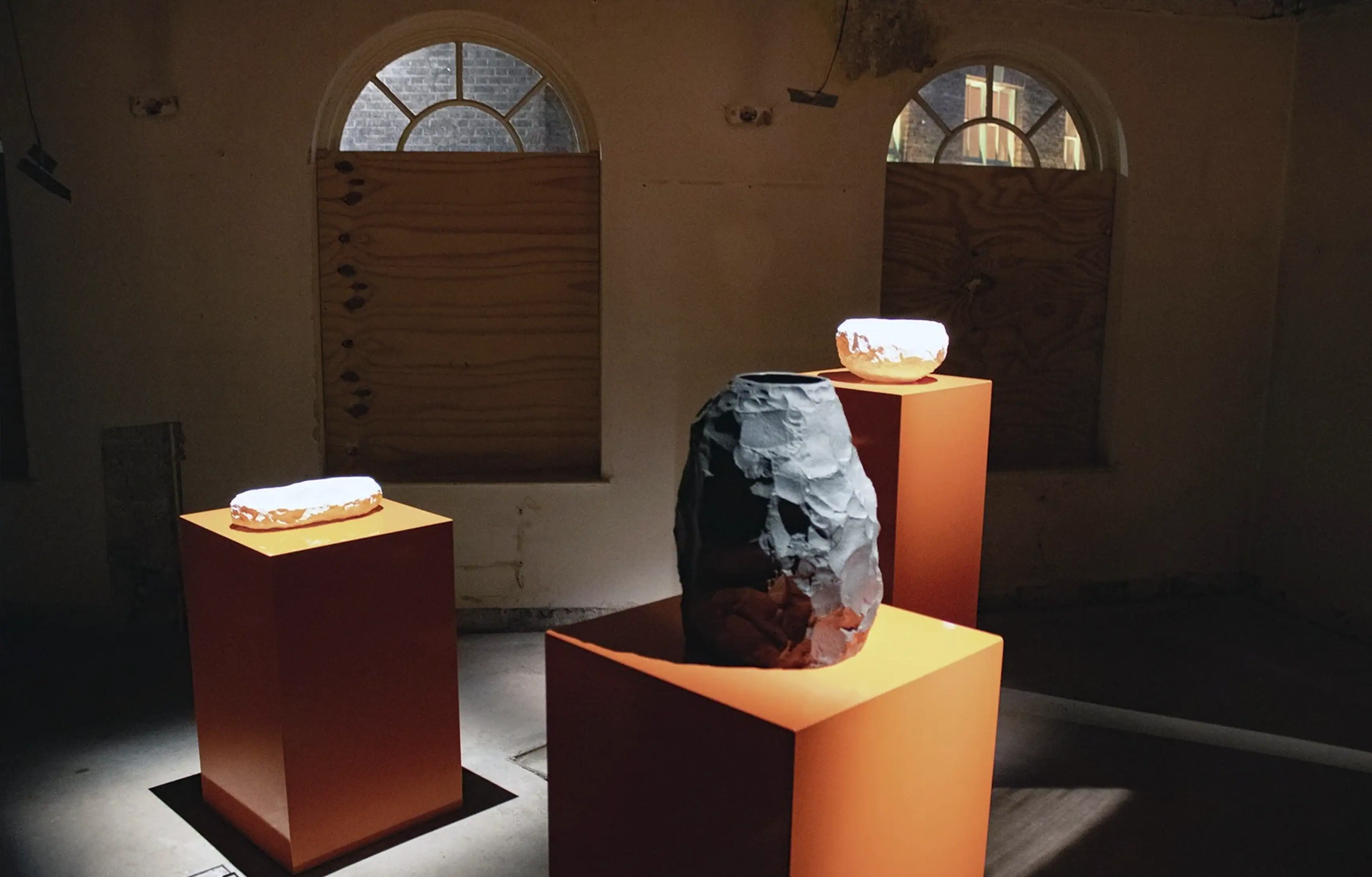
A few feet away, 1882 Ltd staged a decade-old collaboration with Max Lamb on an orange plinth the show nicknamed the Tangerine Test. 1882 Ltd was founded in Stoke-on-Trent in 2011 by the father-and-daughter team of Christopher and Emily Johnson, the fourth and fifth generations of the Johnson Brothers pottery family, and built its identity on commissioning contemporary designers to work in a material English potteries have made for two centuries. Lamb, a Royal College of Art graduate who trained under Tom Dixon before starting his own studio in 2007, had begun designing for 1882 Ltd almost as soon as the company existed, and by 2021 the Crockery series he showed at Cavendish Square represented close to a decade of that partnership. Lamb’s practice runs on direct, visible processes, pouring liquid pewter into sand-carved forms, inventing his own Marmoreal terrazzo composite, carving stone from quarries across three continents, and the Tangerine Test plinth made the same argument in miniature: a single saturated colour, chosen to show how much a plinth changes the way a material and a silhouette are read.

Tiipoi, the London studio Spandana Gopal founded in 2013 with a production workshop in Bangalore, showed an updated run of its Siment vessels, cast concrete plant holders that translate the specific architecture of Indian water towers into domestic objects. Gopal’s studio has spent years documenting the water towers that dot Bangalore’s skyline, each one a slightly different solution to the same structural brief, and Siment renders their funnels, legs and tanks as a family of planters rather than a single souvenir shape. Ruup & Form, the London gallery founded and directed by Varuna Kollanethu, completed the ground floor with a collaborative installation built around sculptural dining and object-led storytelling, treating the table itself as a stage rather than a support.

A plywood chair rejoins a ninety-year-old line
The first floor’s most quietly significant piece was the Iso-Lounge, a cantilevered plywood lounge chair developed by Jasper Morrison for Isokon+ and shown at Cavendish Square for the first time. To understand why it mattered, it helps to know exactly what Isokon+ is continuing.

The Isokon Furniture Company was founded in London in 1929 by the entrepreneur Jack Pritchard and the architect Wells Coates, initially to design and build modernist flats and the furniture to go inside them. In 1935 Pritchard brought in Walter Gropius, the founder of the Bauhaus, as the company’s Controller of Design; within a year Gropius had recommended his former Bauhaus colleague Marcel Breuer as his successor, and it was Breuer, working from a flat in the Isokon Building in Hampstead, who designed the bent-plywood Long Chair and Short Chair that made the company’s name. The Isokon Building itself, known formally as Lawn Road Flats, opened in 1934 and became, for a few remarkable years, home to Gropius, Breuer, Agatha Christie and a cluster of Bauhaus émigrés and British modernists at once.

Isokon Furniture stopped trading in 1939, when the outbreak of war cut off its supply of Estonian plywood, and the company’s history since then has been a story of careful revival rather than reinvention. Pritchard restarted it in 1963 with the designer Ernest Race; in 1982 he handed production on, under licence from the Pritchard family, to what became Windmill Furniture and later Isokon Plus, now trading as Isokon+. Every design added to the collection since has had to sit alongside Breuer’s originals without imitating them, from Edward Barber and Jay Osgerby’s 1996 Loop Coffee Table onward. Jasper Morrison’s Iso-Lounge, debuting at Design House in 2021, was the newest entry in that line: a chair whose cantilevered plywood form owes an obvious debt to Breuer’s structural thinking while remaining recognisably Morrison’s own, stripped back to the point where, as he has put it of his own work elsewhere, the object simply does not shout.

Morrison’s reputation rests on exactly that restraint. Trained at Kingston Polytechnic and the Royal College of Art, and the co-originator, with Naoto Fukasawa, of the Super Normal design philosophy, he has spent four decades designing for Vitra, Alessi, Cappellini, Hermès and Muji, and has been described by the critic Alice Rawsthorn as one of the most influential product designers of his generation. Placing a new Morrison chair inside a building whose entire modernist furniture story began with a Bauhaus émigré working from a rented flat gave the first floor a weight the rest of the show’s furniture, however well made, could not match on its own.

First floor: sacred geometry and painted stones
Sharing the first floor, Angus Hyland showed a series of paintings under the title Looking for a Certain Ratio, exhibited in London for the first time at Design House. A partner at the graphic design consultancy Pentagram since 1998, Hyland is best known professionally for identity and book-cover work, but the canvases at Cavendish Square searched for harmonies within sacred geometry using flat, saturated colour, a personal practice running alongside decades of client work rather than an extension of it.
Marion Deuchars, a Royal College of Art illustration graduate whose hand-lettering has become one of the most recognisable styles in British publishing, brought a more tactile counterpoint: stones collected from East Sussex and the north-east of Scotland, hand-painted in acrylic gouache and Chinese white ink, alongside a set of painted vessels. Where Hyland’s geometry was calculated, Deuchars’s stones kept the irregularity of the material they were found on, and the two practices, shown in the same rooms, made a case for painting as something that could be either a system or a response to what was already there.

Top floor: illustrated cabinets and glass that moves
The top floor belonged to The Wrong Shop, the platform Sebastian Wrong founded in 2011 after leaving his role as a founding director of Established & Sons. Wrong, who trained as a sculptor before moving into furniture, built The Wrong Shop around collaborations that treat familiar objects as a canvas rather than a finished form, and Design House’s top floor showed exactly that instinct at work.
At its centre stood a set of antique cabinets reworked by the Dutch artists Gijs Frieling and Job Wouters, working together as FreelingWaters, who stripped the cabinets back before covering their surfaces in dense hand-painted illustration, folding fine art directly into a piece of furniture rather than decorating around it. Jochen Holz, a neon and borosilicate glass artist, filled the surrounding rooms with sculptural light works that ran across walls and ceilings rather than sitting fixed in a single position, and showed a further body of work made with the ceramicist Attua Aparicio, who pairs hand-built ceramic forms with Holz’s glass to make lamps that read as much as small sculptures as fittings. Aparicio and Holz’s collaboration has continued in the years since, most visibly when Aparicio won the Ralph Saltzman Prize in 2024 for work built from the same combination of ceramics and reclaimed glass shown first at Cavendish Square.

The townhouse that was never finished the first time
None of this would have carried the same weight in a conventional gallery, and that is because 14 Cavendish Square is not one. Cavendish Square itself was laid out from 1717 by the builder John Prince for the 2nd Earl of Oxford, and named for the Earl’s wife, Lady Henrietta Cavendish Holles. James Brydges, the 1st Duke of Chandos, bought the entire northern side of the square intending to build himself a palace there; his fortune collapsed with the South Sea Bubble before it was finished, and the plots eventually passed to more modest speculative development. Numbers 11 and 14 were built around 1770, in the style of the architect John Vardy, by a builder named Tufnell, reputedly using stone originally cut for Chandos’s abandoned scheme. Historic England’s listing for the pair, jointly Grade II*, records giant Corinthian pilasters, a pediment carved with palm leaves framing an oculus, and vermiculated stonework around the doors, the full Palladian vocabulary applied to a townhouse rather than the palace it was never quite allowed to become.
The two houses are physically joined by a bridge, added across what is now Dean’s Mews when Number 11 served as a convent of the Holy Child Jesus. Above its arch hangs Jacob Epstein’s Madonna and Child, cast in three tons of lead in the early 1950s and commissioned by the architect Louis Osman, one of the most significant works by one of twentieth-century Britain’s most important sculptors, and one most visitors to Design House would have walked directly beneath. In its current life as an events venue, the building is deliberately kept in the state Design House found it: floors gutted back to bare plaster and timber rather than restored, a choice its owners have made permanent rather than temporary. It is a building with a habit of being interrupted and repurposed rather than finished as first drawn, which made it an unusually apt host for a show about designers taking established lines, plywood chairs, pottery firms, Bangalore’s water towers, and carrying them somewhere their originators had not quite planned.

Why the mix worked
Design House never tried to unify its nine names by material or method, and the building’s own history explains why that worked rather than scattering the show. A townhouse assembled from another scheme’s leftover stone, extended by a convent’s bridge, stripped back for a party or a product launch and then left that way, is already a building made of continuations rather than a single finished idea. Every piece inside it, from a chair extending a ninety-year-old furniture company’s design language to a pottery collaboration nine years into its own history, was doing the same thing at a smaller scale: taking something already established and finding out what else it could become.

What was Design House at 14 Cavendish Square?
Design House was a multi-room, multi-floor exhibition held during London Design Festival 2021 inside the Grade II* listed Georgian townhouse at 14 Cavendish Square, Marylebone, London. It brought nine designers, studios and galleries together across three floors, spanning furniture, ceramics, illustration and glass.
Where is 14 Cavendish Square, and what is the building?
14 Cavendish Square sits on the north side of Cavendish Square in Marylebone, London W1G. Built around 1770 in the style of the architect John Vardy, it is jointly Grade II* listed with the neighbouring Number 11, with which it shares a bridge carrying Jacob Epstein’s lead sculpture Madonna and Child.
Who took part in Design House?
Sebastian Cox, 1882 Ltd with Max Lamb, Tiipoi, and Ruup & Form showed on the ground floor. Isokon+ with Jasper Morrison, Angus Hyland and Marion Deuchars took the first floor. The Wrong Shop, showing work by FreelingWaters and Jochen Holz, closed the show on the top floor.
What was the Iso-Lounge chair, and why did it matter?
The Iso-Lounge is a cantilevered plywood lounge chair designed by Jasper Morrison for Isokon+, debuting at Design House. Isokon+ is the licensed successor to the Isokon Furniture Company, founded in 1929, whose designers included Walter Gropius and Marcel Breuer, so the Iso-Lounge extends a British plywood furniture line that began nearly a century earlier.
What is 1882 Ltd’s Crockery series, and what was the Tangerine Test?
Crockery is a series by the designer Max Lamb for 1882 Ltd, the Stoke-on-Trent ceramics company founded in 2011 by Christopher and Emily Johnson. At Design House, pieces from the series were shown on a single orange plinth, nicknamed the Tangerine Test, to demonstrate how a strong background colour changes the perceived material and silhouette of an object.
What are Tiipoi’s Siment vessels based on?
Siment is a collection of cast concrete plant holders by the London and Bangalore studio Tiipoi, founded by Spandana Gopal in 2013. Each vessel translates the structural form of a specific type of water tower documented across Bangalore into a domestic planter.
Is 14 Cavendish Square open to the public?
14 Cavendish Square operates as a private events venue rather than a permanent gallery, so access depends on what is being staged there at any given time. Its past use for exhibitions, launches and shoots means its programme changes through the year.
When did Design House run?
Design House ran for nine days during London Design Festival 2021, from 18 to 26 September 2021.
Final thoughts
It would be easy to read Design House as simply a well-chosen group show in an atmospheric building, nine names sharing good light and bare plaster for a week. What the building’s own history adds is the reason the mix held together rather than reading as nine separate rooms. 14 Cavendish Square has never been the building its original scheme intended: a duke’s abandoned palace plot, built out instead as a speculative townhouse from someone else’s leftover stone, later bridged to a convent, later still stripped back and kept that way for hire. It is a structure defined by continuation rather than completion.
That is precisely what the strongest work inside it was doing. Jasper Morrison’s Iso-Lounge did not reinvent Isokon’s plywood language; it added the next chair to a line Marcel Breuer started in a Hampstead flat in the 1930s. Max Lamb’s Crockery did not depart from nine years of work with 1882 Ltd; it found a new way to display what that partnership had already built. Tiipoi’s Siment vessels did not invent a new form; they translated one Bangalore already had. Design House worked because its building and its makers were, without any of them saying so directly, making the same argument at the same time: that the most interesting thing a designer can do with an established line is not abandon it, but see how far it still has to go.


Leave a Reply