
ART & CULTURE · MIAMI
Reading time: 9 minThirty-three galleries filled Miami Beach for Design Miami/’s fourteenth edition in December 2018, and the strongest work in the room rarely announced itself. A Korean ceramicist numbered hundreds of hand-built elements against a play by Samuel Beckett. A New York designer pressed the finger marks of Colombian brickmakers into terracotta furniture. A British maker laminated sycamore and resin into a desk that took seven attempts to get right. This is what four of the fair’s galleries actually showed, beyond the presentations that made the headlines.
Design Miami/ opened its fourteenth edition on 5 December 2018 and ran through 9 December, filling the Miami Beach Convention Center with thirty-three galleries for the duration of Miami Art Week. The fair had been founded in 2005 by the developer and collector Craig Robins, and by its fourteenth year it had settled into a familiar rhythm: a week in which collectible furniture, lighting and sculptural objects from dealers around the world compete for attention alongside Art Basel Miami Beach a few blocks away.

One presentation drew most of the coverage that December. Sabine Marcelis built ten cast resin fountains for FENDI, marking the house’s tenth anniversary at the fair, and the installation has already had its own full account on this site, including how it sat inside FENDI’s parallel decade of restoring real fountains in Rome. It was one booth among thirty-three, and it is not what this piece is about.


What the fair’s other galleries put on their stands that year was, in several cases, more interesting for what it revealed about process. J. Lohmann Gallery gave over its booth entirely to three Korean ceramicists working in three unrelated techniques. The Future Perfect showed a New York designer’s terracotta furniture alongside a Seattle glassblower’s coloured lenses. Etage Projects, the Copenhagen gallery built on the premise that art and design should not be kept apart, brought a speaker system cast in resin and a set of anodised aluminium tables. Todd Merrill Studio filled its stand with four makers working in bronze, onyx, straw marquetry and laminated wood, including a desk that had already picked up a magazine’s “most sinuous” tag before the fair closed.
None of this required a headline installation to be worth seeing. It required, in most cases, a maker willing to explain exactly how something was made, and a gallery willing to give that explanation room.


Breaking the Mold: J. Lohmann Gallery’s Korean ceramicists
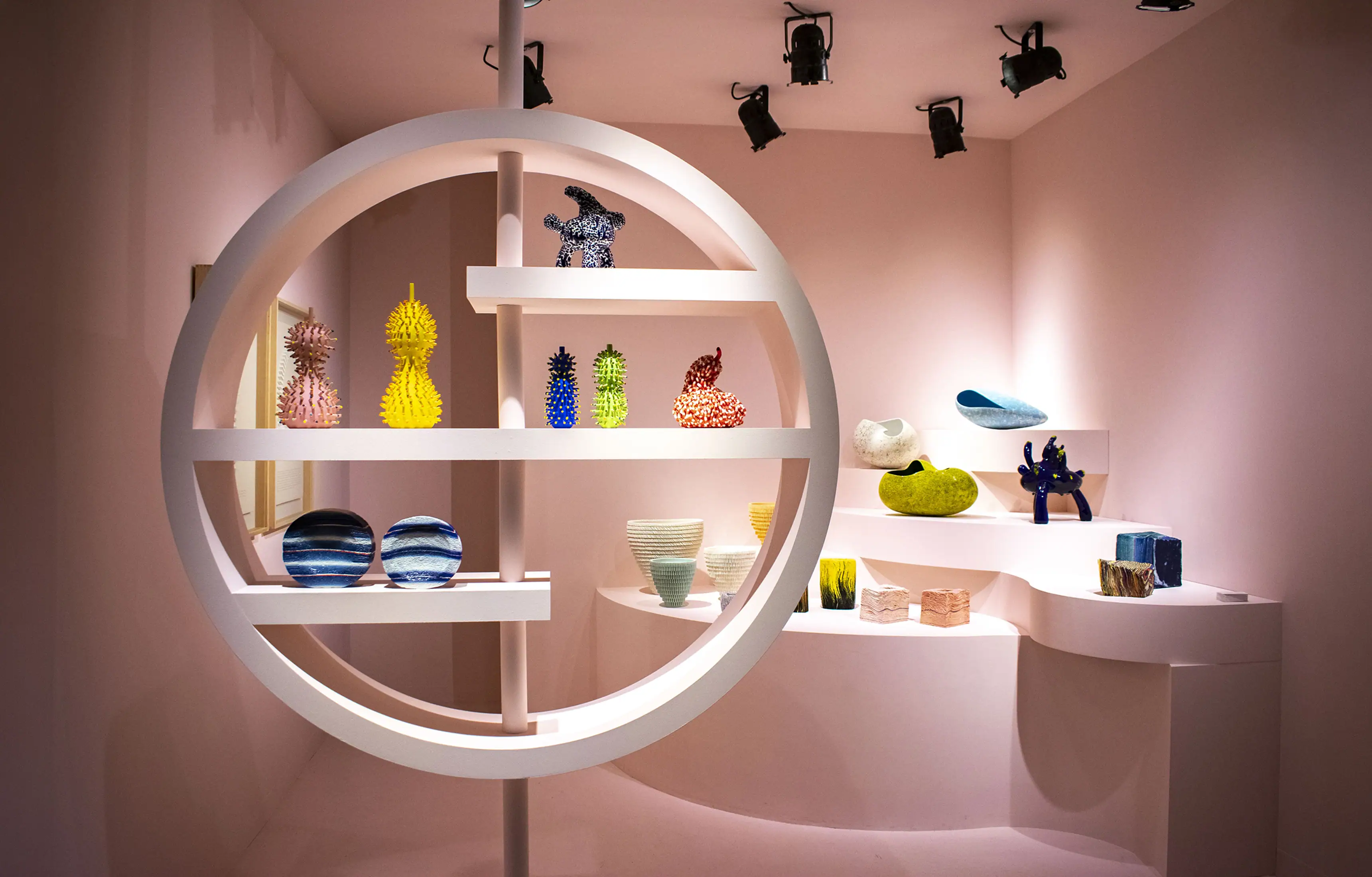
J. Lohmann Gallery, founded in New York in 2006 by Joern J. Lohmann, works by appointment and has built its reputation on contemporary decorative arts, with a particular concentration in ceramics and glass by internationally established and emerging makers. At Design Miami/ 2018 the gallery dedicated its stand to Breaking the Mold: Contemporary Korean Ceramics, a presentation of three artists whose work shared a country of origin and almost nothing else in terms of method.

Ahryun Lee, born in Seoul in 1989, studied design and ceramics at Seoul National University before completing a postgraduate degree at the Royal College of Art in London in 2016. She now works from Bavaria, and her pastel-coloured pieces, several carrying playful names such as Tango and Hopster, sit deliberately across the line between craft, design and art rather than choosing one side of it. That East-West training shows in the work: traditional Korean ceramic sensibility handled with a contemporary designer’s eye for colour and proportion.


Jongjin Park took the opposite approach to surface. His vessels are built from tissue paper soaked in clay slip and layered until the piece reads as folded paper or corrugated cardboard rather than fired porcelain. It is a deliberate deception: Park studied traditional solid porcelain before turning to a method built to make ceramic look like the least durable material in the room, so that the gap between what a piece appears to be and what it actually is becomes the point of looking at it. He has continued that research at doctoral level at Kookmin University, and the same body of work would go on to win him the Loewe Foundation Craft Prize in 2026.


Bae Sejin worked at a different scale altogether. His textured vessels are built from hundreds of small, individually hand-formed ceramic elements, and each one is numbered as it is added. That detail rarely gets explained beyond the fact of it, but Sejin has been specific about where it comes from: the numbering is a way of tracking the passage of time across the length of the piece’s construction, and its origin is Samuel Beckett’s Waiting for Godot, a play built entirely around duration and the wait for something that never quite arrives. Sejin, born in Seoul in 1981 and a 2017 Loewe Craft Prize finalist in his own right, has described clay as a way of unifying the time of nature with the time of a human life. Each numbered element on his vessels is, in that sense, a mark of time passing rather than a decorative flourish, which is a considerably more specific claim than “hundreds of hand-applied numbered ceramic elements” suggests on its own.

The Future Perfect: terracotta, wicker and glass
The Future Perfect, the gallery founded by David Alhadeff with spaces in New York, San Francisco and Los Angeles, built its Design Miami/ 2018 presentation around five specially commissioned editions, extending a format the gallery had debuted earlier that year at Design Miami/Basel. Among the five, two makers stood out for how differently they had arrived at the fair.

Chris Wolston splits his practice between studios in New York and Medellín, Colombia, a base he first established roughly eight years earlier on a Fulbright grant to research pre-Columbian ceramic and brickmaking traditions. His terracotta furniture, including the Tropical chandelier and the Cocorna mirror shown at the 2018 fair, grew directly out of time spent at a Medellín brick factory, where he noticed the deep finger marks left in the clay by workers throwing it by hand. Rather than smoothing those marks away, Wolston reproduces them deliberately across his tables, planters and chairs, turning an incidental trace of manual labour into the object’s decorative language. His more recent work has moved into mimbre, a wicker material sourced through a local economy that still runs on barter rather than cash, which he weaves into chairs alongside local craftspeople in a process he has described as more collaborative and fluid than anything available to him in the United States.


John Hogan, working from Seattle within the Pacific Northwest’s studio glass tradition, showed pieces from his Water Lens series: thick discs of coloured glass, cast to work as functioning lenses, that bend and multiply light across whatever surface sits beneath them. Seen together, the effect is closer to standing water catching sunlight than to conventional studio glass, which is precisely the confusion the series is built to produce.


Etage Projects and the grey area between art and design
Etage Projects, founded in Copenhagen in 2013 by Maria Foerlev, exists on the premise that the line between art and design is not worth defending too carefully. Foerlev has described her curatorial approach as a deliberate embrace of “this grey area,” selecting artist-designers whose work carries both functional purpose and something closer to poetic intent, and who are prepared to let the process stay visible rather than resolving it into a finished, silent object.

At Design Miami/ 2018 that philosophy showed most directly in Guillermo Santoma‘s Miami Sound System, a sculptural speaker built from a Pioneer speaker set embedded in melted resin over an MDF frame, standing 170 centimetres high. It is audio equipment and sculpture at once, with neither role subordinate to the other. Alongside it, the Swedish designer Fredrik Paulsen, who trained at Beckmans College of Design in Stockholm and the Royal College of Art in London, showed anodised aluminium tables paired with glass surfaces, part of a wider practice he has described as interested in counterculture, artificiality and a deliberately unprecious relationship to material.
Etage Projects also carried a second body of work by Sabine Marcelis, separate from the fountains she built for FENDI a few stands away: a series of abstract lighting sculptures combining ceramic, neon and hammered resin. It is a reminder of how much ground one designer’s practice can cover inside a single fair week, and of how differently the same material vocabulary, resin chief among it, can be handled depending on the brief and the gallery behind it.


Todd Merrill Studio’s four makers
Todd Merrill Studio traces back to Todd Merrill Antiques, which Merrill, the third generation of his family in the antiques trade, founded in New York in 2000. Where his family had traditionally dealt in eighteenth and nineteenth-century American furniture, Merrill turned his attention to post-war American design at a point when the period was still comparatively overlooked, a shift that led to his 2008 book Modern Americana: Studio Furniture from High Craft to High Glam, expanded in a second edition the same year as this fair. By 2018 the gallery’s Studio Contemporary programme, representing established and emerging makers across furniture, lighting and sculpture, had become its main focus, with work held in museum collections including the Cooper Hewitt and the Victoria and Albert Museum.

Four makers carried the gallery’s stand that December. Brecht Wright Gander works two practices under two names: Birnam Wood Studio for restrained, industrially made commercial furniture, and his own name for sculptural, deliberately impractical pieces built from resin, paper pulp and single-use moulds, often finished in papier-mâché and gold leaf around concealed LED lighting.
Marc Fish showed the Ethereal Desk, a piece produced as a run of seven editions, each one unique, combining sycamore, resin and carbon fibre into a single laminated form measuring 2,480 by 900 by 730 millimetres. The desk had already been singled out that December by Modern Luxury magazine as the most sinuous piece at the fair, a fair assessment of a form built entirely from curved laminations rather than joined, flat components.


Jean-Luc Le Mounier brought the output of a French workshop built around techniques few furniture makers still hold in house: straw marquetry, mother-of-pearl and gypsum inlay, shagreen assembly and leather-lined interiors, alongside bronze and stainless steel work, with additional finishes drawn from Limoges enamellers and other specialist collaborators. Markus Haase, a German-born sculptor based in New York, closed the stand with his laminated wood, stone, bronze and onyx pieces. Haase trained for close to eight years as a master electrician while apprenticing under a stone carver, and later restored architectural stonework on European cathedrals before turning to furniture and lighting; his method of laminating different stones and woods together and then carving straight through the join, rather than treating each material as a separate applied element, runs through both his Bang collection of cantilevered furniture and his onyx and bronze light sculptures, the bronze components individually hand-carved and cast using the lost-mould method.


What the fourteenth edition actually showed
Set side by side, these four galleries did not share a theme in the way a curated exhibition would. What they shared was a willingness to let technique carry the argument. Bae Sejin’s numbering system, Wolston’s finger-marked terracotta, Le Mounier’s straw marquetry and Haase’s laminated stone are four completely different processes, but each one is legible in the finished object if a viewer knows what to look for, and each maker was prepared to explain exactly how the piece in front of them had been built. At a fair built around thirty-three competing booths, that legibility, the sense that a visitor could actually trace the making, did more to hold attention than scale or spectacle managed to.


Final thoughts
It would be easy to remember Design Miami/ 2018 for its single loudest booth and leave it there. The fountains were genuinely the centrepiece of that December, and they earned the attention. But a fair built from thirty-three galleries is not really a single story, and the parts of it that reward a second look are usually the ones a headline skips past: a Korean ceramicist counting elements against a play about waiting, a New York designer who learned his material from Colombian brickmakers, a French workshop that still keeps straw marquetry in house.
What connects J. Lohmann Gallery, The Future Perfect, Etage Projects and Todd Merrill Studio that year was not a shared theme but a shared standard: work made by someone prepared to say exactly how they made it. That is a smaller claim than “the best fair of the year,” and it is a truer one. Fourteen editions in, that was still what the fair did best.
When did Design Miami/ 2018 take place?
It ran from 5 to 9 December 2018 in Miami Beach, during Miami Art Week, alongside Art Basel Miami Beach.
Which edition of Design Miami/ was the 2018 fair?
Its fourteenth. The fair was founded in 2005 by Craig Robins and has run in Miami Beach every December since.
How many galleries showed at Design Miami/ 2018?
Thirty-three galleries took part, across more than fifty individual exhibitions and installations.
What did J. Lohmann Gallery show at the fair?
Breaking the Mold: Contemporary Korean Ceramics, featuring Ahryun Lee, Jongjin Park and Bae Sejin, three Korean ceramicists working in pastel glazes, layered paper-effect porcelain and numbered hand-built elements respectively.
What was Chris Wolston’s connection to Colombia?
Wolston has kept a studio in Medellín since researching pre-Columbian ceramics and brickmaking there on a Fulbright grant roughly eight years before the fair, and his terracotta furniture reproduces the finger marks left by brick factory workers throwing clay by hand.
What is the correct name of Marc Fish’s Design Miami/ 2018 desk?
The Ethereal Desk, made from sycamore, resin and carbon fibre in an edition of seven unique pieces.
Did FENDI also show at Design Miami/ 2018?
Yes. FENDI marked its tenth anniversary at the fair with The Shapes of Water, Sabine Marcelis’s installation of ten cast resin fountains, covered in full elsewhere on this site.
Is Design Miami/ an annual fair?
Yes, held every December in Miami Beach, with a companion edition, Design Miami/Basel, held in Switzerland each June.

Leave a Reply