
ART & CULTURE · MILAN
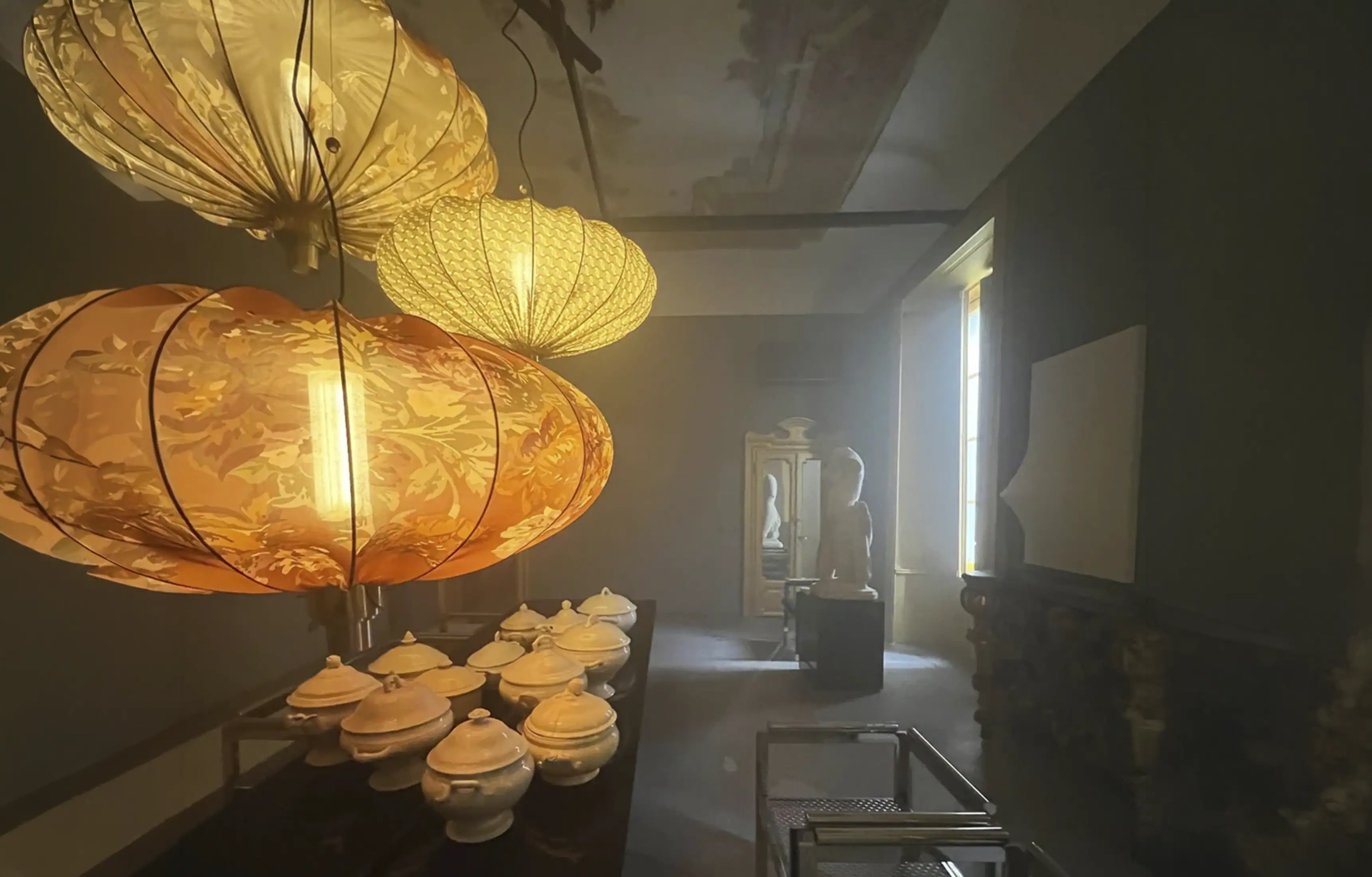
Reading time: 8 minEmiliano Salci and Britt Moran named their 2022 Milan Design Week installation after the French word for forgotten, and staged it inside the second-floor apartment where they themselves once lived. Oublié filled Via Solferino 11 with mist, gold-edged light and new furniture still wrapped in white dust sheets, as though a house shut up during two lost pandemic years were being opened again for the first time. The apartment had already lived several lives before this one, as a home, then a gallery, then a stage, and Oublié simply let all of them show at once.
Oublié ran from Wednesday 8 to Sunday 12 June 2022, staged by Dimoremilano inside a second-floor apartment at Via Solferino 11, on the southern edge of Milan’s Brera district. Founders Emiliano Salci and Britt Moran filled the flat’s rooms with new furniture, textiles and lighting from their label, dressed the space in haze and low gold light, and left much of the new work sheeted in white cloth, as if the rooms had been closed for a while and were only just being reopened. Drawers stood part open. Cabinets and dressers held new textile ranges for visitors to find rather than see laid out. A record player, silent for the length of the closure the installation implied, was switched back on.


The title explains the intent plainly enough. Oublié is French for forgotten, and Milan’s furniture fair had genuine reason to want a year forgotten. The 2022 edition of Salone del Mobile and the wider Fuorisalone had already been pushed from their usual April slot to June, the second consecutive year the fair’s calendar had been disrupted after the pandemic cancelled the 2020 edition outright and reduced 2021 to a smaller September gathering. Oublié opened in the first week since 2019 that the fair had returned to something like its old shape, and Salci and Moran built an installation about a house rediscovered after a period of absence into exactly that week.
What makes the piece worth returning to four years later is where the theme was staged. The apartment at Via Solferino 11 was not a rented set dressed to look like somewhere once lived in. It really had been, and by the two people who built the installation.


What eight rooms of mist and dust sheets actually held
The flat unfolds across eight interconnected rooms, and Salci and Moran treated the whole sequence as a single lit path rather than eight separate sets. Haze hung through the rooms throughout the run, natural light filtered in through partially closed shutters, and a soft classical score played alongside the reactivated record player, so that sound carried a visitor from room to room as much as the light did. Salci described the change to the walls themselves in blunt terms: the space’s usual warm, enveloping tones had been repainted into something “pure, immaculate and almost celestial,” a backdrop pale enough that gold hardware and gold-toned lighting fixtures read as the only warmth left in the room, set against doors picked out in silver.


Furniture from the current Dimoremilano collection stood throughout in white fabric, some of it draped over pieces as dust sheets and lifted only far enough to show what sat underneath, some of it upholstered directly onto new work. Lighting carried much of the room-to-room rhythm: Belle de Jour table lamps, Oriente ceiling fixtures and the Abatjour lamp reappeared across several of the eight rooms, while Parallelo and Millepiedi tables and Razionalista chairs anchored the seating and dining groups. A small number of new pieces, including an additional chair and a new floor lamp, joined the collection specifically for this edition. Flooring changed underfoot from room to room, moving between poured concrete, carpet and linoleum, which did more than any single prop to make each room read as a distinct chapter in a house rather than a single continuous showroom.
The textile ranges were the part of the installation easiest to miss and, in a house built around the idea of rediscovery, the part that made the most sense to hide. Rather than laying new fabrics out on a table for inspection, Dimoremilano stored them inside the cabinets and dressers already furnishing the rooms, so a visitor who opened a drawer expecting nothing found a folded stack of new material instead. It turned a straightforward product display into an act that matched the installation’s own premise: nothing in the apartment was simply shown to you. Most of it had to be found.


A forgotten house that really was theirs first
The apartment’s own history is where Oublié stops being a clever theme and starts being an accurate description. Via Solferino 11’s second floor was Salci and Moran’s private home before it was anything else connected to their business. A 2013 feature on the flat described it as “a container for contemporary life,” built around dark, velvety walls that pushed attention onto luminous objects at eye level, silk rugs, oxidised metal and aged timber gathered from different periods and places into intimate, human-scaled groupings rather than one grand statement. That was still a private apartment, photographed as one.
The following year, Salci and Moran converted that same home into Dimoregallery, opening its eight rooms to the public as a gallery mixing vintage design, among it pieces by Gio Ponti and Franco Albini, with their own new work under the Dimoremilano name. Dimoregallery has operated from Via Solferino 11 ever since, rotating its room-by-room displays roughly every two to three months, and the address had already hosted at least one further Dimorestudio presentation during Milan Design Week 2017, in the years between the gallery’s opening and Oublié.
None of that makes the flat unique among Milan showrooms with long histories. What it does is remove the distance that usually sits between a design week theme and the space chosen to hold it. Oublié staged the fiction of a house closed up and then reopened inside a room that actually had been a home, then closed to the public as a private address, then reopened as a gallery, more than once, over the better part of a decade. The white sheets covering new furniture were not standing in for an idea about time passing in someone else’s house. They were sitting in the room where Salci and Moran had once actually lived, dressed to look, briefly, the way an empty home looks before anyone comes back to it.


From a furniture shop in Arezzo and a graphic design desk to Dimorestudio
Salci was born in Arezzo, in Tuscany, and grew up around his father’s furniture shop before a classical schooling gave him an early, direct exposure to the region’s Renaissance painters. He moved to Milan around 2000 and took a position as creative director at Cappellini, the furniture company, overseeing the brand’s displays, advertising, events and its distribution network across New York, Milan and Paris. Moran arrived from a different direction entirely, an American from North Carolina with a background in graphic design, drawn less to ornament than to what he has called the concrete and the practical. The two met in Milan in 2003 and founded Dimorestudio that same year, splitting the practice along the lines their backgrounds already suggested: Salci shaping the look of a room, Moran managing the contracts, production and administration that let a look survive contact with a client.
The studio’s name carries more of its working method than most studio names do. Dimore is Italian for dwellings, or residences, and it was chosen to evoke the enfilade rooms of an old mansion house, one space opening onto the next through tapestries, stuccoes and the accumulated patina of a building that has been lived in for a long time rather than recently finished. Dimorestudio’s interior projects, and later Dimoremilano’s furniture, textiles and lighting, have returned to that same idea of an inhabited, historically layered room ever since the studio’s earliest work. Read against that name, Oublié was not a departure into a new theme for one week. It was the studio’s founding idea, staged literally, inside the one address that had actually lived it.


How a private apartment became a product label
Dimoregallery’s opening in 2014 did more than give Salci and Moran a public showroom. It gave Dimoremilano, the furniture, textile and lighting label the pair had been developing out of Dimorestudio’s interiors work, a fixed room in which to be seen against the vintage pieces that had shaped the studio’s own visual language, work by Gio Ponti and Franco Albini among it. The label’s own description of its approach is direct about the debt: Dimoremilano’s stated aim is a practice that “interprets memories and creates dreams,” built using Italian artisanal workshops and manufacturers rather than mass production, and pieces beyond the ones shown at Oublié, among them the Oriente ceiling lamp, the Monocentrico table, the Sciura armchair and the Club modular sofa, carry the same mix of a recognisably historical silhouette rendered in a distinctly contemporary material or finish.
That lineage matters to how Oublié should be read. The installation was not a one-off stunt built to generate a week of design week photographs. It was a single, unusually candid presentation of a working method Salci and Moran have applied consistently since 2003, treating a room’s own history, real or invented, as the starting material for whatever gets put into it next.


Why forgetting was the right theme for June 2022
Oublié’s premise, a house rediscovered after a period of absence, landed inside a fair that had genuine cause to want two years put behind it. Salone del Mobile’s usual April date had already given way once, when the 2020 edition was cancelled outright, and again in 2021, when a smaller September gathering replaced the full fair. June 2022 was the first edition since 2019 to return to anything close to the fair’s normal scale and rhythm, and Oublié opened in its first week. Moran’s own framing of the installation made the connection explicit rather than leaving it as background: he described the intent as an invitation to “forget the past two years and embrace our poetic vision of hope and joy through the installation,” language that reads as description rather than slogan once the fair’s own disrupted calendar is set alongside it.
That context gives the mist and the dust sheets a more specific job than atmosphere. A house that has stood empty for a while and is only now being reopened was, in June 2022, a fair asking exactly that question of itself.
Final thoughts
Oublié’s own vocabulary, the haze, the low gold light, furniture half revealed under white cloth, a title borrowed from another language to carry a mood the English word would have made too plain, is worth remembering for what stood behind it. The apartment staging it had already been a home, then a private address turned public gallery, then a design week venue at least once before, all inside the same set of rooms Salci and Moran had once actually lived in.
That is the part worth remembering once the mist has cleared and the fair has moved on. Oublié did not invent a story about a forgotten house to sell new furniture. It found the closest thing to a true one already sitting behind its own front door, and simply let visitors open the drawers.
What was Dimoremilano’s Oublié installation?
Oublié was Dimoremilano’s Milan Design Week 2022 presentation, staging new furniture, textiles and lighting inside a hazy, dreamlike version of an apartment that appeared to have been closed for a while and was only just being reopened, complete with new work draped in white dust sheets and textiles stored inside cabinet drawers rather than laid out on display.
Where and when did Oublié take place?
It ran from Wednesday 8 to Sunday 12 June 2022, inside the second-floor apartment at Via Solferino 11 in Milan’s Brera district, the same address that houses Dimoregallery.
What does Oublié mean?
Oublié is French for forgotten. Britt Moran described the installation as an invitation to leave the two preceding, pandemic-disrupted years behind, which places the title’s meaning inside the fair’s own delayed 2022 calendar rather than as an abstract mood.
Who are Emiliano Salci and Britt Moran?
They are the founders of Dimorestudio, an interior design and architecture practice they established in Milan in 2003. Salci trained as a creative director at the furniture company Cappellini before founding the studio; Moran, an American from North Carolina, brought a graphic design background and now oversees the practice’s contracts and production.
What is the difference between Dimorestudio, Dimoregallery and Dimoremilano?
Dimorestudio is Salci and Moran’s interior design and architecture practice, founded in 2003. Dimoregallery is the showroom they opened in 2014, in their own former apartment at Via Solferino 11, mixing vintage design with new work. Dimoremilano is the furniture, textile and lighting label that grew out of that gallery, produced with Italian artisanal workshops.
Was the apartment at Via Solferino 11 built as a showroom?
No. It was Salci and Moran’s own home before they converted it into Dimoregallery in 2014, and Dimorestudio had already staged at least one earlier Milan Design Week presentation there, in 2017, before Oublié.
What pieces were shown at Oublié?
The installation featured Belle de Jour table lamps, Oriente ceiling fixtures and the Abatjour lamp, alongside Parallelo and Millepiedi tables and Razionalista chairs, plus a small number of pieces added specifically for the 2022 edition, including a new chair and floor lamp.
Can Oublié still be visited?
No, the installation closed on 12 June 2022 and was not a permanent display. Dimoregallery continues to operate from the same Via Solferino 11 address, with its rooms redisplayed roughly every two to three months.

Leave a Reply