
ART & CULTURE · MILAN
Reading time: 10 minA 143-year-old Japanese printing company used its first Milan Design Week appearance to argue that print is not a fixed mark but a process that can hold memory, motion and mathematics all at once. In a vaulted former warehouse at Ventura Centrale, Dai Nippon Printing split the space between AtMa Inc, digitising a vanishing hand-carved textile pattern, and noiz architects, generating a zebra’s stripes with the same equations that grow them in nature.
Every April, the arched brick vaults beneath Milano Centrale station fill with installations that have nothing obviously to do with trains. This is Ventura Centrale, one of the venues that make up Milan’s Fuorisalone, the citywide programme of exhibitions that runs alongside the Salone del Mobile trade fair. In 2019, when Salone del Mobile ran from 9 to 14 April, one of those vaults belonged to a company that had never shown at Milan Design Week before: Dai Nippon Printing, known internationally as DNP, a Japanese firm founded in 1876 and now one of the largest printing groups in the world.
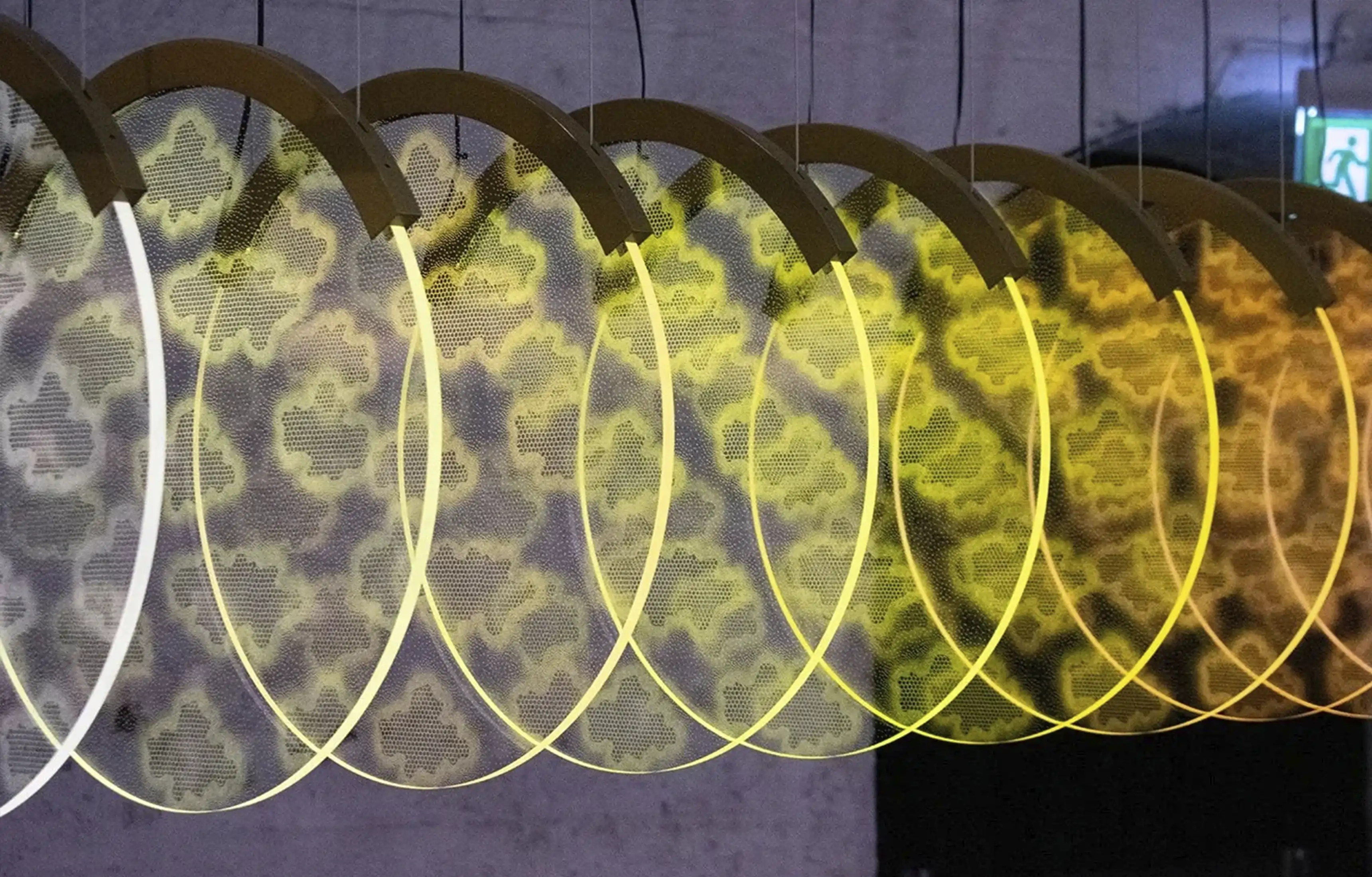
DNP’s installation, titled Patterns as Time, split its vault into two halves, each handed to a different creative partner. On one side, the Tokyo studio AtMa Inc presented Time Printing, a series of internally lit acrylic panels and discs carrying digitised versions of a centuries-old Japanese textile pattern. On the other, the Tokyo and Taipei practice noiz architects presented Patterns of Nature, a pair of objects, a chair and a stool, whose surfaces changed as visitors watched, built from DNP’s own electronic paper technology.
The two halves looked almost nothing alike, one warm and static, the other cool and shifting. Read together, though, they made a single, coherent case about what a printing company actually does, and what it might do next.

What Patterns as Time actually was
The installation occupied one of Ventura Centrale’s brick-vaulted bays, a space with the low, curved ceiling and worn concrete floor of the goods sheds it had once been. DNP and its partners left that industrial shell largely untouched and worked with contrast instead: AtMa’s side was lit from within the objects themselves, a run of discs and panels glowing against the dark brick, arranged along the length of the vault so that walking through it read as walking through a timeline. noiz’s side used ambient lighting, designed by Izumi Okayasu, that shifted between the two halves of the room, so that the chair and stool sat in their own controlled environment rather than a fixed spotlight.
Both sections were, in the end, printing demonstrations. AtMa printed a pattern that already existed, rescuing it from decay. noiz printed a pattern that had never existed before that exact moment, and would keep changing after the visitor moved on. DNP’s argument, stated through the two commissions rather than in a wall text, was that both of these are legitimately its business.
Ventura Centrale, a district built from a station’s leftovers
Ventura Centrale sits at Via Ferrante Aporti, in a run of former warehouses, laboratories and depot buildings that had stood largely disused for around three decades before the Dutch consultancy Organisation in Design began converting them into exhibition space. The brick arches, built to serve Milano Centrale, one of Europe’s grandest railway stations, gave the venue a character that no purpose-built pavilion could match: raw, cavernous, and already full of a history that had nothing to do with design.
The venue grew out of Ventura Lambrate, the design district that had established the “Ventura” name in Milan’s eastern Lambrate quarter through the 2000s and 2010s. As Lambrate’s own footprint changed, Organisation in Design opened Ventura Centrale as a second site closer to the city centre, and by 2019 it had become one of the Fuorisalone’s genuine destinations, drawing brands, designers and studios who wanted a setting with weight to it. For a company as old as DNP, presenting its first Milan installation inside a space defined by its own decades of disuse and restoration was, whether deliberate or not, a fitting parallel to what AtMa’s side of the vault was doing with a Japanese pattern that had itself nearly been lost.

DNP: a printing company far larger than the word suggests
Dai Nippon Printing was founded in Tokyo in 1876, which by 2019 made it 143 years old, and the “printing” in its name understates what the company has grown into. DNP now employs more than 35,000 people across three broad divisions: information and communication (which includes conventional print, packaging and security documents), lifestyle and industrial supplies, and electronics, where it manufactures the photomasks and colour filters used to make LCD and OLED display screens for the wider electronics industry. A company that already supplies part of the machinery behind every modern screen was, in other words, unusually well placed to ask what else printing technology could do.
Patterns as Time marked DNP’s first appearance at Milan Design Week in its long history. Rather than using the platform to show off a printed product in the conventional sense, wallpaper, packaging, a book, the company used it to demonstrate two technologies from opposite ends of its own business: the acrylic printing and precision digitisation behind AtMa’s panels, and the electronic paper display technology, more familiar from e-readers and retail signage, behind noiz’s chair and stool. Both were sponsored materially by Mitsubishi Chemical Corporation, whose Shinkolite acrylic sheet formed the physical substrate for AtMa’s illuminated panels.
AtMa Inc and the pattern that was disappearing
AtMa Inc was founded in Tokyo on 3 December 2013 by the interior designer Makoto Suzuki and the artist Ayumi Koyama, and the studio has built its reputation on moving fluidly between retail interiors, self-initiated projects and gallery work rather than settling into a single discipline. For Time Printing, the studio worked from Edo Komon, a genre of Japanese textile pattern traditionally produced by hand-carving extremely fine, dense motifs into paper stencils and then resist-dyeing cloth through them, historically used for formal kimono. Many of the source stencils and dye samples DNP and AtMa worked from survive only in fragile, deteriorating condition, some too fragile to handle safely.
DNP used its own scanning and colour-reproduction technology to digitise these deteriorating originals at high precision, then printed the results onto Shinkolite acrylic panels and discs, back-lit and suspended through the vault. Alongside the historic Edo Komon patterns, the installation carried motifs from MiDCiD, DNP’s own proprietary line that reinterprets traditional Japanese colours and patterns for contemporary use, effectively placing a centuries-old craft and the company’s present-day design language on the same physical timeline. Suzuki and Koyama have credited the lighting design, by Izumi Okayasu, with a large part of the installation’s effect, saying the illumination did not merely show the printed patterns but changed how visitors read them, sharpening the sense that each disc was a fixed point in a longer continuum rather than an isolated decorative object.
The underlying argument of Time Printing was archival rather than nostalgic. A pattern that exists only as a fragile paper stencil is one accident away from disappearing entirely. Printed onto acrylic and lit from within, the same pattern becomes something closer to permanent, and something a visitor with no knowledge of Edo Komon can still read as a considered, contemporary object.

noiz architects and the mathematics of a zebra’s coat
noiz architects was founded in Tokyo in 2007 by Keisuke Toyoda and Jia-Shuan Tsai, with Kosuke Sakai joining as a third partner in 2016; the practice now runs studios in Tokyo and Taipei. Its work spans architecture, interiors, products and installations, held together by a consistent interest in computational design, treating a building or an object as something generated by a process rather than drawn by hand.
For Patterns of Nature, noiz took natural pattern-making as its subject: the visual noise of a zebra’s stripes, which confuses a predator’s sense of an individual animal’s outline, and the colour-shifting skin of certain marine creatures, which signals mood or camouflage in something close to real time. Rather than illustrating these ideas, the studio built two working objects around them. The Zebra Chair used DNP’s electronic paper, the same low-power, non-emissive display technology found in e-readers, to render a pattern that shifts between standing out from its surroundings and folding into them. The Jellyfish Stool used the same material to cycle through slow, gradual colour changes, timed to suggest breathing rather than signalling.
Electronic paper was, on the surface, an unusual choice for a design installation built around movement and pattern. The technology is normally associated with stillness, with the still page of a Kindle screen that only redraws when the reader turns to the next one. noiz used exactly that quality deliberately: because electronic paper does not emit its own light and only redraws when instructed, the Zebra Chair and Jellyfish Stool could hold a pattern indefinitely without the glow, heat or constant redraw of a conventional screen, closer to how ink actually sits on a page than to how a display normally behaves. It let the objects read as printed surfaces that happened to be able to move, rather than as screens that happened to display a pattern.
The Turing Pattern, and why noiz’s own history explains the choice
The detail that separates Patterns of Nature from a conventional pattern-matching exercise is specific: the stripe pattern generated on the Zebra Chair was built using a Turing Pattern, the reaction-diffusion mathematics the mathematician Alan Turing published in 1952 to explain how regular, repeating patterns such as stripes and spots can emerge spontaneously in biological tissue, from two simple chemical signals spreading and interacting across a surface. It is the leading scientific model for how a zebra’s stripes, a leopard’s spots and a fish’s scales actually form in nature, not a stylistic approximation of what they look like once formed.
That choice reads differently once noiz’s own background is taken into account. Toyoda trained in Tadao Ando’s office in Osaka before spending several years at SHoP Architects in New York, then co-founded noiz in 2007 around an explicitly computational approach to architecture. In the years since Patterns as Time, he has taken up a professorship at the University of Tokyo’s Institute of Industrial Science, where his research centres on architectural informatics, using digital modelling and shared computational standards to connect the design, construction and operation of buildings. A practice built on that foundation choosing to generate a zebra’s pattern with the actual mathematics behind it, rather than approximating the look of one, is consistent with how noiz works everywhere else: as a studio that treats computation as a design material in its own right, not a rendering tool applied after the fact. That is the detail that gives Patterns of Nature its argument. The pattern on the Zebra Chair was not printed to resemble nature. It was generated by the same process nature itself uses.

What the two halves of the vault argued together
Seen separately, AtMa’s glowing acrylic discs and noiz’s shifting electronic paper furniture have little in common beyond sharing a room. Seen as DNP’s single installation, they cover the same ground from opposite directions. AtMa took a pattern from the deep past, close to being lost entirely, and used precision printing to fix it permanently in the present. noiz took a pattern-generating process from the natural world, one that has been running continuously for millions of years, and used a printing-adjacent display technology to run it live, in front of visitors, for the length of the fair. One half of the vault was about preserving time. The other was about compressing it into a single ongoing moment.
For a company turning 143 years old that year, choosing to spend its first Milan Design Week appearance on that contrast, rather than on a straightforward product showcase, was itself a kind of argument about what a printing company is for: not simply the reproduction of existing images, but the handling of pattern, memory and process across genuinely different timescales.
Final thoughts
It would be easy to describe Patterns as Time as two unrelated design objects sharing a vault: some glowing panels on one side, a colour-changing chair and stool on the other. That description is not wrong, but it misses the reason DNP chose those two commissions specifically. AtMa’s Time Printing and noiz’s Patterns of Nature are both, underneath their very different materials, demonstrations of what the same company’s printing technology can do at opposite ends of a timescale: rescue a fragile pattern from the deep past, or generate a living one in real time using the actual mathematics nature relies on to grow it.
That second half is the part worth sitting with. A Turing Pattern is not a design flourish borrowed loosely from the animal kingdom. It is the real mechanism, published in 1952 and still the leading explanation for how a zebra gets its stripes, and noiz reached for it because computation, not illustration, is how the studio’s founders have built every other part of their practice. DNP, a company old enough to have printed for four separate imperial eras, used its first Milan appearance to sit that mathematics next to a five-hundred-year-old textile pattern rescued from decay, in the same room, under the same station arches. The two halves of that vault were never really about a chair and some discs. They were about what print, in all its forms, is actually capable of holding.
What was DNP’s Patterns as Time installation at Milan Design Week 2019?
Patterns as Time was an installation by the Japanese printing company DNP (Dai Nippon Printing) at Ventura Centrale during Milan Design Week 2019, split into two sections designed respectively by AtMa Inc and noiz architects.
Where is Ventura Centrale, and what kind of venue is it?
Ventura Centrale is a Milan Design Week venue occupying former warehouse and depot buildings beneath Milano Centrale railway station, at Via Ferrante Aporti. It grew out of the Ventura Lambrate design district and hosts curated installations during the Fuorisalone each April.
When did Milan Design Week 2019 take place?
The main Salone del Mobile trade fair ran from 9 to 14 April 2019, with the Fuorisalone programme, including Ventura Centrale, running across the same period across venues throughout the city.
Who designed the two sections of Patterns as Time?
The left section, Time Printing, was designed by AtMa Inc, the Tokyo studio founded by interior designer Makoto Suzuki and artist Ayumi Koyama. The right section, Patterns of Nature, was designed by noiz architects, founded by Keisuke Toyoda, Jia-Shuan Tsai and Kosuke Sakai.
What was AtMa Inc’s Time Printing installation made from?
Time Printing used digitised versions of Edo Komon, a traditional Japanese hand-carved textile pattern, printed onto Mitsubishi Chemical’s Shinkolite acrylic sheet and lit from within, alongside patterns from DNP’s own MiDCiD design line.
What is a Turing Pattern, and how did noiz use one?
A Turing Pattern is a mathematical model published by Alan Turing in 1952 that explains how repeating natural patterns, including a zebra’s stripes, emerge from two interacting chemical signals. noiz used this same mathematics, rather than a decorative approximation, to generate the shifting stripe pattern on its Zebra Chair.
Why did a printing company like DNP exhibit at a design week?
DNP is a diversified company whose businesses span conventional printing, packaging and electronics, including the photomasks and colour filters used in display screens. Patterns as Time was its first Milan Design Week appearance and used the platform to demonstrate technologies from across that business, from precision acrylic printing to electronic paper displays.
Is Patterns as Time still on show?
No. It was a temporary installation staged for the duration of Milan Design Week 2019 and was not intended as a permanent piece.


Leave a Reply