
ART & CULTURE · LONDON
Reading time: 10 minEmmanuelle Moureaux did not decorate Greenwich Peninsula for six months in 2020. She hung a working calendar from the ceiling: 168,000 individually cut paper numerals, threaded into 120 suspended colour layers, a hundred shades counting forward across a century and twenty shades of white counting back across two decades. The French architect had already built and tested the device once before, in Tokyo. Greenwich was the first place she pointed it at the actual centre of world time.
For six months in 2020, a section of Greenwich Peninsula filled with colour that moved when you walked through it. Slices of Time, by the Tokyo based French architect and designer Emmanuelle Moureaux, opened at NOW Gallery on 5 February that year, was due to close on 19 April, and stayed up until 27 September once its run was extended. It was Moureaux’s first exhibition in London and the first UK presentation of her ongoing 100 colors series, a body of installation work she has been building in cities across six continents since 2013.
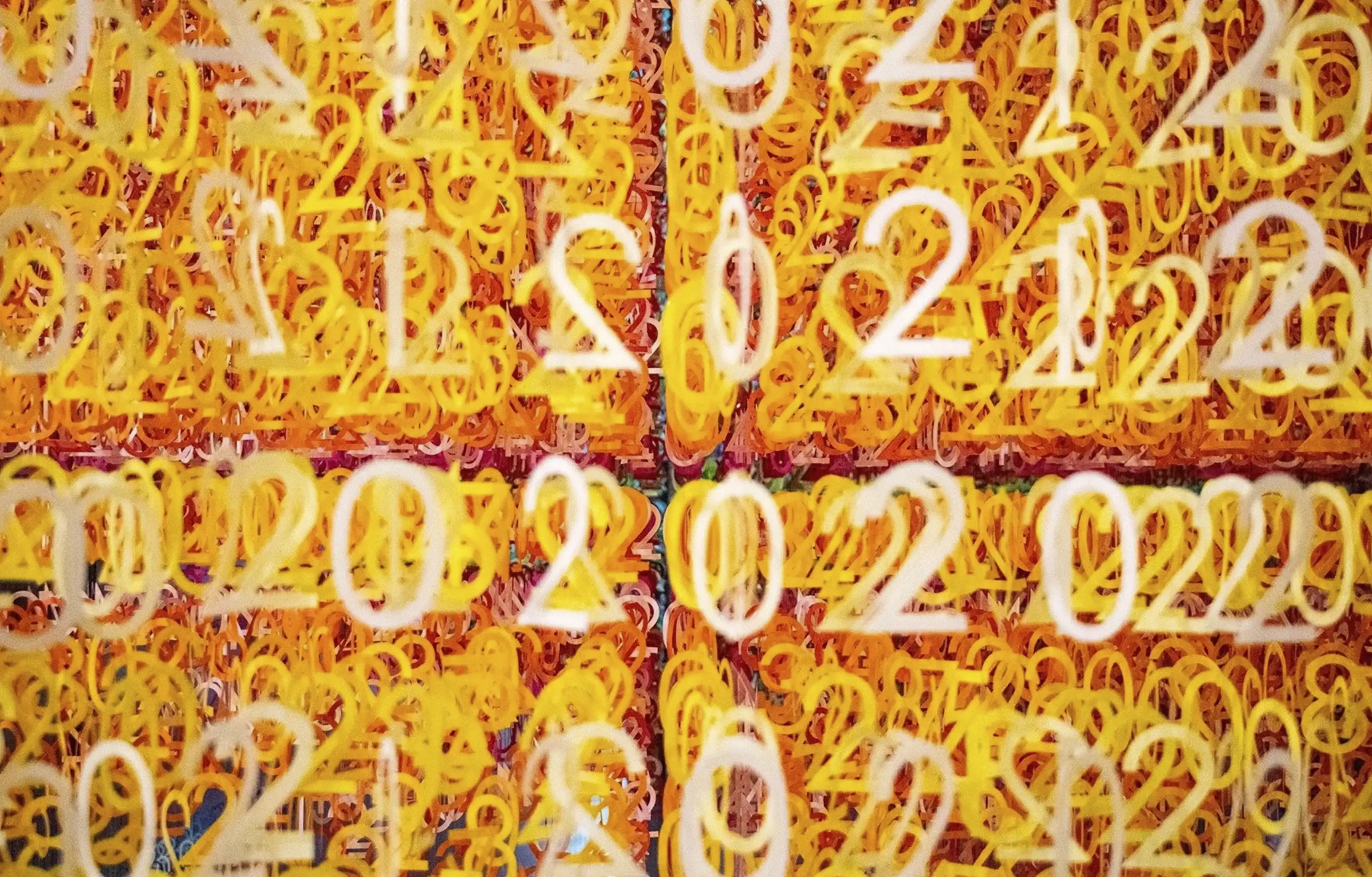
The piece itself was simple to describe and hard to stop looking at. Suspended from the ceiling of the gallery’s ground floor, 168,000 paper numerals, each roughly seven centimetres tall, hung in 120 distinct colour layers, arranged so that visitors walking around and beneath them watched one shade fold into the next. A staircase led to a first floor viewing gallery, where the same installation read completely differently: from above, the layers resolved into a single graduated field of colour, with the visitors below moving through it like figures in a diagram.
Moureaux’s practice is built on a single design idea she calls shikiri, meaning the division of space using colour rather than walls, screens or any other physical material. Slices of Time is that idea taken to its most literal conclusion. Every one of those 168,000 numerals belongs to a specific year, and every layer of colour marks the boundary of one year against the next. The installation does not use colour to decorate a calendar. It uses colour to build one.

What was actually hanging from the ceiling
The structure behind Slices of Time is more precise than its immediate effect of walking through a rainbow suggests. The 120 suspended layers split into two groups. One hundred of them, in a continuous gradient of colour, each represented a single year running forward from 2020 to 2119, a century of the future rendered as a hundred distinct shades. The remaining twenty layers, all in white, represented the twenty years running back from 2019 to 2000, the recent past rendered in a single colour with no gradient at all, because the past, unlike the future, is already fixed and needs no shading to distinguish one year from the next.
Each numeral was cut from coloured paper by hand and strung individually on thread before being hung, a process that Moureaux’s studio has said took roughly two weeks to complete inside the gallery. The effect of the finished piece depended entirely on where a visitor stood. Walking beneath the layers close up, only a handful of numerals and one or two colours were legible at a time, and the years had to be read the way you might read a very tall filing system, one layer at a time. From the first floor viewing gallery above, the same structure became legible all at once: a single field running from white through a full spectrum of colour, with the shift from white to shade marking the exact point in the installation where 2019 became 2020, the year the piece itself was made and shown.

Shikiri: colour as a building material
Moureaux’s central working idea has a name in Japanese: shikiri, which she translates as dividing, or creating, space with colours. The concept is easy to state and unusually consistent in practice. Rather than treating colour as a finish applied to a surface once the real structural decisions have already been made, she treats colour itself as the material that does the dividing, stacking it in layers the way an architect might stack floors or a joiner might stack shelves.
The clearest demonstration of that principle sits not in a gallery but in a working bank. Moureaux has designed several branches of Sugamo Shinkin Bank in Tokyo, including outlets in Shimura, Tokiwadai, Niiza, Nakaaoki and Ekoda, each built around the same idea of colour as structure rather than surface. At the Shimura branch, twelve layers of colour run horizontally across the building’s aluminium facade in a design she called Rainbow Mille-feuille, glowing faintly at night through lighting that shifts with the season and time of day. Inside, chairs in fourteen different colours and three elliptical skylights carry the same logic through to the interior. The bank branch and the gallery installation are, structurally, the same idea: colour stacked in countable layers, doing the work that walls or screens would otherwise be asked to do.

From Ikebukuro to her own studio
Moureaux was born in France and trained there before a period of thesis research took her to Tokyo’s Ikebukuro district in the mid 1990s. She has said the district’s density and visual noise, layered shop signage, overhead cables and fragments of sky glimpsed between buildings, is what first made her conscious of colour as something that could organise a space rather than merely decorate it. She relocated to Tokyo permanently in 1996 and established her own practice, emmanuelle moureaux architecture + design, in 2003. She has taught at Tohoku University of Art and Design since 2008, becoming a professor there in 2023, and is a member of the Tokyo Society of Architects, the Architectural Institute of Japan and the Japan Institute of Architects.
Her body of work spans architecture, interiors, product design and large scale colour installations, and shikiri runs through all of it. What distinguishes the 100 colors series specifically is that it strips the idea down to almost nothing else: no rooms to divide, no furniture to colour code, just the layers themselves, built at a scale a visitor can walk through.

The device she had already built, three years earlier, in Tokyo
Here is what most coverage of Slices of Time left out, and it changes how the piece should be read. The suspended paper numeral, the specific device that made Greenwich’s installation work, was not invented for London. Moureaux had already built and tested a version of it in Tokyo three years before Slices of Time opened.
In January 2017, at the National Art Center in Tokyo, she installed Forest of Numbers, a work that filled a 2,000 square metre gallery with more than 60,000 suspended paper numerals in 100 shades of colour, built with the help of 300 volunteers and seen by more than 20,000 visitors in ten days. That installation used exactly the same mechanism, individual painted numerals strung on thread and hung in colour coded layers, to visualise a single decade running forward from the year it opened, 2017 to 2026, ten layers standing for ten years.
Slices of Time is that same device, scaled up and given a purpose it did not have in Tokyo. Where Forest of Numbers counted an arbitrary decade from the year it was built, Greenwich gave the mechanism a genuine reference point to count from. The span it needed to cover grew from ten years to a hundred and twenty. The numeral count grew from 60,000 to 168,000. And for the first time, the years being counted were not simply the decade nearest to the exhibition’s opening. They were fixed against the one place on Earth from which every clock in the world still takes its time.
Why Greenwich gave the piece its reference point
NOW Gallery sat inside the Gateway Pavilions on Peninsula Square, a curved building designed by Marks Barfield Architects, the practice behind the London Eye, a short walk from the river and from the Royal Observatory across the water in Greenwich Park. Since 1884, the Observatory’s Prime Meridian has been the zero line from which the entire world sets its clocks, the origin point of Greenwich Mean Time. It is difficult to think of a more literal setting, anywhere on Earth, for an installation built entirely from the mechanics of counting years.
That siting is what turns Slices of Time from a repeat of Forest of Numbers into something with its own argument. A calendar needs a starting point before it can count anything, and Greenwich is the place that supplies the world’s. Moureaux’s hundred colour layers ran forward from that point across a full century, to 2119, while her twenty white layers ran back across the two decades already elapsed, to 2000. The installation was not simply sited near the Meridian. It behaved like an instrument calibrated against it, using exactly the reference point the location was built to provide.

A window that collected other people’s dates
Slices of Time asked something of its visitors that Forest of Numbers had not. Alongside the hanging installation, NOW Gallery’s curator, Jemima Burrill, gave visitors circular sheets of paper and coloured pens, and asked them to write down a date that mattered to them personally, along with a short explanation of why. Each contribution was added to the gallery’s street facing window, building over the course of the run into a growing timeline of individual dates, described at the time as a kaleidoscope of colour, memories and dates.
That element extends shikiri somewhere the ceiling installation could not reach on its own. The hanging numerals divided space using colour on an architectural scale, a whole gallery organised into a hundred and twenty countable layers. The window did the same thing at the scale of a single life: one circle of paper, one colour, one date, added to a shared field the same way each numeral had been added to the ceiling above. Burrill described the exhibition as offering visitors a contemplative moment, a chance to enjoy colour and form in both its simplicity and its complexity, and the window was where that contemplation became something visitors actually made rather than simply watched.
NOW Gallery’s decade of solo commissions
NOW Gallery opened on Greenwich Peninsula in September 2014, founded by the curators Jemima Burrill and Kaia Charles as a space built around a specific format: a rolling series of solo commissions, each given roughly three months and the whole of the gallery to work with. Over its run it gave that space to Simon Heijdens, whose Shade opened the gallery in 2014, to Rebecca Louise Law for a suspended installation of preserved flowers in 2017, and to Camille Walala for an immersive painted labyrinth the same year, alongside an annual charity project called Secret 7″ pairing musicians with visual artists. Slices of Time sat squarely inside that format: one artist, one idea, the whole of the gallery given over to testing it at full scale. NOW Gallery operated on Greenwich Peninsula until August 2025, closing after eleven years with its identity as a launchpad for ambitious, single artist installations intact.

Final thoughts
It would be easy to describe Slices of Time as a photogenic rainbow that happened to hang in Greenwich for a season, and leave it there. That undersells what the piece was actually doing. Every one of its 168,000 numerals belonged to a specific year, every one of its 120 layers marked a boundary between one year and the next, and the whole structure was calibrated against the single place on Earth that supplies the rest of the world with its clocks.
The piece also had a history most visitors would not have known to look for. Moureaux had already built this exact mechanism once before, in Tokyo, to count a single decade. Greenwich gave it something Tokyo could not: an actual reference point, the Meridian line, against which a century of colour and two decades of white could be measured rather than simply chosen. And the window installation, gathering hundreds of visitors’ own dates into a shared timeline, took the same principle, colour as a way of dividing and organising time, down to the scale of an individual life.
Slices of Time was never really about colour for its own sake. It was a demonstration, built at full scale and then rebuilt more ambitiously than before, that colour can do the work of structure: divide a space, count a century, and give a roomful of strangers a way to add their own dates to something larger than any one of them.
What was Slices of Time?
Slices of Time was an installation by the French architect and designer Emmanuelle Moureaux, shown at NOW Gallery on Greenwich Peninsula in London. It used 168,000 individually cut paper numerals, suspended in 120 colour graded layers, to visualise a span of years running from 2000 to 2119.
When did it run?
It opened on 5 February 2020, was originally scheduled to close on 19 April, and had its run extended to 27 September 2020. It has since closed, and NOW Gallery itself closed permanently in August 2025.
Who made it?
Emmanuelle Moureaux, a French born architect and designer who has been based in Tokyo since 1996 and founded her own practice, emmanuelle moureaux architecture + design, in 2003.
What is shikiri?
Shikiri is Moureaux’s term for dividing or creating space using colour rather than walls or physical structure. It is the organising idea behind all of her work, including Slices of Time and her architectural projects such as the Sugamo Shinkin Bank branches in Tokyo.
Was this part of a wider series?
Yes. Slices of Time belonged to Moureaux’s ongoing 100 colors series, begun in 2013 to mark her studio’s tenth anniversary, with more than fifty installations shown in cities across six continents.
What were the numerals made of, and how were they installed?
Each numeral was individually cut from coloured paper and hand strung on thread before being hung from the gallery ceiling, a process that took roughly two weeks to complete.
Could visitors take part in the installation?
Yes. Visitors were given circular paper and coloured pens to write down a personally significant date and its meaning, which was then added to a growing timeline displayed in the gallery’s street facing window.
Is Slices of Time still on view?
No. The installation closed in September 2020, and NOW Gallery, the venue that hosted it, closed permanently at the end of August 2025.


Leave a Reply