
ART & CULTURE · STOCKHOLM
Reading time: 9 minFor Stockholm Design Week 2019, Färg & Blanche filled a nineteenth-century house in Södermalm with twelve new and existing pieces, then let the building’s own history set the terms. The house was built on the proceeds of a crispbread recipe invented by Emma Marga Blanche’s great-great-grandfather, and the studio’s response, down to a chandelier of coloured glass strung like drying bread, reads as a design argument about what it means to add to a place rather than redecorate it.
Färg & Blanche, the Stockholm studio run by Fredrik Färg and Emma Marga Blanche, spent Stockholm Design Week 2019 working inside a building most visitors would never otherwise get to see. The Baker’s House opened its doors at Bondegatan 21A in Södermalm from 5 to 9 February 2019, open to the public by advance booking for guided tours, and it ran alongside the Stockholm Furniture and Light Fair taking place the same week across the city.
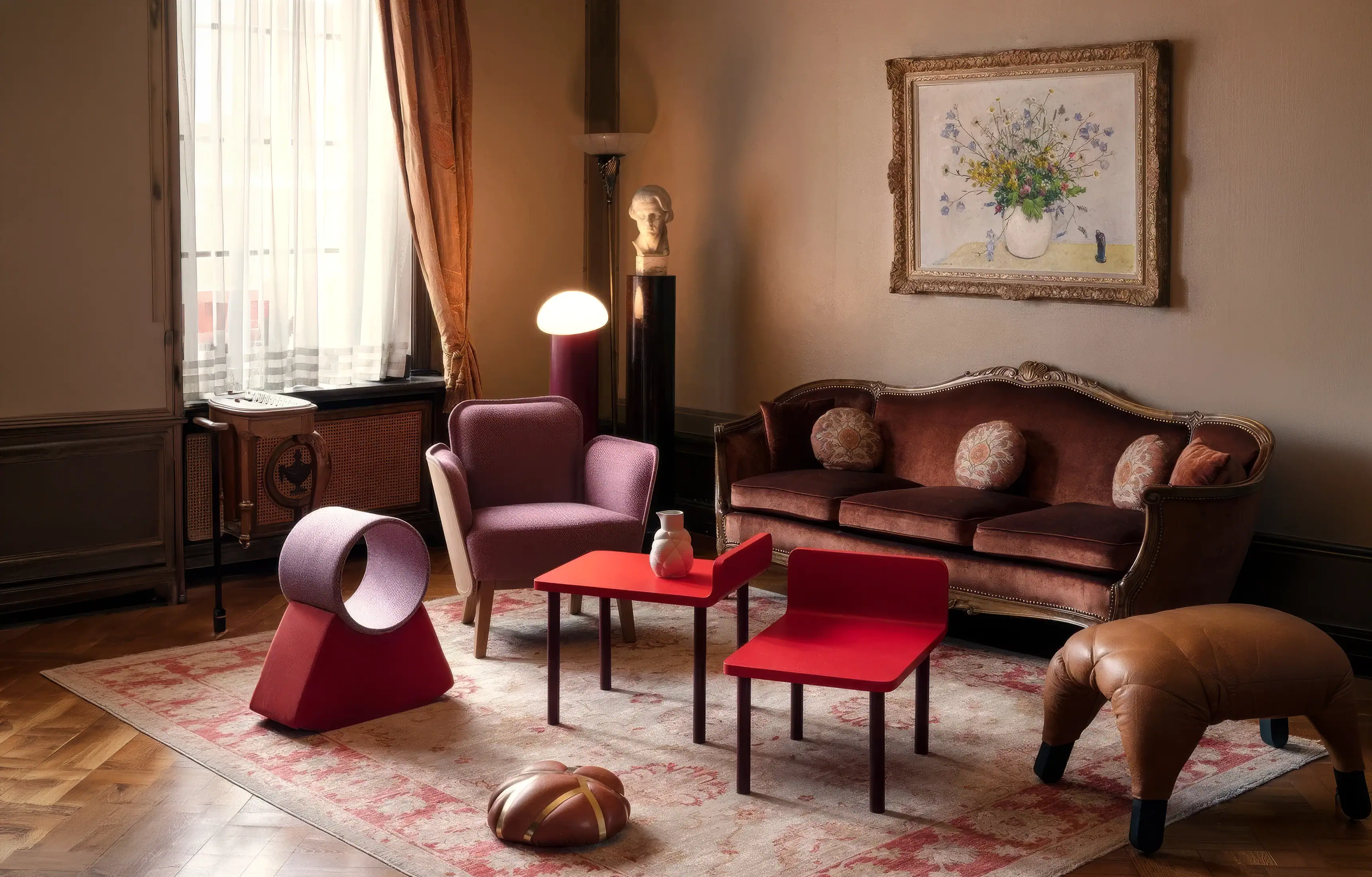
The address is not a showroom. It is Emma Marga Blanche’s own family home, a townhouse built in 1889 by her great-great-grandfather Julius Westerdahl, who ran a traditional Swedish knäckebröd, or crispbread, bakery on its ground floor. The bakery’s income built the house above it, and the building has stayed with the family ever since. For one week, Färg & Blanche turned it into an exhibition, arranging twelve pieces, some made specifically for the rooms and some drawn from the studio’s existing collections, through the entrance hall, the stairway and the upper floors.
What makes the installation worth returning to seven years on is not the novelty of a designer showing work in a domestic setting, which happens constantly during design week season. It is the specificity of the response. Färg & Blanche did not treat the house as a neutral backdrop. They read its architecture, its parquet and its family history closely enough to design a lighting fixture around the exact method Julius Westerdahl would have used to dry his crispbread, and a set of tables around the geometry already in the floor beneath them. The result argues, more persuasively than most design-week statements manage, for what a considered addition to a historic interior actually looks like.

A house built on bread
The story behind The Baker’s House starts a century and a half before the exhibition itself. Julius Westerdahl developed a distinctive round, dimpled style of crispbread that found a market wide enough to fund the construction of a proper townhouse on Bondegatan in 1889, in Södermalm, the Stockholm district that has moved in the intervening decades from working docks and workshops to one of the city’s most sought-after residential quarters. The bakery occupied the ground floor. The family lived above it.
That structure, bakery below and home above, is unusually legible in the surviving building. Södermalm is full of nineteenth-century townhouses that have had their working ground floors converted beyond recognition, but Bondegatan 21A still reads as what it was: a small manufacturing business with a household built directly on top of its income. Emma Marga Blanche grew up aware of that history and has said she had been considering a project responding to the house for more than ten years before Stockholm Design Week 2019 gave her the occasion to do it, since the day she first moved to Sweden from France to build her life and, eventually, her design practice with Fredrik Färg.
The building today continues to belong to the family and hosts events under a cultural initiative connected to the Blanche name, a continuity that gives The Baker’s House a weight most pop-up exhibitions do not have. Färg & Blanche were not borrowing a striking backdrop for a week. They were making work inside a house that has never left their own family, about an ancestor whose trade financed the rooms the visitors were standing in.

The lighting that reads the building’s history literally
The most direct design response in the installation is also the one that requires the least explanation once you know the building’s history. In the entrance hall, Färg & Blanche hung a lighting fixture made from coloured glass discs, blown at Målerås glassworks in Småland, one of Sweden’s best-known glass manufacturers with a history stretching back to 1890, one year after the house itself was built. The discs are strung along illuminated rails in a way that deliberately echoes how a traditional Swedish bakery would hang crispbread to dry and cure once it came out of the oven, threaded onto poles through the hole punched in the centre of each round.
That detail is easy to read as decorative until you understand how knäckebröd was actually made. The dimpled round loaves were, and in many bakeries still are, given a hole at the centre specifically so they could be threaded onto a horizontal pole or rod and left to dry, a practical solution that also became the crispbread’s most recognisable visual feature. Färg & Blanche’s fixture translates that working method directly into a lighting object: each glass disc stands in for a loaf, the illuminated rail for the drying pole, and the effect is a chandelier that is legible as a design object first and only becomes a piece of family history once someone tells you what it is referencing. That is a difficult balance to strike, and it is the clearest evidence in the whole installation of a studio working from research rather than from mood.

Furniture that argues with the floor, not against it
Upstairs, the studio’s response to the house shifts from working history to working geometry. The upper rooms carry star-patterned inlay parquet, a common decorative flourish in grand nineteenth-century Stockholm apartments, and Färg & Blanche designed a set of timber tables with star-shaped bases that pick up the same angles as the floor beneath them. Stand at the right point in the room and the table legs and the parquet pattern read as a single continuous design idea rather than two unrelated objects sharing a floor.
Elsewhere in the sitting rooms, the studio showed a new pairing of upholstered pieces built around the idea of a keyhole, a stool with an open tube through its base and a table with a wedge-shaped foot and a ring-shaped top, both taking their silhouette from the keyholes fitted throughout the flat. A chair named Mr N, after Emma Marga Blanche’s grandfather Neil, sat in what had been used as a study. Brass-bound floor lamps stood in the arched stairway connecting the floors, and jade-green candles were arranged along a fireplace mantelpiece, small interventions rather than centrepieces, placed to sit comfortably in rooms that were still recognisably a family home during the week of the show.
Alongside the new work, Färg & Blanche brought in pieces from their existing catalogue, including the Emma armchair and the Julius seating collection made for Gärsnäs, to sit within the same rooms as the house-specific objects. The effect was not a showroom lined up against a period interior. It was a lived-in house with one week’s worth of new and familiar work moved through it, which is closer to how the studio has always described its intent for the project.

The design argument: addition, not decoration
Färg & Blanche were explicit, at the time, about what they were trying to avoid. Their stated aim was for the new pieces to enhance the interior and take nothing away from the original fabric of the house, treating the relationship between new object and old room as a dialogue rather than an attempt at seamless period matching. That is a more difficult brief than it sounds. A designer working inside a historic interior can lean on pastiche, reproducing period details closely enough that new work disappears into the room, or they can lean on contrast, making the new object as different as possible so nobody mistakes old for new. The Baker’s House does neither.
The glass lighting is unmistakably a contemporary object, made with contemporary glassblowing techniques at a working Swedish glassworks, but its form is drawn directly from a domestic craft practice that predates the house. The star-based tables are new furniture, but their geometry is lifted straight from the room’s own decorative floor. Each piece in the installation earns its place by responding to something specific already present in the building, whether that is a pattern in the parquet, the shape of a keyhole, or the memory of bread hung to dry over a century earlier. That is what a genuine dialogue between new design and an existing interior looks like in practice, and it is a more useful reference for anyone designing inside a historic building than the usual choice between imitation and contrast.

Stockholm Design Week as a city, not a hall
The Baker’s House is also a useful reminder of how Stockholm Design Week actually works. The Stockholm Furniture and Light Fair, held at Stockholmsmässan across the same five days, is the trade event most international coverage focuses on, and its 2019 edition ran alongside dozens of smaller shows staged across the city in showrooms, galleries and, in this case, a private family home. Färg & Blanche chose to put their most personal and research-led project of the week somewhere the trade fair could never have replicated. A stand at Stockholmsmässan can show what a studio has made. A guided tour through the rooms Emma Marga Blanche grew up around could show why.
That distinction is worth holding onto for anyone planning a Stockholm Design Week visit. The fair remains the place to see the largest concentration of new product in one week, but the installations staged in the city’s own buildings, in courtyards, ground-floor spaces and, occasionally, family homes, are where a studio has the most room to make an argument rather than a sales pitch.

Final thoughts
It would be easy to describe The Baker’s House as another design-week studio show staged somewhere more photogenic than a fair hall. That undersells what Färg & Blanche actually did with the opportunity. The interesting decision here was not the choice of a characterful old building. It was the discipline of designing every new object as a direct response to something specific already in that building, a floor pattern, a keyhole, a family trade a century old, rather than simply placing attractive furniture inside attractive rooms.
Emma Marga Blanche had reportedly wanted to make this project for a decade before the timing and the occasion of Stockholm Design Week 2019 finally aligned. That patience shows in the finished installation. The crispbread lighting fixture in particular does something genuinely rare in design-week work: it takes a piece of specific, local, almost domestic craft history and turns it into a contemporary object without flattening it into decoration or stating its reference too loudly. It simply works as a light, and it happens to also be a small piece of family history rendered in glass.
That is the argument The Baker’s House makes about designing inside a historic interior. The strongest response to an old building is rarely to imitate it or to ignore it. It is to find out, specifically, what the building already knows, and then design something new that answers it.
What was The Baker’s House by Färg & Blanche?
It was an installation by the Stockholm design studio Färg & Blanche, showing twelve new and existing pieces inside Emma Marga Blanche’s family home in Södermalm during Stockholm Design Week 2019.
Where was The Baker’s House held?
At Bondegatan 21A in Södermalm, Stockholm, a townhouse built in 1889 that has remained in Emma Marga Blanche’s family since it was built.
When did The Baker’s House run?
It was open to the public, by advance booking for guided tours, from 5 to 9 February 2019, alongside that year’s Stockholm Design Week and Stockholm Furniture and Light Fair.
Why is the building called The Baker’s House?
Because the ground floor originally housed a traditional Swedish crispbread bakery run by Julius Westerdahl, Emma Marga Blanche’s great-great-grandfather, whose trade financed the construction of the house above it.
What was the lighting fixture in the entrance hall inspired by?
A set of coloured glass discs, blown at Målerås glassworks, hung from illuminated rails to reference the traditional method of threading crispbread loaves onto a pole to dry after baking.
Who are the designers behind Färg & Blanche?
Fredrik Färg, a Swedish designer with a background in cabinetmaking, and Emma Marga Blanche, a French-born designer based in Stockholm. They founded the studio together in Stockholm in 2010.
Did the installation include existing Färg & Blanche pieces as well as new work?
Yes. Alongside pieces made specifically for the house, including the crispbread-inspired lighting and a set of star-based tables, the studio showed pieces from its existing catalogue, including the Emma armchair and the Julius seating collection made for Gärsnäs.
Is The Baker’s House still open to visitors?
No. It was a temporary installation staged for Stockholm Design Week 2019 and closed on 9 February 2019. The house remains the Blanche family’s private home.


Leave a Reply