
ART & CULTURE · DUBAI
Reading time: 9 minIn its first autumn at Alserkal Avenue, Firetti Contemporary opened Praxis of Change, a ten-artist manifesto on land, material and repair that ran straight through Dubai Design Week 2021. Contaminated soil from an Albanian oilfield, silk-wrapped bottle tops, agricultural patterns burned into wood and coal: six of the artists in the room set the terms a young gallery has been building on ever since.
Firetti Contemporary opened at Unit 29, Alserkal Avenue in March 2021, and by that September it had settled on the show that would define its programme for the rest of the year. Praxis of Change ran from 22 September to 24 November 2021, held under the patronage of Sheikh Nahyan bin Mubarak Al Nahyan, the UAE’s Minister of Tolerance and Coexistence, and it sat across the gallery’s rooms for the entirety of the seventh Dubai Design Week, held 8 to 13 November 2021.

Ten artists from Lebanon, the United States, Finland, the United Kingdom, Morocco, Albania and Uganda made up the exhibition, described by the gallery as a statement that protecting the planet is both a collective project and an individual one. Six of those artists, Fatiha Zemmouri, Eltjon Valle, Ghizlane Sahli, Rachel Libeskind and Irvin Pascal among the Praxis of Change roster, plus Helidon Xhixha, the sculptor whose steel gave the gallery its founding identity, are the reason a visit to Alserkal Avenue that week stayed in the memory.
This was not a general survey of Firetti Contemporary’s programme. It was a specific, dated presentation, the gallery’s first extended statement of what it would go on to show, and it sits at the start of a curatorial line the gallery has kept building on in the years since, through solo presentations that have taken its artists in increasingly pointed directions.

What Praxis of Change actually was
The exhibition took its title seriously as a working method rather than a slogan. Each artist arrived with a different material relationship to land, and the show’s argument came from placing those relationships next to each other rather than explaining them. Fatiha Zemmouri showed three works, two from her Mother Earth series and a piece titled Suspension I, built from wood, coal and earth fused with water and fire. Eltjon Valle showed a group of mixed media pieces built from petroleum-affected material. Ghizlane Sahli contributed three sculptural works made from recycled matter. Rachel Libeskind showed two photolithographs. Irvin Pascal exhibited two oil paintings.

Zemmouri’s contribution read most directly as landscape. The Mother Earth pieces take their structure from the patterns agricultural land leaves on the ground it has been worked over, cracked, furrowed, terraced, and rebuild those patterns in materials that carry their own histories of transformation: wood that has been burned, coal that was once wood, earth mixed with water until it holds a new shape. The work does not illustrate a landscape. It behaves like one, subject to the same slow chemistry of construction and collapse that shapes a field.
Valle’s material is more direct still. His long-running Land Pieces are segments of soil lifted from the Patos-Marinza oilfield near Kuçova, the Albanian town where he grew up inside a communist-era petroleum industrial base, and in Praxis of Change one work extended that vocabulary into something closer to home: children’s toys, coated in the same black matter that saturates the soil he has spent over a decade exhibiting. Where the soil pieces document a landscape, the toy piece implicates a generation being raised on top of it.

Two artists in silk and steel
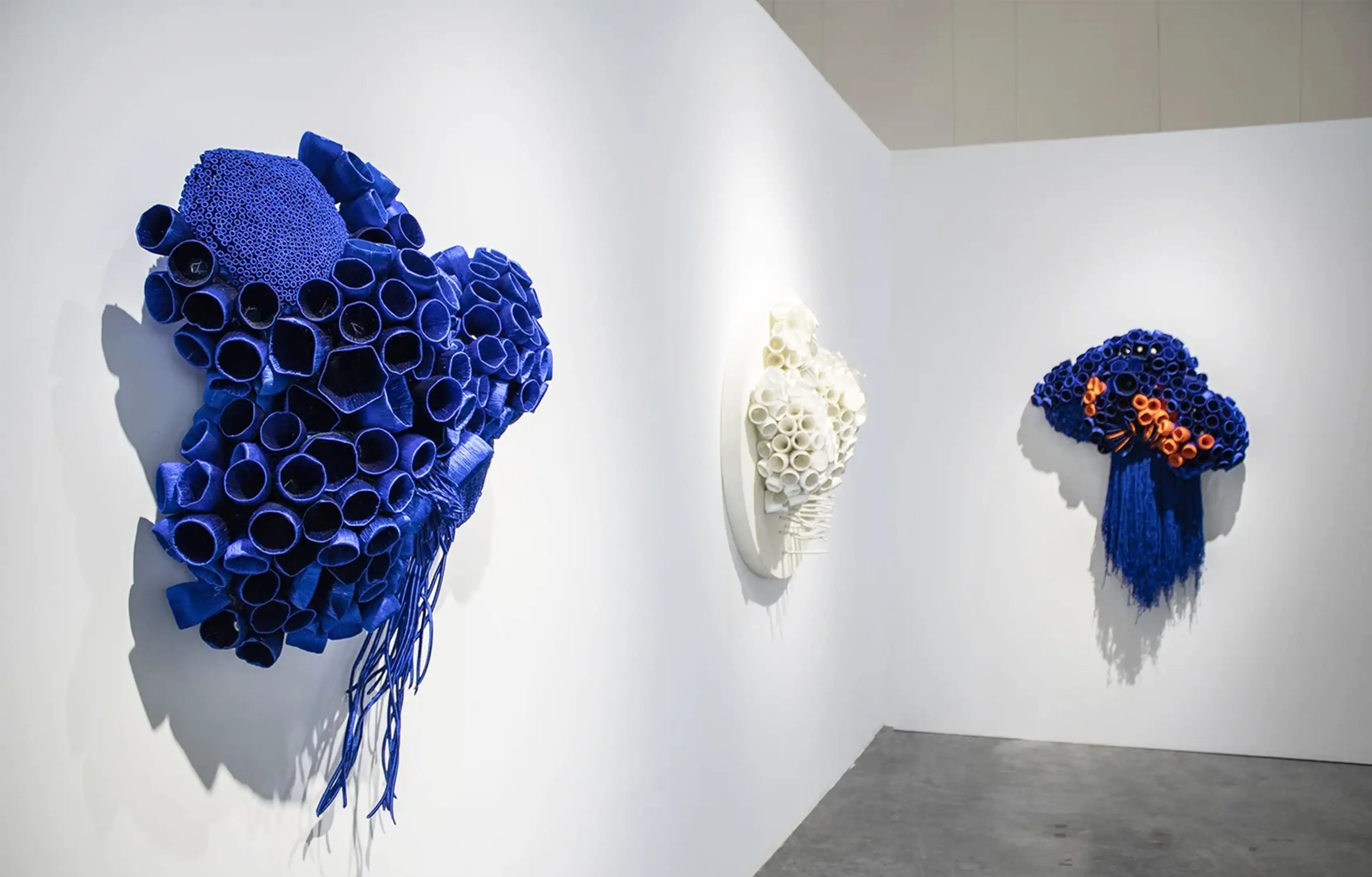
Ghizlane Sahli’s practice runs on collaboration in a way the exhibition’s environmental theme needed. Trained as an architect in Paris before returning to Morocco, she spent seven years running a silk embroidery workshop with artisan women in Marrakech, work that won the Trophée Couleurs prize in 2009, before turning the workshop’s techniques toward sculpture. Her Alveoles, three-dimensional forms built from used bottle tops wrapped entirely in silk thread by hand, are the clearest expression of a practice she describes as bridging architecture, textile craft and environmental sustainability. The material she starts with is waste. What she hands the room is something closer to a honeycomb, patient and structurally exact, made through hundreds of hours of hand embroidery rather than a single gesture.

Helidon Xhixha worked in the opposite register, in scale rather than intimacy. Trained at the Brera Academy of Fine Arts in Milan and at Kingston University in London, the Albanian sculptor has spent two decades describing his own method in one sentence: he does not sculpt materials, he uses materials to sculpt light. His stainless steel forms, folded, cut and polished until they behave less like objects than like weather, had already shown at the Venice Biennale, the Uffizi Galleries and Somerset House by the time the gallery opened, and his sculpture remained part of Firetti Contemporary’s rotation through that first year, a steel counterpoint to the show’s soil, silk and coal.

Rachel Libeskind and Irvin Pascal, working from the personal outward
Rachel Libeskind’s installation in Praxis of Change carried three short, declarative phrases through the room: Nature owes you nothing, Terror of Territory, You are not on Earth. Born in Milan and raised in Berlin, with a degree from Harvard, Libeskind works across collage, installation, video and performance, and her practice consistently disrupts the boundary between the personal and the historical. She is the daughter of the architect Daniel Libeskind, and has spoken of him instilling in her the freedom to keep pushing at the edges of a discipline rather than settling inside one. The three phrases in Praxis of Change worked as a set of instructions the rest of the exhibition was already following: territory is not a neutral word, and the earth’s patience has limits.

Irvin Pascal’s two oil paintings brought the show back to the body. Trained in architecture before completing a fine art degree at the University of Brighton, and selected for Bloomberg New Contemporaries in 2017, Pascal works across painting, sculpture and performance, developing a signature material he calls Pascollar, a textured compound that incorporates his own hair. His figurative paintings draw on his African-Caribbean family heritage and, at times, on his own history as a boxer, applying the exhibition’s language of land and inheritance to a body rather than a field.

Why Alserkal Avenue was the right room for it
None of this would have carried the same weight anywhere else in Dubai. Alserkal Avenue was built as an industrial compound of 39 warehouses in Al Quoz, developed by Abdelmonem Bin Eisa Alserkal for storage and light manufacturing. Its transformation began when Ayyam Gallery relocated there in 2008, followed a year later by Carbon 12, and the shift from goods store to gallery district gathered pace from there. The avenue doubled in size in a 2012 to 2015 expansion, adding 62 units and taking its footprint to roughly 500,000 square feet, and launched a programming arm supporting artists across the Middle East, North Africa and South Asia. OMA completed Concrete, its first UAE building, in 2017, and the Alserkal Arts Foundation followed in 2019 to run residencies and public commissions. The district now holds more than 60 creative venues, including some 25 contemporary art galleries, the highest concentration anywhere in the region.
That density is what makes a show like Praxis of Change legible in the way it is intended to be. A visitor moving between Firetti Contemporary and its neighbours during Dubai Design Week was already primed to read raw material as argument, because half the buildings around it were making the same case in concrete and steel that the gallery’s warehouse shell had once been something else entirely.

The gallery Mara Firetti built around one sculptor
Mara Firetti’s own route to Alserkal Avenue explains why Xhixha’s steel sat at the centre of the gallery’s first year rather than at its edge. Italian by nationality, she spent her formative years in Kaduna, Nigeria, before building a career as an entrepreneur across Nigeria and Dubai. Roughly fifteen years before Firetti Contemporary opened, she encountered Xhixha’s sculpture for the first time, an encounter she has since described as transformative, and it led her first to manage his career and then to begin collecting seriously. The gallery she eventually opened with her co-founder, Celine Azem, was built on the conviction that came out of that meeting: that sculpture belongs in public space as much as in a white room, and that a gallery’s programme should treat humanitarian and environmental questions as material for artists to work with directly rather than a subject to gesture at from a distance.
That conviction is the throughline between Praxis of Change and what the gallery has done since. The ten artists in that first group show, the toy sculptures covered in oilfield residue, the silk grown from bottle caps, the steel that behaves like light, were not a one-off curatorial flourish. They were a founding statement, made in public, during the one week of the year when Dubai’s design community was already looking at Alserkal Avenue.

What Firetti Contemporary built on from there
Firetti Contemporary has continued to develop the programme Praxis of Change opened. Since 2021 the gallery has moved from group presentations into closely focused solo exhibitions, giving individual artists the space to extend a single idea across a full show rather than a handful of works in a group room. Aidha Badr’s I’m Never Coming Back took the toy horse, a form Valle had already used to carry difficult material two years earlier, and cut it open. Ihab Ahmad’s I Put My Brain on Pause examined a designer disabling his own hand mid-process. Kaikhan Salakhov’s The Cosmic Renaissance followed an architect who lost the site he was designing for. Each show narrows the aperture Praxis of Change first opened, on land, material and the body, to a single artist working through a single idea in full.

Final thoughts
It would be easy to describe Praxis of Change as an opening-season group show, the kind of exhibition every young gallery mounts to introduce its roster before the real programming begins. What actually happened at Alserkal Avenue that autumn was more specific than that. Ten artists were asked to bring their most direct material relationship with land, and six of them, working in oilfield soil, silk, wood, coal, steel and paint, gave the show a vocabulary that Firetti Contemporary has kept using ever since.

Mara Firetti’s own path into the gallery world, built around a single sculptor’s work encountered fifteen years before she had a gallery to put it in, explains why that vocabulary held together rather than reading as a checklist of themes. The show was never really about ten different artists making ten different points about the planet. It was about a gallery, still finding its shape, discovering that its own founding conviction, that raw material carries argument, applied equally to soil from an Albanian oilfield and to a sheet of polished steel.
That is what makes Praxis of Change worth returning to now, years and several solo shows later. It is not a footnote to what Firetti Contemporary has become. It is the first full sentence of an argument the gallery is still making.
What is Firetti Contemporary?
Firetti Contemporary is a contemporary art gallery at Alserkal Avenue in Dubai’s Al Quoz district, founded by Mara Firetti and Celine Azem in March 2021, presenting regional and international artists working across painting, sculpture, installation and mixed media.
Where is Firetti Contemporary?
The gallery is at Unit 29, Alserkal Avenue, Al Quoz 1, Dubai, in the district’s main gallery cluster.
What was Praxis of Change?
Praxis of Change was Firetti Contemporary’s ten-artist group exhibition, running from 22 September to 24 November 2021 and spanning the seventh edition of Dubai Design Week, held under the patronage of Sheikh Nahyan bin Mubarak Al Nahyan.
Which artists were featured during the gallery’s Dubai Design Week 2021 presentation?
Fatiha Zemmouri, Eltjon Valle, Ghizlane Sahli, Rachel Libeskind and Irvin Pascal showed in Praxis of Change, alongside sculpture by Helidon Xhixha, the gallery’s founding artist.
What materials did the artists use?
Materials ranged from oilfield soil and children’s toys coated in petroleum residue, in Eltjon Valle’s work, to wood, coal and earth in Fatiha Zemmouri’s, silk-wrapped bottle tops in Ghizlane Sahli’s, polished stainless steel in Helidon Xhixha’s, and oil paint in Irvin Pascal’s.
How did Mara Firetti come to found the gallery?
Firetti encountered Helidon Xhixha’s sculpture roughly fifteen years before opening the gallery, went on to manage his career, and eventually opened Firetti Contemporary with Xhixha’s work at its centre.
Is Praxis of Change still on view?
No. The exhibition closed on 24 November 2021. Firetti Contemporary has since moved into a programme of solo exhibitions extending the same themes.
What has Firetti Contemporary shown since Praxis of Change?
The gallery has presented solo shows including Aidha Badr’s I’m Never Coming Back, Ihab Ahmad’s I Put My Brain on Pause and Kaikhan Salakhov’s The Cosmic Renaissance, each developing a single idea from the gallery’s founding programme in depth.


Leave a Reply