
ART & CULTURE · LONDON
Reading time: 9 minFrieze London 2024 ran from 9 to 13 October in The Regent’s Park, its 21st edition and the most significant redesign of the fair’s tent since 2014. The architect Richard McConkey built the new floorplan directly from the urban theorist Jane Jacobs, and the decision to scatter the biggest galleries away from the entrance rather than cluster them there explains more about how the fair actually worked that year than any single stand does.
Frieze London 2024 ran from 9 to 13 October in The Regent’s Park, its 21st edition and, by most measures, the most significant physical reworking of the fair since 2014. It ran alongside its sister fair Frieze Masters and the outdoor exhibition Frieze Sculpture, both staged nearby in the same park across overlapping dates, together forming the London art world’s busiest week of the year.
The easy way into a fair this size is a list of the galleries showing there, and Frieze London 2024 had plenty worth listing: strong stands from London, Glasgow, Mumbai, Seoul and Hamburg, a major London solo debut, and a Frieze Artist Award commission built around an AI therapist for broken self-driving cars. All of that is covered below. The more interesting story sits underneath the gallery list, in a decision most visitors walked past without registering directly: for the first time in a decade, someone had deliberately redesigned where in the tent a visitor’s feet actually went.


Union Pacific – London
A floorplan built from a 1961 book about cities, not a fair
The 2024 redesign was led by Richard McConkey, founder of the design practice A Studio Between, who had previously worked on Frieze’s last major tent overhaul in 2014 while head of hospitality design at Universal Design Studio. For 2024, McConkey did not start from a conventional trade fair layout. He started from The Death and Life of Great American Cities, the 1961 book by the urban theorist Jane Jacobs, and applied her ideas about how a city actually functions directly to a temporary tent in Regent’s Park.
Jacobs argued that a healthy urban district needs busy arterial routes connecting different zones, and enough varied, interesting destinations scattered along those routes to keep people moving through rather than retreating to a single hub. McConkey adapted both ideas for the fair floor. He built a central arterial loop running through the tent with clear sightlines and no dead ends, and rather than clustering the biggest, best-known galleries near the entrance, the way most fairs do, he distributed them as what he called “chess pieces”, strategic anchors placed deliberately throughout the space to pull visitors past younger and less established galleries on the way to a name they already recognised. The team produced around fifty separate 3D-rendered floorplans over four months to arrive at a layout that worked within the park’s protected tree canopy while achieving that distribution.


Carl Freedman Gallery – Margate
The physical materials carried the same logic through into how the space actually felt. A new grand staircase entrance opened views into the park itself rather than straight into the fair. The restaurant’s walls were built from cotton artist’s canvases positioned in front of floral installations by the artist Hattie Fox, filtering light and dampening sound rather than acting as a hard partition. Low-energy LED lighting with a high colour rendering index, combined with translucent fabric roof skins, lit the space as a whole rather than spotlighting individual booths, and the entire structure was built on a modular, lightweight cassette system engineered specifically to be disassembled and reused for future editions rather than built once and discarded.
McConkey has described the intent behind all of it plainly: “We changed the whole geography,” creating, in his words, “an idea of exchange, with various galleries in conversation with social spaces,” alternating “compact aisles” with “moments of big release where you have lots of light.” Eva Langret, Frieze’s artistic director, put the underlying goal even more directly: “emerging voices have always been at the heart of Frieze, but not necessarily at the heart of the tent.” The 2024 redesign was the year that changed, structurally rather than just editorially.
The Focus section, dedicated to galleries eight years old or younger, was relocated to sit directly at the fair’s new entrance as a result, curated that year by Angelina Volk, Piotr Drewko and Cédric Fauq and featuring 34 exhibitors from 21 countries, the clearest single expression of McConkey’s redistribution principle in the finished floorplan. Frieze Masters, running concurrently nearby, took its own, differently reasoned approach to floorplanning that same year, refined by the architect Annabelle Selldorf around sightlines and cross-era connection rather than discovery and circulation. That pairing, and the full story of Frieze Masters 2024, is covered in our companion piece on this site.


Galerie Gisela Capitain – Cologne, Naples
Smoke: a new section built around clay’s non-Western histories
Frieze London 2024 introduced an entirely new curated section, Smoke, dedicated to ceramics and clay and curated by Pablo José Ramírez, a curator at the Hammer Museum in Los Angeles. Ramírez has been direct about the section’s premise: he works consistently with artists from the Global South, and Smoke was built specifically to trace aesthetic trajectories in clay that originate outside Western art history rather than being read against it. The section’s title comes from the work of the K’iche’ Maya writer Humberto Ak’abal, anchoring it explicitly to an Indigenous literary tradition rather than a purely material one.


Galerie Gisela Capitain – Cologne, Naples
The artists Ramírez brought together each pushed clay past its own conventional boundaries: Manuel Chavajay, working from Guatemala; Adán Vallecillo, from Honduras; Christine Howard Sandoval, whose practice draws on Obispeño Chumash and Hispanic ancestry; Karla Ekaterine Canseco and Roksana Pirouzmand, presented as a paired dual presentation through the Los Angeles gallery Murmurs; and Noé Martínez, working from Mexico City using sgraffito, a technique that scratches through a surface layer to reveal the material beneath it, a fitting method for a section explicitly concerned with what sits under a more familiar surface reading of clay and ceramics.


The Modern Institute – Glasgow
The Frieze Artist Award: an AI therapist built as a walking simulator
The 2024 Frieze Artist Award went to Lawrence Lek, the London-based artist and filmmaker, for a multimedia installation titled Guanyin: Confessions of a Former Carebot, sited at Booth P1. Lek built the work using the structural logic of a video game “walking simulator,” a genre where a player explores an environment to uncover a story rather than to complete conventional objectives, and populated it with a mechanical sculpture and a full narrative voice track.


Project 88 – Mumbai
The installation’s central figure, Guanyin, is a therapeutic cyborg created to counsel malfunctioning artificial intelligence, and visitors followed her voice through journal entries, company reports and messages addressed to a series of broken self-driving cars she has been assigned to treat. The name is not incidental. Guanyin is the Buddhist goddess of mercy, and Lek has built his own body of work for years around the idea that technological progress carries a spiritual and emotional dimension most conversations about AI leave out entirely, tracing a line from the Turing test through to the conversational systems now shaping how people actually talk to machines. Lek is represented by Sadie Coles HQ, and the 2024 Frieze Artist Award followed earlier recognition including the 2017 Jerwood/FVU Award and a 2021 grant from LACMA’s Art + Technology Lab.


PKM Gallery – Seoul
The galleries worth stopping for
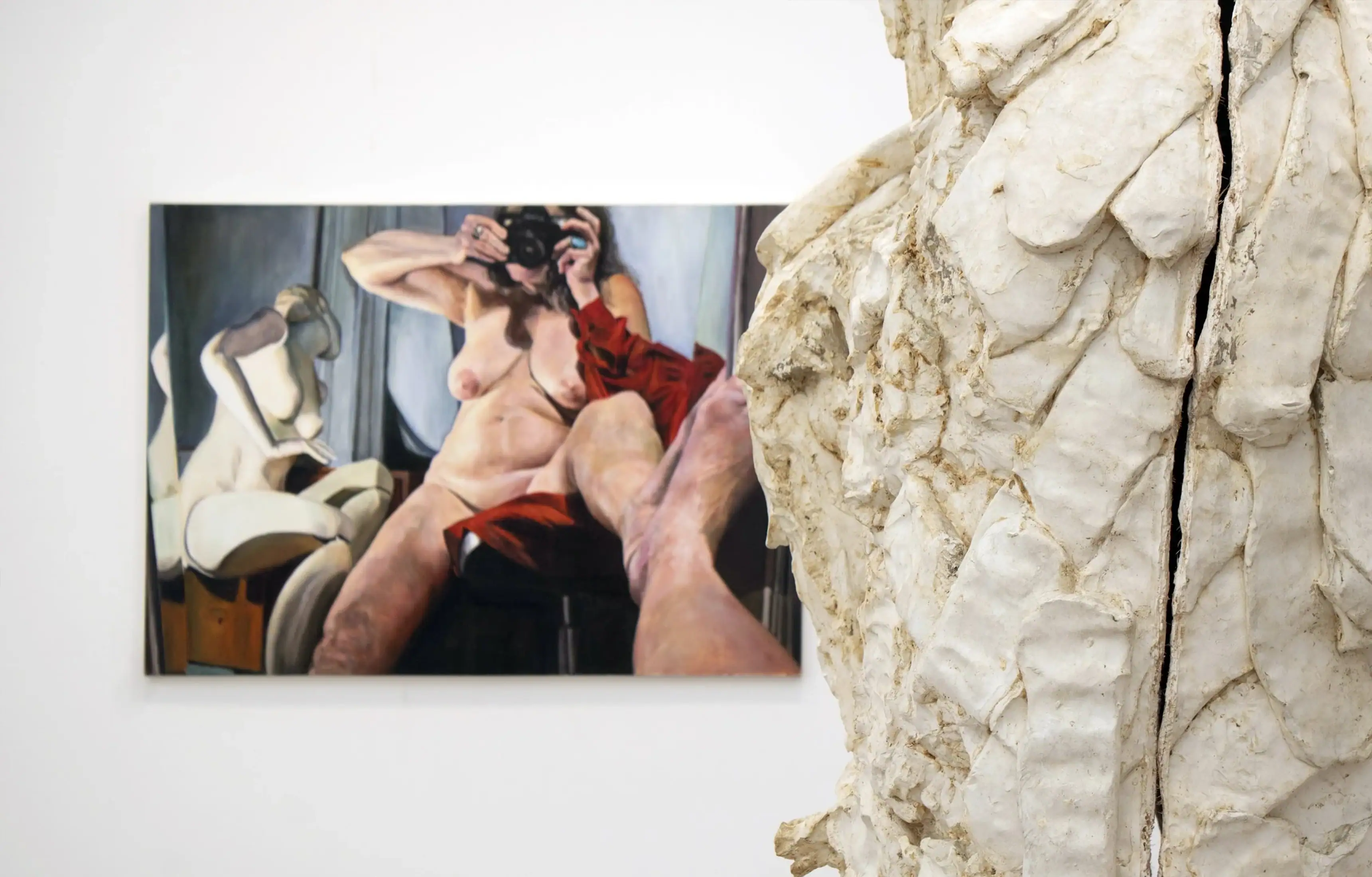
Several stands made their own case for the fair beyond its architecture and headline commission. Lisson Gallery gave the Japanese-Swiss artist Leiko Ikemura her first London solo showcase, presenting tempera and oil paintings on jute alongside sculpture in glass, terracotta and bronze, a rare opportunity to see the full material range of an artist who moves between painting and object-making as a single continuous practice rather than two separate disciplines. At Sadie Coles HQ, the New York-based artist Tau Lewis showed monumental works built from found textiles, transforming salvaged material into pieces addressing agency, resistance and healing within African diasporic communities, sculpture built quite literally from what had already been discarded and lived in once before.


Alexander Gray Associates
PKM Gallery, from Seoul, brought two of Korea’s most closely watched women artists into direct conversation: Koo Jeong A, selected that year to represent the Korean Pavilion at the 2024 Venice Biennale, and Young In Hong, whose work examines equality and social justice through a distinctly material practice. The Modern Institute, the Glasgow gallery founded in 1997, showed new work by Alex Dordoy, Luke Fowler, France-Lise McGurn and Andrew Sim, backed by a gallery roster that has produced four Turner Prize winners and three further nominees, a track record few galleries outside London can match. And Carl Freedman Gallery, based in Margate, showed ceramic work by Lindsey Mendick alongside painting from Billy Childish, Studio Lenca, Navot Miller, Vanessa Raw and Benjamin Studio, plus debut presentations from TM Davy and Laura Footes, one gallery covering an unusually wide span of media and career stage on a single stand.


Galerie Karin Guenther – Hamburg
That last connection is worth drawing out. Carl Freedman Gallery represents Jack O’Brien, shown that year by the London gallery Ginny on Frederick, winner of the 2023 Camden Art Centre Emerging Artist Prize, now in its sixth year. The prize’s reward is a solo exhibition at Camden Art Centre, and O’Brien’s show, The Reward, opened on 4 October 2024, timed deliberately to run through the whole of Frieze week and give the London gallery scene one more reason to keep moving beyond the tent itself.
Elsewhere on the floor, Galerie Gisela Capitain, working from Cologne and Naples since 1986, showed a roster built around major names in international contemporary art from the 1980s onward, including Günther Förg, Charline von Heyl, Zoe Leonard, Albert Oehlen and Christopher Wool. Xavier Hufkels, from Brussels, brought an unusually broad group spanning Lynda Benglis and Louise Bourgeois through to Cassi Namoda and Danh Võ, and Project 88, founded in Mumbai in 2006 under Sree Banerjee Goswami, showed Amol K Patil, Ashwini Bhat, Mahesh Baliga and others working through the shared theme of nature’s materiality against existence itself. Pace Gallery, showing across seven cities worldwide, gave particular attention to new work by Robert Longo and Genesis Belanger.


Lisson Gallery – London, New York, Los Angeles, Beiijing, Shanghai
The funds behind the fair
Several acquisition funds and prizes ran alongside the 2024 edition, supporting exactly the kind of gallery discovery McConkey’s floorplan was built to encourage. The Frieze Tate Fund, supported by Endeavor, ran for a ninth consecutive year with £150,000 committed to acquiring work at the fairs for the Tate collection, a fund that has enabled the acquisition of more than 160 works by over 100 artists since it began. The Spirit Now London Acquisition Prize, worth £40,000 and dedicated to women artists under 40 showing at Frieze London, benefited the Women’s Art Collection at Cambridge, directed by Marie-Laure de Clermont-Tonnerre. The Fluxus-CPGA Prize, in its second year, offered £15,000 split equally between artist and exhibiting gallery, open to French or France-based artists. The Contemporary Art Society’s Collections Fund, in its eighth year, facilitated a 2024 acquisition for the Hepworth Wakefield’s collection, and the Arts Council Collection Fund, in its second year, continued its focus on early and mid-career or historically overlooked UK-based artists.


Sadie Coles HQ – London
Final thoughts
The strongest argument for Frieze London 2024 was never really any single stand, even one as considered as Lawrence Lek’s carebot or as generous as Lisson’s showcase for Leiko Ikemura. It was the floorplan underneath all of it, built by someone who read a book about cities rather than a previous year’s fair map, and who then spent four months and fifty draft layouts making sure the biggest names in the tent would no longer be the first thing a visitor saw. Eva Langret said emerging voices had always been at Frieze’s heart but not necessarily at the heart of the tent. In 2024, McConkey rebuilt the tent until that stopped being true.


Pace Gallery – New York, London, Seoul, Geneva, Hong Kong, Los Angeles, Tokyo
Frieze London’s 2024 floorplan was a curatorial argument about how a fair should be walked. Three years earlier, at Frieze London 2021, the fair’s first physical edition after a year of online-only viewing rooms, the argument was simpler and came from the work itself: gallery after gallery, unprompted, chose presentations that only meant anything in the room, from a boulder held in place by tension alone to clay fired into the shape of a hand. Read side by side, the two editions make the same underlying case from opposite directions, one built by an architect and one built by nothing more than what a room full of galleries chose to bring back to it.
What is Frieze London?
Frieze London is an annual contemporary art fair held in The Regent’s Park each October, showing work by living artists made predominantly since 2000. It runs alongside its sister fair Frieze Masters and the outdoor exhibition Frieze Sculpture.
When did Frieze London 2024 take place?
Frieze London 2024 ran from 9 to 13 October 2024 in The Regent’s Park, London, marking the fair’s 21st edition.
Who designed the Frieze London 2024 floorplan?
The architect Richard McConkey, founder of A Studio Between, led the redesign, drawing on the urban theorist Jane Jacobs to build a floorplan that distributed major galleries throughout the tent rather than clustering them near the entrance.
What was Smoke at Frieze London 2024?
Smoke was a new curated section dedicated to ceramics and clay, curated by Pablo José Ramírez of the Hammer Museum in Los Angeles, focused on artists tracing clay’s aesthetic histories outside Western art history, including several from the Global South.
Who won the Frieze Artist Award in 2024?
Lawrence Lek won the 2024 Frieze Artist Award for Guanyin: Confessions of a Former Carebot, a multimedia installation built around an AI therapist character voicing journal entries and messages to a series of malfunctioning self-driving cars.
How does Frieze London relate to Frieze Masters and Frieze Sculpture?
All three run concurrently each October in and around The Regent’s Park. Frieze London shows contemporary work made mostly since 2000, Frieze Masters shows work from before 2000, and Frieze Sculpture is a free outdoor exhibition linking both fairs in the park’s English Gardens.


Leave a Reply