
ART & CULTURE · LONDON
Reading time: 9 minA blacksmith who spent sixty years in a Treviso forge, and a Mayfair townhouse that spent most of the 2010s fighting to stay a gallery at all. In May 2025, London Craft Week put the two in the same room. Frieze No.9 Cork Street is built for four-week gallery residencies, not four-day festival takeovers, and the difference is exactly what made Béton Brut’s show worth seeing.
Frieze No.9 Cork Street is easy to describe and easy to miss the point of. It is a permanent exhibition space in Mayfair, two converted townhouses over three floors, run by Frieze and let out to international galleries on rotating residencies. It opened in October 2021. None of that explains why, for four days in May 2025, its ground floor held ironwork mirrors made by a craftsman who died five years earlier alongside furniture by three living designers, or why that combination said more about the building than most of what has shown there since.
The occasion was London Craft Week, the citywide festival founded in 2015 that turns workshops, galleries and showrooms across London into a week of open doors. The gallery, Béton Brut, brought a show called Forge to Fold: Hands at Work From Iron to Paper, built around its newly announced representation of the estate of the Italian metalworker Salvino Marsura.
The straightforward version of this story is a listing: dates, a venue, a set of names. The more useful one is about what a purpose-built exhibition space does with a week-long brief it was not designed for, and about the decade of Mayfair property history that had to happen first for that space to exist at all.


What Frieze No.9 Cork Street actually is
No.9 Cork Street occupies two adjoining Mayfair townhouses that keep their nineteenth-century street facades. Behind those facades, before Frieze took the building on, was a modern office fit-out with none of the qualities a gallery needs. The architect Jason Whiteley, of Matheson Whiteley, led the conversion with project architect James Bailey, working within the shell to build spaces that could hold, in his own description, a very wide range of artworks without any of them feeling like a compromise.
Whiteley has talked about wanting the finished rooms to feel as if they had always been there rather than freshly built, and he named a specific historical reference for that instinct: Peggy Guggenheim’s Guggenheim Jeune, which operated a few doors down on Cork Street for a matter of months in 1938. It is a telling choice of precedent. Guggenheim Jeune was brief, private and highly specific to the person running it, which is close to what No.9 Cork Street’s residency model asks of every gallery that takes the space: four weeks to make the rooms answer to your own programme, then hand them on.
Frieze developed the building with the Pollen Estate, which owns the freehold, and opened it in October 2021 as the organisation’s first permanent exhibition space, distinct from the tented fairs it runs each October in Regent’s Park. A gallery applying to show there gets fully fitted rooms, private viewing space and Frieze’s own visibility, for a fee scaled down for emerging exhibitors. It is, in effect, London gallery infrastructure that a smaller gallery could not build for itself, made available in short lets.


The decade that had to happen first
The reason there was a building to convert in 2021 is a story that rarely gets attached to what shows inside it now. By 2012, Cork Street’s roll call of galleries, once home to the first London shows of Francis Bacon, Max Ernst and Joan Miro, and to Peggy Guggenheim’s brief tenancy, had thinned to around twenty, and a redevelopment proposal put the street’s identity as an art district in question. The Save Cork Street campaign, backed by more than 13,000 signatures and by artists including David Hockney and Sir Peter Blake, petitioned Westminster Council to guarantee that whatever got built would still be gallery space.
It worked. The Pollen Estate’s subsequent rebuild, carried out over three years across roughly 60 per cent of the street’s frontage, delivered around 43,000 square feet of purpose-built gallery space, more than double what had stood there before. No.9 Cork Street is one product of that rebuild, and Frieze’s tenancy there is a direct continuation of the argument the campaign made: that the street’s value was as working gallery space, not as whatever else Mayfair property might have become.
That lineage is the fact a listing of May’s opening times will never carry. A blacksmith’s mirrors could hang in Mayfair in 2025 because a group of artists and 13,000 signatories spent 2012 insisting the rooms stay galleries rather than something else. Nobody at the private view needed to know that. It is, all the same, the reason the room was there to book.


London Craft Week, and what it actually covers
London Craft Week was founded in 2015 by Guy Salter, and it runs on a different model to a trade fair: rather than filling one venue, it opens the doors of workshops, ateliers, galleries and shops that already exist across the city, for one week each May. The current edition covers roughly a thousand makers, designers, brands and galleries, with a programme of tours, talks, demonstrations, open studios, exhibitions and markets running well past 200 events. The inaugural edition, held in Bloomsbury in February 2015, was attended by the then Prince of Wales, who took part in a printing press demonstration; the festival has run every May since.
The format explains why a permanent art gallery like No.9 Cork Street can appear on the same programme as a silversmith’s workshop or a bookbindery. London Craft Week is not a curated selection made by its own organisers. It is a week in which existing spaces choose to open with craft-specific programming, and a Frieze gallery hosting a metalworker’s estate for four days is exactly the kind of participation the format was built to hold.
What Béton Brut actually brought to Cork Street
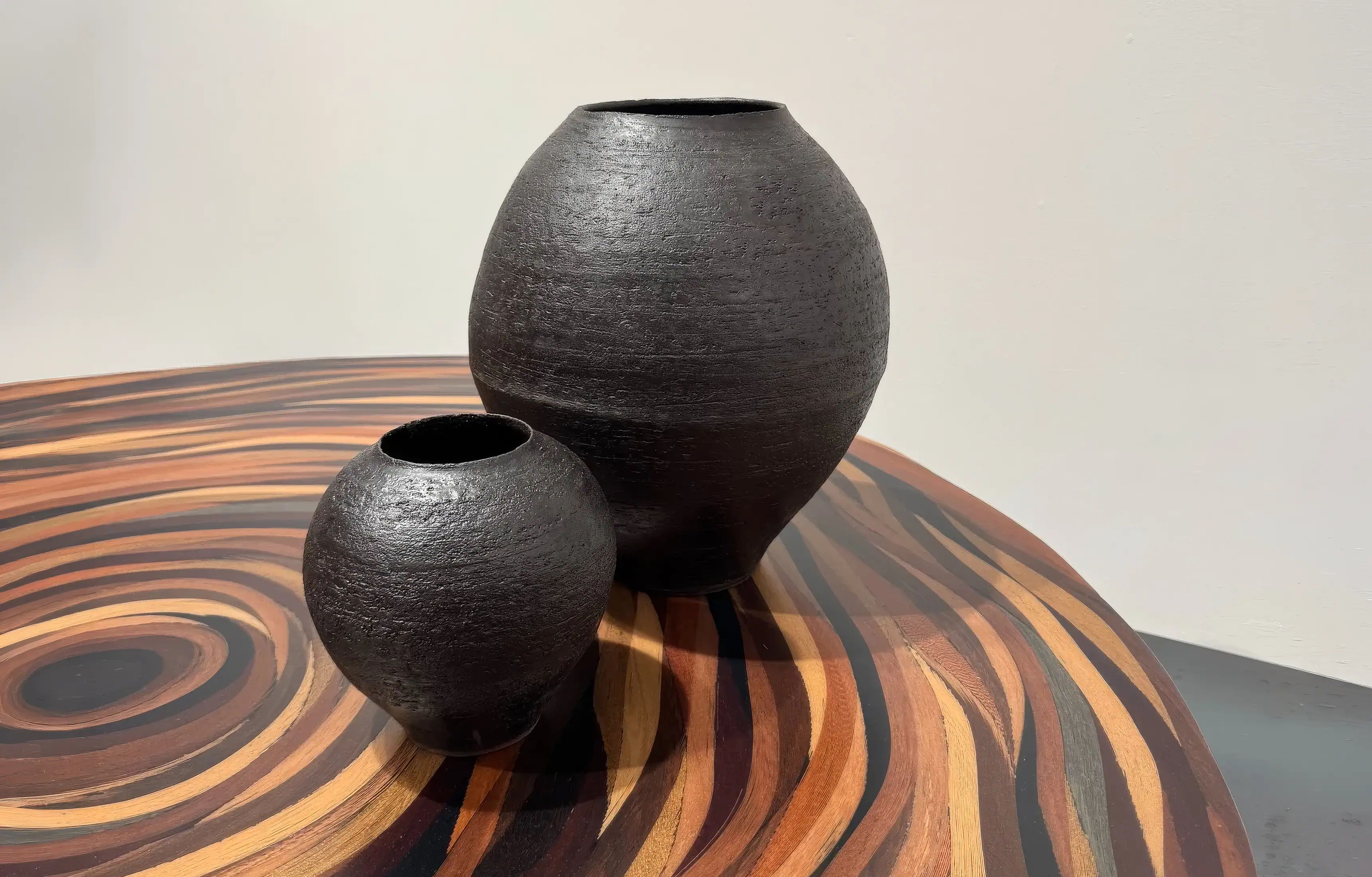
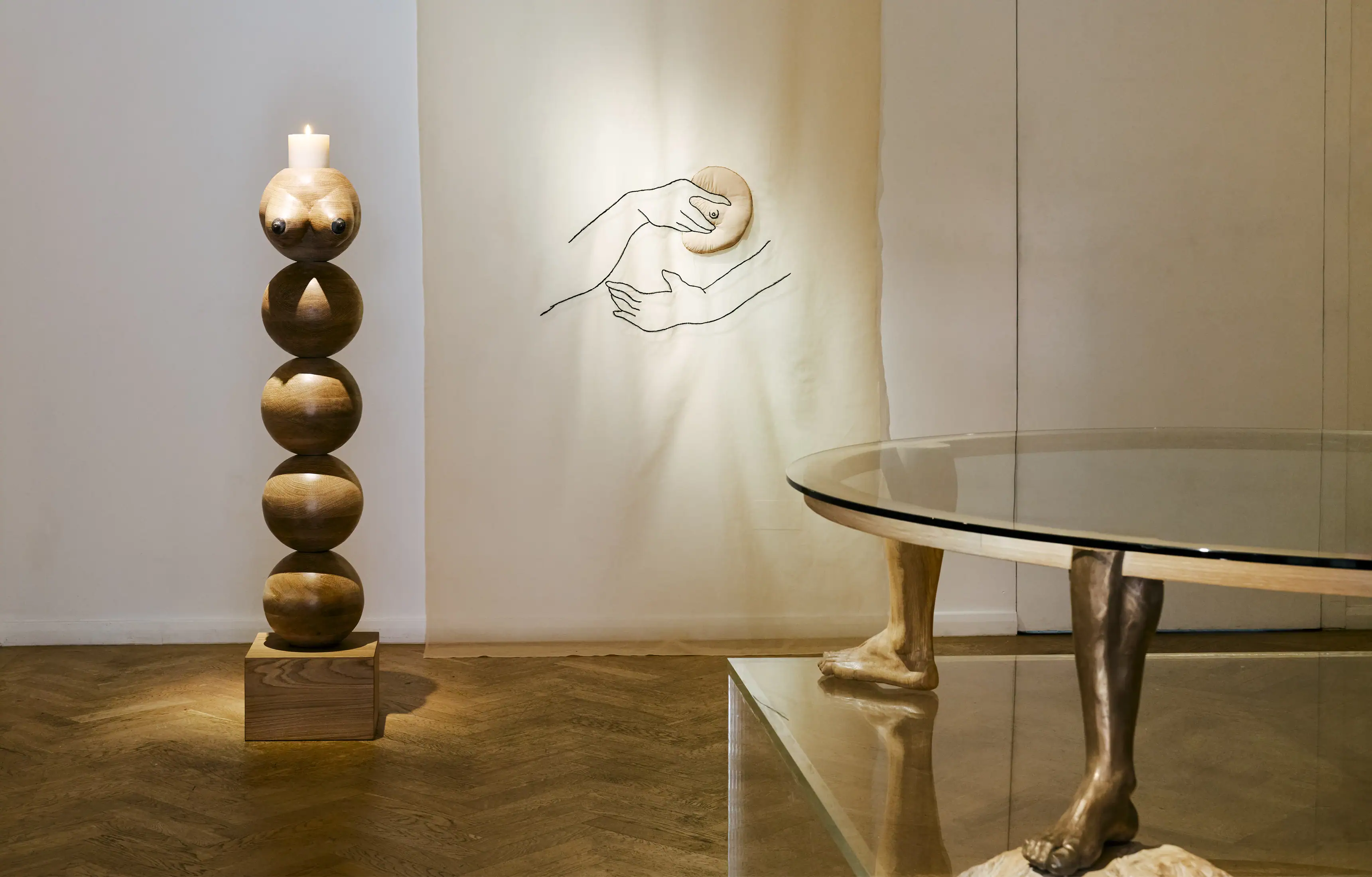
Béton Brut, the design gallery founded in 2013 by Sophie Pearce, took the ground floor at No.9 Cork Street from 14 to 17 May 2025, with a private view on the evening of 15 May. Forge to Fold: Hands at Work From Iron to Paper was built around two contrasting kinds of making: forged ironwork mirrors and sculptural pieces from the estate of Salvino Marsura, and new furniture from three living designers working in entirely different registers.
David Horan showed furniture built with Japanese heritage papers, extending the technique into pieces meant to be lived with rather than handled as objects behind rope. Archive for Space, the practice run by Arabella Maza and Stephen Maginn, presented a series in aluminium. Grace Prince showed hand-patinated bronze and steam-bent wood pieces developed during time spent in Kyoto. None of the three designers was working in Marsura’s material or his period, and the show did not ask them to. It set contemporary furniture-making against a body of work made mostly by hand in one Italian workshop across six decades, and let the room’s domestic scale, three floors of a converted townhouse rather than a trade-fair booth, do the work of making that comparison feel like a room rather than a survey.


Salvino Marsura, the maker behind the mirrors
Salvino Marsura worked as a metalworker in Treviso, in the Veneto region of northern Italy, from the 1950s until his death in 2020, having trained in the workshop of the sculptor Toni Benetton. His method stayed close to the forge throughout: heating, hammering, bending and welding iron by hand, building mirrors, furniture, sculpture and memorial pieces that combined a raw, brutalist surface with the proportion and finish of decorative art. Béton Brut announced its representation of his estate in 2025 and has committed to three years of exhibitions built around it, of which the Cork Street show was the first London outing.
The choice to introduce that estate through a group show rather than a solo retrospective is worth noting. It let Marsura’s mirrors be judged as objects a room could actually use, next to furniture other people were making that same year, rather than presented as a historical statement before an audience had a chance to place him.
One estate, three cities, one year
The Cork Street show was not an isolated booking. Across 2025, Béton Brut moved Marsura’s estate through three distinct events, each asking something different of the work. In April, at Milan Design Week, the gallery showed his pieces twice over: in Apertura 01 with the design platform Tutto Bene, and as monumental sculpture at Alcova’s Villa Borsani. In May, London Craft Week put a smaller, mixed selection into a Mayfair gallery alongside three contemporary furniture makers. In October, for London Design Festival and to mark ten years of Béton Brut’s Hackney Wick space, the gallery opened Unbound, its first full retrospective of Marsura’s work, spanning the six decades of his career and drawing on previously unseen pieces from the Treviso forge.
Read in sequence, the year traces a deliberate widening: monumental sculpture in an architectural setting, then a domestic-scale showing next to living designers, then a full retrospective on the gallery’s own ground. Frieze No.9 Cork Street’s contribution was the middle step, the one where Marsura’s work had to hold its own in company rather than stand alone, and the one built entirely around the fact that a room existed in central London that a small gallery could book for four days without owning it for four years.


A residency space, run as a festival week
No.9 Cork Street’s ordinary rhythm is the four-week residency: a gallery applies, gets the fitted rooms and the visibility that comes with Frieze’s name attached, and builds a full show around that stretch of time. Four days is a different proposition entirely, closer to what a festival like London Craft Week asks of any venue on its list: open the doors, put the work up properly, and let the week’s foot traffic do what a longer run usually has to build for itself.
That compression is where the building’s design argument actually shows. A townhouse room built to feel, in Whiteley’s own phrase, as if it had always been there lets a dead craftsman’s ironwork sit next to three living designers’ furniture without either side needing to shout, because the room already reads as a place where things are lived with rather than merely displayed. That quality is harder to deliver in four days than across four weeks, and it is the reason Forge to Fold read as a considered show rather than a quick turnaround.
What is Frieze No.9 Cork Street?
It is Frieze’s permanent exhibition space in Mayfair, London, occupying two converted townhouses over three floors. It opened in October 2021 and is let to international galleries on rotating residencies, distinct from the Frieze London and Frieze Masters fairs held each October in Regent’s Park.
What did Béton Brut show at No.9 Cork Street for London Craft Week?
Béton Brut presented Forge to Fold: Hands at Work From Iron to Paper from 14 to 17 May 2025, showing forged ironwork mirrors and sculpture from the estate of Salvino Marsura alongside new furniture by David Horan, Archive for Space, and Grace Prince.
Who was Salvino Marsura?
Salvino Marsura, active from the 1950s until his death in 2020, was an Italian metalworker based in Treviso, trained in the workshop of the sculptor Toni Benetton. He worked in forged iron across six decades, making mirrors, furniture, sculpture and memorial pieces.
Who designed No.9 Cork Street?
The architecture studio Matheson Whiteley, led by Jason Whiteley with project architect James Bailey, converted the building’s modern office interior into gallery space behind its nineteenth-century Cork Street facade.
What is London Craft Week?
London Craft Week is a citywide festival founded in 2015 by Guy Salter, held annually in May. It opens workshops, galleries, ateliers and shops across London for a week of demonstrations, talks, open studios and exhibitions rather than gathering exhibitors under one roof.
When is London Craft Week held?
London Craft Week runs annually in May. The 2025 edition, during which Béton Brut’s show took place, ran in the second half of the month; the 2026 edition ran from 11 to 17 May.
How is No.9 Cork Street different from Frieze London and Frieze Masters?
Frieze London and Frieze Masters are tented fairs held for five days each October in Regent’s Park. No.9 Cork Street is a permanent, year-round Mayfair building that hosts changing gallery residencies throughout the year, unconnected to the October fair dates.
Why does Cork Street matter as a location for this kind of show?
Cork Street has been a Mayfair gallery address since the Mayor Gallery opened there in 1925, hosting early London shows by Francis Bacon and Joan Miro among others. A 2012 campaign to save the street’s gallery identity from redevelopment led directly to the rebuilt gallery space that Frieze later took for No.9 Cork Street.
Final thoughts
It would be simple enough to file this as a craft listing: a gallery, a week, some names. What is actually interesting is what the building was asked to do with the week it was given, and what had to happen for the building to exist at all.
Frieze No.9 Cork Street is built around the assumption that a gallery gets four weeks to make a room its own. London Craft Week gave Béton Brut four days, and the show that resulted, a blacksmith’s estate introduced through the company it kept rather than a solo statement, worked because the room itself had been built to carry that kind of company without strain. That is Jason Whiteley’s design argument, tested by a shorter brief than the one he actually designed for.
None of it happens without the decade before it: a street nearly lost to redevelopment, a campaign that insisted the replacement stay galleries, and a rebuilt block of Mayfair frontage that a permanent art fair space could eventually take a lease on. Salvino Marsura’s mirrors spent 2025 travelling from a Milan villa to a Mayfair townhouse to a full retrospective in Hackney Wick. The middle stop is the one that depended on the most history to exist, and it is the one that gets remembered as four days in May.

Leave a Reply