Exhibition · London
Reading time: 11 minLukas Wegwerth trained as a cabinet maker. Corinna Dehn trained as a fashion designer and spent years at Y-3. Every object in their exhibition on Hay Hill is made the way that pairing suggests: he builds the body, she cuts and colours the coat that goes over it.
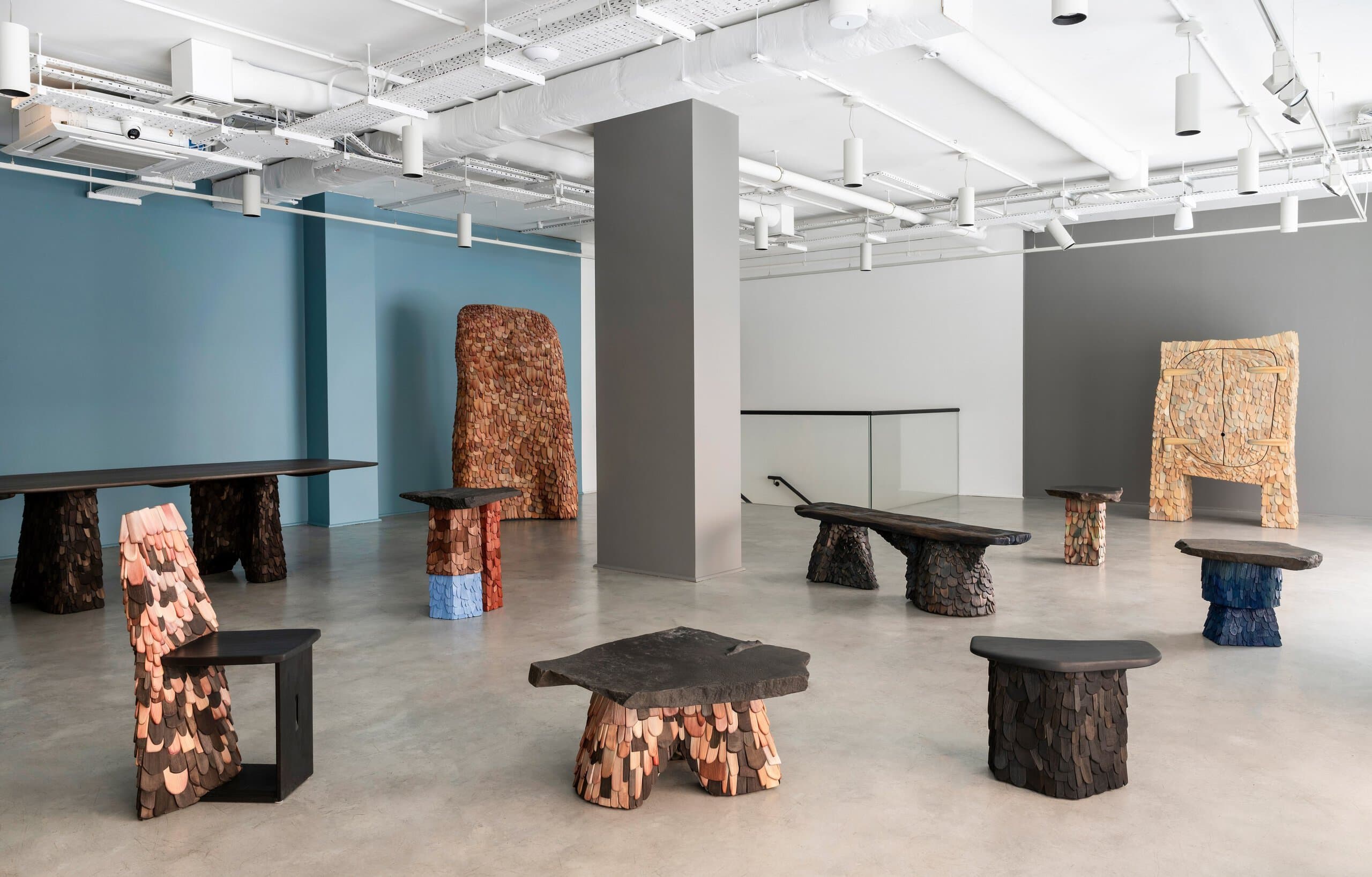
Companions at Gallery FUMI is the first UK exhibition by Lukas Wegwerth and Corinna Dehn, and it runs at the gallery’s Mayfair rooms on Hay Hill until 21 November 2026. The floor holds cabinets, a chair, a sideboard, a dining table, stools, a coffee table and a birdhouse, every one of them clad in wooden shingles.
The shingles are what you see first, and they repay a close look. Each one is cut, shaped, sanded and coloured individually by hand before it goes on, and a large cabinet takes ten to twelve weeks from start to finish. Depending on the colour and the angle of the light the surfaces read as scales, as feathers or as bark, which is where the Armadillo series takes its name.
What a photograph will not tell you is that each object has two authors doing two completely different jobs, and that those two jobs line up exactly with two different trainings.

Two trainings, and two halves of every object
Wegwerth was born in 1984 in Ilbeshausen, a village in the Vogelsberg, the volcanic upland in central Hesse. He trained as a cabinet maker before going on to study product design at the University of the Arts in Berlin. Dehn studied fashion design and worked for years in the industry, latterly as a senior designer at Y-3, collaborating with Yohji Yamamoto’s design team on menswear and accessories. She has since taught design workshops inside a Berlin youth prison. The two met while studying in Berlin.

In the studio the work divides along that line and stays there. Wegwerth builds the substructure and the interior joinery, then clads it from the bottom up. Dehn cuts, shapes, sands and pigments every single shingle that goes onto it. They settle each piece together first, through long conversations and prototypes, and then they separate.


Every shingle is cut, shaped and coloured individually before the coat is built up from the bottom. Photos by Sandra Gramm, courtesy of Lukas Wegwerth. Photography by Moritz Wegwerth, courtesy of Gallery FUMI.
That is a division of labour borrowed from tailoring rather than from furniture making. A carcass and a covering, designed as one thing and then made by two people with different hands. It explains why the inside of an Armadillo cabinet looks nothing like the outside: open the doors and you find plain pale shelves and clean joinery, the work of somebody who was taught to make a box properly. Everything expressive is on the skin.

Wegwerth is direct about how loosely the form is held at the start. “I start without a plan, I use almost no machines, and the shape develops over time,” he says. A garment maker would recognise that too.
In the Vogelsberg, a shingle was never a roof
The shingle is doing something here that is closer to its original job than it looks, and the Vogelsberg is the reason why.
The region’s traditional building is the Vogelsberger Einhaus, an eighteenth and nineteenth century farmhouse that puts living quarters, stable and barn under one long roof. The timber frame stands on a plinth of basalt, which lies close to the surface across the region. Roofs were thatched, then covered in hollow clay tiles from around 1800, and in factory tiles once the railway arrived. The shingles went on the walls. Small beech or larch shingles covered the weather-facing elevations and the ground floor, and were set around the windows.
So in the tradition Wegwerth grew up inside, a shingle is not roofing. It is a coat, fixed to the windward side of a building, and its whole purpose is to be worn away by the weather over decades so that the frame behind it is not. He grew up in a farmhouse clad in beech shingles. “Wood as a material and the forests I grew up surrounded by always shaped my design works,” he says.

Dehn has noticed something else about those walls. Behind every shingle there is a small pocket of rain shadow, and wild bees move into them. A shingled elevation is not only a coat. It is also, quietly, occupied.
The coat has to describe the form
On a building, shingle courses are regular. The wall is flat, the job is shedding water, and uniformity is the efficient answer. On these objects the courses are not regular at all, and that is the most interesting design decision in the room.
The shingles change shape and size across a single piece. Tighter curves take slimmer shingles, and the thickness of the coat adapts to the complexity of the form underneath. Where a cabinet swells, the courses open out. Where it turns hard, they tighten and the pieces shrink.


Tighter curves take slimmer shingles, and the courses close up where the surface turns hardest. Photography by Moritz Wegwerth, courtesy of Gallery FUMI.
Read that way, the coat is doing the job a contour line does on a map. The density of the courses tells you how fast the surface is turning, so you can see the body through its covering without ever being shown it. That is why the curved pieces hold the eye longer than the flat ones, and it is a drawing decision as much as a cladding one.

“Using shingles to build protective skins is a natural strategy that can be found in numerous life forms,” Wegwerth says, and the armadillo of the title is the obvious reference. Fish scales and butterfly wings are the others. All three solve the same problem, which is how to be covered and still be able to move.
Wood that already had a job
Almost nothing here is new material.
The shingles come off barns, off houses several hundred years old, and off objects that were built for some other purpose entirely. Some of them are around a century old before they are cut down into a new shape. Beech came from the renovation of the couple’s own buildings, oak from repairs to a timber frame, and a quantity of larch was left over from an architectural project. Another batch had been sitting stacked in the attic of their barn.
The stone follows the same logic. The dark tops on the stools and the low tables are basalt, picked up from the collection points where Vogelsberg farmers leave the stones they clear off their fields. It is the same rock the old farmhouses sit on, arriving by the least glamorous route available.

All of it is processed through the couple’s own sawmill. They work between two studios, one in Berlin and one in the Vogelsberg, and which building a piece is made in depends largely on the season. For anyone who followed Byron Pritchard taking a single slab of sycamore apart with hand tools, this is a very similar relationship between a maker and one material, worked at a different scale.
Colour that is a reaction rather than a coating
The palettes run from bleached pinks and ochres through to deep reds, blues and near blacks, and the way they are arrived at matters.
Dehn works with natural pigments, linseed oil paints and traditional oil paints from the region, laid on as gradients rather than as flat colour. The darkest tones are not painted on at all. They come from ebonising, which she describes as a matter of tannin, rust and lime, and which produces blacks, dark greens and dark browns depending on the wood.


Pigment laid on as a gradient, and ebonised blues running down into near black. Photography by Moritz Wegwerth, courtesy of Gallery FUMI.
The distinction is worth holding on to. Ebonising is a reaction that happens inside the timber rather than a layer sitting on top of it, so the grain comes back up through the colour instead of disappearing under it. Hold a black shingle next to a pale one and they still read as the same substance in different weather, rather than as painted and unpainted wood.
It also means the colour is not fully specified in advance. A batch of shingles cut from one building will take the treatment differently from a batch cut from another, which is a large part of why the surfaces have the unevenness they do.

What is in the room
The new pieces are a tall curving cabinet, a lower arched cabinet on legs, a chair, a sideboard, a dining table, stools, a coffee table and a birdhouse, shown alongside earlier work from the series.
The dining table is the clearest demonstration of the two-handed method: a long dark top, almost severe, carried on two shingled trestles that look like something that walked in. The sideboard is the loudest thing in the gallery, a bright red arch whose shingles turn from scarlet to rust as the form bends. The stools are the ones that show the colour thinking most plainly, with a red upper body running down into blue.

Dehn’s description of the tall cabinet is the best summary anyone has offered of the whole series. “A very gentle, friendly monster,” she calls it.


Armadillo stool and Armadillo chair, both 2026. Photography by Moritz Wegwerth, courtesy of Gallery FUMI.
The work has been arriving in steps. A cabinet and a standing screen in 2023, a bench and a piano stool in 2024, a wall shelf and a hope chest in 2025, and this year’s group. Two of the new pieces were seen briefly at PAD London in October, on Berkeley Square, before the gallery show opened.
Thirteen years at Gallery FUMI, and the thread back to the crystals
Gallery FUMI was founded in 2008 by Sam Pratt and Valerio Capo, and it built its reputation by backing people early. Max Lamb showed with them in 2008 while he was still a student. The roster now runs to around twenty-eight artists and designers, and recent shows in the same Hay Hill rooms have included Casa al Mare and Kobina Adusah’s Inherited Beings.
Wegwerth has been with the gallery for roughly thirteen years, and the work that started the relationship was Crystallizations: broken and cracked ceramic vessels repaired by growing salt crystals into the fractures, after the Japanese practice of kintsugi, which mends pottery with lacquer and gold rather than hiding the break. The National Gallery of Victoria in Melbourne acquired two of them.

Put the crystals and the shingles side by side and the same person is clearly at work. Both are repairs that add something rather than conceal something. Both take a material that had been written off and give it a second structural life. And both are processes he sets going and then decides when to stop, which is the opposite of drawing an object and then making it.
Why they are called Companions
The title is doing more work than it first appears.
A shell, a set of scales, a wing: these are coverings that belong to something living, and the pieces have been placed around the gallery floor at different heights rather than lined up, so that walking between them feels like moving through a group rather than past a display. The birdhouse makes the point explicitly. It is a shingled cone on a slab of basalt with a forked branch rising out of it, which is to say a coat made for an animal, by two people who have spent three years making coats for furniture.

And there is the older sense of the word. A companion is the thing that stays closest to you, which is as good a description of a coat as anyone has managed.
Frequently asked questions
What is Companions at Gallery FUMI?
An exhibition of new furniture by Lukas Wegwerth and Corinna Dehn, their first in the UK. It runs from 6 October to 21 November 2026 at Gallery FUMI, 2 to 3 Hay Hill, London W1J 6AS, and shows new work from the Armadillo series alongside earlier pieces.
Who are Lukas Wegwerth and Corinna Dehn?
Wegwerth was born in 1984 in the Vogelsberg region of Hesse, trained as a cabinet maker and studied product design at the University of the Arts in Berlin. Dehn studied fashion design and was a senior designer at Y-3, working with Yohji Yamamoto’s design team. They met while studying in Berlin and work between studios there and in the Vogelsberg.
What is the Armadillo series made from?
Reclaimed wooden shingles, mostly beech, oak and larch, taken from barns, houses several hundred years old and former functional objects. Some of the shingles are around a century old. The darker tops are basalt, collected from stones cleared off Vogelsberg fields. The couple process the timber in their own sawmill.
How are the shingles coloured?
By hand, one at a time, using natural pigments, linseed oil paints and traditional regional oil paints applied as gradients. The blacks, dark greens and dark browns come from ebonising, which Corinna Dehn describes as a reaction involving tannin, rust and lime, so the colour forms in the wood rather than sitting on top of it.
How long does one piece take to make?
A large cabinet takes ten to twelve weeks. Lukas Wegwerth builds the substructure and the interior joinery and clads it from the bottom up, while Corinna Dehn cuts, shapes, sands and pigments every shingle individually.
What else has Lukas Wegwerth made?
He is best known for Crystallizations, a series of broken ceramic vessels repaired by growing salt crystals into the cracks, which began his thirteen year relationship with Gallery FUMI. The National Gallery of Victoria in Melbourne holds two of them. He has also made the Blankenau series, which uses branch forks in their natural form.
Final thoughts
The ordinary fate of a shingle is to be used up. It sits on the weather side of a building and wears down over decades precisely so that the frame behind it does not have to, and then somebody replaces it. What Wegwerth and Dehn have done is take that material at the end of one life and put it on the outside of an object where it will now be looked after rather than left out in the rain.
The reason it holds together as design, rather than as a good idea about reuse, is the division of labour. One person who knows how to build a sound carcass, one person who knows how to cut and colour a covering, and a shared decision about the shape before either of them starts. A fashion training and a cabinet making apprenticeship turn out to meet very neatly on a curved cabinet door.
Companions runs until 21 November 2026 at Gallery FUMI, 2 to 3 Hay Hill, London W1J 6AS.
Project Credits
Go further from here
Read next
Seventeen artists have each made a decoration for the tree at Ruup and Form. Set the show against the gallery's own exhibition year and it turns into a group portrait,…
London