
ART & CULTURE · LONDON
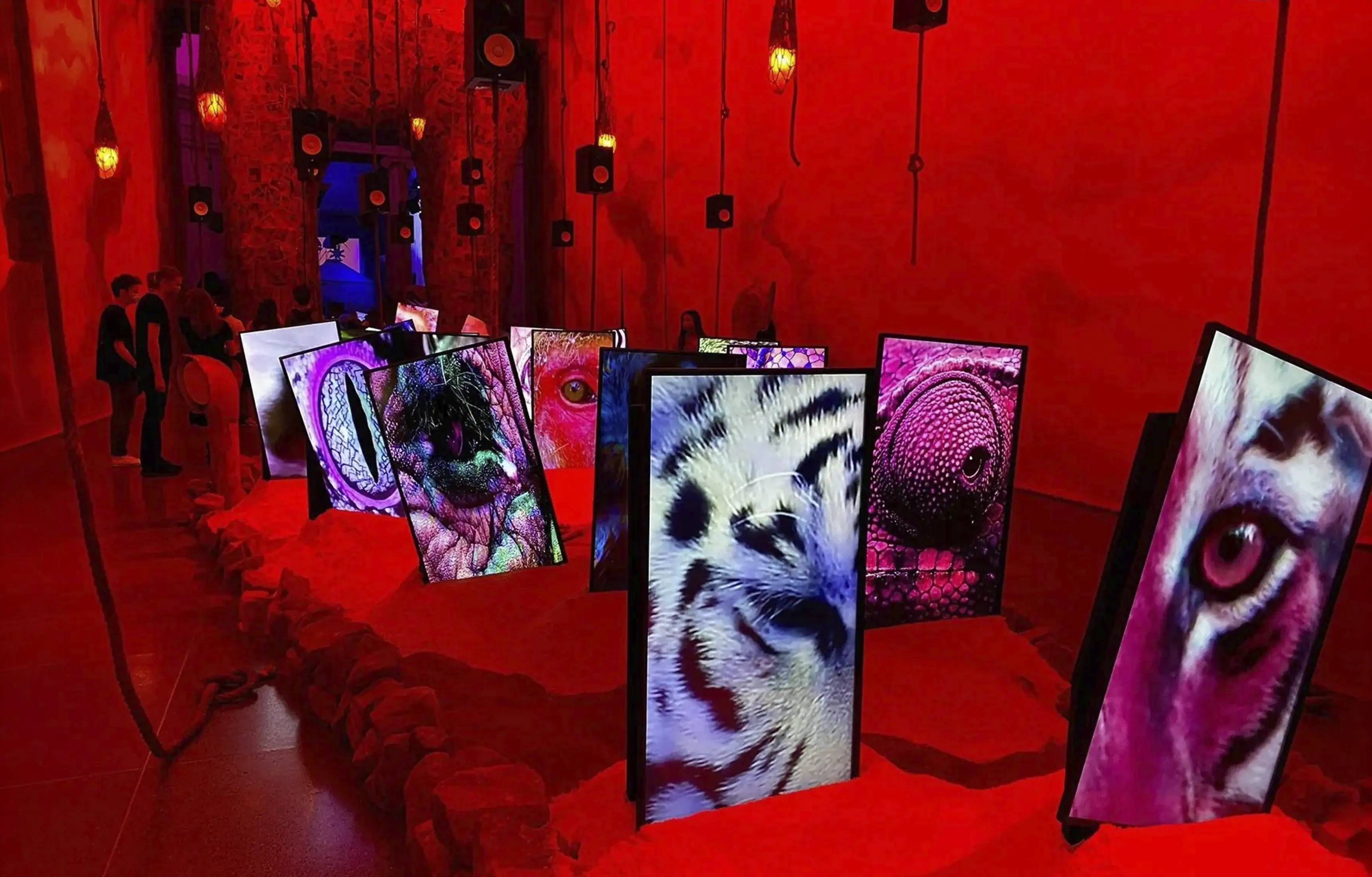
Reading time: 9 minSalt piled into mountains, bisected aircraft fuel tanks, gas canisters mounted to rotate, and roof vents that seem to breathe. For her Tate Britain commission, Heather Phillipson filled the neoclassical Duveen Galleries with a landscape that belongs to no recognisable era, built from the same vocabulary of oversized, uncanny matter she had used a year earlier on the Fourth Plinth. The two works, made in successive years for Britain’s two most visible open-access commissions, argue the same case from opposite ends of London.
Tate Britain’s Duveen Galleries are not a gentle room to fill. They run in a single processional line through the centre of the building, lit from above by a coffered barrel vault, floored in stone, and scaled for the nineteenth and early twentieth century marble figures they were built to hold. Every artist given the annual commission has to decide what to do with that scale and that history in one move, because the galleries do not really allow for a quiet intervention tucked into a corner.
Heather Phillipson’s answer, unveiled in May 2021, was to remake the space almost entirely: a floor-to-vault environment of salvaged industrial parts, hand-built sculpture, video and sound that she titled Rupture No. 1: blowtorching the bitten peach. It was the Tate Britain Commission for that year, delivered into a building whose grandest architectural gesture is a straight line of Portland stone and classical proportion, and it did not defer to either.
This is a piece that rewards being read as part of a longer sequence in Phillipson’s own work, not as a single stand-alone spectacle. The year before, she had already reshaped how several million people a year encounter public sculpture in London, on the Fourth Plinth in Trafalgar Square. The year after, she was shortlisted for the Turner Prize. Rupture No. 1 sits at the centre of that run, and understanding what it is doing means understanding what came immediately either side of it.

A parallel planet under a neoclassical roof
Walking into the Duveen Galleries during the commission meant walking into tinted light and an unfamiliar floor plan. Phillipson worked across the full length of the galleries rather than staging a single object at their centre, so the piece functioned less like a sculpture placed in a room and more like a terrain the visitor had to move through. She has described the resulting environment as pre post historic: not a reconstruction of any known past and not a projection of a specific future, but a landscape that could plausibly be either, assembled from material that reads as both ancient and mechanical.
The elements that built that terrain were physical and heavy. Salt was piled into drifts across the stone floor, the kind of substance that reads simultaneously as geological, culinary and preserving. Aircraft fuel tanks were cut in half and repositioned as vessels and thresholds, their industrial curvature at odds with the classical curves of the architecture around them. Gas canisters, the mobile cylindrical kind more familiar from a building site than a gallery, were mounted so that they rotated slowly, and the roof vents Phillipson introduced changed shape as visitors passed beneath them, giving the ceiling a low, mechanical pulse that the original Edwardian design never had. Large papier-mâché forms and hand-painted scenes sat alongside this salvaged hardware, so that the handmade and the industrial occupied the same visual register rather than being kept apart.
Video and sound ran through the whole length of the space, layered rather than isolated to a single screen, so that the audio followed a visitor from one end of the galleries to the other. The effect Phillipson has spoken of wanting to produce is disorientation, specifically the kind that only becomes apparent on the way out, when the ordinary scale and quiet of the rest of the museum reasserts itself. That is a deliberate design outcome, not an accident of scale: the piece is built to make the visitor briefly forget which century, and which kind of matter, they are standing in.

From poetry to public sculpture
Phillipson’s route to the Duveen Galleries did not run through sculpture in any conventional sense. She trained and continued to work as a poet alongside her visual practice, publishing collections such as Instant-flex 718, and that background shows in how her installations are built: as accumulations of image and object that behave more like a poem’s line breaks than a single composed scene, each element interrupting the one before it rather than resolving into it.
Her video and sculptural work through the 2010s, shown at venues including the Whitechapel Gallery, the Zabludowicz Collection and the South London Gallery, established the vocabulary she would later scale up for Trafalgar Square and Millbank: everyday and biological imagery, much of it drawn from eyes, food and bodily processes, rendered at a size and intensity that makes it strange again. She has spoken of her works as thought experiments rather than statements, built to test what happens when a familiar image or system is pushed past the point where it still makes ordinary sense.
That is the same instinct that produced Rupture No. 1. Both the video pieces that built her reputation and the room-sized commission at Tate Britain work by taking something recognisable, in this case machinery, salt, and the classical gallery itself, and holding it just long enough past the point of recognition that a viewer has to look again.

Two plinths, one argument, two successive years
The clearest way to understand Rupture No. 1 is against the work Phillipson made immediately before it. In 2020, she became the artist behind THE END, the thirteenth Fourth Plinth commission in Trafalgar Square: a swirl of whipped cream, several metres high, topped with a cherry, a fly and a drone that periodically broadcast a live feed of the square back to the public. It stood through 2020 and into 2022, on a plinth that had previously carried work by Marc Quinn, Katharina Fritsch and Michael Rakowitz, in the single most photographed public art site in the country.
Read together, THE END and Rupture No. 1 are the same argument made twice, in successive years, on Britain’s two highest-profile open-access commissions. Both take an object that reads as edible, comforting or ordinary (a peach, a swirl of cream) and inflate it until its scale and material start to say something closer to warning than comfort. Both introduce a mechanical or living intrusion that punctures the illusion of stillness: a drone and a fly on the plinth, rotating canisters and shapeshifting vents in the galleries. And both were built for spaces that carry serious institutional weight, a national square and a neoclassical museum, which is precisely why placing something this strange inside them registers as forcefully as it does.
The sequence did not stop there. In 2022, the year after Rupture No. 1 closed, Phillipson was shortlisted for the Turner Prize, alongside Ingrid Pollard, Veronica Ryan and Sin Wai Kin, with the exhibition staged at Tate Liverpool. Three consecutive years, two of Britain’s most visible commissions and its most prominent art prize, is not a coincidence of scheduling. It is a single practice being recognised at national scale in immediate succession, and it means Rupture No. 1 should be read not as an isolated Tate Britain event but as the middle chapter of the strongest run any British artist working in this territory had at the time.

A commission with its own history of disruption
The Duveen Galleries have hosted an annual commission since the early 2000s, and the artists chosen for it have consistently used the space to argue against its own architecture rather than complement it. Martin Creed sent athletes sprinting the full length of the galleries. Fiona Banner suspended a decommissioned Harrier jet and a Jaguar fighter nose to tail down the same processional axis in 2010. Pablo Bronstein and Cerith Wyn Evans later filled the space with choreographed movement and cascading neon. Mike Nelson, in 2019, packed the galleries with salvaged machinery pulled from closing British factories, engineering plant standing where marble figures once stood.
Phillipson’s commission belongs squarely inside that lineage of using salvage and disruption against a room built for permanence and order, but her material vocabulary (biological, papier-mâché, sound-led) is distinct from the engineering language Nelson had used two years earlier. Where his galleries read as an elegy for industrial Britain, hers read as a speculative ecosystem, closer to a planet than a factory floor. The two commissions, seen back to back, show how differently two artists can use exactly the same architectural provocation and arrive at entirely different arguments. That provocation is the long stone nave built by the American architect John Russell Pope in 1937 for Lord Duveen’s donation.

The bitten peach as the piece’s real title
The working part of the title, blowtorching the bitten peach, is where Phillipson states her actual subject. A peach that has already been bitten is evidence of contact and consumption, not an untouched object waiting to be admired. Adding a blowtorch to it pushes that evidence further, into transformation under heat, and the combination reads as a compressed image of a system somewhere between being used and being remade.
That is consistent with how Phillipson talks about her wider practice: as work built around the idea that received ideas, images and the systems underpinning them may be on the verge of collapse. Rupture No. 1 takes that idea and gives it a physical form inside a room designed, in 1937, to represent permanence and classical order. The peach is not a decorative flourish added to the title after the work was finished. It is the clearest single image the artist gives for what the whole installation is doing to the space around it.

What the piece gives a visitor
The most useful way to visit is to walk the galleries slowly and end to end, since the piece is built around a single processional route rather than a series of separate stops. The sound and lighting are layered so that the experience changes as you move through it, and the disorientation Phillipson is aiming for tends to arrive only once you step back outside into the museum’s ordinary galleries and register how far the intervening rooms had shifted your sense of scale and material.
It rewards a second look at the architecture itself, too. Pope’s coffered vault and stone floor were built to hold static, classical form, and seeing them carrying salt drifts, cut fuel tanks and moving roof vents instead makes the original design legible in a way it rarely is when the galleries are empty or carrying more conventional sculpture. The commission, in that sense, does what the strongest Duveen Galleries interventions have always done: it makes the room argue with itself.
Final thoughts
It would be easy to describe Rupture No. 1 as a single spectacular room, and leave it there. That undersells what Phillipson actually built. The piece is the middle instalment of a run that took her from the most photographed plinth in the country to the most historically loaded gallery in Tate Britain to a Turner Prize shortlist, three consecutive years of work that share one material language: everyday and organic imagery inflated past the point of comfort, punctured by something mechanical and moving.
What the Duveen Galleries gave that language was scale and architectural resistance. Pope’s coffered vault and processional stone floor were built for permanence, and Phillipson’s salt drifts, cut fuel tanks and rotating canisters do not sit quietly inside that setting, they argue with it, in the same way THE END argued with the plinth’s history of bronze generals and admirals a year earlier. Seen as a pair, the two commissions are the clearest evidence of an artist working at national scale with a single, consistent thesis: that the systems and images we treat as settled are closer to rupture than they appear.
What is Heather Phillipson’s Tate Britain commission called?
The work is titled Rupture No. 1: blowtorching the bitten peach, and it was the Tate Britain Commission staged in the Duveen Galleries.
Where is the Duveen Galleries commission held?
It occupies the Duveen Galleries, the long central sculpture halls that run through the middle of Tate Britain in Millbank, London, designed by the American architect John Russell Pope and opened in 1937.
What is the installation made of?
Phillipson combined salvaged industrial parts, including bisected aircraft fuel tanks and mobile gas canisters, with mounds of salt, large papier-mâché sculptures, hand-painted scenes, shapeshifting roof vents, tinted lighting, and layered video and sound.
When did Rupture No. 1 open?
The commission opened at Tate Britain in May 2021.
Is Heather Phillipson the same artist behind the Fourth Plinth whipped cream sculpture?
Yes. Phillipson made THE END, the 2020 Fourth Plinth commission in Trafalgar Square, the year before Rupture No. 1 opened at Tate Britain.
Has Heather Phillipson been shortlisted for the Turner Prize?
Yes. She was shortlisted for the Turner Prize in 2022, the year after her Tate Britain commission closed, alongside Ingrid Pollard, Veronica Ryan and Sin Wai Kin.
What does the title Rupture No. 1: blowtorching the bitten peach mean?
The bitten peach stands for an object already in use and already changing; adding a blowtorch pushes that change further, giving physical form to Phillipson’s recurring interest in systems and images that are on the verge of collapse.


Leave a Reply