INTERIORS · DUBAI
Reading time: 7 minHenge’s Dubai flagship opened in June 2025 with a view of the Burj Al Arab, a Veneto pedigree and an art director who once built a research laboratory at 5,050 metres on Everest. The equally revealing story is who put it there: a Brianza carpentry firm founded in 1933, now American-owned, that entered the Gulf market the year before.
New Italian furniture showrooms have been arriving in Dubai for two decades, and the city has built up a formidable concentration of them. Craftsmanship, material honesty and a dialogue with the region are the themes each one returns to.
What makes the Henge flagship worth a closer look is a combination of three things that rarely appear together: a genuinely idiosyncratic brand, an art director with an unusual body of work behind him, and a retail structure that says a great deal about where the Gulf’s high-end furniture business is heading.
The showroom opened on 19 June 2025 at 831 Jumeira Street, on the stretch of coast facing the Burj Al Arab. It is Henge’s flagship for the Middle East, and it was delivered in partnership with Interni, which is where the interesting part begins.

Henge: a young brand with an old method
Henge is more recent than its aesthetic suggests. It was founded in 2011 by Paolo Tormena, born in Valdobbiadene in the Veneto in 1967, alongside co-founder and architect Isabella Genovese, who leads the design department.
The proposition is essentially anti-industrial. Henge works natural materials by hand: wood, stone, metal, glass, leather and fabric, sourced internationally and finished using traditional Italian artisanal techniques rather than production-line processes. The brand is explicit that this means variation, and treats it as the point rather than a tolerance to be managed. Each piece differs from the next.
That approach produces furniture with real physical presence, often heavy, often sculptural, closer to architecture than to product design. The company’s own framing is a question: whom would we want to share our home with? It positions its pieces as long-term companions rather than seasonal purchases, which is the correct pitch for work at this price and weight.
Henge also collaborates well outside its own studio, with Yabu Pushelberg, Maarten Baas, Ugo Cacciatori, Tanju Özelgin and Johanna Grawunder among the names it has worked with. That is a deliberately eclectic list, and it keeps the catalogue from settling into a single house style.

Massimo Castagna, and the pyramid on Everest
The consistency comes from one person. Massimo Castagna has been Henge’s art director since the brand’s founding in 2011, and the collections have been shaped collection by collection under his direction.
Castagna is worth knowing about. Born in 1957, he graduated in architecture from Milan Politecnico in 1984 and founded his studio, AD Architettura, in 1986. His practice spans residential and commercial architecture, restoration, hotels, interiors and art direction.
The detail that stands out is the Piramide: a laboratory built in Nepal at 5,050 metres in 1991 for the Everest-K2-CNR scientific committee of Italy’s National Research Council, and selected for the 18th Milan Triennale. A high-altitude research station is about as far from a luxury furniture catalogue as an architect can travel.
It is not incidental. The discipline that a building at that altitude demands, which is structural clarity, material honesty and no decorative slack, is visible in Henge’s furniture. The pieces are heavy and legible. You can see how they are made. That is an architect’s instinct rather than a stylist’s, and it explains why the brand reads as coherent despite an unusually wide roster of collaborators.
The showroom itself
The Dubai space is arranged as a continuous sequence of living and dining settings rather than a product floor, the established approach at this end of the market, and it is executed here with real care.
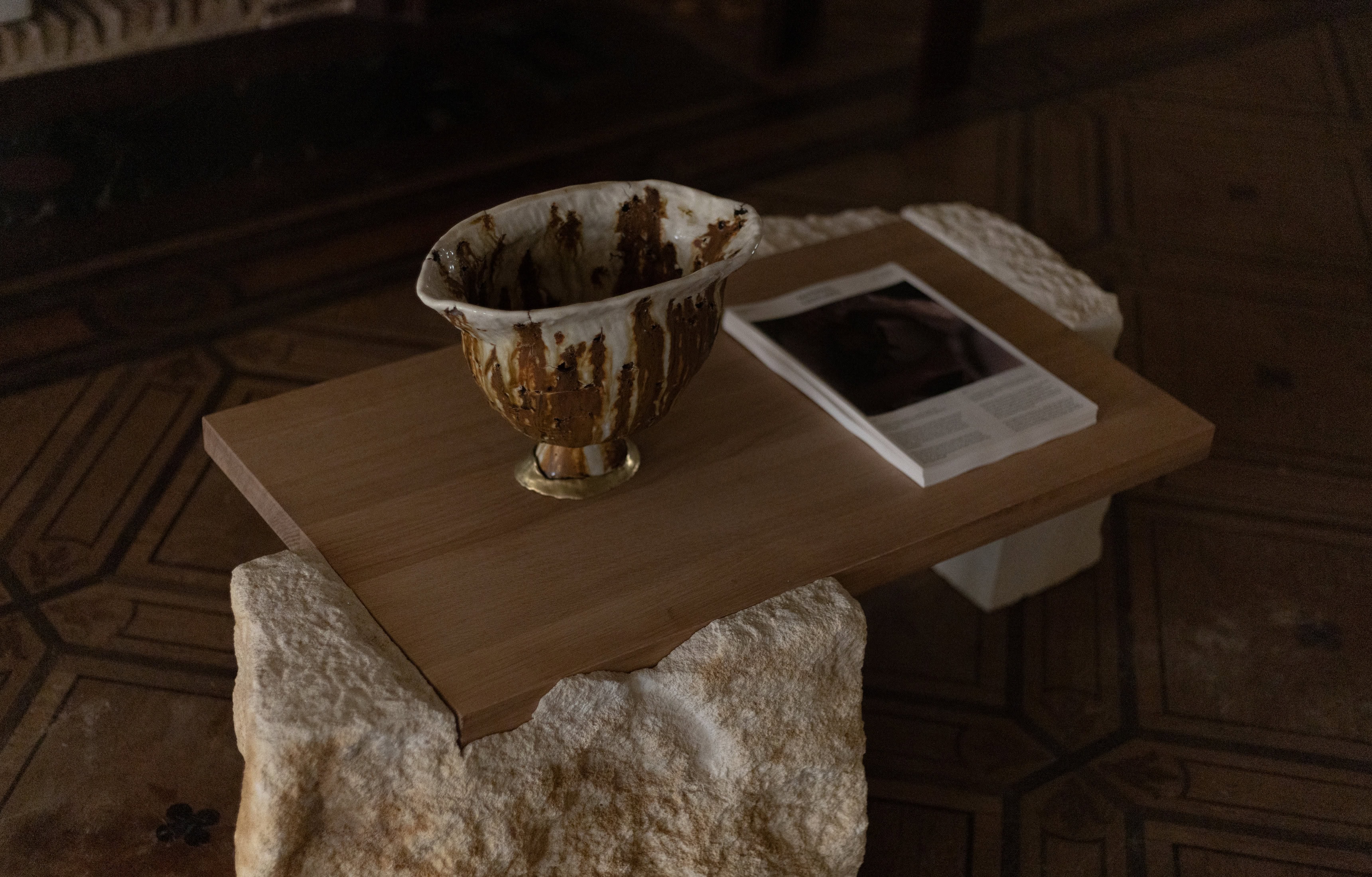
Materials do the work: stone, burnished metals, fine woods and hand-treated leathers, lit warm and low. The composition is sculptural, closer to a furnished apartment than a shop, and the intention is that visitors read atmosphere before they read individual products. On display is a mix of Henge’s established pieces and its 2025 collection.
Tormena has described the approach as site-specific, responding to the particular quality of Gulf light, local proportions and regional sensibilities without diluting the brand: “Dubai is a global hub for design and architecture, and we wanted to create a space that could engage with this multicultural landscape without compromising our identity. It’s not about adapting our style, but about interpreting the context with coherence and respect.”
That is a considered position, and the room bears it out. Rather than build a separate regional collection, Henge has brought its full identity to Dubai and let the local light, proportions and sensibilities do the interpreting.

The story behind the partnership
Here is the story underneath the story.
The showroom was delivered with Interni, and Interni is not a local agent. It began in 1933 as a carpentry workshop opened by Leonardo Cazzaniga in Verano Brianza, in the Italian furniture heartland north of Milan. More than ninety years later it runs 27 stores, represents over 200 brands, employs more than 160 people and has worked in over 2,000 cities. It is now part of the Haworth Lifestyle Retail Division, the group that also holds Cassina, Poltrona Frau and Cappellini.
And in 2024, Interni acquired a majority stake in Vivente, a Dubai luxury furniture distributor that had been operating in the market for more than thirty years.
Read those two facts together and the Henge opening looks different. This is not simply an Italian brand arriving in Dubai. It is a European retail group, owned by an American furniture corporation, buying an established local distributor and then using that platform to plant monobrand flagships in the Gulf. The Henge store is the visible output of a transaction completed the year before, and it is the second Henge project Interni has delivered, after the London flagship.
This is good news for buyers. Consolidation of this kind usually improves the customer experience, because a group with that much buying power can deliver stock, aftercare and installation at a consistently high standard. It is also the real story here, and it explains why more of these openings are coming.

Why Dubai, and who the showroom is really for
The commercial logic is straightforward. Dubai now serves as the procurement centre for high-end residential and hospitality projects across the UAE, Saudi Arabia, Qatar and Kuwait, and the volume of Gulf development means specification decisions worth a great deal of money are made here.
Which points to something worth understanding about spaces like this: a monobrand flagship at this level is not principally a shop.
Its primary audience is the trade. Architects and interior designers specify furniture for projects long before any private client sees a catalogue, and they need to touch the stone, sit on the leather and understand the weight of a thing before they will put it in a scheme. The showroom exists so that specification can happen with confidence. Private sales follow, but they are not the business case.
That reframes the design of the space too. The apartment-like sequencing, the emphasis on atmosphere over product density, the warm low lighting: these are not merchandising decisions, they are demonstrations. The room is showing a designer what the furniture does to a room.
Dubai’s design calendar reinforces the pattern. Downtown Design, running alongside Dubai Design Week at d3 in early November, has become the annual moment when this trade audience assembles, and the permanent showrooms increasingly function as the year-round extension of that week.
What comes next
Two things.
The material promise, carried into new markets. Henge’s whole proposition rests on hand-working natural materials and accepting variation. That craft has defined the brand at boutique scale, and it now travels further as Henge expands into new markets through a group retail structure with serious distribution behind it. Expect the pieces coming out of Valdobbiadene to carry their hand-made character to a much wider audience over the next few years.
How many more of these arrive. Interni’s acquisition of Vivente gives the group a platform for exactly this kind of opening, and it holds a very large portfolio of brands. Expect more monobrand flagships in Dubai, and expect the city’s design retail landscape to grow richer for it.

Frequently asked questions
What is Henge?
An Italian furniture and lighting brand founded in 2011 by Paolo Tormena, based in the Veneto, known for hand-worked natural materials including stone, wood, burnished metals, glass and leather, produced using traditional artisanal techniques.
Where is Henge’s Dubai showroom?
At 831 Jumeira Street, Dubai, on the coastal stretch facing the Burj Al Arab. It opened on 19 June 2025.
Who designs Henge?
Massimo Castagna has been art director since 2011. The brand also collaborates with designers including Yabu Pushelberg, Maarten Baas, Ugo Cacciatori, Tanju Özelgin and Johanna Grawunder.
Who is Interni?
An Italian design retailer founded in 1933 in Verano Brianza, now operating 27 stores and representing more than 200 brands. It is part of the Haworth Lifestyle Retail Division and acquired a majority stake in the Dubai distributor Vivente in 2024.
Is the Dubai showroom open to the public?
Yes. Opening hours are Monday to Friday, 10:00 to 19:00, and Saturday, 10:00 to 16:00.
Is Henge expensive?
It sits at the upper end of the Italian furniture market, with pricing reflecting hand-finished natural materials and low-volume artisanal production. Most pieces are specified through architects and interior designers.
Final thoughts
Judged purely as a showroom, the Henge flagship does what a good one should. It puts serious material in front of you, lights it properly, and arranges it so you understand what the furniture would do to a room rather than what it looks like on a plinth. Castagna’s architectural discipline holds the whole thing together, and the decision to bring the collection to the Gulf in its full, undiluted form is the right one.
But the more instructive reading is structural. A ninety-year-old Brianza carpentry firm, now inside an American corporate group, bought a thirty-year-old Dubai distributor and within a year was opening monobrand flagships with it. That is what the maturing of a design market actually looks like, and it happens through acquisitions and distribution agreements rather than through openings.
The furniture is the visible part. The retail architecture behind it is the part that will shape what gets specified in this region for the next decade.
Project Credits
Go further from here
Add to calendar
Google CalendarApple or OutlookRead next
The Dior Doha Vendôme Salon, a private lounge designed by Dimorestudio, spans 233 square metres within the Dior boutique, accessible only by appointment for the house's Very Important Clients. Contrary…
Doha