
ART & CULTURE · PARIS
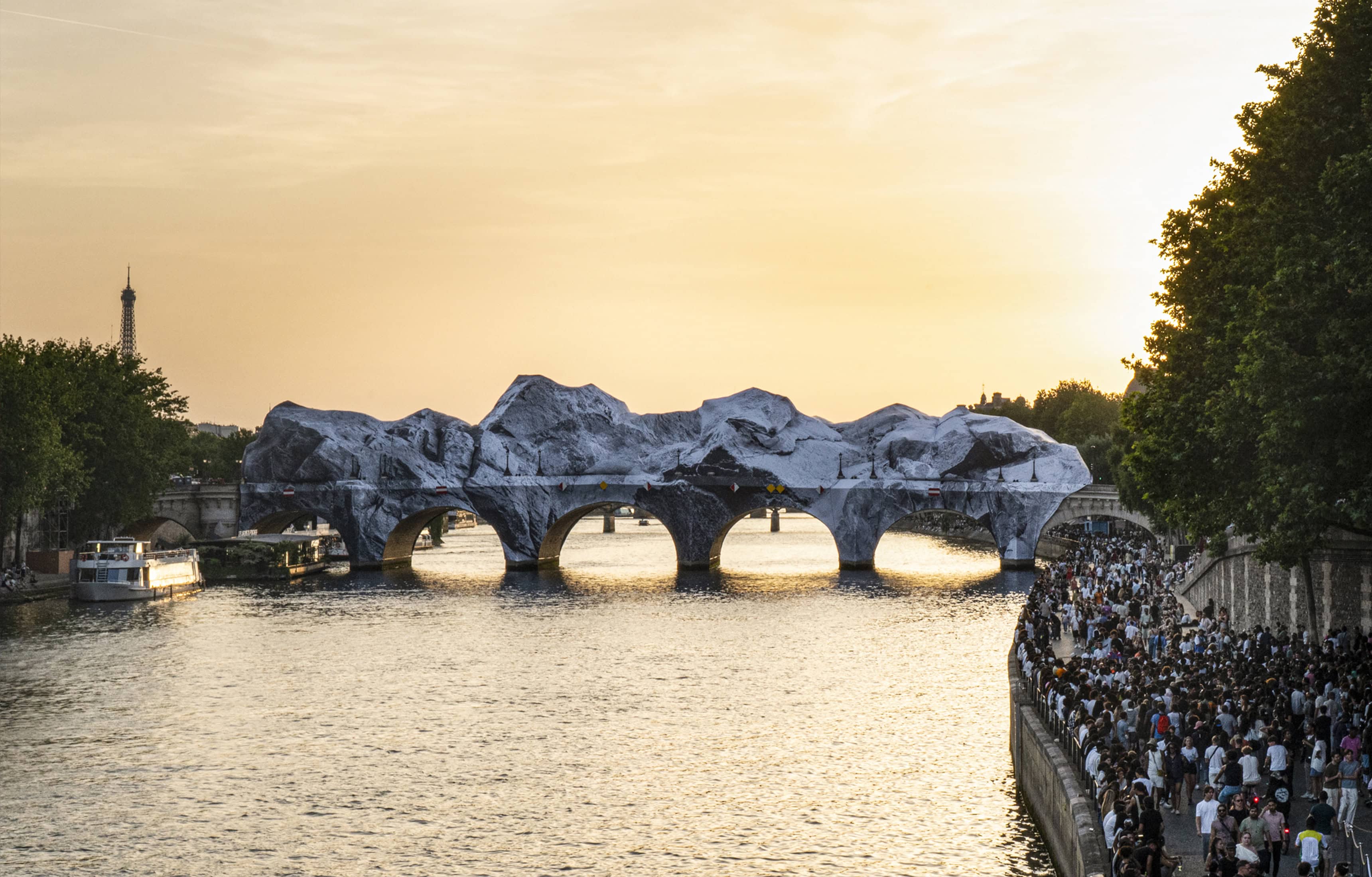
Reading time: 9 minFor three weeks this summer, Paris’s oldest bridge disappeared inside an inflatable limestone cave built from twenty thousand cubic metres of air. A storm tore the structure open four days before it was due to open to the public. JR sent the fabric back to Brittany, had it repaired, and then left the mend visible rather than painting over it, which turned a construction accident into part of the argument the piece was making.
Introduction
JR closed the Pont Neuf to traffic for the better part of two months this year so that he could turn it, briefly, into a mountain. La Caverne du Pont Neuf, a monumental inflatable installation that wrapped Paris’s oldest bridge in trompe-l’oeil limestone rock, ran from 15 to 28 June 2026, open free to the public around the clock. It has since closed and been dismantled, which means the piece that follows is an account of what actually happened on that bridge rather than a preview of what was planned, including the part the original plan did not survive intact.

The Pont Neuf, despite its name meaning new bridge, is the oldest bridge in Paris still standing, completed in 1607 and built from the same Lutetian limestone quarried from beneath the city that raised most of the capital’s grand nineteenth century boulevards. JR’s installation reached back into that stone’s origin rather than competing with the bridge’s four centuries of polish, wrapping the crossing in a raw, mineral, cave-like form that asked visitors to walk through rock rather than over water. Getting that idea onto the bridge intact took eight hundred people, a Brittany workshop, and, in the end, a repair crew working through the night after the weather intervened.

What the storm did to the piece
Construction began in earnest in mid May, with the installation’s public opening originally scheduled for 6 June. It did not open that day. On 2 June, four days before the planned opening, strong winds and a hailstorm tore the printed fabric envelope at both ends of the structure. The damaged sections were transported back to the Brittany workshop that had built them for repair, and specialist rope-access technicians, cordistes, spent four nights repositioning the mended fabric from above the bridge, a manoeuvre the original installation sequence had been designed to avoid entirely. The public opening slipped nine days, to 15 June, while the scheduled closing date held at 28 June, which meant the storm did not just delay the piece. It shortened the run by more than a week before a single visitor had walked through it.

JR’s response to the damage is the decision that gives the piece its actual argument. Rather than disguising the repaired seams, he left them visible on the finished structure, turning the evidence of the storm into part of what the installation was saying rather than a flaw to be corrected before opening night. Read that way, the visible mend is not a construction footnote. It is the clearest single piece of evidence in the whole installation for what JR was actually arguing: that a structure built entirely from air and printed fabric, standing in for four centuries of solid stone, was never going to pretend to permanence in the way the bridge underneath it does. A repaired tear left on show says that plainly, in a way no amount of curatorial text could.

The bridge underneath the bridge
The installation itself measured 120 metres long and up to 18 metres high, a double-walled inflatable structure held up by roughly 20,000 cubic metres of pressurised air moving through eighty separate structural arches, covering a footprint of around 2,400 square metres of the bridge. The whole assembly weighed only five tonnes and needed no foundations driven into the historic structure beneath it, which is precisely why an inflatable system was the only material that could have done this job on a protected seventeenth century monument. The printed fabric, some 18,900 square metres of it, was designed in Paris and hand-stitched by twenty-five artisans at a specialist inflatable-textile workshop in Brittany, then tested at full scale inside a hangar at Orly Airport before it ever reached the Seine.

The trompe-l’oeil printing did the rest of the work. From a distance, the pixellated black-and-white photography covering the structure read as rugged, geological rock face, deliberately styled on the limestone quarries that supplied the stone for the Pont Neuf and for much of the rest of the city above it. Close up, the same surface resolved into contemporary construction, fabric and print rather than mineral. JR has described wanting to deform the bridge, to make its familiar silhouette almost disappear inside the illusion, and the installation held both readings at once rather than resolving into one or the other. That doubled reading, the same surface behaving as ancient rock from thirty metres and as printed fabric from three, was the whole mechanism the piece depended on, and it is why the installation needed to be walked through rather than simply looked at from the riverbank.

Inside the cave, the illusion extended beyond sight. Thomas Bangalter, formerly one half of the electronic duo Daft Punk, composed an electroacoustic sound environment for the passage rather than a piece of music, built to resonate with the installation’s mineral character and described as closer to the sound of wind moving through mountains than to any conventional score. Working with the author Sarah Bouasse and the fragrance house Odore Scola, JR’s team also built an olfactory layer around geosmin, the compound responsible for the smell of rain hitting dry earth, releasing it through diffusion grilles set into the base of the structure. Snap’s AR Studio Paris added a fourth layer, an augmented reality experience called Echoes that overlaid chronophotography-inspired visual traces onto the physical space for anyone viewing it through a smartphone or a pair of Snap Spectacles. Sight, sound, smell and an optional digital layer were all pointed at the same argument: that the cave was a space to be inhabited rather than a backdrop to be photographed.

A wrap answered four decades later
JR built La Caverne du Pont Neuf as a direct, acknowledged homage to Christo and Jeanne-Claude’s The Pont Neuf Wrapped, the September 1985 project that covered the same bridge in more than 40,000 square metres of sandstone-coloured fabric and drew an estimated three million visitors over its two-week run. JR worked with the Fondation Christo et Jeanne-Claude on the new installation, and Vladimir Yavachev, Christo’s nephew and a longtime collaborator on the couple’s projects, took part directly. Both installations shared a financing principle as well as a location: like Christo and Jeanne-Claude before him, JR paid for La Caverne du Pont Neuf entirely through sales of his own artwork, a deliberate choice that keeps a temporary public project free of sponsor conditions on what it can say or show. Christo carried that same insistence into his own solo years after Jeanne-Claude’s death in 2009, funding The London Mastaba, his 7,506-barrel sculpture on London’s Serpentine Lake in 2018, exactly the same way, and describing the work as theirs jointly even though she never saw it built.

The two projects answer each other rather than simply sharing an address. Christo and Jeanne-Claude concealed the bridge’s surface entirely, wrapping it until its familiar form disappeared under fabric. JR’s cave does the opposite, working to reveal something the bridge’s polished nineteenth century surface has always concealed: the raw quarried stone the whole city was built from before it became a monument. Wrapping hides a form. A cave excavates one. Read together, more than 40 years apart, the two projects form a genuine pair rather than a tribute act, each one using the same 400 year old crossing to make an opposite argument about what public art can do to a familiar landmark.

The sound of a ten-year-old’s memory
The detail that connects those two projects most directly has nothing to do with fabric or geology, and it belongs to Thomas Bangalter rather than to JR. Bangalter was ten years old in September 1985, growing up in Paris, when Christo and Jeanne-Claude wrapped the Pont Neuf, and he has described the experience of encountering that transformed bridge as a child as one that stayed with him. Four decades on, the same artist who spent Daft Punk’s career building sound for stadiums and studio albums was the person JR asked to build the sound inside a structure standing on the exact spot where that childhood memory was made. That is not a casual collaborator credit. It is the clearest evidence in the whole project that the tribute to Christo and Jeanne-Claude was not simply thematic. It ran through the specific choice of who was in the room, built around someone whose own sense of what public art can do to a city was formed on that bridge in the first place.

The artist behind it
JR, born Jean-René in Paris in February 1983 to a Tunisian mother, started out as a teenage graffiti artist working rooftops and Métro tunnels before finding a discarded camera on the Paris underground at around seventeen and turning to photography almost by accident. He began pasting photocopied portraits onto the same walls he had been tagging, an early, unauthorised version of the large-scale public photography that has defined his career since. Face 2 Face (2007) placed matching portraits of Israelis and Palestinians on both sides of the separation barrier between the two territories. Women Are Heroes (2008 onward) photographed women in conflict-affected communities across Sierra Leone, Liberia, Kenya, Brazil, India and Cambodia at monumental scale. The Inside Out Project, launched after JR won the 2011 TED Prize, has since collected portrait submissions from more than 150,000 participants across upward of 108 countries, each pasted up locally as part of a growing, crowd-authored global archive.

JR’s two Louvre Pyramid interventions, in 2016 and 2019, used anamorphic photography to make the glass pyramid appear to dissolve into the courtyard around it or float above an excavated void, techniques that anticipated exactly the kind of trompe-l’oeil illusion at the heart of La Caverne du Pont Neuf a decade later. His 2017 installation at the US-Mexico border, a giant photograph of a child appearing to peer over the fence line, extended into a shared picnic staged across the border itself. Faces Places, his 2017 documentary collaboration with the filmmaker Agnès Varda, won the Golden Eye at Cannes and earned both directors an Academy Award nomination. Time named him among its hundred most influential people in 2018. That same summer as the Pont Neuf installation, JR also showed work at Galerie Perrotin in the Marais and took part in the Beyond the Streets exhibition at the Grande Halle de la Villette, making June 2026 one of the busiest single stretches of his career in his home city.

Frequently asked questions
What was La Caverne du Pont Neuf?
A monumental inflatable installation by the artist JR that wrapped Paris’s Pont Neuf in trompe-l’oeil limestone rock, open to the public from 15 to 28 June 2026.
Can La Caverne du Pont Neuf still be visited?
No. The installation closed on 28 June 2026 and has since been dismantled, with its fabric designed for reuse.
Why did the installation open later than planned?
A storm on 2 June 2026 tore the printed fabric structure, which had to be repaired at the Brittany workshop that built it before the public opening, delaying it from 6 to 15 June.
How does La Caverne du Pont Neuf relate to Christo and Jeanne-Claude?
JR built it as a direct homage to the couple’s 1985 project The Pont Neuf Wrapped, working with their foundation and with Christo’s nephew, Vladimir Yavachev, and following their practice of self-financing the work through art sales.
Who composed the sound inside the installation?
Thomas Bangalter, formerly of Daft Punk, who was ten years old in Paris when Christo and Jeanne-Claude wrapped the same bridge in 1985.
Final thoughts
The most telling decision in La Caverne du Pont Neuf was not a design choice at all to begin with. It was an accident, a storm tearing fabric four days before opening, and the repair crew who spent four nights putting it right. JR could have hidden that mend entirely, and almost nobody would have known. Leaving it visible instead turned a piece of bad luck into the installation’s most honest statement: that a structure built from air and printed cloth was always a temporary answer to a four-century-old question, not a permanent one. Christo and Jeanne-Claude wrapped this same bridge to make it disappear for two weeks in 1985. JR unwrapped something underneath it instead, kept the evidence of what it cost to get there, and then, on schedule, let the whole thing come down.


Leave a Reply