

ART & CULTURE · VENICE
Reading time: 10 minJulien Creuzet filled France’s Giardini pavilion with bronze vessels, hanging thread and a four-channel video of objects drifting through water, built around a poem so long it became the exhibition’s title. The installation closed with the 60th Venice Biennale on 24 November 2024, but the work itself did not stop there: it has since resurfaced, larger and reworked, on two American campuses. That is the more interesting story, and it is the one this piece tells.
For six months in 2024, the French pavilion in the Giardini held water. Not as metaphor, though there was plenty of that, but as a physical material: bronze-cast vessels filled with pools of scented water sat among wire sculptures wrapped in coloured thread, while a four-channel video of submerged objects played across the walls. The artist behind it was Julien Creuzet, a sculptor and poet born in the Paris suburbs and raised in Martinique, and his installation carried a title long enough to be a poem in itself: Attila cataracte ta source aux pieds des pitons verts finira dans la grande mer gouffre bleu nous nous noyâmes dans les larmes marées de la lune.
The pavilion was one of roughly thirty national presentations built into the Giardini for the 60th International Art Exhibition, La Biennale di Venezia, which ran from 20 April to 24 November 2024 under the title Stranieri Ovunque, Foreigners Everywhere. Readers wanting the fuller picture of that edition, its central exhibition and the wider run of national pavilions, will find it in Martyn White’s overview of the 2024 Venice Biennale. This piece stays inside one building. Elsewhere in the Giardini that year, the United States pavilion underwent a comparably thorough transformation, in Jeffrey Gibson’s hands.
France’s presentation was commissioned by the Institut français on behalf of the Ministry of Europe and Foreign Affairs and the Ministry of Culture, and curated by Céline Kopp and Cindy Sissokho. Creuzet was the first Black man to represent France alone in the pavilion, a fact that has been widely reported and one Creuzet himself has described as simply one step in an ongoing practice rather than the point of the work. The point, as this piece sets out to show, was water, and the way it refuses to stay where it is put. Twenty months after the Biennale closed, that argument has proved true of the artwork as well as its subject.


What the pavilion actually contained
The French pavilion at the Giardini was built in 1912 to a design by Faust Finzi, the chief engineer of the Venice municipality at the time, and its layout echoes the neighbouring German pavilion, designed by an architect Finzi had previously worked under. It is a solid, symmetrical building, and for most of its history it has been treated as a neutral container for whatever a given artist brings to it. Creuzet did not treat it that way.
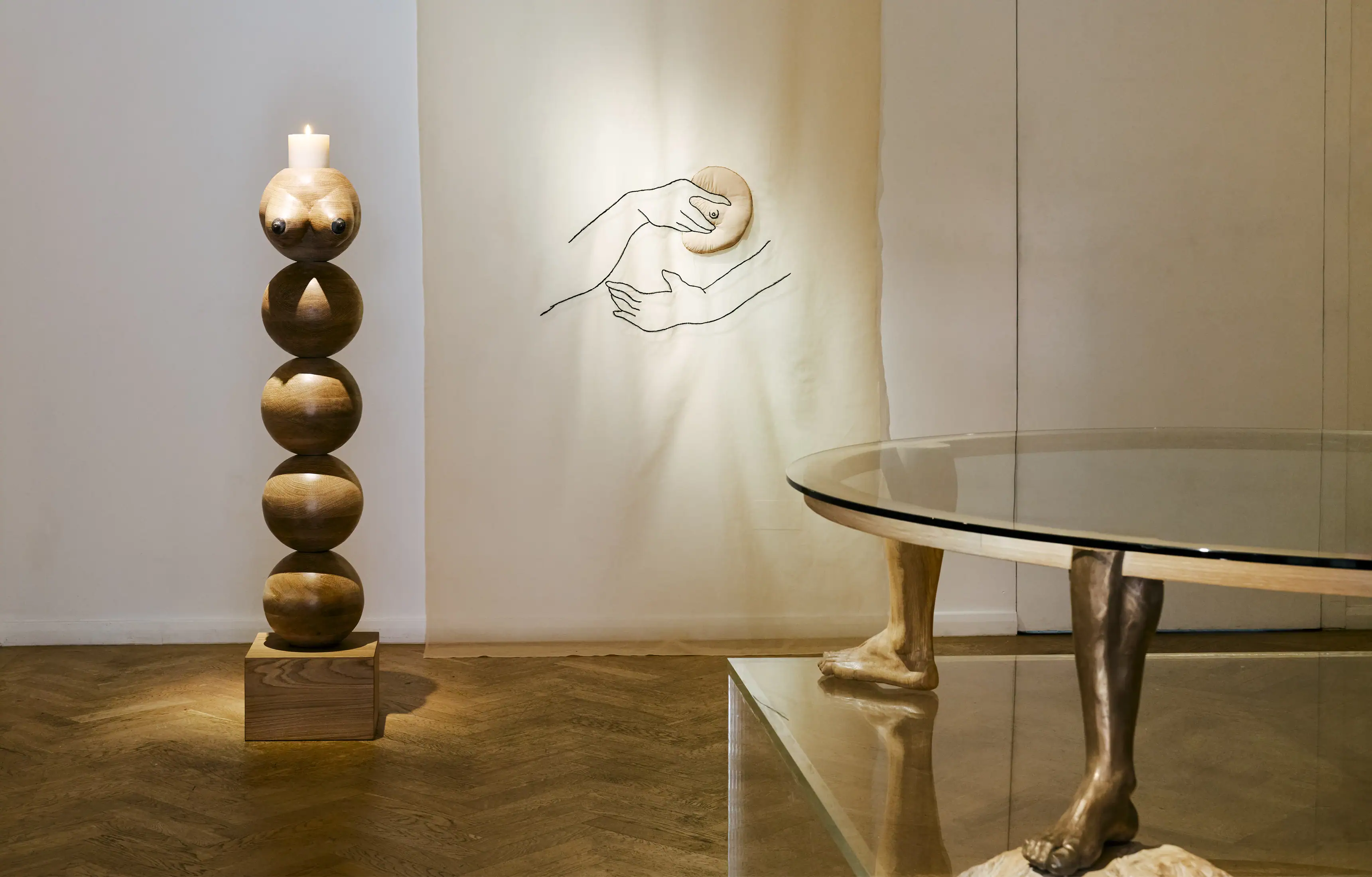
He divided the interior into a sequence of interconnected spaces that visitors could move through in no fixed order, an arrangement several critics compared to a physical equivalent of the non-linear, feedback-and-echo structure of his own poetry. A large screen ran across part of the pavilion’s exterior facade, showing what one reviewer described as ambiguous, shifting figures, effectively announcing the installation before a visitor had stepped inside. Within, four channels of video showed objects and half-recognisable creatures suspended and drifting in water, looped and set to a score that mixed Creole song, sampled percussion and what one review called Afro-Caribbean acid-house rhythms, run through a Dolby surround system. Wiry, thread-wrapped sculptures and woven hangings occupied the middle distance between screen and floor, some suspended from the ceiling, some rising from it. The bronze vessels, cast and filled with water carrying a faint scent, sat at floor level, turning the gallery briefly into something closer to a shrine than a screening room.
Nothing in that description is decorative flourish. Creuzet works, and has always worked, from the position that sculpture, sound, smell and text are a single medium rather than four separate ones deployed to support each other. The bronze vessels are not props beside the video: they are the same argument about water made in a different material, at a scale a visitor can smell as well as see.


The sculptor who writes his titles as poems
Creuzet was born in 1986 in Le Blanc-Mesnil, a suburb north-east of Paris, and moved to Martinique at the age of four, where his father, a nursing assistant with a serious interest in art, introduced him to the island’s visual and literary culture. He returned to mainland France at twenty, in 2006, to study at French art schools, and he now holds the position of chef d’atelier, or workshop director, at the École des Beaux-Arts de Paris, where he also lives, in Montreuil, on the eastern edge of the city.
His practice moves freely between sculpture, poetry, video, animation and music, and his sculptures are frequently built from unglamorous, provisional materials: raffia bags, thread, bent metal poles, plastic, glue, bread and dried grains, alongside more recent work in Corten steel and digital projection. He cites the writers Aimé Césaire and Édouard Glissant among his central influences, particularly Glissant’s idea of the droit à l’opacité, the right to opacity, the argument that a work is not obliged to explain itself fully to be understood. That principle shapes Creuzet’s titles as much as his sculpture: Attila cataracte ta source… runs to more than thirty words, reads as a single continuous sentence about water falling, gathering and drowning, and functions less as a label than as the first artwork a visitor encounters, before they have seen anything at all.
By 2024 Creuzet arrived at the Giardini with a substantial exhibition history behind him, including a solo presentation at the Palais de Tokyo in Paris in 2019, a show at Camden Arts Centre in London in 2022, and participation in the Lyon Biennale, the Gwangju Biennale and Manifesta 13. He had also been shortlisted for the Prix Marcel Duchamp in 2021.


A tarantula as a working method
The exhibition’s recurring image, referenced throughout the curatorial material and reproduced in most of the coverage, was the matoutou falaise, known to scientists as Caribena versicolor and to English speakers as the Antilles pinktoe tarantula: a tree-dwelling spider native to the rainforest around Précheur, in the north of Martinique, close to where Creuzet spent his childhood. The curators framed it not as a mascot but as a method, a symbol of what Kopp and Sissokho described as a way of watching, waiting and sensing rather than seizing and explaining. Creuzet’s own writing around the show returns repeatedly to ideas of camouflage, appearance and disappearance, protection and exposure, all of which the matoutou falaise embodies literally: it is a creature that survives by being seen only when it chooses to be.
That idea runs directly into the pavilion’s other major reference point, Katherine Dunham’s 1938 dance work L’Ag’Ya, based on a Martinican combat dance rooted in African martial tradition, whose silhouettes later appeared cut into steel sculptures made for the project’s continuation in the United States. Creuzet has also drawn on the environmental history of Martinique and Guadeloupe, including the long-term contamination of agricultural land by the pesticide chlordecone, as part of the material his work holds in tension: ecological memory as a form of knowledge carried in water, soil and the body, alongside migration, Creole language and diasporic music. None of it is presented as argument or protest. It is presented, in Creuzet’s own account, as texture, the accumulated residue that a sculpture can carry the way water carries silt.


Two curators who had already tested the ground
Kopp and Sissokho did not arrive at Creuzet’s work cold. Kopp, an art historian trained at the University of Strasbourg, the École du Louvre and the Royal College of Art, led Triangle-Astérides, the contemporary art centre in Marseille, from 2012 to 2022, before taking over as director of the Magasin, the national centre for contemporary art in Grenoble, later renamed Magasin des Horizons, that same year. In late 2023, ahead of the Biennale, she staged a substantial Creuzet survey at the Magasin titled Oh téléphone, oracle noir, explicitly framed at the time as a prelude to Venice. The pavilion, in other words, was not a first encounter between artist and curator but the second act of a collaboration already under way. Kopp has since moved on again: in September 2025 she was named director of the MAMAC, the museum of modern and contemporary art in Nice, taking up the post from January 2026 while the museum undergoes a renovation due to finish in 2029.
Sissokho brought a different, complementary body of work. Her curatorial practice is built around anticolonial and diasporic perspectives, developed through posts including Nottingham Contemporary, New Art Exchange and, since Venice, the Wellcome Collection in London, where she curated the exhibition Hard Graft: Work, Health and Rights. She is now associate programme director for Africa and Europe at the Kadist foundation. Between them, Kopp’s institutional grounding and Sissokho’s research into racialised and diasporic art histories gave the pavilion a curatorial argument as considered as the sculpture it supported, rather than a thesis bolted onto an artist’s existing practice after the fact.


The part of the story the Biennale doesn’t tell you
Here is the detail that separates this pavilion from most of the roughly ninety national presentations mounted in Venice that year: it did not end when the Giardini gates closed on 24 November 2024. The installation reappeared, substantially expanded, at the Bell Gallery at Brown University in Rhode Island, running through June 2025, and then at the Institute for Contemporary Art at Virginia Commonwealth University in Richmond, from 15 August 2025 to 22 February 2026, curated respectively by Kate Kraczon and Amber Esseiva.
The American presentations kept the title and the underlying material but were not a straight reinstallation. Where Venice showed a four-channel video on flat screens, Brown hung four large double-sided projection panels from the ceiling, so the aquatic imagery lit the surrounding sculpture from both sides at once. Six new steel floor sculptures, laser-cut with migration patterns, plant forms and the L’Ag’Ya dancer silhouettes and collectively titled Palmistry of the Desiring Waters, were commissioned specifically for the Bell Gallery and installed across its lobby and into the main space. The video itself grew a new central image: an inverted rendering of Jacopo Sansovino’s sixteenth-century Neptune, the sculpture that stands on the Doge’s Palace’s Scala dei Giganti in Venice as a monument to the city’s historic command of the Mediterranean, shown here upended and sinking, read by one critic as marking a shift in dominion from the Mediterranean to the Atlantic. A companion soundtrack of six songs, with Creuzet’s Creole lyrics translated in real time into French, English, Spanish and Portuguese on flanking screens, replaced the surround-sound score used in Venice.
That is the genuinely useful fact here, and it is one the pavilion’s own wall text could not have offered while it was still standing in Venice: this was never a fixed showpiece built for six months in a Giardini building and then dismantled. It was one stage in a work that keeps absorbing new material as it moves, precisely mirroring the subject the title describes, a source that becomes a cataract, a river, a sea, and finally an abyss, none of it standing still. Venice was the source. It was never the destination.


What the pavilion gave its visitors
For those who did see it in the Giardini in 2024, the pavilion offered something closer to immersion than instruction. Visitors were not required to move through the rooms in any particular sequence, and the accompanying material, including a catalogue published by the Beaux-Arts de Paris and a sonic reader running to more than seventy sound pieces recorded in French, English, Spanish and Portuguese by collaborators including the choreographer Ana Pi, the scholar Maboula Soumahoro and Sissokho herself, was designed to be dipped into rather than read cover to cover. The project received support from the CHANEL Culture Fund and the LUMA Foundation, alongside its core Institut français commission.
The effect, for several visitors who wrote about it afterwards, was closer to a mood than an argument: one described losing track of thought entirely inside the looped percussion and shifting light, a state the curators had explicitly set out to produce, describing the work as an invitation to unlearn habitual ways of seeing in favour of a softer, more attentive gaze. That is a considered curatorial aim in its own right, distinct from and more precise than the immersive spectacle that has become a default mode at recent Biennales: it asks for slower attention rather than a bigger screen.
Final thoughts
It would be easy to describe the French pavilion in 2024 as an atmospheric, hard-to-parse immersive installation, and leave it there. Plenty of coverage did exactly that, reasonably enough, since Creuzet’s own working principle is that a work does not owe anyone a full explanation. But the more durable fact about this pavilion is a structural one, not an atmospheric one: it was designed, deliberately or not, to keep flowing past its own closing date.
A title about a source becoming a river becoming a sea is not a decorative flourish sitting on top of the work. It is a description of what the work then did. The bronze vessels and thread sculptures that stood in the Giardini for six months were followed, within a year, by new steel floor pieces in Rhode Island and Virginia, a reworked video carrying an inverted Neptune borrowed from Venice’s own iconography of maritime power, and a soundtrack rebuilt for new audiences in a new language mix. The curators who built the case for Creuzet in Grenoble in 2023 have themselves since moved on to museums in Nice, carrying the same eye for diasporic, water-borne material with them.
None of that motion needed the Giardini to keep happening. The pavilion did its job as a source: it sent the work onward, and the work kept the water moving exactly as its title said it would.
What was the French pavilion’s installation at the 2024 Venice Biennale?
An immersive, multi-room installation by the artist Julien Creuzet, combining a four-channel video of objects drifting in water, bronze vessels filled with scented water, thread-wrapped wire sculptures and a surround-sound score built from Creole song and percussion.
What was the title of the work?
Attila cataracte ta source aux pieds des pitons verts finira dans la grande mer gouffre bleu nous nous noyâmes dans les larmes marées de la lune, a single long sentence in French that functions as both title and poem.
Who curated the French pavilion in 2024?
Céline Kopp, then director of the Magasin in Grenoble and now director of the MAMAC in Nice, and Cindy Sissokho, now associate programme director for Africa and Europe at the Kadist foundation.
Who was Julien Creuzet, and what is his background?
A French-Martinican sculptor and poet born in 1986 near Paris and raised from early childhood in Martinique. He teaches at the École des Beaux-Arts de Paris and works across sculpture, poetry, video and sound, drawing on the writing of Aimé Césaire and Édouard Glissant.
What is the matoutou falaise?
A tree-dwelling tarantula native to Martinique, known to science as Caribena versicolor, which the curators used as a recurring symbol for a way of watching and sensing rather than seizing and explaining.
When did the exhibition run, and can it still be visited in Venice?
The 60th Venice Biennale, including the French pavilion, ran from 20 April to 24 November 2024 and has since closed. The pavilion building now awaits France’s next commissioned artist for the 2026 edition.
Did the installation appear anywhere after Venice?
Yes. An expanded version, with new steel sculptures and a reworked video and soundtrack, was shown at the Bell Gallery at Brown University through June 2025 and at the Institute for Contemporary Art at Virginia Commonwealth University from August 2025 to February 2026.
Where was the French pavilion located?
In the Giardini, Venice’s historic public gardens that house the Biennale’s oldest national pavilions, in a building constructed in 1912 to a design by Faust Finzi.

Leave a Reply