
ARCHITECTURE · DUBAI
Reading time: 6 minA sail. A wave. And now a superyacht. With Jumeirah Marsa Al Arab, opened in March 2025, Shaun Killa has added the third form to a maritime story Jumeirah began writing on the Dubai coast nearly thirty years ago. The surprise is how quietly the loudest possible gesture has been made.
Look along the Jumeirah coastline and you are reading a sentence that took twenty-six years to finish.
It began in 1997 with the Jumeirah Beach Hotel, shaped like a breaking wave. Two years later came the Burj Al Arab, shaped like the billowing sail of a dhow, and one of the most recognisable buildings on earth. For a quarter of a century, the sentence stopped there, at two words.
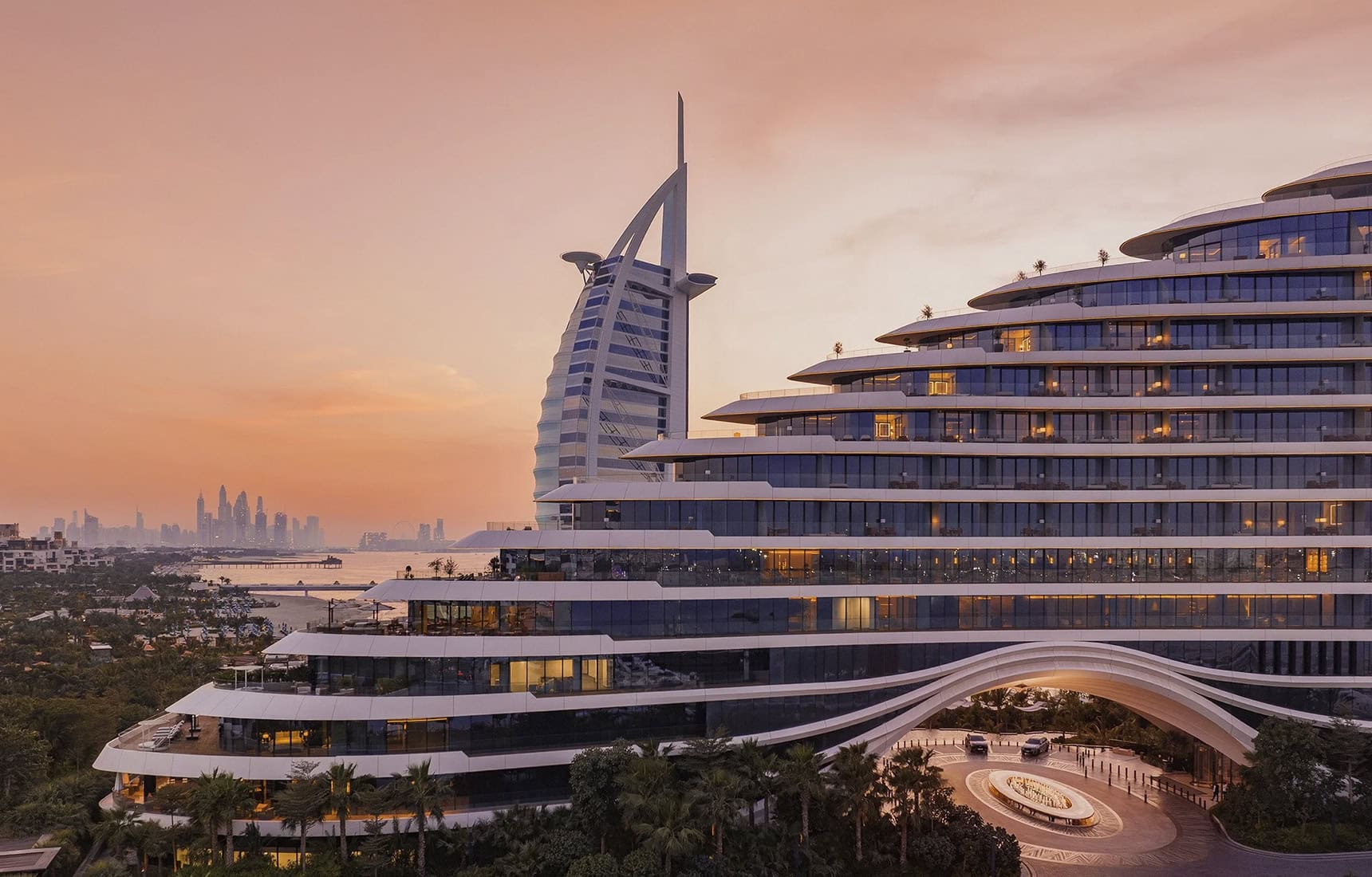
In March 2025, it gained its third: Jumeirah Marsa Al Arab, designed by Shaun Killa in the form of a superyacht, moored between its two predecessors. The wave, the sail, the yacht; a trilogy of maritime forms, spread along a single stretch of shore, finally complete.
That is the story of this building, and it is a better one than “another luxury Dubai hotel.” Marsa Al Arab is not a stand-alone icon. It is the closing gesture of a decades-long architectural narrative, and it was designed by exactly the right architect to close it.

The right architect for the job
The commission went to Shaun Killa, and if that name is familiar from these pages, it is because he is the founder of Killa Design, the studio behind the Museum of the Future, the calligraphy-wrapped torus that has become the single most recognisable building in the modern UAE.
Killa’s signature, across the museum and his residential towers, is unusually consistent: he makes buildings that look found rather than built, forms that read as though a natural process shaped them. That instinct is perfect for a maritime trilogy. The Burj Al Arab and the Jumeirah Beach Hotel are both nature abstracted into architecture: a sail, a wave. To complete the set, you needed an architect who thinks in exactly those terms, and Killa does.
What is striking is his restraint. In a city that rewards volume, Killa set out, in his words, to make “a subtle intervention of beauty that doesn’t shout or try to be something it is not.” He wanted a building that would invite admiration over time rather than demand it on arrival; timeless, quiet, confident. That is a genuinely unusual ambition for a Dubai landmark, and it is the same restraint that runs through his best work: the conviction that the most confident thing a building can do is belong to its place rather than compete with it.

Motion, held still
The design idea is precise: capture the sensation of a superyacht gliding across water, and freeze it.
The building’s exterior is all sinuous, double-curved forms and dynamic slopes; a silhouette that leans, as though the whole structure were underway. “Though stationary,” Killa says, “the design gives the impression of the building moving in a direction.” That is the hardest thing to achieve in architecture; the illusion of motion in a fixed mass, and it required advanced digital design and fabrication to realise the compound curves without them reading as a gimmick.
Inside, the metaphor holds. The circulation is organised to flow like the deck of a vessel, leading through lounges, bars and dining rooms toward the accommodation, so that moving through the hotel feels like moving through a ship. The interiors lean on a 1960s aesthetic; the golden age of the ocean liner and the Riviera yacht, which is exactly the right reference: the era when a boat was the most glamorous place a person could be.
The arch that frames its ancestor
The single best gesture in the building is at the entrance, and it is an act of architectural humility disguised as spectacle.
Arrival is staged through a monumental steel arch; 36 metres wide, weighing 3,000 tonnes, and the arch does something specific: it frames the Burj Al Arab in the distance. You approach the new hotel, and through its arch, you see the old one, held like a picture.
Read that carefully, because it is unusually generous. Marsa Al Arab could have tried to eclipse its famous neighbour. Instead, its grandest single element exists to point at the Burj Al Arab, to complete the family portrait rather than upstage it. The newest member of the trilogy arrives, and its first move is to show you the most famous member, perfectly framed. That is the sentence closing itself, in steel.

The marina, and living on the water
At the water’s edge, Killa extended the vision into a reimagined marina, and this is where Marsa Al Arab earns its name (marsa means harbour or anchorage).
The resort holds 386 rooms and 82 serviced residences with expansive terraces, and at the waterline nine exclusive villas rest against the sea like jewels, alongside an 82-berth superyacht marina operated by D-Marin. This is the point where the metaphor stops being a metaphor: a hotel shaped like a yacht, with a harbour full of actual yachts, where guests can arrive by sea and berth beneath a building designed to look like the thing they sailed in on.
Rather than simply adding density to a crowded coast, the marina deepens the site’s relationship with the water, the whole reason the trilogy exists. It is a hotel about the sea that finally lets you live on it.
Quiet luxury, and a real environmental idea
Marsa Al Arab makes a point of restraint in its detailing: 11 restaurants, each with its own material identity (Umi Kei drawing on Japanese kintsugi, Mirabelle on French-Mediterranean warmth, the Bombay Club on jewel tones and brass, and the Mediterranean pairing of Rialto and Iliana), interiors that balance natural texture with minimal detail. This is luxury that trusts material and proportion rather than ornament.
And beneath the aesthetics is a genuine environmental move worth naming: smart shading on the balconies alone reduces energy consumption by up to 40%. In the Gulf, solar control is the single biggest lever on a building’s running cost and carbon, and a 40% cut from shading is a serious number, not a marketing one. Careful orientation and siting do the rest, every room reaching for a view without the building fighting its climate. It is the same intelligence, quietly applied, that the best new Gulf architecture keeps returning to: shade first, spectacle second.

Frequently asked questions
What is Jumeirah Marsa Al Arab?
A luxury resort on the Dubai coast, opened in March 2025, designed by Shaun Killa of Killa Design in the form of a superyacht. It holds 386 rooms, 82 serviced residences, nine marina villas and an 82-berth superyacht marina.
Who designed it?
Shaun Killa, founder of Killa Design and architect of the Museum of the Future in Dubai.
What is the “nautical trilogy”?
Three Jumeirah hotels on the same coastline, each shaped by the sea: the Jumeirah Beach Hotel (a breaking wave, 1997), the Burj Al Arab (a sail, 1999) and Jumeirah Marsa Al Arab (a superyacht, 2025). Marsa Al Arab completes the set.
What is the arch?
A monumental steel entrance arch, 36 metres wide and weighing 3,000 tonnes, positioned to frame the Burj Al Arab in the distance as guests arrive.
Is it sustainable?
Smart shading on the balconies reduces energy consumption by up to 40%, with careful orientation and siting further limiting environmental impact.
Where is it?
On the Jumeirah coastline, between the Burj Al Arab and the Jumeirah Beach Hotel.

Final thoughts
Dubai is a city that usually competes with itself, every tower a little taller, every hotel a little louder. Jumeirah Marsa Al Arab does something rarer. It looks back.
Shaun Killa took a maritime story that Jumeirah started in the 1990s and finished it: a superyacht to join the wave and the sail, and then, at the entrance, built a 3,000-tonne arch whose only job is to frame the building that came before. It is a landmark designed not to eclipse its ancestors but to stand alongside them and to point.
In a city of superlatives, that quiet act of completion may be the most confident gesture of all.


Leave a Reply