
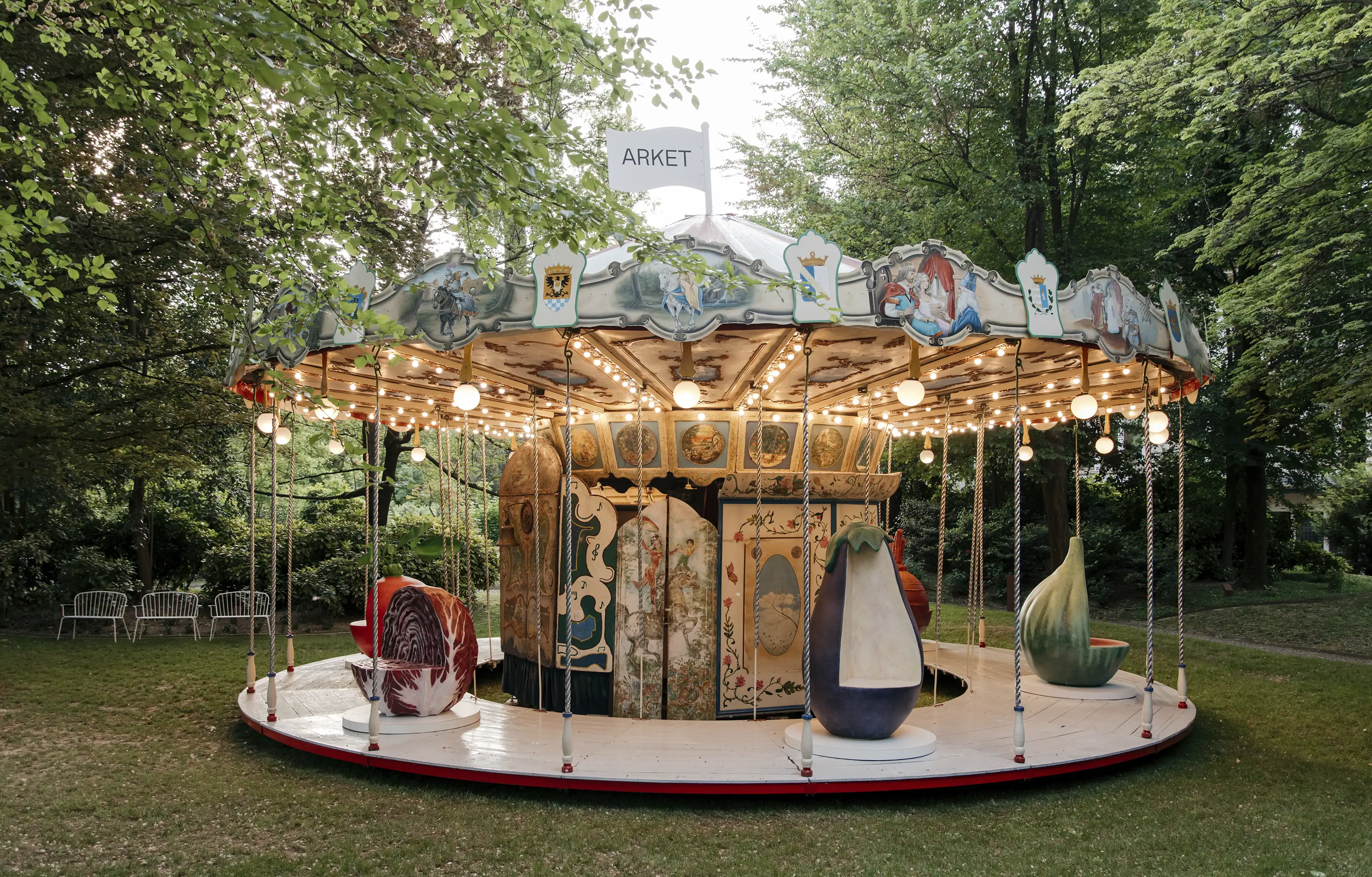
For the second Milan Design Week running, Laila Gohar has enlarged an ordinary object into something you can climb inside. In 2025 it was a bed. In 2026 it is a genuine eighteenth-century German carousel, kept in the same family for generations, its horses replaced with human-scale fruit and vegetables. Both years the installation doubled as a launchpad, and this year what it launched is her first collection in fashion.
Introduction
ARKET and Laila Gohar presented a reimagined carousel at Giardino delle Arti, Via Palestro 8, Milan, from 20 to 24 April 2026, open 12pm to 8pm daily during Milan Design Week. The ride’s original figures were replaced with sculptural, human-scale fruit and vegetables, among them apples, pears, radishes, aubergines, figs and cabbages, each one cut once to work as a seat, rotating slowly against the garden behind it. The installation also marked the launch, on 21 April, of Gohar’s first ready-to-wear collection, a 27-piece range made with ARKET, the Swedish brand owned by H&M Group.
What makes the carousel more than a photogenic prop is that it is not a prop at all. It is a real antique, and this is not the first time Gohar has spent a Milan Design Week turning something ordinary and domestic into a stage for a new collection.

A carousel with real papers, not a purpose-built stage
The carousel itself originates in Wiesbaden, Germany, a historic centre of woodworking craftsmanship, and is believed to date to the late 1700s. It has been passed down through generations of the same family, the Degli Innocentis, and survives today as one of only a handful of carousels of its type and age still in working order. Its festive fairground lighting and intricate floral illustrations, original to the ride, were left untouched. An ARKET flag was added to its crown, and that appears to be the only other alteration beyond the seats themselves.

That distinction matters more than it might first appear. A newly built carousel dressed to look old would have been a considerably easier brief, and nothing in the installation’s presentation would have told a visitor the difference. Gohar and ARKET instead sourced and restored a genuine, two-century-old fairground object and worked within what it already was, replacing only what needed to move for people to sit down. The single clean cut into each piece of fruit, the detail every outlet covering the installation singled out, is a restrained enough intervention that it reads less like a design flourish and more like a rule Gohar set herself: change only what has to change.

The second year running Gohar has enlarged something domestic
This is Gohar’s second consecutive Milan Design Week installation, and both have followed the same underlying structure, though nobody covering the carousel has connected the two. At Milan Design Week 2025, Gohar and the Finnish textile brand Marimekko presented All the Things We Do in Bed, a larger-than-life bed installation inspired by the tradition of communal sleeping, which doubled as the debut presentation for a bedding capsule collection built around Maija Isola’s stripes. A year later, the format repeats almost exactly: an object everyone recognises from childhood or domestic life, built at a scale that turns sitting or lying down into a shared, faintly theatrical act, timed to launch a new product category for Gohar with a different brand.

The two projects are not identical, and the shift between them is the more interesting fact. A bed is private; a carousel is public and always was built for strangers to share. Moving from Marimekko’s bedroom to ARKET’s fairground tracks a matching move in what Gohar herself was launching: a bedding collection meant for a home, and a ready-to-wear collection meant to be worn out into the world. The installation’s format is following the collection’s own logic outward, not just repeating a successful idea.
Both installations also lean on an inherited tradition rather than an invented one. The 2025 bed drew explicitly on the age-old custom of communal sleeping; the 2026 carousel is not a reference to fairground history but an actual two-century-old fairground ride, borrowed rather than built. The two are not the same kind of borrowing, a custom in one case and a physical object in the other, but the underlying habit is consistent: Gohar reaches for something with a history longer than the collection she is launching, rather than inventing a stage set with no history behind it at all. That habit, repeated across two separate collaborations and two separate brands, reads as a genuine part of how she works rather than a coincidence of what happened to be available each year.

Laila Gohar’s food theatre, at furniture scale
Gohar was born in Egypt in 1988 and now works between New York, London, Paris, Milan and Venice. She built her reputation on sculptural food design: polished butter carvings, oyster shell installations, a life-size armchair made from bread, and 2021’s Pigeon Table, work that treated eating and hosting as material for theatre rather than as a service to be arranged around a design object. She co-founded Gohar World, an artisanal tableware and lifestyle house, with her sister Nadia in 2022, guest-edited Wallpaper*, and writes a regular column on hosting for the Financial Times supplement HTSI. Her collaborations span Prada, Simone Rocha, Hermès, Comme des Garçons, Sotheby’s and Perrier-Jouët, alongside a 2022 homeware collection called Sobremesa for the Danish brand HAY and a capsule collection the same year for the perfume house Byredo.

That background explains why the ARKET carousel reads as more than a novelty object. Gohar has spent her career finding the theatre already latent in ordinary domestic ritual, mostly through food, and the carousel is what that instinct looks like once it is applied to something you ride rather than something you eat. Enlarging a fig or a radish to human scale is not a new material or a new medium for her. It is the same trick of scale and familiarity she has used on butter and bread, moved onto a fairground ride built two hundred years before she was working in either.
The choice of produce is not incidental either. Apples, pears, radishes, aubergines, figs and cabbages are the ordinary, everyday produce that has run through Gohar’s table settings and food sculptures for a decade, the same register of humble ingredient she has always favoured in her work. Putting them on a carousel rather than a table is a change of venue, not a change of vocabulary.

What actually changed about the ride
Each fruit and vegetable seat was defined by scale, placement and a single clean cut, the minimum intervention needed to let a visitor sit down. Gohar has described the approach in terms of accessibility rather than spectacle: “We wanted to create something open and inclusive, something that invites people in, rather than asks them to observe from a distance. A carousel felt like a natural way to do that. It’s familiar, physical, and meant to be shared.” She has also spoken about the symbolism of the object itself: “A carousel is about joy. It’s so symbolic of childhood and of play.”

Beyond the seats, the carousel’s structure, lighting and painted floral decoration remained as found. Visitors could also collect a ticket redeemable at the ARKET Milan store, and an ARKET café ran throughout each day of the installation, both of which kept the piece functioning as a place to spend an afternoon rather than an object to photograph and leave.
That distinction between a photographed object and a used one runs through the whole installation. A carousel only finishes making its argument once someone sits down and it turns, which is a different kind of demand to place on a visitor than simply asking them to look. Five days and eight hours a day is a short window for a piece built around that kind of participation, and the café and the ticket giveaway both work in service of the same idea: keeping people in the garden long enough to actually ride it, rather than pass through and photograph it from the gate.

A first fashion collection riding along beside it
The 27-piece collection launched on 21 April, available in ARKET stores and online, and marks Gohar’s first full entry into ready-to-wear after more than a decade working in food, tableware and homeware. Materials range from compact cotton through to silk organza, and the range balances workwear references, aprons and work jackets among them, with more delicate, hand-finished pieces carrying beading and embroidered monograms applied by hand. The combination reads as a considered translation of Gohar’s own visual language into a new material: the workwear pieces carry an echo of the aprons and uniforms that appear throughout her food and hospitality work, and the embroidery brings the same handmade specificity she has applied to butter and bread into fabric.
Gohar has described the guiding idea behind the collection as the belief that beauty should be accessible in the everyday, shaped by surprise rather than reserved for formal occasions. The carousel makes a physical argument for the same idea: a ride built for anyone who wants to climb on, styled with the same produce-as-material logic as the clothes launching alongside it.

ARKET’s own case for the pairing
ARKET was launched by H&M Group in 2017, opening its first store on Regent Street in London and going online across eighteen European markets simultaneously. The brand has described itself from the outset as a modern-day market, a broad but selected range of functional, timeless essentials. A carousel restored rather than rebuilt, seats cut rather than manufactured from scratch, sits comfortably with that stated identity: ARKET’s own pitch has always rested on restraint and utility, and lending its name to an installation that makes exactly one intervention into a genuine antique is a fairly literal demonstration of the same instinct.

Nine years after that Regent Street opening, ARKET has continued expanding at a similarly measured pace, adding stores across Europe and launching on the marketplace Zalando to reach markets it does not yet serve directly. A Milan Design Week installation is a different kind of expansion, not into a new country but into a new collaborator’s own creative language, and Gohar’s carousel is the clearest sign yet of a brand willing to hand its name to someone else’s idea rather than commission a version of its own house style.

Frequently asked questions
What is the ARKET x Laila Gohar carousel?
A reimagined antique carousel at Milan Design Week 2026, with its original figures replaced by human-scale fruit and vegetable seats, created by the artist Laila Gohar in collaboration with the Swedish brand ARKET.
Where and when did it take place?
At Giardino delle Arti, Via Palestro 8, Milan, from 20 to 24 April 2026, open 12pm to 8pm daily.
What is the carousel’s history?
It is a genuine antique carousel from Wiesbaden, Germany, believed to date to the late 1700s, passed down through generations of the Degli Innocenti family and among only a handful of carousels of its type and age still functioning.
What did Laila Gohar actually change about it?
Each seat is an oversized fruit or vegetable sculpture, defined by scale and a single clean cut for sitting. The carousel’s original structure, lighting and painted floral decoration were left as found.
What is the collection launching alongside the installation?
A 27-piece ready-to-wear collection, Gohar’s first full fashion collection, launched on 21 April 2026 in ARKET stores and online, using materials from cotton to silk organza with hand-applied beading and embroidery.
Has Laila Gohar done a Milan Design Week installation before?
Yes. At Milan Design Week 2025 she presented All the Things We Do in Bed with the Finnish brand Marimekko, a larger-than-life bed installation that launched a bedding capsule collection.
Who is Laila Gohar?
An Egyptian-American artist, born in 1988, known for sculptural food design and for co-founding the tableware house Gohar World with her sister Nadia. She has collaborated with Prada, Hermès, Comme des Garçons and HAY, among others.
Final thoughts
The easiest version of this installation would have been a new carousel built to look old, with nothing lost if a visitor never noticed the difference. ARKET and Gohar chose the harder version instead: a genuine two-hundred-year-old ride, restored rather than replicated, altered only where a body needed to sit. That choice is consistent with everything else Gohar has built her career on, finding the theatre already sitting inside an ordinary object rather than inventing a new one, and it is the second year running she has used exactly that instinct to launch something new. A bed became a stage for sleepwear in 2025. A carousel has become one for clothes in 2026.


Leave a Reply