
ART & CULTURE · MIAMI
Reading time: 9 minLeandro Erlich built a traffic jam of 66 cars and trucks from 330 tons of compacted sand on the Miami Beach shoreline, then let the tide and the wind take it apart over fifteen days. The material was the argument: nothing built from sand can outlast the water it sits beside. Six years on, the same artist and the same curator have turned that argument into something permanent.
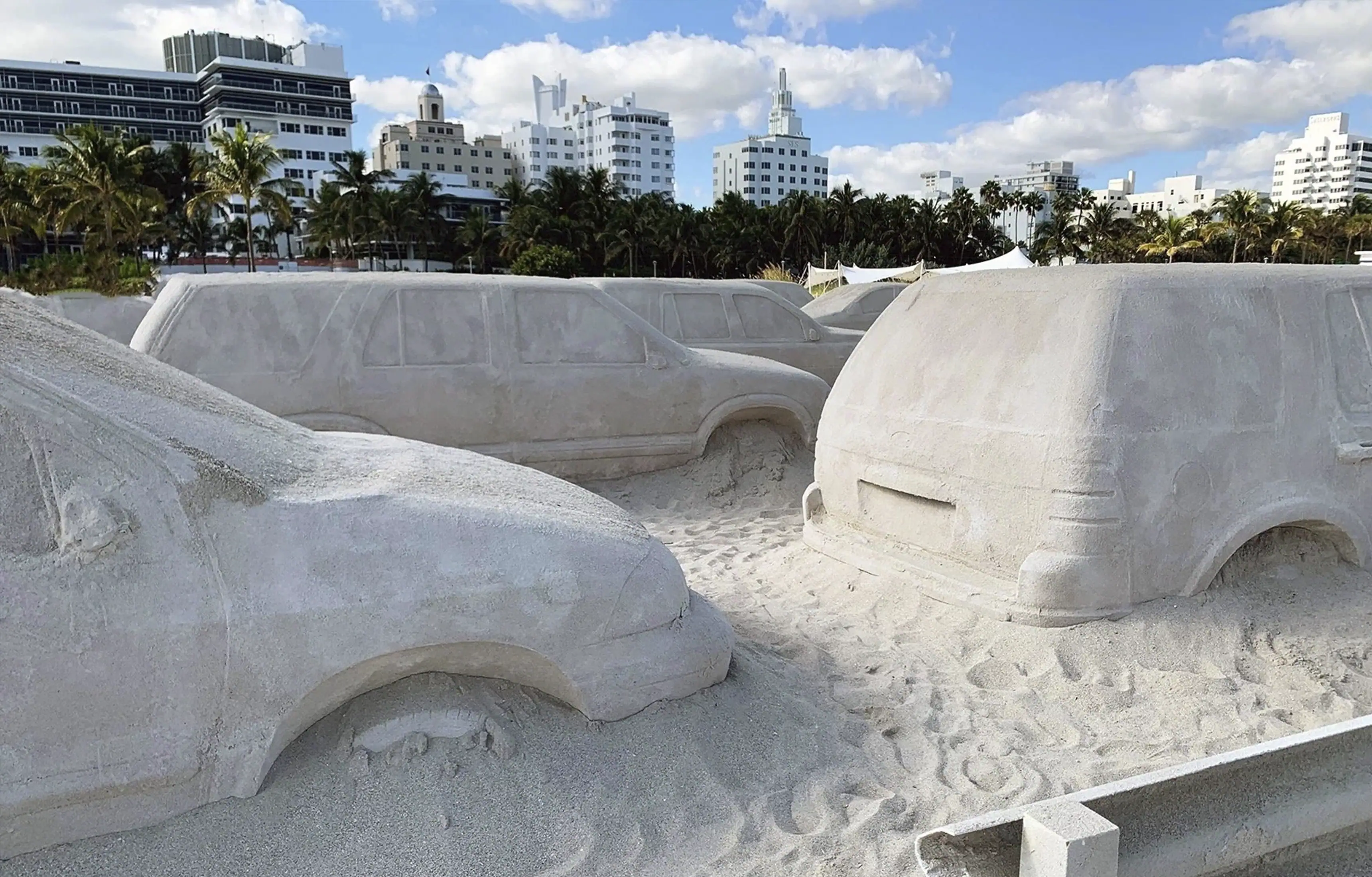
For two weeks in December 2019, a stretch of the Miami Beach shoreline at Lincoln Road looked as though the tide had caught rush hour off guard. Sixty-six vehicles, sedans and pickups and one unmistakable school bus among them, sat nose to tail in two facing lanes, their bodies rendered in exact, sand-coloured detail down to wing mirrors and door handles. Some stood clear of the beach. Others had already gone half under, roofs and bonnets breaking the surface like something surfacing, or sinking.
The artist behind it, the Argentine sculptor Leandro Erlich, called the piece Order of Importance, and he built it to fail. Every vehicle was sand, packed and carved with no armature to hold it together, and every vehicle was left on an open beach to be worked over by wind, rain and salt air for fifteen days before the City of Miami Beach restored the sand ahead of the winter season. That is not a description of a work that went wrong. It is the work.
Order of Importance was commissioned by the City of Miami Beach for Miami Art Week 2019, timed to the week each December when Art Basel Miami Beach turns the city into the art world’s largest annual gathering point. It was, by the artist’s own account, the largest installation he had built at that point in a career built almost entirely on large installations. What makes it worth returning to now is not only what it argued about rising water. It is what happened to the argument afterwards, when the same curator who commissioned the sand cars decided that a fortnight was not long enough for the point to land.

Sixty-six cars, three hundred and thirty tons of sand
The scale of Order of Importance is the first thing to register. Erlich and his production team used an estimated 330 tons of sand to build the sixty-six vehicles, arranged in two rows facing each other across a central divider, exactly as they would sit in a stalled highway queue. Each car was carved and compacted individually, life-size, with enough definition in the bodywork that particular models were recognisable from a distance.
The installation sat directly on the beach at the Lincoln Road oceanfront, at the water’s edge rather than set back from it, so that the vehicles closest to the shoreline were already within reach of the surf on the day the piece opened. Erlich placed the most exposed cars so that they would be the first to lose their form, sinking into wet sand as the tide worked at their base and their edges softened into the beach around them. Vehicles further from the water held their shape longer, which meant the installation read differently depending on where a visitor stood in the two weeks it was on view: an orderly, almost showroom-precise queue of cars at one end, and a row of collapsing, half-submerged hulks at the other.
That range, from crisp to ruined, was the entire point. A sand sculpture has no long-term future by definition, and Erlich built the work to make that fact do the talking. Rather than a plaque or a wall text carrying the argument about sea level rise, the argument was structural: watch a solid, recognisable object lose its edges to water over a fortnight, and you have watched, in miniature and at speed, the process the piece was actually about.

The artist behind the illusion
Erlich was born in Buenos Aires in 1973, into a family of architects; his father, brother and aunt all worked in the profession, and he has said in interviews that architecture’s vocabulary, of thresholds, rooms and structure, shaped his own work even after he chose sculpture over the family trade. He trained in the Core Program at the Museum of Fine Arts, Houston, and today lives and works between Buenos Aires, Montevideo and Paris.
He built his reputation on works that use architecture against itself: familiar domestic and civic structures rebuilt at scale, then tilted, mirrored or otherwise made to behave in ways solid buildings do not. Swimming Pool, created in 1999 and shown at the Venice Biennale in 2001 representing Argentina, is the clearest example and remains his best-known piece. It appears to be a conventional in-ground swimming pool, its water visibly rippling, until a visitor descends a staircase at its edge and walks beneath the “water” in a dry room lit blue from above; the illusion depends on a thin layer of real water held over a sheet of glass. A version of Swimming Pool is installed permanently at the 21st Century Museum of Contemporary Art in Kanazawa, Japan, and MALBA in Buenos Aires exhibited it as the centrepiece of Erlich’s major 2019 retrospective, Liminal.
Dalston House, built in London in 2013 for the Barbican’s public programme, works the same trick at civic scale: a full Victorian terrace facade laid flat on the ground, paired with a 45-degree mirror suspended above it, so that visitors lying or climbing on the horizontal facade appear, in the mirror, to be scaling or dangling from a vertical building. Both works share the method that runs through Order of Importance: build the real, physical thing at full scale and let a simple physical principle, water, gravity, a mirror, do the work of dismantling the viewer’s certainty about what they are looking at.
Why sand, and why let it fail
Order of Importance took roughly three months to plan and build before it opened, according to Erlich, and the decision to work in sand rather than a more durable material was deliberate from the start. Concrete, resin or fibreglass could have produced the same sixty-six cars with a far longer public life. Sand produced cars that could not survive the two weeks they were asked to stand.
“Climate change and its consequences are no longer a matter of perspective or opinion,” Erlich said of the piece. “The climate crisis has become an objective problem that requires immediate solutions. As an artist, I am in a constant struggle to make people aware of this reality, particularly the idea that we cannot shrink away from our responsibilities to protect the planet.”
The work was curated by Ximena Caminos and Brandi Reddick for the City of Miami Beach, part of a public art programme that has used Miami Art Week to commission ambitious, site-specific work directly on the beach and along the boardwalk rather than confining art to the fair halls inland. Caminos described the piece at the time as reading “like an image from a contemporary Pompeii or a future relic,” alluding, in her words, to “our fragile position in the large universal canvas” and to the rising sea level Miami Beach was already contending with through its stormwater pump programme and street-raising projects. Commissioning a work about that risk, sited on the beach where the risk is most visible, put the city’s own long-term thinking on public display alongside the art fair crowds it was hosting that week.

Two other elegies built to disappear
Order of Importance was not Erlich’s first work to use disappearance as its subject. In 2015, as part of the Nuit Blanche festival, he installed Maison Fond on the forecourt of the Gare du Nord in Paris: a nineteenth-century Directoire townhouse, modelled closely on a real building on the Rue de Grenelle, rendered nearly seven metres tall and appearing to melt, its walls and windows slumping as though the structure itself were made of wax. The title carries a pun that does not survive translation into English: “maison fond,” house melts, is a near-homophone of “mes enfants,” my children, turning a picture of a dissolving building into a direct address to the generation that will live with the consequences. Unlike the Miami sand cars, Maison Fond was built to be durable rather than to erode on schedule, and it stood at the station forecourt for six years before it was dismantled in March 2021.
Earlier still, in 2008, Erlich contributed Window and Ladder Too Late for Help to Prospect.1, the first edition of the triennial founded in New Orleans in the aftermath of Hurricane Katrina. Sited in the Lower Ninth Ward, the district that suffered the worst of the levee failures, the work was a freestanding sixteen-foot window frame with a ladder propped against it from outside, the exact image residents and rescuers associated with the rooftop escapes of the flood. It offered no figure, no rescue, only the apparatus of one that had not arrived in time. Where Maison Fond used a slow, engineered collapse and Order of Importance used real erosion, the New Orleans piece used absence: a single, still image standing in for an event the city did not need explained to it.
Read together, the three works form a consistent method rather than three isolated statements. Erlich does not illustrate environmental and climate risk with diagrams or data. He builds a full-scale, physically real object that embodies the specific mechanism of the risk itself, whether that is a house losing its structural integrity to heat, a doorway that arrived too late, or a car park’s worth of vehicles losing their form to the sea, and then lets the object’s own physical behaviour carry the argument.
From sand to permanent reef
The detail that has not made it into most accounts of Order of Importance is what happened to the idea after the sand went back into the beach. Ximena Caminos, who curated the 2019 installation, went on to found The Reefline, an underwater sculpture park now taking shape roughly 780 feet off the Miami Beach shoreline, in the stretch of water between 4th and 5th Streets. Its inaugural work, installed in late October 2025, is Erlich’s Concrete Coral: twenty-two marine-grade concrete vehicles, cast from the same near-life-size car forms, lowered some twenty feet underwater to serve as an artificial reef.
Where the sand cars were built to lose their form within a fortnight, the concrete cars are built to be colonised. Each vehicle is fitted to carry around a hundred native gorgonian soft corals, cultivated at the Miami Native Coral Lab and grafted onto the concrete bodywork, with the reef expected to fully establish over three to five years. Caminos has said directly that dismantling the sand version in 2019 is what set the later work in motion, describing her thinking as a question: how do you create something with the same impact that is not disposable. The traffic jam that was designed to sink into the sand for a fortnight has a sequel that is designed to sink permanently and grow a reef. It is the rare case of a temporary artwork’s central metaphor being taken literally, funded, engineered and put back into the same stretch of water six years later.

Final thoughts
It would be easy to read Order of Importance as a striking photograph from a single art week and leave it there: a clever sandcastle at scale, gone by Christmas. That undersells what the piece actually did. Erlich did not build sixty-six cars and then explain climate risk to the people walking past them. He built an object whose only possible fate, on that stretch of beach, was to lose its shape to the water, and let visitors watch it happen in real time over a fortnight.
The stronger case for the work is what it set in motion. A commission that was designed to disappear turned out to be the opening move in something built to last: a curator who watched the sand cars go under and decided the next version should sink on purpose, permanently, and grow a reef while it did. Few temporary public artworks get to prove their point twice, once as a warning and once as a solution engineered from the same image six years later. Miami Beach now has both.
What is Order of Importance?
Order of Importance is a public art installation by the Argentine artist Leandro Erlich, consisting of 66 life-size cars and trucks sculpted from roughly 330 tons of compacted sand and arranged as a traffic jam on Miami Beach.
Where was Order of Importance located?
The installation stood directly on the beach at the Lincoln Road oceanfront in Miami Beach, Florida, at the water’s edge.
When did Order of Importance run?
It was on view for Miami Art Week 2019, running through 15 December 2019, after which the City of Miami Beach restored the beach ahead of the winter season.
Who commissioned Order of Importance?
The City of Miami Beach commissioned the work, curated by Ximena Caminos and Brandi Reddick.
Why did Leandro Erlich use sand rather than a permanent material?
Sand let the work embody its own subject. Built to erode under wind, rain and tide over the two-week run, the installation’s physical collapse stood in for the rising sea levels and flooding risk it addressed.
What is Leandro Erlich best known for?
Erlich is best known for Swimming Pool (1999), a full-scale illusion of an in-ground pool that visitors can walk beneath while staying dry, and for Dalston House (2013) in London, which used a horizontal building facade and a suspended mirror to make visitors appear to climb a vertical wall.
Is there a connection between Order of Importance and Erlich’s later work?
Yes. Ximena Caminos, who curated Order of Importance, later founded The Reefline, an underwater sculpture park off Miami Beach. Its first installation, Concrete Coral (2025), reworks the same car motif in submerged, marine-grade concrete built to host coral growth.
Can Order of Importance still be seen today?
No. It was a temporary installation and the beach was restored on schedule in December 2019. Erlich’s related concrete car sculptures are now installed permanently underwater as part of The Reefline.


Leave a Reply