
ART & CULTURE · LONDON
Reading time: 7 minThe LUXART Battersea Power Station installation stood for nine days this May, a structure built entirely from air and PVC in the shadow of the site’s four chimneys, its glowing chambers designed specifically for the location by the Nottingham studio Architects of Air. The company’s founder did not start out as a designer. He started out running a 1980s probation scheme that built inflatables with people doing community service, for children who otherwise had nowhere colourful to play, and that origin still shapes every luminarium the studio makes, LUXART included.
Introduction
LUXART, a luminarium designed by the artist Alan Parkinson for Architects of Air, stood in Power Station Park at Battersea Power Station from 23 to 31 May 2026, open to the public for £10 a ticket across the May half-term. It has since been taken down, packed away and, per the studio’s own working method, will eventually be recycled once its exhibition life is over, which means the piece that follows describes a structure that no longer stands on that site rather than one still waiting to be visited.
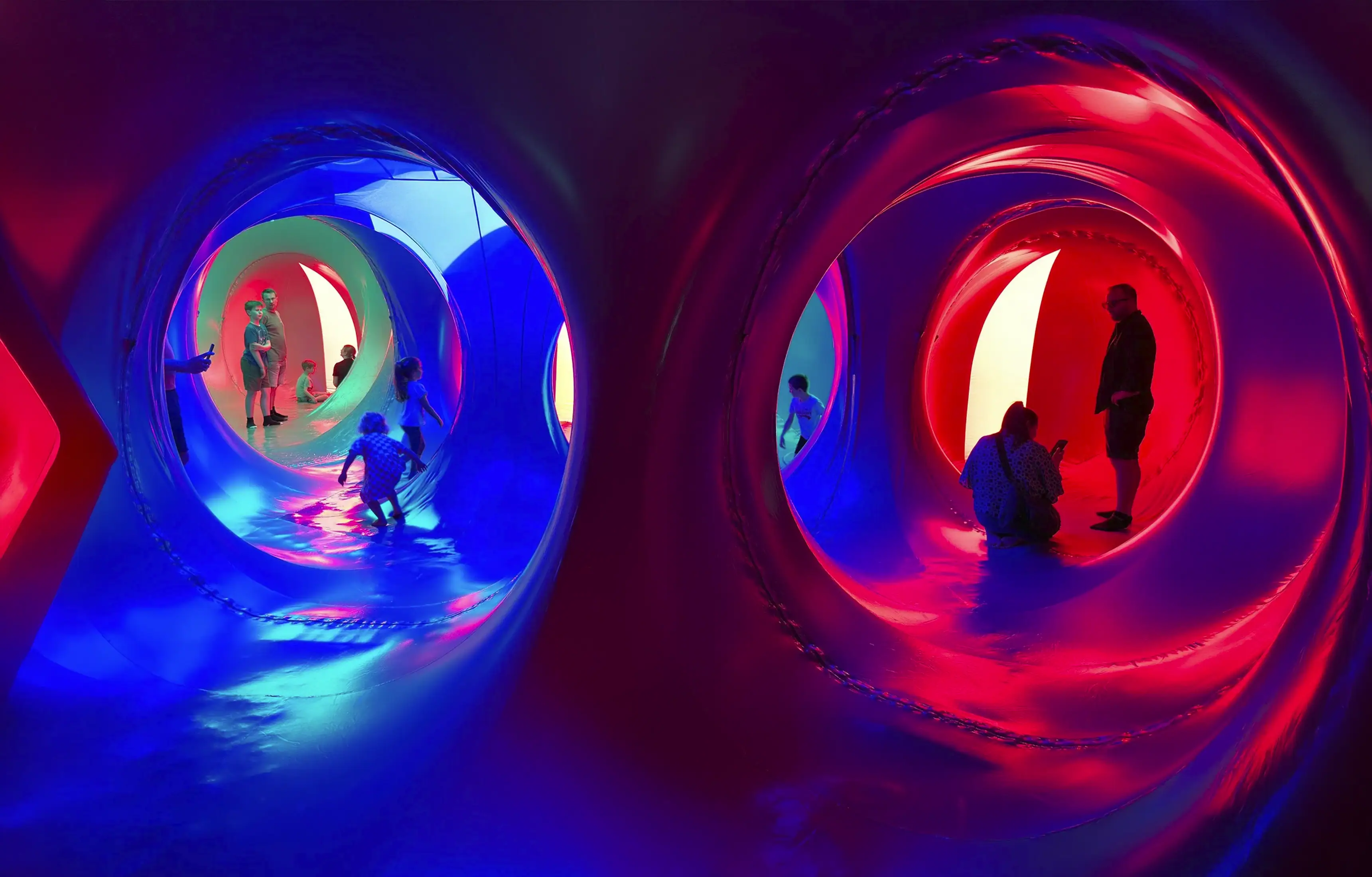
A luminarium is not a bouncy castle with better lighting, though it is built using the same basic technology, pressurised air holding up a skin of coloured plastic. Architects of Air has spent more than three decades refining that technology into something closer to inhabitable architecture: chambers you walk through rather than jump on, built from spheres, cones and cylinders and shaped by principles borrowed from Gothic rib vaulting, Islamic muqarnas ceilings and the catenary curves Antoni Gaudí used to let a structure hold its own weight. LUXART, built specifically for Battersea rather than adapted from an existing touring design, was the studio’s most recent attempt to put that architecture in front of a London audience, and it did so a short walk from one of the most monumental brick buildings in Europe.

The company that grew out of a probation scheme
Architects of Air was formally established in 1992, but its actual origin goes back a decade earlier, to 1982, when Alan Parkinson began supervising a community service project for the Nottinghamshire Probation and Aftercare Service. Working with the magistrate Ethel Swann, Parkinson developed what became known as the Windbag Inflatable Project, a ten-year scheme that gave people doing court-ordered community service the job of building inflatable play structures for inner-city children and children with special needs who had little access to that kind of experience otherwise. The project culminated in 1990 with Eggopolis, the first structure recognisable as what the studio now calls a luminarium. When the charity that had hosted the scheme closed, Parkinson kept building independently, and Architects of Air was incorporated two years later specifically to manage a twenty-eight city tour of Germany.
That history matters for a reason beyond biography. Architects of Air’s stated design principles, on light and colour, on wheelchair access, on keeping ticket prices low and building word-of-mouth rather than marketing spend, all trace back to a scheme built to give people without much access to art or architecture a genuinely wondrous experience rather than a decorative one. Parkinson has described the effect the structures still have on him directly: “When I enter one of our Luminaria, I’m still struck by the beauty of light and colour.” Thirty years and more than three million visitors after Eggopolis, that is not a founder’s tidy origin story. It is the same design brief the studio has been building to the entire time, including on the nine days LUXART stood at Battersea.
What LUXART actually looked like from the inside
Visitors entered LUXART through a yellow reception tent, used to orient the eye before the main structure, then passed through an airlock lit in shifting blue and red that marked the transition from outside to inside. The Green Dome came first proper, a threshold chamber rising 6.5 metres, before the route opened into a Red Chamber built around a form the studio calls the Radiant Red Tree. From there the path led into the Blue Helix Dome, six metres high and built around a spiralling tracery pattern drawn directly from Gaudí’s catenary work, then into a Golden Space marked by green structural columns and yellow skylights, and a Blue Tree Chamber before the sequence closed in a cupola finale built from the kind of sacred geometry, Platonic solids and Art Nouveau patterning that recurs across the studio’s touring designs. None of it was fixed decoration. Every dome, tunnel and chamber is a single-skin pneumatic structure, meaning the coloured plastic is doing the structural work as well as the visual one, which is why Architects of Air’s own design language treats form and colour as inseparable rather than colour as something applied afterwards.
The studio’s own design principles are unusually specific for a practice working at this scale. Its stated axioms include beauty in simplicity, colour without decoration, and a direct rejection of scale for its own sake, big is not beautiful, in the studio’s own phrasing. That is a striking rule for a structure sited a few hundred metres from the largest brick building in Europe, four chimneys and a turbine hall built to generate power for a fifth of London. LUXART did not compete with that scale. It offered the opposite experience at ground level in the park beside it, an intimate, walk-through structure built from air rather than masonry, its whole argument resting on colour, light and geometry rather than on size.

How a luminarium actually gets built
Every Architects of Air luminarium is hand-built in the studio’s Nottingham workshop from custom-cut PVC, a process that typically takes four to six months and around six people working from templates Parkinson originally drew by hand and now, working with his son and design partner Meko, models in three dimensions before a single piece of plastic is cut. A finished structure is expected to last roughly three hundred exhibition days across four years of touring before it is retired and recycled, a working lifespan the studio treats as a design constraint in its own right rather than an afterthought, since a structure inflated and deflated hundreds of times across dozens of countries has to survive that handling as well as look right once it is up. Parkinson has been candid about the material’s limits, noting a wish to eventually build luminaria from something more sustainable than PVC once a genuine alternative exists.
Accessibility runs through the same design brief as the material choice. LUXART, like the studio’s other structures, was built to be navigated in socks rather than shoes, food, drink and pets were kept out to protect the skin of the structure, and assistance dogs were accommodated by prior arrangement rather than excluded outright. None of that is incidental to a studio whose founding project was built specifically to bring an unusual, wondrous experience to people who might not otherwise encounter contemporary art or architecture at all.
Why Battersea Power Station commissioned it
LUXART ran as part of a wider May half-term programme at Battersea Power Station that also included an interactive flower-colouring installation by the artist Anna Bruder, a curated makers’ market over the bank holiday weekend, and the venue’s regular River Walk Market through the summer. Sarah Banham, the venue’s head of community and sustainability, described the intent behind the programme in plain terms: “We’re delighted to welcome visitors this May half-term with this exciting programme of unmissable immersive art and family-friendly experiences.” That framing sits LUXART inside a broader pattern at Battersea Power Station, alongside the site’s dedicated cultural venue, NEON, and its rotating exhibitions, of temporary, family-facing programming built to keep the wider development active between its permanent architectural set pieces. A nine-day luminarium in the park, priced at £10 rather than staged as a ticketed gallery event, fits that brief precisely, an accessible, short-run experience built for a mixed audience rather than a specialist one.
LUXART was also, by the studio’s own account, built specifically for this site rather than adapted wholesale from an existing touring design, which sets it apart from luminaria such as Katena, built around more than a hundred Gaudí-referencing catenary curves, or Pentalum, organised around the geometry of the dodecahedron, both of which tour largely unchanged from booking to booking. A bespoke commission is a heavier undertaking for a six-person permanent studio to take on for a nine-day run, and it is a reasonable measure of how seriously Battersea Power Station and Architects of Air both treated the brief that they built something specific to the site rather than simply shipping in whichever structure happened to be free that week.

Frequently asked questions
What was LUXART at Battersea Power Station?
A luminarium, an inflatable, inhabitable light sculpture, designed by the artist Alan Parkinson for the studio Architects of Air, built specifically for Battersea Power Station and sited in Power Station Park.
Can LUXART still be visited?
No. LUXART ran from 23 to 31 May 2026 and has since been taken down and packed away.
Who designed LUXART?
Alan Parkinson, founder of the Nottingham studio Architects of Air, working with his son and design partner Meko Parkinson.
What is Architects of Air’s history?
The studio grew out of a 1980s probation scheme in Nottingham that built inflatable play structures for inner-city children, formally becoming Architects of Air in 1992.
What are luminaria made from?
Custom-cut PVC, hand-built in the studio’s Nottingham workshop over four to six months per structure, using single-skin pneumatic construction where the coloured plastic provides both the structure and the light effects.
Final thoughts
A structure this delicate, held up by nothing but air, standing for nine days a few hundred metres from a power station built at industrial scale to burn coal, could easily have read as a stunt. LUXART did not, because the studio behind it has spent more than three decades building the opposite argument on purpose: that wonder does not require size, that colour does not need to be decorative to do real work, and that the people most worth designing for are not always the ones already inside the gallery. Alan Parkinson learned that running a probation scheme in Nottingham forty years ago, building inflatables with people doing community service so that children with little access to art could have something extraordinary to walk through. LUXART, briefly, in the shadow of London’s biggest chimney stack, was the same idea, sized for a single park and a single week.
Leave a Reply