
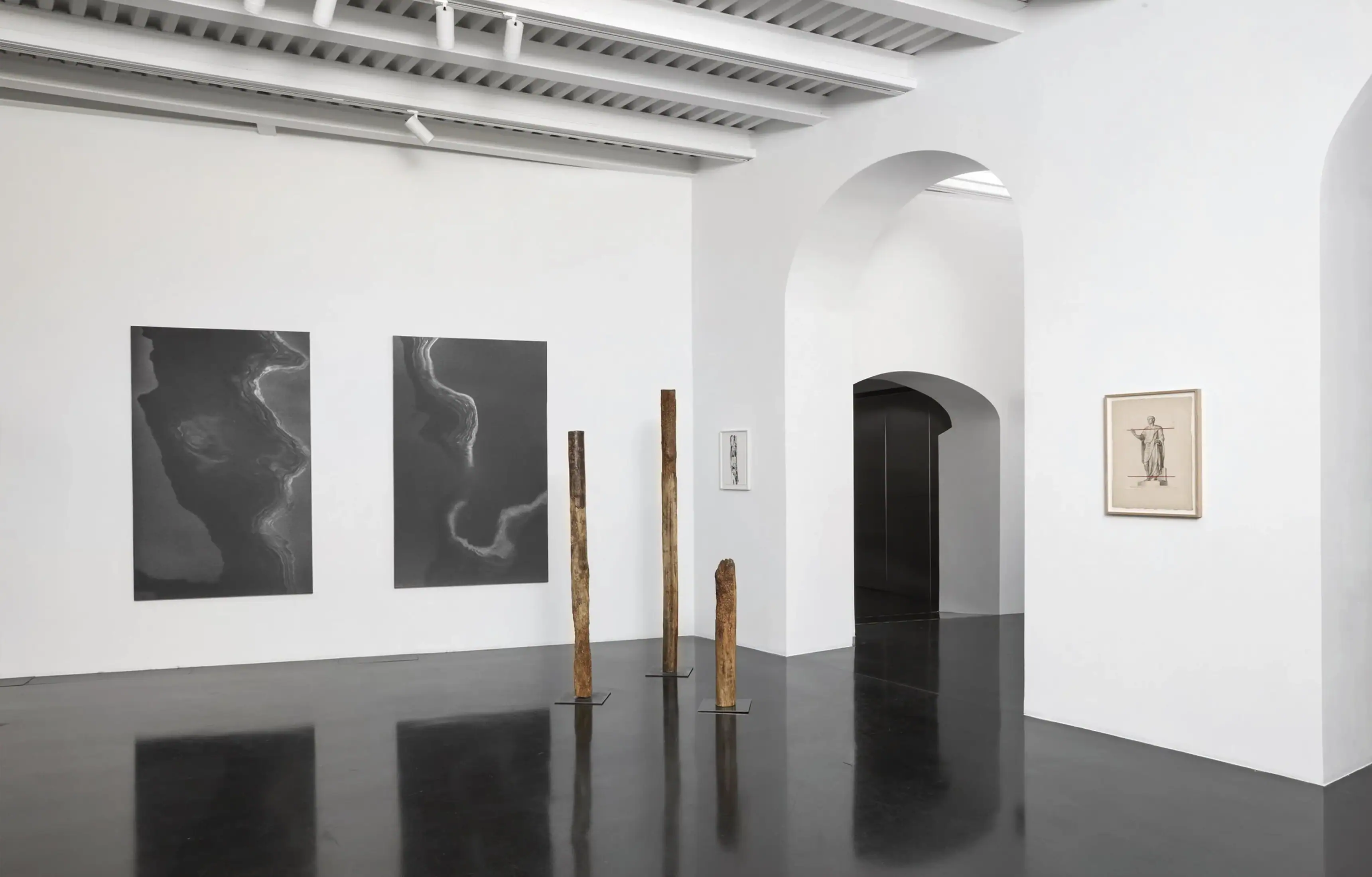
Nello Spazio closes a year-long trilogy staged inside Palazzo Rhinoceros, the Jean Nouvel-restored home of Alda Fendi’s foundation in Rome. Ten photographers and one installation artist take on space as their subject, in a building that sits in the one Roman neighbourhood built entirely on the idea of where things begin.
Introduction
Rhinoceros Gallery closes its year-long collaboration with the Paris photography gallery Bigaignon on 15 March 2026, with an exhibition called Atto 3/3: Nello Spazio, Within Space. Ten photographers and one installation artist take up space as their working material, inside Palazzo Rhinoceros, the restored seventeenth-century palazzo on Via del Velabro that Jean Nouvel completed for Alda Fendi’s foundation in 2018.
The address is not incidental to the argument. Velabro is, by Rome’s own founding legend, where the flooded Tiber set down the basket carrying Romulus and Remus. An exhibition about space, built around the idea that Rome’s urban fabric is itself a record of accumulated solids and voids, is showing inside the district the city names as its own point of origin. Nobody involved in the show has needed to say this out loud. The building already makes the argument.

A trilogy that ends where its subject was set down
Nello Spazio is the third and final act of a programme that Thierry Bigaignon, the Paris dealer, and Alessia Caruso Fendi, who has directed Rhinoceros Gallery since March 2024, built around photography’s three constituent conditions. Atto 1/3: Sotto la Luce (Under the Light) opened the sequence on 19 September 2025, with fifteen artists working across photography, painting, sculpture and installation. Atto 2/3: Col Tempo (With Time) followed on 26 November 2025. Nello Spazio, the closing chapter, opened on 18 January 2026 and runs to 15 March.


Bigaignon has framed the trilogy’s final subject as what “contains us and what we project,” and Rome, in his description, as “embodied memory: an accumulation of solids and voids, ruins and constructions.” That is a claim any city could make for itself. Velabro is where Rome makes it literally: a marshy lowland between the Palatine and Capitoline hills that the foundation myth names as the spot where the she-wolf found the twins who would go on to found the city. The Arch of Janus and the Arch of the Argentarii, both imperial-period monuments, still stand nearby as evidence of how quickly the site accrued significance once the story took hold.

Palazzo Rhinoceros did not arrive at that address by chance either. Alda Fendi, the youngest of the five sisters who built Fendi into a global house before stepping back from it, spent roughly a decade searching for a second Roman site for her foundation after an earlier renovation near the Forum turned up the remains of what is thought to be the largest ancient basilica yet found in the city, discovered under the gallery floor she was already fitting out. She eventually settled on three adjoining buildings in Velabro, originally a seventeenth-century trading post, standing derelict on the edge of collapse. Jean Nouvel, taking his first Rome commission, spent close to a decade restoring them into a single six-storey, 38,000 square foot complex: gallery floors, a 24-suite hotel, a cinema, shops and a rooftop restaurant, all under one roof Fendi describes as “a neighbourhood.” It opened on 11 October 2018 with a loan of Michelangelo’s Crouching Boy from the State Hermitage Museum.

Since March 2024, when Alda Fendi’s daughter Alessia Caruso Fendi took over the gallery’s direction, the programme has pursued international partnerships rather than a fixed collection, opening with a collaboration with Paris’s Galerie Kreo around the designer Ronan Bouroullec, and continuing through the Bigaignon trilogy now closing with Nello Spazio.


Naming the ten who make space a material rather than a subject
A press line about “space as photography’s deepest element” is easy to write and hard to substantiate. The value of Nello Spazio is in the ten photographers actually doing the substantiating, each working a different definition of the word.

Vittoria Gerardi shows from her Pompeii series, in which silver gelatin photographs of the excavated city are partially buried in plaster, so that only their upper edges surface as fragmentary, fluid lines. Each cast is numbered to the exact section of the site where the photograph was taken, so the finished pieces function less as images of Pompeii than as a second excavation, one that buries the picture in the same material that first preserved the bodies it commemorates.

Jean de Pomereu, a research associate at Cambridge’s Scott Polar Research Institute and co-author of Antarctica: A History in 100 Objects, works from Cold War-era aerial photographs of Antarctica originally shot for cartographic survey. He cuts and overlays the negatives to build topographies that did not exist in the original frame, using instruments of measurement to make an argument about how thoroughly human activity has already reshaped a landscape most people still describe as untouched.


Mary Ellen Bartley contributes from Morandi’s Books, made during a 2020 residency at Casa Morandi in Bologna, where she photographed the contents of Giorgio Morandi’s own library as sculptural objects rather than as texts. The Metropolitan Museum recently acquired a print from the series, which treats restraint as Morandi himself treated it: a discipline, not an absence.

Three photographers turn space into invention rather than record. Renato D’Agostin, born in Venice in 1983 and trained assisting Ralph Gibson in New York, shows from The Beautiful Cliché, Venezia, his stark black-and-white study of the city he grew up in, made after he returned to open a studio on its outskirts in 2018. Marco Tagliafico builds his images from acrylic paint on glass, cyanotype and silver salt prints taken from a smartphone, layering and veiling the results until the photograph behaves as an object with real depth rather than a flat window; his recent series Isole Immaginarie (Imaginary Islands) invents landscapes that hold together only as long as the layering does. Thierry Urbain, trained at the École des Beaux-Arts under Claude Viallat, photographs architecture and archaeological sites in black-and-white until they read as hieratic, occasionally labyrinthine spaces built more for contemplation than for use.

A fourth thread runs back decades. Yannig Hedel has worked exclusively in black-and-white analogue photography since the 1970s, tracing light and geometry across cityscapes for fifty years. Elyn Zimmerman, the American sculptor whose large-scale stone and water works include Marabar at the National Geographic Society and the 2016 Isamu Noguchi Award to her name, shows installation and mylar drawing from the same decade she began working outdoors, after a 1977 trip to India turned her towards site-specific stone. Bernard Joubert, working since the early 1970s, shows from his Rubans series: ribbon markers he installed in the streets of Paris, New York, Brussels and Venice between 1972 and 1981, geometric forms left deliberately unresolved. And the show includes photographs by Denis Malartre, who abandoned representational photography after a 1986 trip to New York and spent the following two years scratching and deconstructing negatives for a series called Les Objectales, before stopping altogether in 1988. Malartre died in 2017. His inclusion here, alongside nine living photographers, is the exhibition’s quietest argument: that a body of work can keep making its case for space long after the person who made it has stopped being able to argue for it themselves.


The installation that argues the same point without a camera
One floor below the photographs, Olivier Ratsi‘s Frame Destruct runs for the length of the whole trilogy rather than just its final act. The piece uses LED fixtures, wire and polycarbonate to construct eight sequential stages of a square imploding, generated through 3D simulation and staggered in physical space so that walking around the 815cm installation reveals a different point in its own collapse. Ratsi built the work using chronophotography, the same nineteenth-century technique that first let photographers break motion into discrete, sequential frames, and the debt shows: Frame Destruct is less a sculpture than a single exposure spread out across a room, asking a viewer to do with their feet what a camera shutter would otherwise do in an instant.
Its presence for the full six months gives the trilogy something none of the three acts could argue alone: a fixed point that light, then time, then space could each be measured against. First shown at the Echolyse solo exhibition in Landerneau in 2023, it now sits underneath ten photographers making variations of the same claim it makes with hardware, that a boundary is never as fixed as it looks from just one angle.

Why a photography gallery is arguing about buildings
The design case for Nello Spazio is that photography, a medium that produces flat rectangles, has been made to argue about three-dimensional structure without leaving the frame. Gerardi’s plaster does it by adding a third material dimension to a print. De Pomereu does it by re-cutting an existing image until it describes a landscape the original photographer never saw. Ratsi does it without a lens at all, building the argument directly in space and letting photography’s own history of sequential exposure supply the logic.
That is a more specific claim than “photography explores space,” and it is the one worth taking from the building rather than the wall text. A gallery that occupies six floors of a restored Roman palazzo, sitting on a site whose own layered occupation runs from a Bronze Age marsh through an imperial arch to a 2018 restoration, is not a neutral box for hanging pictures in. It is itself an argument about accumulated space, and Nello Spazio is the first of the trilogy’s three chapters built inside a venue that was already making its point before a single photograph went on the wall.

Frequently asked questions
What is Atto 3/3: Nello Spazio?
Nello Spazio (Within Space) is the third and final chapter of a photography trilogy staged by the Paris gallery Bigaignon in partnership with Rhinoceros Gallery in Rome, running from 18 January to 15 March 2026 at Palazzo Rhinoceros.
Where is Palazzo Rhinoceros?
Palazzo Rhinoceros is at Via del Velabro 9, in Rome’s Velabro district, close to the Forum and the Arch of Janus. It was restored by Jean Nouvel for Alda Fendi’s foundation and opened in October 2018.
Who curates the Bigaignon x Rhinoceros trilogy?
The programme is led by Thierry Bigaignon, director of the Paris gallery Bigaignon, and Alessia Caruso Fendi, who has directed Rhinoceros Gallery since March 2024.
Which artists are showing in Nello Spazio?
Vittoria Gerardi, Jean de Pomereu, Marco Tagliafico, Yannig Hedel, Elyn Zimmerman, Mary Ellen Bartley, Renato D’Agostin, Thierry Urbain, Bernard Joubert and Denis Malartre show photographic work, alongside Olivier Ratsi’s separate installation, Frame Destruct, on the palazzo’s first floor.
What were the first two chapters of the trilogy about?
Atto 1/3: Sotto la Luce (Under the Light), which opened in September 2025, explored light across fifteen artists’ work. Atto 2/3: Col Tempo (With Time), which opened in November 2025, took time as its subject.
Is Nello Spazio free to visit?
Yes. The exhibition is open to the public at no charge during Rhinoceros Gallery’s stated hours.
Final thoughts
A trilogy about photography’s foundational elements could easily have stayed an in-house curatorial exercise, three group shows linked by a shared premise and not much else. What closes it properly is the coincidence its organisers did not manufacture: a building about accumulated space, in the one part of Rome the city names as where it started accumulating in the first place. Ten photographers and one installation artist spend Nello Spazio proving that photography can argue about three dimensions from inside two. The palazzo they are showing in was already proving it before they arrived.
Leave a Reply