
ART & CULTURE · LONDON
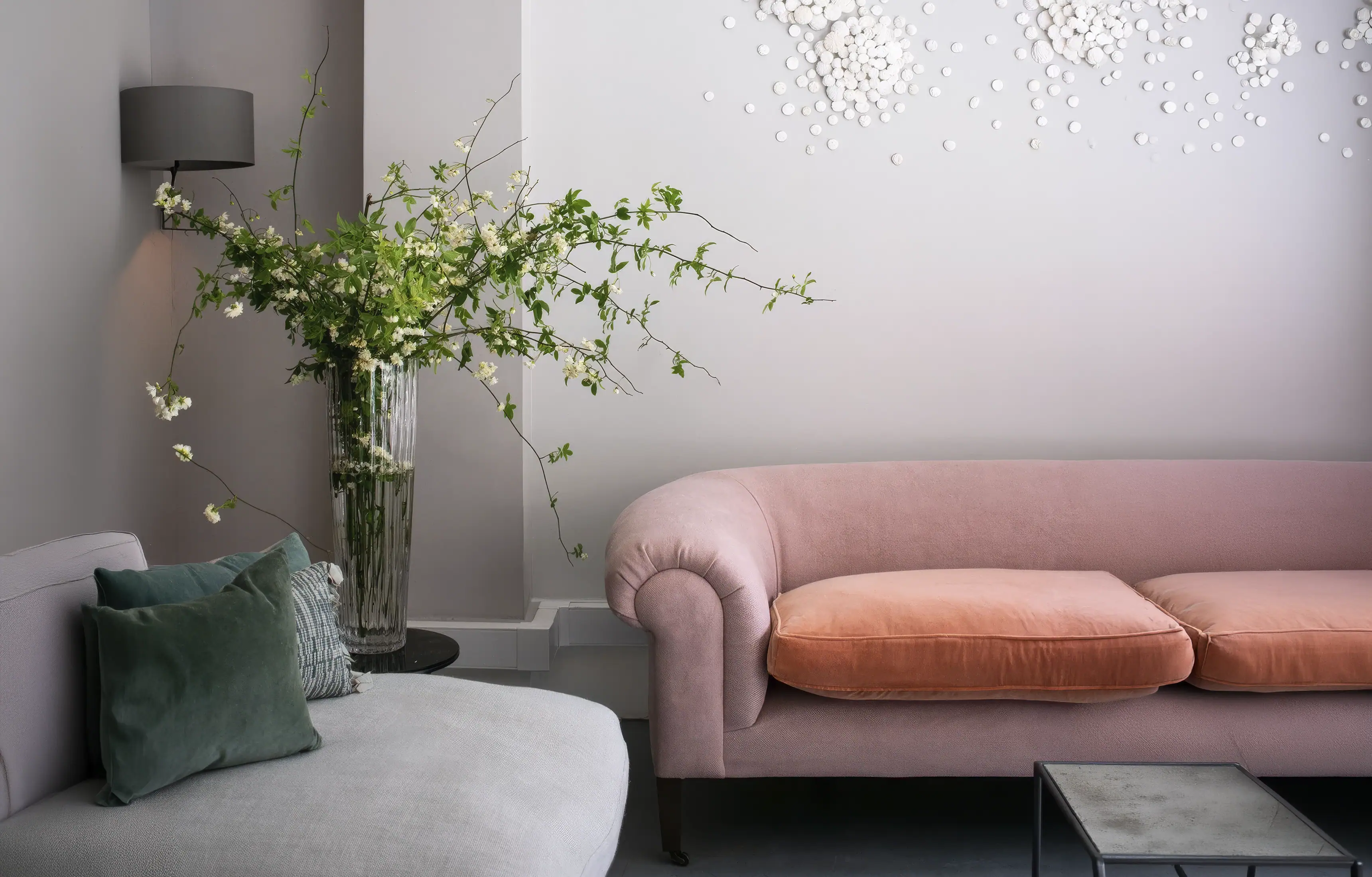
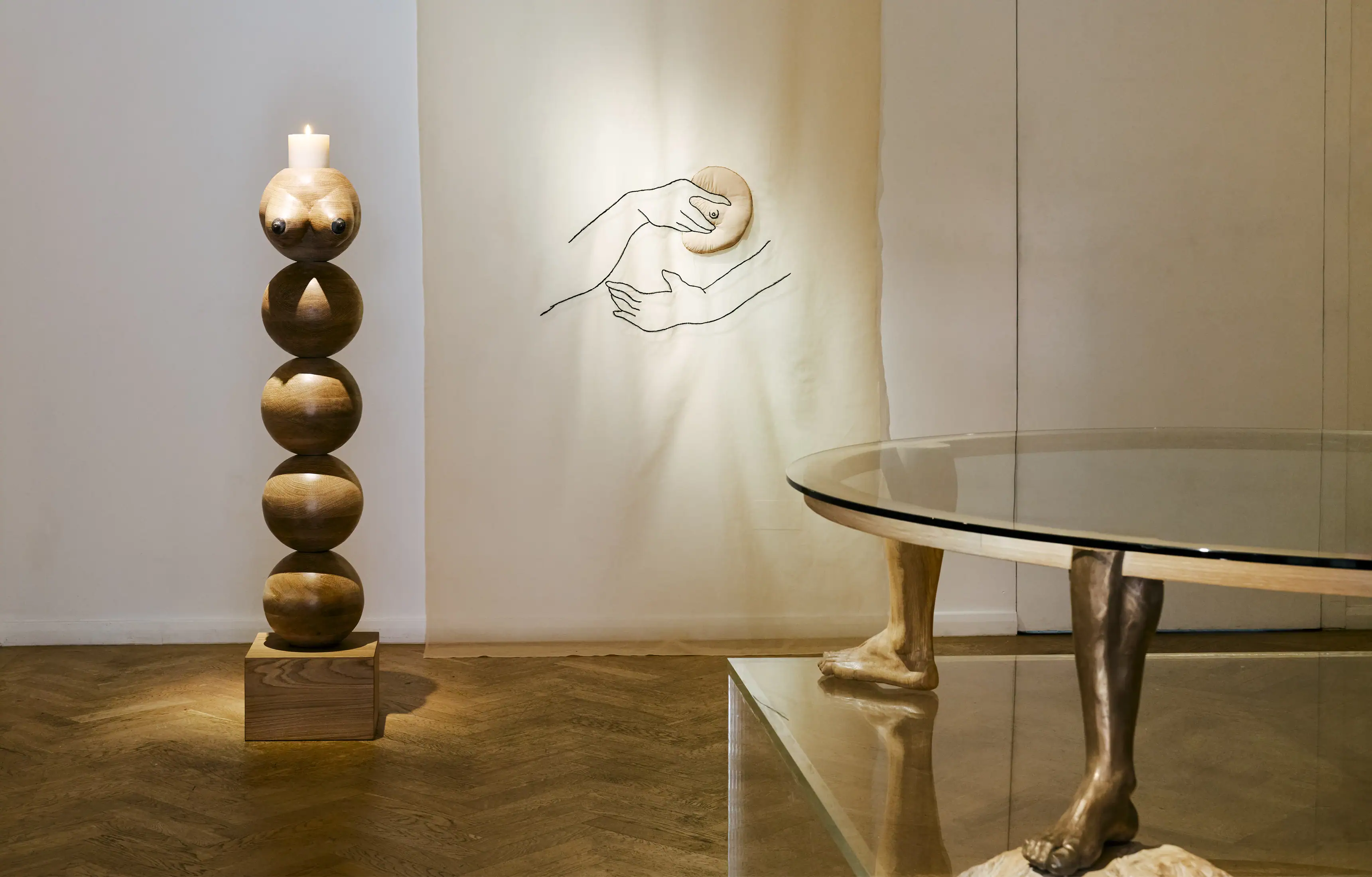
Reading time: 10 minFor three weeks in the summer of 2018, OCHRE turned its Clerkenwell showroom over to twelve independent makers curated by Flow Gallery, standing hand-carved ceramics, turned wood vessels and enamelled forms alongside its own furniture and lighting. The pairing was not incidental. Nearly every maker in the show works by putting material through some kind of transformation, fire, weather or time, which is the same instinct OCHRE applies to bronze, horn and porcelain.
OCHRE opened its Britton Street showroom to Flow Gallery for Clerkenwell Design Week 2018, running an exhibition from 23 May to 14 June that placed twelve craft artists working in ceramics, wood and enamel directly among the British furniture and lighting brand’s own pieces. Clerkenwell Design Week itself ran its main three days from 22 to 24 May, and OCHRE kept the show open for a further three weeks afterwards, giving the collaboration a longer life than the festival that hosted its opening.

The venue was OCHRE’s own showroom at 46 to 47 Britton Street, a short walk from Farringdon station and one of the addresses that makes Clerkenwell the design festival’s natural home. Flow Gallery, the Notting Hill gallery founded by Yvonna Demczynska, brought the artists. OCHRE, founded in 1996 by Joanna Bibby and Harriet Maxwell Macdonald, with Solenne de la Fouchardière joining as a third partner and designer in 2000, brought the furniture and the room.
What the pairing produced was less a trade show display than a working argument about material. OCHRE’s own pieces are built from FSC-approved wood, bronze, horn, glass and porcelain, chosen for what happens to them under a maker’s hand rather than for how they look on a spec sheet. Flow Gallery’s twelve artists make that same argument from the opposite direction: ceramicists who trust a kiln to finish what a wheel started, and wood turners who let a damp log dictate its own final shape.

OCHRE, and the room the show was staged in
OCHRE has spent close to three decades building a reputation on restraint rather than spectacle. Bibby and Maxwell Macdonald founded the company in 1996 around a shared instinct for understated luxury, and de la Fouchardière’s arrival four years later brought a third design voice into a partnership that has stayed close-knit ever since. The brand describes its own aim as discreet glamour, built on harmonious proportion, luxurious material and craftsmanship carried out by hand rather than by machine.

Materially, that translates into FSC-approved timber, leather made from industry by-products, horn, bronze, glass, porcelain and natural fibres, along with an algae-based alternative to petroleum foam in its upholstery. It is a materials list that reads like a craft gallery’s inventory, which is precisely why lending the Britton Street showroom to twelve independent makers cost the brand nothing in coherence. The pieces on the walls and the pieces on the floor were speaking the same material language.
The Britton Street address matters beyond convenience. Clerkenwell’s design showrooms cluster around Clerkenwell Green, Great Sutton Street and the surrounding grid precisely because the area has been London’s design trade quarter since the nineteenth century, when its workshops supplied instruments, jewellery and printing. A luxury furniture brand hosting a gallery show inside its own trading showroom, rather than at a neutral fair stand, put the exhibition inside the working context the pieces were made for rather than a temporary booth built to be dismantled on Sunday night. OCHRE had made the same case a month earlier in Milan, launching new pendant collections at Rossana Orlandi’s Milan Design Week presentation that April.

Flow Gallery, and the case Yvonna Demczynska has built for craft
Flow Gallery has operated from Needham Road in Notting Hill since the late 1990s, founded by Yvonna Demczynska on a straightforward premise: that contemporary craft, ceramics, glass, textile, metalwork and jewellery made by hand, deserves the same serious attention as fine art. Demczynska has cited Kettle’s Yard, the Cambridge house and gallery where art and everyday objects share the same rooms, as the model for how she wants collectors to live with the work she represents, treating a hand-thrown pot or a carved vessel as something to be lived with and passed on rather than displayed once and forgotten.
That philosophy is why the OCHRE showroom made sense as a venue. Demczynska’s roster is built around makers whose work rewards close, repeated looking, exactly the kind of attention a furniture showroom, where visitors sit in chairs and handle materials rather than filing past a plinth, tends to invite. The Clerkenwell exhibition put that theory into practice for three weeks, letting Design Week’s trade visitors encounter studio ceramics and turned wood in a room built for touching things rather than roping them off.

The kiln as the real subject: ceramics that trust fire to finish the work
Four of the twelve makers worked in clay, and each treats the kiln as an active collaborator rather than a neutral finishing step. Hans Vangsø, the Danish potter based in Mols on the Jutland peninsula, builds his glazes through a process that goes well beyond a single firing. His pieces pass through a homemade gas kiln several times, wrapped in paper saggars packed with salt, seaweed and metals, at temperatures around 1300 degrees Celsius. What comes out is not a glaze sitting on a clay surface but what Vangsø describes as a total melting of glaze and body together, a genuinely alchemical process that produces the rich, mineral colour and texture his pots are known for. Vangsø trained at the Jutland Academy of Fine Arts in Aarhus under Gutte Eriksen, who once praised the sheer wildness of his firings, a fair description of a technique that treats unpredictability as a design tool rather than a risk to be engineered out.

Nina Malterud, the Norwegian ceramicist who headed the ceramics department at the Bergen Academy of Art and Design and later served as its rector, showed large glazed disks whose colour and texture draw on Nordic folk decoration and Mediterranean palettes she has studied over a career stretching back to 1975. Her work sits in Norwegian public buildings, including large decorative commissions for the University of Tromsø and Sandvika Courthouse, and her disks in the Clerkenwell show carried the same confident, flattened form into a domestic context.
Vezzini & Chen, the London studio formed by the Italian ceramicist Cristina Vezzini and the Taiwan-born glass artist Stan Chen after they met as students at the Royal College of Art, showed Shades of White, a wall installation of hand-carved ceramic discs mounted on perspex and inspired by winter landscape. The piece extends a practice built on the pair’s shared interest in nature and growth, worked out through Vezzini’s ceramic carving and Chen’s glass, where gravity and heat are allowed to shape a form before any tool touches it.
The Dutch studio of Maarten Kolk and Guus Kusters, working from Eindhoven, showed pieces from their Withering Tableware series, fine porcelain first developed in 2013 for the design house Thomas Eyck. The series translates the visible decay of cut flowers, petals curling and colour fading, into painted glaze and form, part of a wider practice built on returning to techniques the pair have developed across earlier commissions rather than starting each new piece from nothing.

Wood, worked with rather than against
Two woodworkers in the show approached timber from opposite directions and arrived at a similar honesty about the material. Hans Henning Pedersen, based in the fishing village of Gudhjem on the Danish island of Bornholm, deliberately turns bowls from wet, imperfect wood rather than seasoned, stable stock, because he wants the timber to keep moving after it leaves the lathe. As it dries, the wood warps and settles into a shape no drawing could have predicted, walls sometimes turned down to as little as three millimetres, with a single piece taking months of turning followed by up to four months of drying before it is finished. Pedersen has worked with Bornholm timber since opening his own studio in 1972 and became a recognised master turner in 1980, a career built on trusting the wood to have the final say.

Eleanor Lakelin, working from London, takes the opposite starting point, choosing British timber from trees that have already been felled through decay, disease or storm damage, and carving vessels that keep the evidence of that decline visible in the finished surface. Her sculptural bowls read the grain, the rot pockets and the erosion in a trunk as material history rather than as flaws to be turned away, a practice that has since taken her work into the Victoria and Albert Museum, the Museum of Arts and Design in New York and the Museum of London. Pedersen chases the movement still left in living wood; Lakelin chases the record already written into dead wood. Between them, the two approaches cover most of what a woodturner can ask timber to do.

Pattern, decay and the miniature form
The remaining makers pushed clay towards surface and scale rather than fire. Lisa Stockham builds her vessels outward from decorative pattern rather than applying pattern to a finished form afterwards, working textured surfaces that reference weathered textile and worn architectural detail so that, in her own description, the decoration becomes the structure. Joanna Still, trained at Harrow School of Art and shaped by residencies with indigenous potters in Nigeria, Ethiopia and Mexico, works unglazed stoneware on the wheel, favouring low-temperature reduction and smoke firing that lets the clay and the fire, rather than a glaze recipe, determine the final surface.
Rowena Brown, who trained in fashion at Central Saint Martins before moving into ceramic sculpture, showed miniature house forms, typically sets of four sculpted individually and reassembled after firing, each between eight and twelve centimetres tall. The houses read as both self-contained and grouped, a small community of separate structures standing close together, and Brown has described the work as holding two competing needs at once: the pull towards individual autonomy and the pull towards belonging. She fires the pieces in an electric kiln at low temperature, a practical choice that sits alongside a broader environmental discipline in how she runs her practice.

The connection the flat exhibitor list does not draw out
Read individually, the twelve makers look like a broad survey of British and European craft. Read together, a sharper pattern appears. Vangsø’s saggars, Pedersen’s wet wood, Lakelin’s decayed timber, Malterud’s fired clay and Kolk and Kusters’ painted decay are all versions of the same working method: hand the material to a process, fire, weathering, drying, and let that process finish a decision the maker only partly controls. Almost none of the twelve pieces on show were fully resolved by the maker’s hand alone. Each depended on a kiln, a season of drying, or years of accumulated timber decay to become what it became.
That is also, quietly, the same argument OCHRE makes about its own furniture. A hand-rubbed bronze finish, a hide chosen for its natural grain, a piece of horn kept in its irregular original form rather than machined smooth: these are all decisions that trust material behaviour over total design control. Putting twelve makers who build entire practices around that trust inside a showroom built on the same principle was not simply convenient scheduling around Clerkenwell Design Week. It made the showroom’s own furniture legible in a way a catalogue photograph rarely manages.

What the showroom gave Clerkenwell Design Week
OCHRE and Flow Gallery’s exhibition offered something closer to a study room than a launch. Visitors moving through Clerkenwell could stop at Britton Street and see furniture and studio craft sharing a floor, with nothing roped off and nothing marked as more important than anything else in the room. The three-week run, well beyond Design Week’s own three days, meant the show was never solely a festival fixture. It gave London collectors, and the trade visitors who returned to Clerkenwell after the festival crowds thinned, a genuine window to spend time with twelve practices that rarely appear together under one roof.

Final thoughts
It would be easy to describe OCHRE x Flow Gallery as a furniture brand lending its walls to a gallery for a fortnight, a nice piece of Design Week programming and little more. What actually happened in that Britton Street showroom was more specific than that. Twelve makers whose practices depend on handing material to a process it cannot fully control, a kiln, a season of drying, decades of timber decay, stood inside a showroom built by three designers who apply exactly the same trust to bronze, horn and porcelain. The exhibition did not need to argue that craft and luxury furniture belong in the same room. For three weeks in Clerkenwell, they simply were.

What was OCHRE x Flow Gallery?
A group exhibition during Clerkenwell Design Week 2018, in which the furniture and lighting brand OCHRE hosted twelve craft artists curated by Flow Gallery inside its own Clerkenwell showroom, displaying ceramics, wood and enamel work alongside OCHRE’s furniture and lighting.
Where and when did it take place?
At OCHRE’s showroom, 46 to 47 Britton Street, Clerkenwell, London EC1M 5UJ, running from 23 May to 14 June 2018, overlapping with Clerkenwell Design Week’s main three days of 22 to 24 May.
Who curated the exhibition?
Flow Gallery, the Notting Hill gallery founded by Yvonna Demczynska, which specialises in contemporary craft and applied arts including ceramics, glass, textile and metalwork.
Who founded OCHRE?
Joanna Bibby and Harriet Maxwell Macdonald founded OCHRE in 1996. Solenne de la Fouchardière joined as a third partner and designer in 2000.
Which artists were featured?
Confirmed makers include Vezzini & Chen, Nina Malterud, Hans Vangsø, Hans Henning Pedersen, Eleanor Lakelin, Studio Maarten Kolk and Guus Kusters, Lisa Stockham, Joanna Still and Rowena Brown, among twelve artists in total.
What materials and techniques did the show cover?
Ceramics fired using specialist and homemade kiln techniques, turned and carved wood vessels, enamel work, and hand-built sculptural forms, spanning makers based in Denmark, Norway, the Netherlands and the United Kingdom.
Is OCHRE’s Britton Street showroom open to the public?
Yes, it operates as OCHRE’s London trading showroom, open through the working week, and it continues to host events during Clerkenwell Design Week each year.

Leave a Reply