
ART & CULTURE · LONDON
Reading time: 8 minMost designers draw a form and then find a way to make it. Paul Cocksedge sets up a physical situation, applies a force, and lets the material arrive at the shape on its own. Reflections put four bodies of work in one building, and read as four different answers to the same question: what happens if you stop designing one move earlier than usual?
Paul Cocksedge: Reflections ran at Carpenters Workshop Gallery, Ladbroke Hall from 22 May to 19 September 2025, alongside a new monograph published by Phaidon. It brought together roughly a decade and a half of work, including the first gallery showing of a piece made in 2013, and two series that had only recently begun.
Read as a survey it is a designer’s greatest hits. Read as a method it is something tighter, because all four bodies of work in the building operate the same way. In each of them Cocksedge builds a set of conditions, introduces a force, and hands the last decision to physics. Gravity does the shaping in two of them. Pressure does it in a third. A core drill does it in the fourth.
That is unusual enough to be worth setting out object by object.

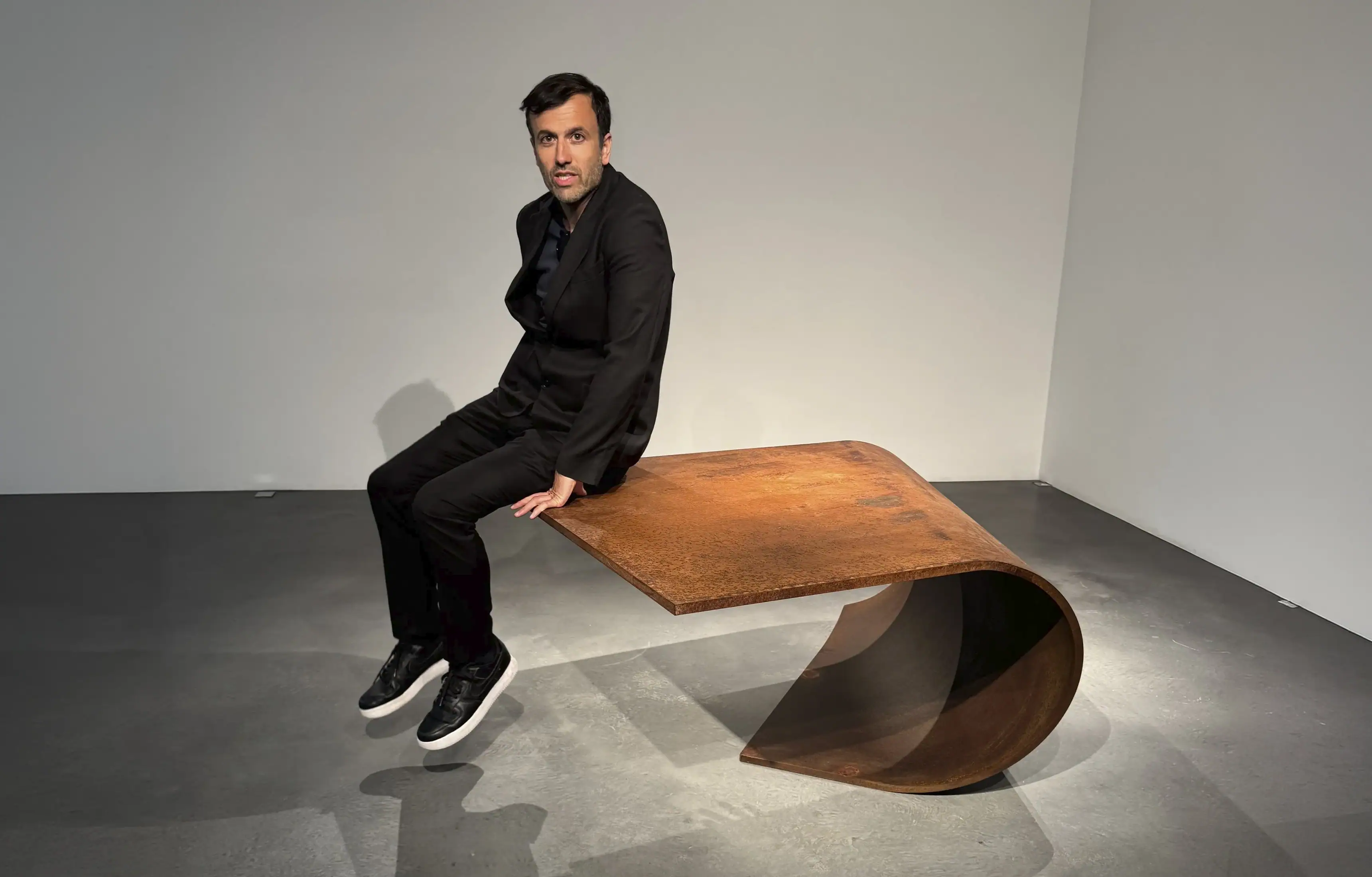
Poised: half a tonne that behaves like a feather
Poised was made in 2013 and had never been shown in a gallery before this exhibition.
It is a single sheet of steel, weighing around half a tonne, that runs flat for most of its length and then curls under itself into a deep scroll at one end. There is no visible support of any other kind. The rolled portion sits on the floor and the flat portion cantilevers out from it, unbraced, ending in a corner that hangs in the air.
The piece looks precarious and is not. A person can sit on that outer corner, feet clear of the floor, and nothing tips, shifts or complains. The mass in the curled end is doing exactly the job it was calculated to do, and the calculation is the design.
What makes it worth a room to itself is that the object gives you no help in reading it. Steel of that thickness looks heavy from across a gallery, and the geometry looks like it should fall. Neither impression survives contact. The work is an argument about how badly the eye judges weight when it cannot see the fixings, and the only way to settle it is to put a person on the end.
That is the pattern for everything else in the building.

Excavation: the floor he was made to leave
Excavation began in 2017, and its origin is not a metaphor. Cocksedge’s east London studio was subject to eviction, in the ordinary way that happens to workspaces in a city where the ground is worth more than what is made on it. Rather than leave with nothing, he took the floor.
Hundreds of cylindrical cores were drilled out of the studio’s concrete slab. Each is roughly the diameter of a fist, and each carries in its cut face the exact aggregate it happened to pass through: flint, brick, gravel, the odd void. No two are alike, because a concrete floor is not a designed material. It is whatever the batch contained and however it was poured.

In the Sliced Core Table the cores are packed upright into a dense oval drum, shoulder to shoulder, some of them sliced lengthwise so the flat face shows the section rather than the end. A large round sheet of glass rests straight on top of them, and small lights sit down among the cylinders so the whole base glows amber from inside and the aggregate reads like the section of a cliff.
Seen at Ladbroke Hall, with a raw concrete column rising through the same room and a set of Jean Prouvé Standard chairs pulled up to the table, the piece is doing something quietly funny. A studio floor that was taken away from a designer is now the only thing in the room you would be allowed to eat off.
Cocksedge has been direct about what the series is for: it is about how precarious a creative practice’s position in a city actually is. But the object does not argue that in words. It argues it by being made of the specific building he had to leave, in pieces small enough to carry.

Squeeze: pressure kept as a shape
The Squeeze series began in 2024 and takes up the two long walls of one of the ground-floor rooms.
Each work is a large black-framed panel, close to floor to ceiling, filled with mirror that has been formed into soft, rounded, pillow-like volumes. Four or five of these lobes meet inside a single frame, and where they touch they do not meet in a line. They meet in a seam that curves, the way two cushions pressed together produce a valley rather than an edge.
The effect on the reflection is the point. Across the flat of each lobe the room comes back almost normally, so you see the gallery, the windows, the concrete column, the Excavation table. As the surface turns towards a seam it compresses, and the reflection folds and slides. Standing in front of one, the room appears four or five times at slightly different scales, and the joins between those versions are where the eye keeps going.
Smaller works from the same idea sit on plinths in the window bay, squeezed into the round rather than flattened into a panel, in polished metal that behaves like something pinched between two fingers and then left.
Cocksedge has described the relationship between the forms in intimate rather than technical terms: there is an intimacy in the way they come together, he has said, almost like a parent and child, soft and protective and connected. It is a description of a physical result, and it is accurate to what the objects look like, which is two soft things holding each other under pressure.

Slump: gravity at working temperature
Slump is the newest series, extended for this exhibition, and it is the clearest statement of the method because the design step is almost entirely removed.
Sheet glass is laid over an object and heated until it stops behaving like a solid. Gravity then pulls it down over whatever is beneath, and the glass takes the shape of the thing it is draped across. When it cools, that moment is fixed.
The Slump Bubble Table puts a round sheet over a tight cluster of upright metal cylinders of different diameters. The glass sags into every open tube, so the finished top is a field of circular wells of varying size and depth, each with a thick rounded rim where the glass gathered as it fell. Between them the surface stays flat. The cylinders remain as the base, dark and patinated, visible through the wells they created.
The Slump Rock Drop coffee tables are simpler and stranger. A rough sandstone boulder stands on the floor. A disc of textured glass has been slumped over its peak, so the sheet drapes outwards like a wide brim with a puckered summit where the rock pushed through. Three of them stand together in one room, the same operation performed on three different stones, and the differences between the results belong entirely to the stones.
Seen from above, one of them is remarkable: the glass around the rock reads as frosted and granular, and where it met the stone under heat it has taken on teal and ochre, colour that arrived from the contact rather than from a decision.
Nobody drew any of those forms. Cocksedge chose the glass, chose the object underneath, and chose the temperature. The shape is the consequence.

The method, and where it comes from
Cocksedge was born in 1978, took a degree in industrial design at Sheffield Hallam and then an MA in product design at the Royal College of Art, completed in 2002, studying under Ron Arad. He founded his studio in 2004 with the fellow RCA graduate Joana Pinho, and works from Hackney. His practice runs from small objects through to public installations: Orbits in 2018, Please Be Seated in 2019, Loop in 2022, Coalescence at Liverpool Cathedral in 2023.
The through-line across all of it is a preference for finding out rather than deciding. A designer who wants total control specifies a form and asks a fabricator to reach it. Cocksedge specifies a situation and finds out what the material does. It is a slower way to work, because the first several attempts tell you about the process rather than about the object, and it produces results that cannot be exactly repeated, which is why these pieces sit in a collectible design gallery rather than in a catalogue.
It also explains why the four series hold together as one exhibition despite looking nothing alike. Steel that will not tip, a floor turned into a table, mirrors compressed into cushions and glass poured over a rock are four different materials given four different forces. In every case the finished object is a record of what happened, held still.
The title covers more than it appears to. Squeeze reflects the room back at you and Slump reflects light through itself, so the word does its literal work. But the show is also a designer looking back over fifteen years and noticing that he has been doing the same thing the whole time.

Frequently asked questions
What was Paul Cocksedge: Reflections?
A solo exhibition at Carpenters Workshop Gallery, Ladbroke Hall in London, running from 22 May to 19 September 2025, bringing together roughly fifteen years of work alongside a new monograph published by Phaidon.
What is Poised?
A steel sculpture from 2013, weighing around half a tonne, in which a flat sheet curls into a scroll at one end and cantilevers unsupported from it. The balance is calculated so a person can sit on the free corner without it moving. Reflections was its first gallery showing.
What is the Excavation series?
Work begun in 2017 from cores drilled out of the concrete floor of Cocksedge’s east London studio after it was subject to eviction. The Sliced Core Table packs hundreds of those cores into a drum beneath a round glass top, with the cut faces showing the aggregate of the original slab.
What is the Squeeze series?
A body of work begun in 2024 in which mirror is formed into soft, rounded volumes that meet along curved seams, framed as large panels or made as smaller objects in the round. The reflection distorts where the surfaces turn towards each other.
What is the Slump series?
Work in which sheet glass is heated over an object until gravity pulls it into shape. It includes the Slump Bubble Table, where glass sags into a cluster of metal cylinders to form circular wells, and the Slump Rock Drop coffee tables, where a glass disc is draped over a sandstone boulder.
Who is Paul Cocksedge?
A British designer born in 1978, who took an MA at the Royal College of Art under Ron Arad in 2002 and founded his studio in 2004 with Joana Pinho. He works from Hackney across objects, sculpture and public installation.
Where is Ladbroke Hall?
79 Barlby Road, London W10 6AZ. It is Carpenters Workshop Gallery’s London home, combining exhibition spaces with performance, dining and events.

Final thoughts
There is a version of this exhibition that would have been about materials, and it would have been true: steel, concrete, mirror and glass, handled with unusual confidence.
The better reading is about authorship. Every object in Reflections was made by deciding when to stop deciding. The scroll of steel finds its own equilibrium. The concrete cores bring their aggregate with them. The mirror settles where the pressure puts it. The glass goes wherever the rock and gravity agree.
That leaves a designer whose real skill is knowing which force to introduce, and how far to let it run. Which is a harder discipline than drawing a shape, and considerably harder to fake.

Leave a Reply