
ART & CULTURE · MIAMI
Reading time: 9 minPulse Art Fair spent its fifteenth December on the sand at Indian Beach Park, three blocks from Art Basel’s convention centre crowds, doing what it had always done: putting emerging and mid-career galleries in front of collectors without the scale of its neighbours. One booth built its entire presentation inside Microsoft Excel, another cast brushstrokes directly into acrylic, and a third had spent over a decade photographing the reconstruction of the World Trade Center. Within a year the fair itself folded into a rebranded event, making the 2019 edition the last Pulse ever held on Miami Beach.
Indian Beach Park sits at 4601 Collins Avenue, a strip of public oceanfront a short walk north of the hotels where most of Miami Art Week’s crowds gather. For four days in December 2019, a tented fair went up on that stretch of sand and grass: Pulse Art Fair, marking its fifteenth year in business and its fifteenth appearance during Miami’s December art calendar. Roughly sixty five galleries exhibited, a deliberately compact number that let a visitor see the whole fair properly in an afternoon. Pulse had built its identity since 2005 around a specific proposition: emerging and mid-career galleries, shown at accessible price points, in a setting sized for close attention rather than sheer volume.

Nadia Arnold
The 2019 edition ran under the tagline “The Calm in the Palms,” complete with a beachfront Wellness Lounge, hammocks, and oceanside dining from Malibu Farm. Fair director Cristina Salmastrelli framed the programming plainly: the aim was to relax visitors enough that “the eye can actually ingest the beautiful art,” a deliberate contrast to the sprint most collectors run through the roughly sixteen major fairs that fill Miami Beach, Wynwood, Downtown and Allapattah that week. Whatever the setting did for its visitors’ attention spans, what filled the booths that December deserved it. A Kyiv gallery brought an artist who builds his images entirely from spreadsheet software. A New York gallery devoted to hand-cast sculpture pushed acrylic into forms that read as frozen brushwork. And a fair built on discovery closed out its own fifteen year run within the same twelve months, a detail that gives the 2019 edition a significance nobody exhibiting that December could have anticipated.

Art Bond New York
A Kyiv gallery, and a fair built inside a spreadsheet
Voloshyn Gallery, founded in Kyiv in 2016 by Max and Julia Voloshyn and based in a converted 1913 building on Tereshchenkivska Street, brought two Ukrainian artists to Indian Beach Park who worked in almost opposite registers.

Voloshyn Gallery
Igor Gusev, born in Odesa in 1970 and trained at the Odessa Art School under painter Vladimir Krishtopenko, showed Mister Nobody, a series of wall-mounted figures caught mid-motion. Gusev’s practice runs wider than painting alone. He is the founder of the underground Odesa gallery Norma and a leading figure in the Art Raiders movement, and his work has appeared in the First Kyiv International Biennial of Contemporary Art in 2012 alongside painting, performance, film and installation. Mister Nobody carried that multidisciplinary instinct into a single wall piece: figures rendered with enough blur and displacement that they read as caught between frames of a film rather than fixed in a single pose, an anonymity built directly into the title.

Voloshyn Gallery
The gallery’s second artist worked in a medium few visitors to an art fair would expect. Oleksiy Sai, born in Kyiv in 1975 and trained in painting at the National Academy of Visual Arts and Architecture of Ukraine, builds his images entirely inside Microsoft Excel. The technique, which Sai has developed since first showing an Excel-based satellite map series at Tsekh Gallery in Kyiv in 2007, treats the spreadsheet grid as a canvas: individual cells are resized, coloured and filled, often with data or fragments of text, until thousands of them together resolve into a recognisable image. The effect has been likened to pointillism rendered through office software, each cell standing in for a brushstroke, with the finished compositions later printed at scale. For Pulse, Sai turned the technique on Miami itself, building a series of Miami-themed pieces from his spreadsheet grids, including a rendering of a lifeguard station, one of the most photographed objects on the beach the fair itself was standing on. Sai has since taken the same cell-by-cell method into darker territory, using it to document war in Ukraine after 2014, which makes the lightness of a lifeguard hut built from office software in 2019 a specific point in a longer body of work rather than a novelty on its own.

Voloshyn Gallery
Charcoal, collage and the body, from Nadia Arnold Gallery
Nadia Arnold Gallery, which shows internationally including a London programme, brought three artists whose work approached the human figure from different angles of abstraction.
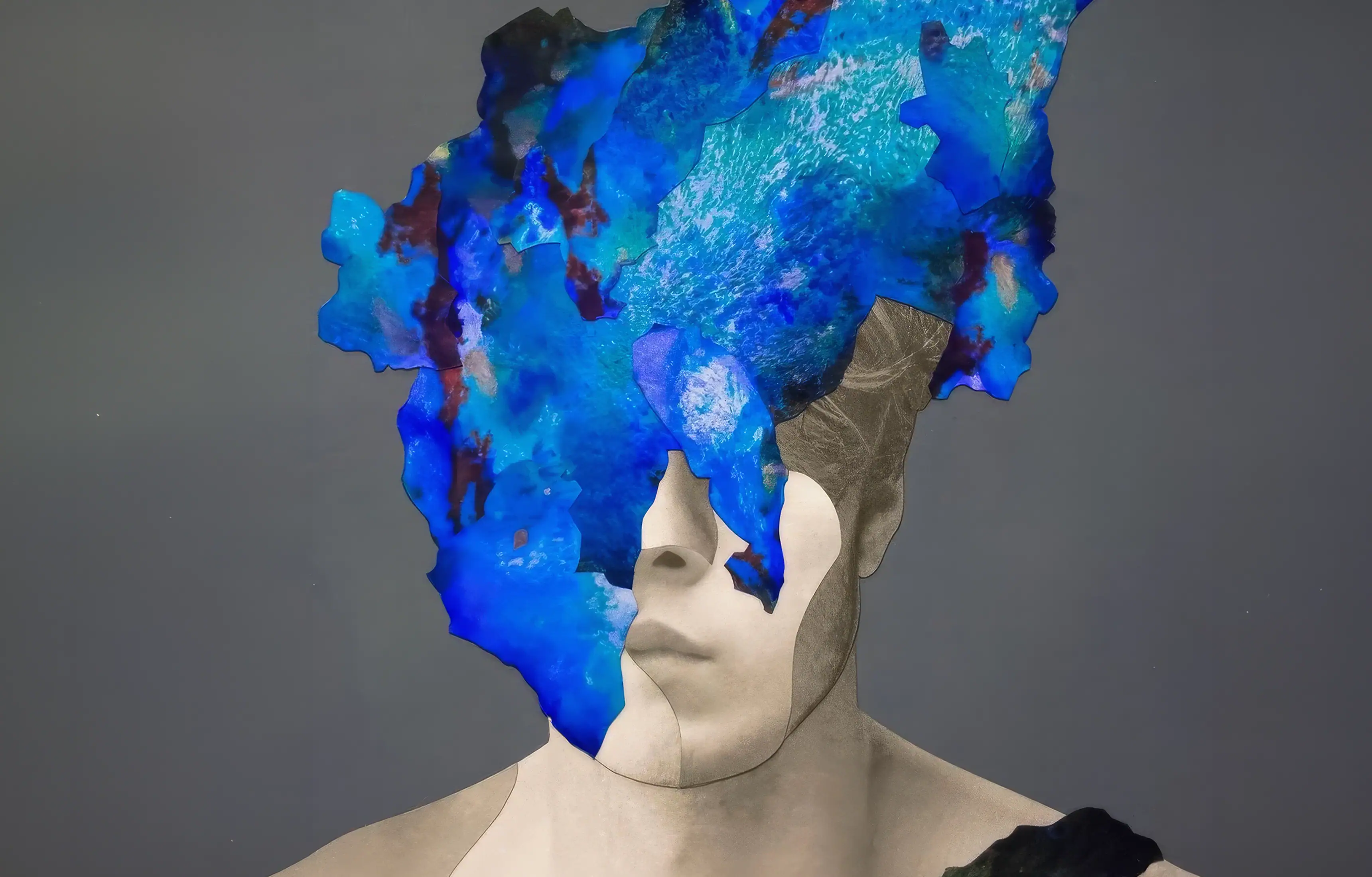
Stefan Gunnesch showed Keeping You Occupied from My Heart, a series of abstract collages built around the human body, breaking figures into layered fragments rather than presenting them whole. Schalk Van Der Merwe exhibited Jumper, a body of work built on blurred, indistinct subjects that Van Der Merwe uses to carry a specific emotional register: beauty sitting alongside worry, sorrow and despair within the same blurred figure, rather than resolving into any one of them.

Nadia Arnold
Felix Dolah brought three charcoal drawings, Prevention, Me and Myselves and Fliegen züchten. Dolah’s technique is distinctive within charcoal drawing: he dilutes the medium with water, working it across the page over months of contemplation rather than in a single sitting, and lets his own fingerprints remain visible in the finished surface. The result is a ghostly, minimalist figure built from washes rather than hard line, gangly and sparse in some works and gathered into crowded, writhing heaps of figures in others. The comparison to Alberto Giacometti’s elongated, worn-down figures is a natural one for work built on erosion and reduction rather than addition, and Dolah has shown the same body of work in London as well as Miami, including a solo presentation titled In Silence at Nadia Arnold’s London gallery.

Nadia Arnold
When a brushstroke is cast rather than painted
Reference Contemporary used its Pulse booth to show three artists whose common thread was materials behaving like something other than themselves.
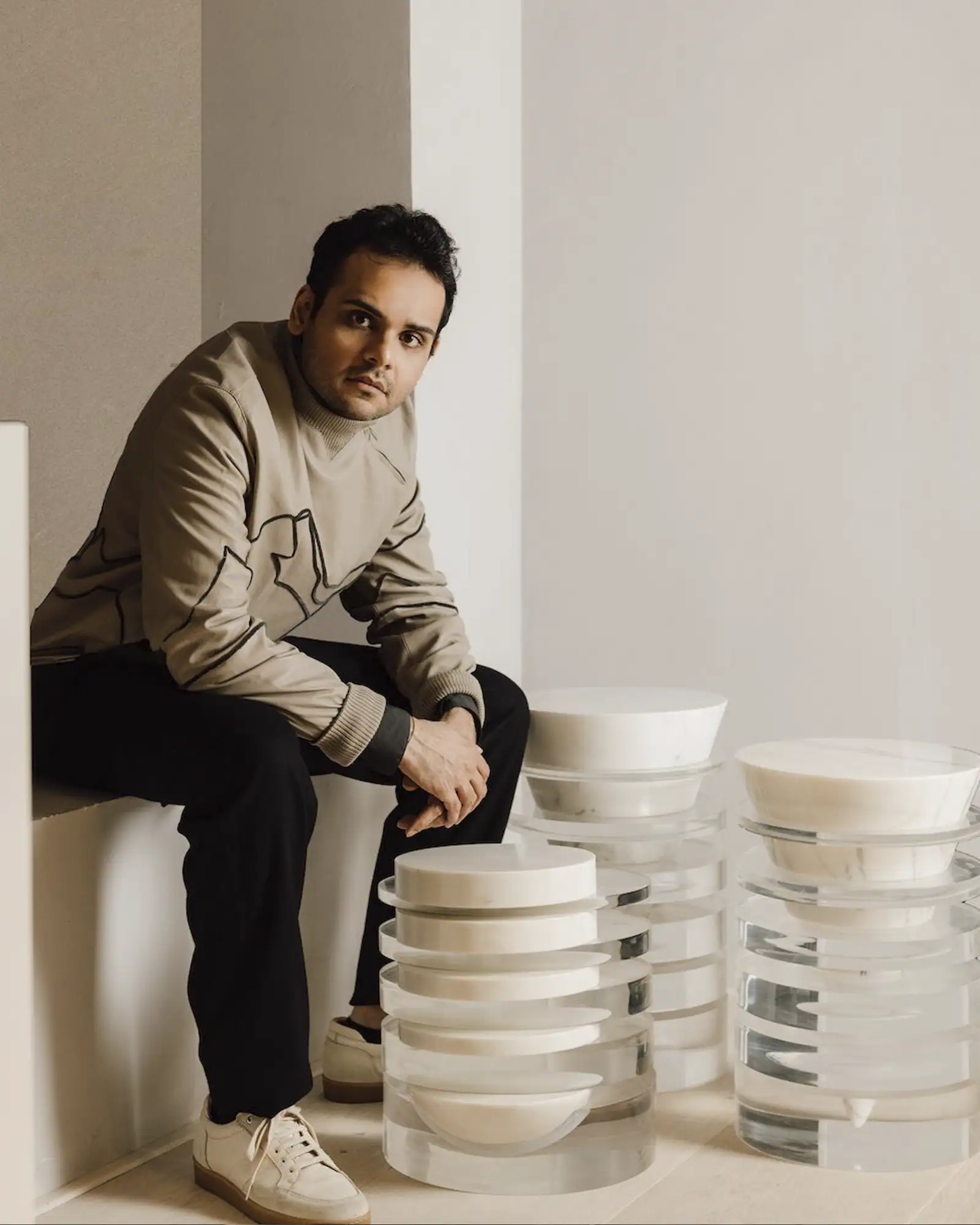
Court Swartz exhibited A-Field #1 through #6, a series of small hand-cast acrylic sculptures, each roughly the size of a hand, that capture the physical form of a brushstroke and hold it in solid, three-dimensional acrylic rather than paint on a flat surface. The effect inverts the usual relationship between a painter’s gesture and its record: instead of a mark that exists only as pigment on canvas, Swartz’s brushstrokes become objects with weight and shadow, something a viewer can walk around.

Reference Contemporary
Natale Adgnot, a Texas-born, Brooklyn-based sculptor with dual American and French citizenship, showed Dispersion Square, a work that continues her practice of building three-dimensional wall panels from thermoplastic and fibre rather than framing them as paintings. Adgnot moved into sculpture after years designing for haute couture runways in Paris and working in Japan, and her material choices, thermoplastic, textiles, horsehair, carry that cross-disciplinary background directly: each material is chosen for a cultural association it brings with it, not simply for its texture. Dispersion Square extended that layered, sculpture-meets-canvas approach into a single wall-mounted work built specifically to blur the line between the two disciplines.

Reference Contemporary
Kal Mansur completed the booth with Shelter 2, an acrylic painting incorporating fluorescent pigments within its surface, part of an ongoing Shelter series Mansur has continued to develop in the years since. The fluorescent elements shift the painting’s character depending on the light it is viewed under, oceanfront daylight during Pulse’s afternoon hours reading differently to a single canvas than gallery lighting would.

Reference Contemporary
Ten years of concrete, photographed from inside the rebuild
Art Bond NY, a New York gallery with a history of showing at Art Miami and Context Art Miami as well as Pulse, brought Israeli-born photographer Shai Kremer‘s series World Trade Center: Concrete Abstract, a body of work documenting the reconstruction of Ground Zero across more than a decade, from 2001 into the following years of rebuilding.

Art Bond New York
Kremer’s method is a layering technique rather than a single exposure: he combines multiple photographic images from his own archive of the site, blending them into hybrid compositions that push straightforward documentary photography toward abstraction. Straight, man-made structural lines meet the more chaotic textures of a construction site mid-rebuild, producing images that read, from a distance, closer to abstract paintings than photographs of a specific place. The full series runs to ten large-scale photographs, each measuring sixty by eighty inches, and has been shown at Julie Saul Gallery and the Bronx Museum in New York, at Robert Koch Gallery in San Francisco, and at the Florida Museum of Photographic Arts in Tampa. Kremer has described the project as an attempt to hold what he calls a post-traumatic gaze on Manhattan’s skyline, tracking the physical process by which a wound in a city’s built environment is rebuilt over years rather than resolved in a single moment. He would go on to apply the same layered, archive-based method to Brooklyn’s redevelopment in a later series, which makes the World Trade Center work at Pulse the origin point of a technique Kremer has continued refining ever since.

Art Bond New York
Fifteen years, and the edition that turned out to be the last
Pulse Art Fair launched in 2005 with a specific gap in mind: a fair built for emerging and mid-career galleries and collectors buying at accessible price points, sitting alongside Art Basel Miami Beach’s blue-chip focus rather than competing with it directly. Fifteen years later, the December 2019 edition at Indian Beach Park was, by every measure, business as usual for that model: around sixty five galleries, a full programme of talks and video art, and a beachfront setting that let it stand apart from the convention-centre scale of its bigger neighbour a few minutes south.
What nobody exhibiting that week could have known was that Indian Beach Park would be Pulse’s last Miami address. Weeks before the fair opened, its owner, Ramsay Fairs, had acquired Volta, another fair built on a similar founding premise of platform-for-emerging-galleries, itself founded in 2005. Within a year, Ramsay Fairs made the decision to consolidate the two brands into one, launching Volta Miami in December 2020 at Mana Wynwood rather than reviving Pulse on the beach. Fair director Kamiar Maleki explained the thinking at the time as a matter of focus rather than retreat: concentrating the company’s resources behind a single fair, he said, so that “brand” could be made “great again,” while carrying Pulse’s identity forward within the newly combined event, including plans to continue its solo-booth prize under Volta’s banner. Fifteen years of championing galleries that Art Basel’s blue-chip focus tends to overlook did not disappear with the brand name. It became the foundation Volta Miami built on, which makes the 2019 edition less an ending than a fifteen-year body of work handed on intact to what came next.
Final thoughts
Pulse’s fifteen years were built on a simple bet: that a smaller, calmer fair could put emerging and mid-career galleries in front of serious collectors just as well as a vast convention hall could, if the work itself was strong enough to carry the room. The 2019 booths at Indian Beach Park made that case as clearly as any edition before them, from a gallery that turned Microsoft Excel into a working art medium to a sculptor casting brushstrokes into solid acrylic. That the fair’s own fifteen year identity was carried into Volta within the year is not a coda to that story. It is the clearest evidence the model worked.
When and where was Pulse Art Fair held in 2019?
Pulse Art Fair’s 2019 edition ran from 5 to 8 December 2019 at Indian Beach Park, 4601 Collins Avenue, Miami Beach, during Miami Art Week.
Was 2019 the final year Pulse Art Fair took place in Miami?
Yes. It was the fair’s fifteenth and last edition on Miami Beach. Its owner, Ramsay Fairs, consolidated Pulse into Volta, another fair it owned, and launched Volta Miami at Mana Wynwood in December 2020.
What is Excel art, and which artist showed it at Pulse in 2019?
Excel art is a technique developed by Ukrainian artist Oleksiy Sai, shown at Pulse by Voloshyn Gallery, in which thousands of individually resized and coloured spreadsheet cells are built up inside Microsoft Excel until they resolve into a finished image.
Which galleries exhibited at Pulse Art Fair’s 2019 edition?
Exhibitors included Voloshyn Gallery from Kyiv, Nadia Arnold Gallery, Reference Contemporary, and Art Bond NY, among roughly sixty five galleries in total.
What was Shai Kremer’s World Trade Center series about?
Concrete Abstract is a series of ten large-scale photographs by Israeli-born photographer Shai Kremer, built by layering multiple images of the World Trade Center reconstruction site taken across more than a decade following 2001.
How was Pulse Art Fair different from Art Basel Miami Beach?
Pulse, founded in 2005, focused on emerging and mid-career galleries at accessible price points, with a fair of around sixty five galleries, in contrast to the larger blue-chip scale of Art Basel’s main convention centre fair.

Leave a Reply