
ALSERKAL AVENUE · DUBAI
Reading time: 10 minRichi Bhatia builds shelters out of fish scales. Read as symbolism that is affecting. Read as construction it is something better, because an overlapping array of small rigid units laid on a flexible backing is the oldest weatherproofing technology humans have, and she is using it to make housing.
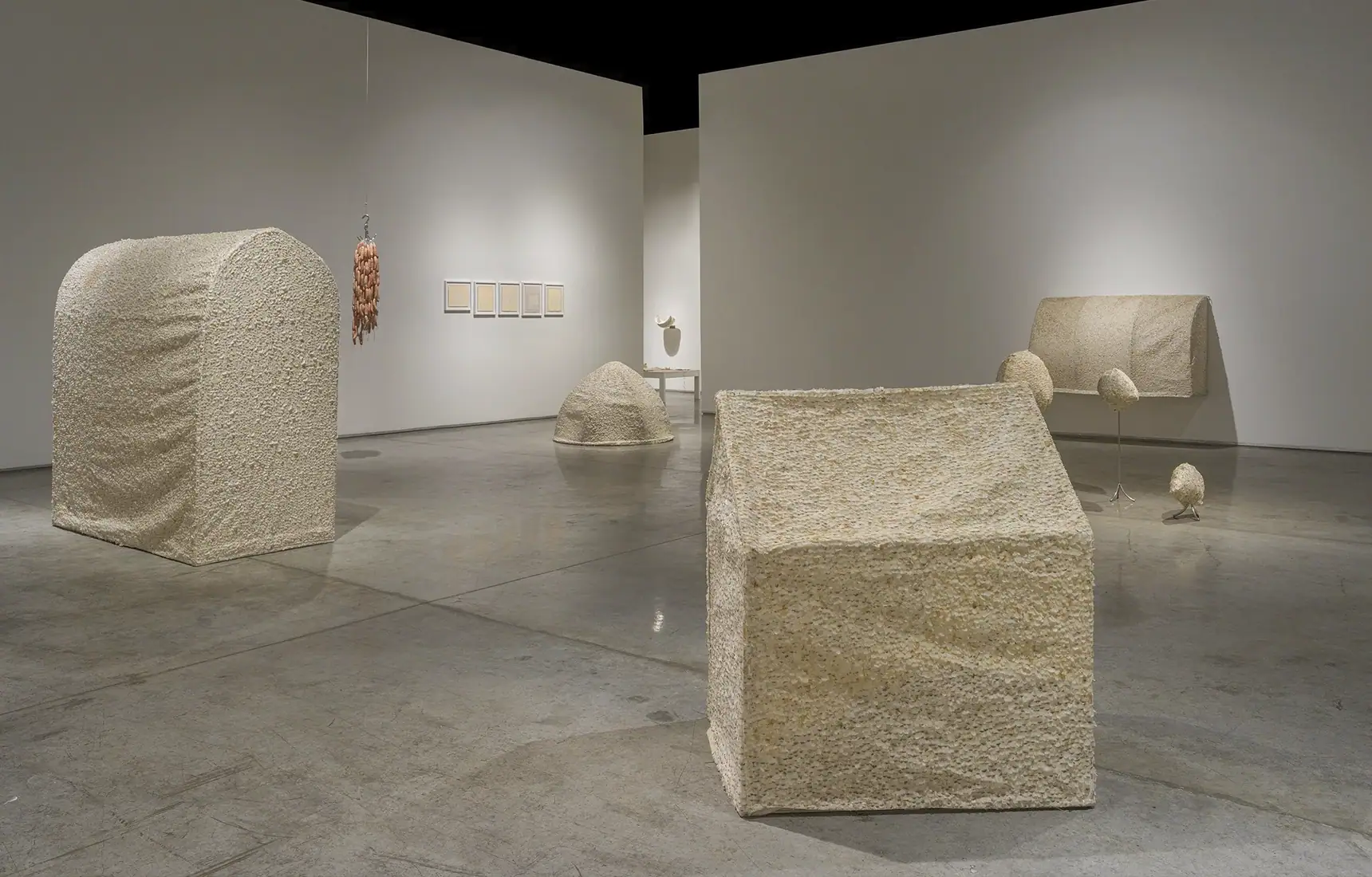
Antevasin: the one who sits at the border of two worlds, at Gallery Isabelle on Alserkal Avenue from 15 June to 10 September 2025, was Richi Bhatia‘s solo exhibition of sculpture, video, ceramics, artist’s books, performance and installation. Antevasin is a Sanskrit term for one who lives at the border, and the show used it to hold together a set of subjects that do not usually sit in one room: migrant labour, meat and fish markets, food, religion, trade routes, and the line between human and animal.
Most writing about it went, understandably, to the themes. Liminality, transnational identity, invisible labour. All present, all true.
But this is a show made almost entirely out of unusual materials assembled by hand, and the materials are not illustrations of the argument. They are the argument. Fish scales adhered to canvas. Scales built into tent-like shelters. Ceramic sausages. Animal hide stitched with human hair. Water preserved and kept. Books hand-sewn in four scripts.
Take those seriously as construction rather than as symbol and the exhibition gets considerably sharper, because what Bhatia is doing with a fish scale is what a roofer does with a tile.

A scale is a cladding unit
Consider what a scale actually is, structurally.
It is a small rigid plate, fixed at one edge, overlapping its neighbour so that water runs across the joint rather than into it, arranged in offset rows on a flexible backing so the whole surface can bend without the plates cracking. That system is called imbrication, and it is one of the most widely reinvented ideas in the history of building. Clay roof tiles are imbricated. Timber shingles, slate, fish-scale tiles on a Victorian turret, the lamellar armour worn from the steppe to Japan. All of them are the same solution to the same problem: how do you make a large continuous protective surface out of small units that can be produced, carried and replaced one at a time?
Fish got there several hundred million years before roofers did.
So when Bhatia takes scales gathered from a fish market and builds shelter forms from them, referencing the accommodation of migrant and temporary workers in India and Dubai, the material is not standing in for something. It is doing the job it evolved for, at a different scale, by hand, in a gallery. She is cladding a building with the original cladding.
The sculptures in the series The Animals, The Bodies and Coefficient of Time, made between 2020 and 2025, carry this most directly. They read as tents or tapestries depending on where you stand, and the iridescence works exactly as it does on a fish, which is to say it changes with the angle of the viewer rather than with the light on the object. That is a surface effect no paint achieves, and it is the reason the works are difficult to photograph and much better in person.

The material started with a skin
The origin of all this is specific, and personal, and worth setting out in full.
Bhatia, born in 1990 and based in the UAE, began working with fish scales in 2012, while thinking about a skin condition she has, lichen planus pigmentosus, which leaves dark marks on the skin. Around the same time she came across the iridescent scales of rohu, a common South Asian carp, near her university campus. She has described the process as reimagining her own skin in terms of scales.
This matters to a design reading rather than only a biographical one, because of the word itself. In architecture the outer layer of a building is called its skin, and the term is not lazy. A building envelope and a body envelope do the same four jobs: shed water, regulate what passes in and out, take the wear that the interior cannot, and carry the appearance of the thing it wraps. Cladding is the discipline of designing a surface that is simultaneously structural, environmental and representational.
Bhatia’s route runs from an envelope that misbehaved on her own body to envelopes she constructs by hand for imagined shelters. Put like that, a practice that could look like an accumulation of unusual materials turns out to be unusually consistent. She has been working on one problem for over a decade: what a surface is for, and who it protects.
There is a second consequence, which is about labour. Imbricated cladding is slow. Every unit is placed individually, and a hand-laid scale surface is measured in weeks. Bhatia’s method is deliberately labour-intensive, built on walking, gathering and hand-making, and a show about invisible labour that was itself made quickly would be an argument against itself. The construction technique and the subject are the same thing.

Table Bed II, and a typology collapsing
The work that names the condition most efficiently is Table Bed II, from 2025, which assembles ceramics, raw materials, hand-stitched books, animal hides and preserved water.
Set the contents aside for a moment and look at the title. A table and a bed are two of the most basic furniture typologies there are, and they are distinguished almost entirely by what a body does on a horizontal plane at a given height. Collapse them into one object and you have described, in two words, the actual spatial condition of shared worker accommodation, where a single surface serves for eating, working, storing and sleeping because there is not enough room for two.
Furniture design usually treats that collapse as an opportunity: the sofa bed, the folding table, the micro-apartment fitted out with transforming joinery, all sold as clever. Bhatia’s title names the same collapse as a constraint imposed rather than a feature chosen. The difference between those two readings is entirely a question of whether the person on the plane had a say.
That is a rewarding thing for a design audience to sit with, and it gives the language of liminality something concrete to hold.

The market is the studio, and the market is a building
Bhatia has described the Waterfront Market in Deira as her primary research studio, the place she observes and gathers material. Her ongoing performance series Hamlet Without the Prince, begun in 2014, is set in fish markets across Indian cities and the UAE.
The Waterfront Market is worth describing as architecture, because it is a designed civic object and it changes the reading of the work. It opened in 2017, developed by Ithra Dubai, covering more than 11,000 square metres, and it replaced the original Deira fish market that had operated on the creek since 1958. It is air-conditioned and zoned, with dedicated areas for raw meat, dried fish, live fish and crustaceans, fruit and vegetables, dairy, bakery and coffee, a live auction hall, cleaning stations, and a dhow dock. As of 2022 it held more than eight hundred traders.
So the shift from the old market to the new one is a shift from an open, hot, improvised, weather-exposed working environment to a serviced interior with a mechanical plant, controlled temperature, hygiene protocols and a plan. That is a genuine improvement in working conditions, and it also changes what a visitor sees. A building of that type is designed so that the process inside it runs smoothly: waste moves through service corridors, smells are extracted, the transformation of an animal into a portion happens behind stainless steel.
Which is what makes Bhatia’s project structurally interesting. She takes the material that the building is designed to remove, and she uses it to build the housing of the people the building is designed to keep working. The waste stream of a climate-controlled civic facility becomes the cladding of a shelter. The circle that architecture opened, she closes by hand.
Design has been arriving at the same material from the other direction
There is a live conversation in material design about fish skin, and it is worth putting next to this show because the two arrive at the same substance from opposite ends.
The design case is a waste case. The global fishing industry discards enormous quantities of skin, with figures of around thirty two million tonnes of fish waste a year cited as potentially recoverable. Fish leather requires less input than conventional hides, the animals are not raised for it, and the supply can be local rather than shipped across continents. Research led by Elisa Palomino at the Centre for Sustainable Fashion at London College of Fashion has spent years on the tanning, finishing and industrialisation of it, and has documented the long precedent among Inuit, Yup’ik, Athabascan, Siberian, Ainu, Chinese and Icelandic makers, for whom fish skin was ordinary clothing material rather than a novelty.
That work is heading towards a supply chain: consistent material, tested performance, a route to market.
Bhatia is heading the other way. She did not arrive at scales through a sustainability brief. She arrived through a diagnosis and a walk near a campus, and she has kept the material irregular, hand-placed, iridescent and specific to the individual fish it came from. Where the material design project needs standardisation, hers depends on refusing it.
Both are correct for their purposes, and the pairing is instructive. The industrial version can scale, which is the only way a waste stream ever actually gets used. The artist’s version keeps visible the thing standardisation removes, which is that every one of those plates came off a particular animal handled by a particular person. A design publication should be able to hold both without deciding that one is serious and the other decorative.

Four scripts, and hair as thread
The artist’s book Include Some, Exclude Others, in its first edition from 2025, stitches the artist’s own hair alongside testimony from workers, and sets text in Urdu, Hindi, Sindhi and Arabic.
The choice of four scripts is a typographic decision with a geographic argument inside it. Two of those scripts run right to left and two of them do not share a writing system with each other. Setting them in one object means the book cannot be read continuously by almost anyone who picks it up, and that is the point: the routes it maps, from South Asian ports to Gulf markets, are not continuous for the people who travel them either. A reader hitting a script they cannot read experiences, in a very small way, the ordinary condition of the workforce the book documents.
Using hair as thread is the sharper move. Thread is the most anonymous component in any made object; it is chosen for tensile strength and colour match and is meant to disappear. Substituting something that came off a specific person’s head means the binding, the least visible element of the book, is the only part that can be traced to an individual body. In a work about labour that goes unrecorded, putting the identifiable material into the invisible component is precise rather than merely striking.

What the show asks of you
Two things worth noting.
The first is density. This is a rich show with a Sanskrit title, four scripts, several bodies of work spanning five years, a three-channel video shot in Leh with an abandoned donkey, and a set of material references that reward prior knowledge. The fish scale shelters need none of that scaffolding; they are immediate. The surrounding material repays the wall text, and reading it first opens up how far the research reaches.
The second is the labour subject. The show is careful and clearly built on real time spent in markets, with testimony gathered rather than imagined. Art about work that goes unrecorded has to earn its ground, and Bhatia earns it, largely because she keeps returning to material specifics rather than to representation of people. That discipline is what gives the testimony its weight, and it is worth naming, because it is the whole basis of the show’s authority.
Frequently asked questions
What was Antevasin? Antevasin: the one who sits at the border of two worlds was a solo exhibition by Richi Bhatia at Gallery Isabelle, Alserkal Avenue, Dubai, running from 15 June to 10 September 2025. It brought together sculpture, ceramics, video, artist’s books, performance and installation around migrant labour, food, markets and the boundary between human and animal.
What does antevasin mean? Antevasin is a Sanskrit term for one who lives at the border, a person positioned between two worlds rather than settled in either.
Who is Richi Bhatia? Richi Bhatia is an Indian multidisciplinary artist, born in 1990 and based in the UAE, working across drawing, performance, object-making, food intervention and assemblage. Her work has been shown at Gallery Isabelle, Foundry, Alserkal Foundation, NYU Abu Dhabi and Bikaner House in New Delhi.
Why does she work with fish scales? She began in 2012 while reflecting on lichen planus pigmentosus, a skin condition that leaves dark marks, and started imagining her own skin as scales. Around the same time she encountered the iridescent scales of rohu near her university. Fish and meat markets have been her research sites since, and she has described the Waterfront Market in Deira as her primary research studio.
What is Table Bed II? Table Bed II, 2025, is an assemblage of ceramics, raw materials, hand-stitched books, animal hides and preserved water. Its title collapses two furniture typologies into one object, describing the condition of shared worker accommodation where a single surface serves for eating, working and sleeping.
Where is Gallery Isabelle? Gallery Isabelle is on Alserkal Avenue in Al Quoz, Dubai. It was founded as B21 Gallery in 2006 by Isabelle de Caters, among the first contemporary art spaces in the UAE, later became Gallery IVDE, opened on Alserkal Avenue in 2010, and now operates as Gallery Isabelle, co-led with director Jad Karam.

Final thoughts
The available reading of this exhibition is about borders, and the artist supplied the word herself. It is a good word and the show earns it.
The reading worth keeping is about surfaces. A woman with a skin condition started thinking about scales, found some on the ground near her university, and spent the next thirteen years working out what an envelope is for. She ended up hand-laying imbricated cladding, gathered from the waste of an air-conditioned civic market, into shelters that stand in for the housing of the people who work in it. Then she called one of the objects a table and a bed at the same time, because for a lot of people it is.
That is not a show about identity that happens to use interesting materials. It is material research that happens to be about identity, and the difference is the whole reason it belongs on a design site rather than only on an art one.



Leave a Reply