
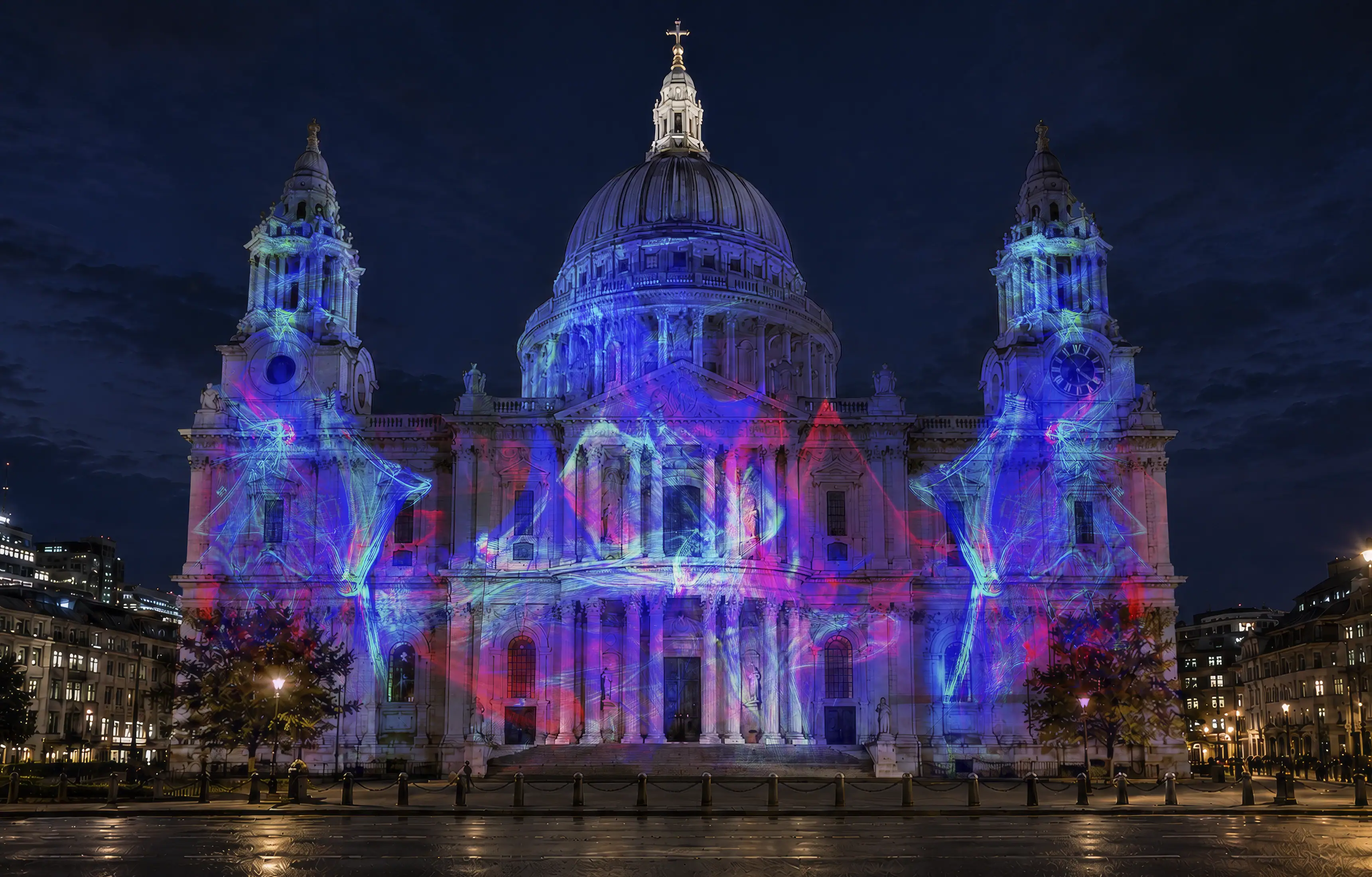
A projection that is never rendered twice, generated live from the interaction of light, glass and movement rather than played back from a file. Mykola Kabluka’s Soul has already animated a museum facade in Dnipro, a Baroque church in Kyiv and a railway station in Zurich. This September it reaches St Paul’s Cathedral, paired with a second work, The Point of Unity, that first appeared in the Nevada desert.
Introduction
London Design Festival’s Landmark Projects have used the city’s public spaces as a stage since 2007, and this year two of them arrive together at a single address. Mykola Kabluka, the Ukrainian lighting designer and artist who founded the Kyiv-based studio Expolight in 2000, will present Soul and The Point of Unity at St Paul’s Cathedral from 12 to 20 September 2026.
Soul is an audiovisual installation that plays across the Cathedral’s exterior. The Point of Unity is a freestanding sculpture built from mirrors and fibre optics, making its UK debut after appearing at Burning Man in 2025. Both works come from the same studio and the same design language, but they behave differently: one lives on the surface of a 17th-century building, the other stands apart from it in the churchyard, reflecting the sky.
What connects them is not their form but their engineering. Kabluka trained first in applied mathematics, and it shows. Soul does not project a finished film. It generates one, continuously, from a live system that never produces the same frame twice. That distinction, more than the subject matter, is the reason this piece is worth stopping for.
“The commissioned special projects have become a key part of the festival’s DNA,” says Ben Evans CBE, London Design Festival’s director and co-founder. “Our first was with Zaha Hadid in 2007 and since then we have created over 150 different projects.” St Paul’s arrives this year with the Mayor of London as the festival’s Principal Supporter, alongside continued backing from Bloomberg Philanthropies, whose Bloomberg Connects app is serving as the festival’s official digital guide across all nine days.

What Soul actually does, and why the picture never repeats
Most architectural projection is video: a file, rendered in advance, looped on a screen or a facade. Soul works differently. Its imagery is produced live, through the physical interaction of light, glass, movement and space, which means the composition on the stone is never the same twice and cannot be paused and replayed exactly as seen.
The visual and audio systems behind it were built using neurophysiological research into the brain activity associated with daydreaming, inward attention and creative thought, the state a mind enters just before an idea takes shape. Soul is built to trace that moment: the space between an internal thought and its first physical form, between contemplation and action. It is less a picture of an idea than a picture of the instant an idea arrives.
At St Paul’s, that generative system plays across the Cathedral’s own surfaces, the building Sir Christopher Wren completed in the late 17th century on a site that has carried a cathedral for more than 1,400 years. Soul does not compete with that architecture. It uses the stone as the screen it was never built to be, which is a different proposition to projecting onto a blank wall.

The mathematician who became one of Europe’s most-awarded lighting designers
Mykola Kabluka was born in Dnipro, Ukraine, on 8 April 1978. He studied applied mathematics before switching to lighting, and later completed a Master of Arts in Architectural Lighting Design at Hochschule Wismar in Germany. “My first education was in mathematical modelling, and my second was in lighting design,” he has said. “This combination expresses my approach to light.”
He founded Expolight in 2000 with Olena Kabluka, who serves as the studio’s chief executive while Mykola works as its creative director. Over twenty-five years the studio has completed more than 1,500 projects across architectural and landscape lighting, media facades and art installations, and it now runs its own research and development arm, building custom luminaires and proprietary software for lighting control rather than buying the technology off the shelf.
The clearest evidence of that engineering depth sits in Kyiv rather than London. In 2022, Expolight installed a chandelier at Unit City’s B14 campus built from prismatic glass tubes 1,600 millimetres long, paired with custom optical lenses in three separate beam widths. The length of the glass made it difficult to manufacture without the rods shifting against each other, which the studio solved with transparent optical spacers engineered specifically for the piece. It won Lighting Product Design of the Year at the LIT Lighting Design Awards. Kabluka is also an associate member of the IALD and the IES, the two organisations that set the field’s international standards.

What else Expolight has built
The St Paul’s commission is not Expolight’s first attempt at turning a piece of infrastructure into an artwork. Between 2020 and 2021, the studio ran a laser and projection installation across five disused chimneys at a former industrial site in Dnipro, nicknamed the city’s “light flowers,” which reworked redundant factory architecture into a public light show rather than waiting for it to be demolished. The studio has also lit Freedom Square in Mariupol and built a memorial installation, Cross of Heroes, in Vyshhorod dedicated to Ukraine’s fallen defenders, alongside a combined laser and video light show on Khortytsia Island, the country’s largest river island and a national heritage site on the Dnipro.
That range, landscape lighting, memorial work, media facades and now cathedral projection, is the reason Expolight’s own account of itself leans on engineering as much as art direction. The studio runs five internal departments, covering conceptual design, project management, engineering, manufacturing and system servicing, and it has picked up six awards in a single year at the 2024 Lighting Design Awards along with prizes at the IES Illumination Awards. Kabluka’s own membership of the IALD, the IES and LUCI, the Lighting Urban Community International association, places him inside the same professional bodies that set standards for architectural lighting worldwide, rather than treating light art as a discipline adjacent to that world.
Soul has already lit up three other cities
Before St Paul’s, Soul has had a touring life most single-city coverage of the London commission will miss. It first appeared on the facade of the Dnipro Art Museum for the museum’s 110th anniversary. It then moved to the Roman Catholic Church of St Nicholas in Kyiv, a Neo-Gothic building still recovering from fire damage sustained in 2021, where the installation drew attention to the building’s own restoration alongside the artwork itself. From there it travelled to Bahnhof Enge, a historic railway station in Zurich, as part of a cultural exchange between Kyiv Design Week and Zurich Design Weeks.
Each staging uses the same generative system on a different surface, which means the work has now been tested against a museum, a church and a transport building before it meets a cathedral. St Paul’s is the fourth building Soul has been asked to read, and by some distance the largest.

The Point of Unity, and the 3,500 points of light it carries from the desert
The Point of Unity is the newer of the two works, first shown at Burning Man in the Black Rock Desert in August and September 2025, where it was included among ArchDaily’s selection of the festival’s standout temporary structures. St Paul’s Cathedral is its first presentation outside the United States.
The sculpture is built around a circular, mirrored form that behaves differently by the hour. During the day, its polished surfaces reflect the sky and the clouds moving across it, so the piece appears to fold the landscape into itself. At night, 3,500 fibre-optic points activate across the structure, turning it into a field of stars, while custom optical filters break plain white light into shifting spectral patterns that never settle into a fixed image. A soundtrack composed from astronomical data accompanies the transformation. In the desert, the piece became a gathering point in a more literal sense than most public art manages: it hosted 36 wedding ceremonies during the festival.
Conceived as a meeting point between earth and sky, the sculpture asks visitors to stand inside the junction rather than look at it from outside, which is the same instinct that shapes Soul, expressed through a different material.
Why the two works belong at St Paul’s, and how to see them properly
London Design Festival has commissioned special projects at the city’s landmarks since its first, with Zaha Hadid, in 2007, and more than 150 since. St Paul’s has hosted the festival before, and this year’s pairing continues that relationship rather than opening a new one. What makes the site work for these two pieces specifically is the contrast it offers: a building defined by permanence and repetition, in liturgy and in stone, hosting two works whose entire premise is that neither performance will look the same twice.
Soul is worth returning to more than once during the nine days, precisely because the generative system means a second visit is not a repeat viewing. The Point of Unity rewards the opposite approach: one visit that spans daylight into dusk, so the same structure can be seen reflecting clouds and then filling with fibre-optic stars within a single evening. Together, the two works give St Paul’s Cathedral’s grounds a genuinely different character at either end of the day, for the length of the festival.

Frequently asked questions
What is Soul, by Mykola Kabluka?
Soul is an audiovisual light installation whose imagery is generated live rather than played back from a pre-rendered film, so the composition on display never repeats exactly. It is built around research into the brain activity associated with daydreaming and creative thought.
Where and when can I see Soul at St Paul’s Cathedral?
Soul appears at St Paul’s Cathedral in London from 12 to 20 September 2026, as part of London Design Festival’s Landmark Projects, alongside a second work by the same artist, The Point of Unity.
What is The Point of Unity?
The Point of Unity is a mirrored, fibre-optic sculpture by Mykola Kabluka that reflects the sky by day and transforms into a field of light at night, using 3,500 fibre-optic points and custom optical filters. It makes its UK debut at St Paul’s after first appearing at Burning Man in 2025.
Who is Mykola Kabluka?
Mykola Kabluka is a Ukrainian lighting designer and artist, born in Dnipro in 1978, who founded the lighting design and media art studio Expolight in 2000. He holds a Master of Arts in Architectural Lighting Design from Hochschule Wismar in Germany and is an associate member of the IALD and the IES.
What is Expolight?
Expolight is a Kyiv-based lighting design and media art studio founded by Mykola Kabluka and Olena Kabluka in 2000. It has completed more than 1,500 projects and operates its own research and development centre, building custom luminaires and proprietary lighting-control software.
Has Soul been shown anywhere before London?
Yes. Soul has previously appeared on the facade of the Dnipro Art Museum in Ukraine, at the Roman Catholic Church of St Nicholas in Kyiv, and at Bahnhof Enge railway station in Zurich, as part of a cultural exchange between Kyiv Design Week and Zurich Design Weeks.
Is there a charge to see the installations?
London Design Festival’s Landmark Projects are typically free to view from St Paul’s Cathedral’s public grounds during festival hours; visitors wanting to enter the Cathedral itself should check St Paul’s own admission terms directly.
What else is happening at London Design Festival 2026?
The festival runs across London from 12 to 20 September 2026, with Landmark and Special Projects also staged this year at the V&A, the Barbican, Wapping Hydraulic Power Station, Somerset House and Strand Aldwych, where Studio Saar’s Pangolin Shield pavilion is also showing.
Final thoughts
It would be easy to describe Soul and The Point of Unity as two more additions to London Design Festival’s long list of landmark commissions, arriving and departing inside a nine-day window like everything else on the programme. That undersells what is actually happening at St Paul’s this September.
Soul has already had a life before London: a museum in Dnipro, a damaged church in Kyiv, a station in Zurich. The Point of Unity has already hosted 36 weddings in a desert. Neither work was made for this address. Both are arriving with a history, and St Paul’s is simply the next place asked to hold them.
What the two pieces share is a refusal to sit still. One is engineered never to repeat its own image. The other changes its entire character between midday and midnight. Kabluka’s training as a mathematician built the systems; his years in lighting design decided what those systems should be asked to do, which is to make an old building behave, briefly, like something that is still thinking.
Leave a Reply