
ART & CULTURE · LONDON
Reading time: 9 minA laser corridor tuned to the same frequency archaeologists have measured inside six-thousand-year-old burial chambers. A studio that scored the Red Hot Chili Peppers’ arena tour turning its rig on a room instead of a crowd. The man who co-wrote Ableton Live drawing with ultraviolet light rather than sound. Thin Air, the inaugural exhibition at The Beams in London’s Royal Docks, gathered seven artists who know the entertainment industry’s toolkit from the inside, and pointed it at something the industry rarely asks it to do: show you what you cannot normally see.
Thin Air opened at The Beams on 17 March 2023 and ran until 4 June, occupying more than 55,000 square feet of a former industrial warehouse on Factory Road in the Royal Docks, close to London City Airport. It was the first exhibition staged at the venue, produced by Broadwick Live (the company behind Printworks and Drumsheds) in association with the culture consultancy That Right There, and curated by the artist and curator Alex Czetwertynski.

Seven artists and collectives took part: James Clar, 404.zero, S E T U P, Robert Henke, Matthew Schreiber, Kimchi and Chips with Rosa Menkman, and UCLA Arts Conditional Studio working with Goldsmiths, University of London. Between them they filled the warehouse with lasers, ultraviolet light, LED cable and generative sound, using almost none of the equipment associated with a conventional gallery.
That is the position this piece takes: the strongest thing about Thin Air was not scale, although the scale was real. It was that every artist in the building had spent their career inside the technology of live events and entertainment, and had turned that exact toolkit toward revealing structure rather than producing spectacle. A laser rig built to move a crowd was instead built to show a visitor how their own perception works. That is a harder trick than it sounds, and the show pulled it off across seven very different rooms.


What the warehouse actually held
The Beams occupied a raw industrial shed, the kind of space usually rented out for filming, brand activations and club nights. For Thin Air, Broadwick Live and Czetwertynski divided that volume into a sequence of discrete environments rather than a single hall, so a visitor moved from a laser corridor into a football-pitch-sized room of shifting darkness, then into a chamber lit only by ultraviolet dust, then into a wall of crossing beams that appeared to hold solid objects in mid-air.
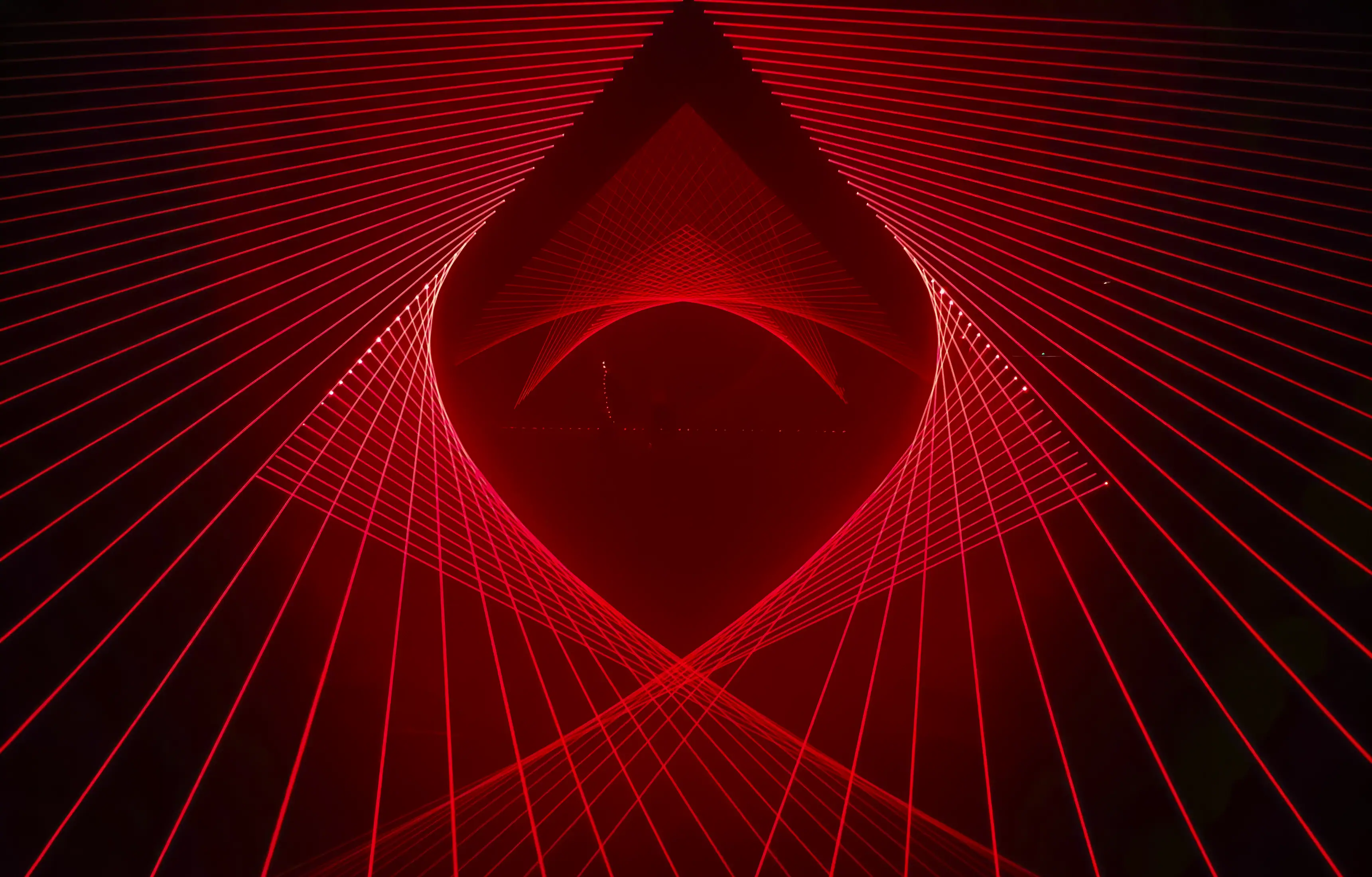
404.Zero – 3.24
None of it depended on projection screens or plinths. The materials were the same ones a festival production company would order for a headline set: moving lights, haze machines, high-power lasers, kilometres of LED cable and a serious sound system. What changed was the brief. Rather than choreographing those tools to a drop or a chorus, each artist choreographed them to a question about perception, algorithm or frequency, and let the audience walk through the answer at their own pace.
The corridor tuned to 110 hertz
James Clar’s Cleanse/Mantra set the tone at the entrance. A laser beam travelled the length of a corridor, pulsing at 110 hertz, its physical pattern spaced out to match the wavelength of a 110 hertz sound wave in air, roughly three metres. As a visitor walked the corridor, their own change in position sliced that wave into repeating sections, so the beam appeared to build in amplitude the further in they went. The accompanying tone, held at the same frequency, was described in the exhibition’s own materials as the human pitch, and linked to the pitch used in Buddhist chant.
James Clar – Cleanse/Mantra
Clar, a Filipino-American artist based between Tokyo, Manila and New York and trained at NYU’s Interactive Telecommunications Program, has spent two decades building light systems that treat perception itself as the subject, shown at the New Museum in New York, MACBA in Barcelona, Pera Museum in Istanbul and SeMA in Seoul among others. Cleanse/Mantra was consistent with that practice: a corridor is the plainest possible architectural form, and Clar used it to demonstrate that even the plainest form can be tuned like an instrument.
Older than the exhibition: what a laser corridor shares with a Neolithic tomb
Here is the connection the show’s own framing gestures at but does not spell out. The claim that 110 hertz is a human pitch is not marketing language invented for the exhibition. It comes from a real, if still niche, field called archaeoacoustics, and specifically from research led by the UCLA neuroscientist Ian Cook and colleagues, who used EEG to monitor volunteers exposed to different resonance frequencies inside chambered Neolithic monuments. At resonances around 110 hertz, activity in the prefrontal cortex shifted: the language centre, based in the brain’s left hemisphere, quietened, while activity linked to emotion and spatial processing, based in the right hemisphere, increased. The sites where this effect was measured include Newgrange in Ireland and the Hal Saflieni Hypogeum in Malta, both built from stone roughly five to six thousand years ago, long before anyone had a word for acoustics, let alone a laser.
SETUP – Lines
Whether or not the Neolithic builders of those chambers intended the effect, later researchers have argued the stonework produces it reliably. Clar’s corridor produces something structurally identical using twenty-first century materials: a 110 hertz frequency, an enclosed passage, a sliced field of view, and a measurable shift in how the brain processes what it is looking at. A visitor walking that corridor in the Royal Docks was, whether they knew it or not, standing in for the same experiment prehistoric builders may have run in stone. That is the genuine link between an industrial warehouse in east London and some of the oldest surviving architecture on earth, and it is a stronger case for taking Clar’s corridor seriously than any description of what it looked like.
Six other ways to bend the same toolkit
The other six installations pursued the same idea by different routes. 404.zero, the Moscow-formed duo of Kristina Karpysheva and Alexandr Letsius, filled a vast darkened room with 3.24, a generative sequence of red light, white light and total blackout, driven by real-time code rather than a fixed script, so the piece never repeated itself in the same way twice. S E T U P, the international lighting and stage design studio founded in 2018 by Dmitry Znamensky, Stepan Novikov, Pavel Zmunchila and Anton Kochnev, built Lines, a ceiling of synchronised LED cable and sound that shifted between flickering static, aquarium-like drift and something closer to a spacecraft interior, a studio whose day job includes touring productions for acts such as the Red Hot Chili Peppers.
Robert Henke – Phosphor
Robert Henke’s Phosphor used a single ultraviolet laser to paint slowly decaying traces onto a bed of phosphorescent dust, an image that never fully resolved because it was always in the process of fading and being redrawn. Matthew Schreiber’s Banshee divided a room with hundreds of precisely placed red lasers, calculated from the exact dimensions of the space, so that a visitor’s own movement through the beams became the only thing that changed the picture. Kimchi and Chips, the Seoul-based collective, worked with the artist Rosa Menkman on an adapted version of their Light Barrier, using crossing beams and convex mirrors to construct floating forms that appeared to hang unsupported in the haze. UCLA Arts Conditional Studio, working with Goldsmiths, built Impure Functions, an interactive pair of modules that turned a visitor’s photograph, and later their own voice, into a live digital portrait.
The people who built the instruments, and where they learned to
The show’s coherence came from who was in it as much as what was on show. Robert Henke, based in Berlin and trained as an engineer, co-created Ableton Live with Gerhard Behles, the software that underpins the way most of the world’s electronic musicians write and perform. He has spent the years since building his own Monolake project and, increasingly, working with high-power lasers, so Phosphor was made by someone who helped build the entertainment industry’s core production tool and is now using an adjacent technology to make something that resists performance rather than accompanying it.


Matthew Schreiber’s route to Banshee runs through James Turrell. After training in holography at the Royal College of Art and founding the holographic studio C-Project in Miami, where he produced fine art holograms for artists including Louise Bourgeois, Schreiber became Turrell’s chief lighting collaborator, working on the technical side of Turrell’s light installations for years, including his 2013 retrospective. The Getty Museum acquired the C-Project archive in 2019. A laser room built by someone who spent a career solving lighting problems for one of the most exacting light artists alive is not a novelty act borrowing a rig; it is a direct continuation of that lineage using a different tool.

A warehouse chosen on purpose
The Royal Docks setting mattered too. Broadwick Live built its reputation on Printworks, the former newspaper printing plant in Rotherhithe, and later Drumsheds, a former IKEA warehouse in north London, both spaces where the scale and rawness of an industrial building became part of the work rather than a backdrop to it. The Beams followed the same logic: a genuinely vast, unfinished shed, big enough that seven artists could each claim a full room without the show ever feeling like a corridor of booths. Alex Czetwertynski’s curatorial decision to give each artist that much space, rather than compressing the show into a single shared hall, is what allowed pieces built on quite different scales of technology, from Henke’s single laser to S E T U P’s ceiling of cable, to sit next to one another without competing.


What the show leaves behind
Thin Air welcomed tens of thousands of visitors over its twelve-week run, and The Beams has since announced that it is moving on from its original Royal Docks site to a new London location, with details still to follow. That makes Thin Air, in retrospect, a first chapter rather than an ongoing show, which is worth knowing before setting out to visit the building it was made for.


What the exhibition demonstrated will outlast the address. Seven artists who each know the mechanics of live entertainment production from the inside, lasers, LED, code-driven lighting, atmospheric haze, chose to aim that mechanics at revealing structure instead of producing spectacle, and the results held up as art rather than as a demonstration reel. James Clar’s corridor did it with a frequency archaeologists have traced back six thousand years. Robert Henke did it by turning the software behind modern electronic music toward something that resists performance. Matthew Schreiber did it with the same technical rigour he brought to James Turrell’s own work. None of that needed spectacle to prove itself impressive; it needed precision, and precision is what the show delivered.


Final thoughts
It would be easy to describe Thin Air as an immersive art show, in the sense that phrase has come to mean in London over the past few years: a large dark room, moving light, a queue for photographs. That description would not be wrong, exactly, but it would miss what made this particular building full of lasers worth taking seriously.
What actually happened at The Beams was seven practitioners of production technology, the exact equipment used to move stadium crowds and score arena tours, choosing to point that equipment at something other than a crowd. A frequency tuned not to a drop but to a measurable state of attention. A laser rig calculated not to a lighting cue but to the architecture of the room itself. A generative system left to run without a script because a script was never the point.
The genuinely interesting fact is not that the technology could do this. It is that the people running it already knew how, because they had spent careers learning the entertainment industry’s tools from the inside, and chose, for twelve weeks in a Royal Docks warehouse, to use that fluency for something other than spectacle.
The Beams has since moved on from that building. What it proved while it was there has not.
What was Thin Air at The Beams?
Thin Air was the inaugural exhibition at The Beams, a large industrial venue in London’s Royal Docks, bringing together seven international artists and collectives working with laser, light, sound and generative code across a 55,000 square foot warehouse.
Where was Thin Air held?
The exhibition took place at The Beams, Factory Road, Royal Docks, London E16 2HB, a former warehouse close to London City Airport.
When did Thin Air run?
Thin Air opened on 17 March 2023 and closed on 4 June 2023, a twelve-week run.
Who curated Thin Air, and who produced it?
The exhibition was curated by Alex Czetwertynski and produced by Broadwick Live, the company behind Printworks and Drumsheds, in association with the culture consultancy That Right There.
Which artists took part in Thin Air?
The line-up was James Clar, 404.zero, S E T U P, Robert Henke, Matthew Schreiber, Kimchi and Chips with Rosa Menkman, and UCLA Arts Conditional Studio with Goldsmiths, University of London.
What is James Clar’s Cleanse/Mantra, and why is 110 hertz significant?
Cleanse/Mantra was a laser corridor pulsing at 110 hertz, a frequency researchers studying ancient chambered monuments such as Newgrange have linked to measurable shifts in brain activity toward the right hemisphere, associated with emotional and spatial processing.
Is The Beams still open at its original site?
The Beams has announced it is relocating from its Royal Docks building to a new London location, with further details expected in due course, making Thin Air the venue’s opening chapter at that address rather than an ongoing show there.
Who else has Robert Henke and Matthew Schreiber worked with?
Robert Henke co-created the music software Ableton Live and performs as Monolake; his installation work has appeared at Tate Modern and Centre Pompidou. Matthew Schreiber trained in holography and worked for years as James Turrell’s chief lighting collaborator, and his C-Project holography archive is now held by the Getty Museum.


Leave a Reply