
ART & CULTURE · LONDON
Reading time: 10 minTwenty-one installations, one estate, and a fifth edition that turned Canary Wharf’s docks, plazas and underpasses into a two-week walking route after dark. Squidsoup suspended 24,000 points of light over Montgomery Square, Julius Popp fed a live news feed into a waterfall of words, and a run of new commissions built their message from recycled bottles, biodegradable fibre and reclaimed toys. Between 15 and 26 January 2019, Winter Lights made the case that a corporate estate can also be a proper exhibition.
Canary Wharf spends most of the year being a financial district: glass towers, a Jubilee line interchange, and enough office workers to fill a small town. For twelve nights every January, Canary Wharf Group turns the same estate into an outdoor gallery. Winter Lights, now in its fifth edition, ran from 15 to 26 January 2019 and spread 21 lighting installations by international artists across the docks, plazas and underpasses of the estate, all of it free and open until 10pm.

The works ranged from a handful of decorative trees to genuinely significant pieces of media art. Squidsoup, the UK collective behind some of the most exhibited light installations of the last decade, brought the largest version yet of their signature Submergence. Julius Popp, the German artist whose Bit.Fall has run in cities from Moscow to Hong Kong, contributed the piece that had already made Canary Wharf one of only a handful of places in the world to host his work on a semi-permanent basis. Around them sat a cluster of new commissions with a shared subject: plastic, waste, and what happens to it in the ocean.

The visual arts curator behind the programme, Keith Watson of Canary Wharf Group, put the theme plainly: the aim was to keep “pushing the conversation about waste across all generations.” That line does a lot of work in explaining why 2019’s edition reads differently from a simple lights trail, and it is worth tracing through the individual pieces to see how deliberately it was built.

Submergence and the scale of Squidsoup’s ambition
Submergence, installed in Montgomery Square, was the biggest version Squidsoup had built of a piece they had already shown more than a hundred times on six continents. Over 24,000 individually suspended points of light hung above the walkway, dimming and brightening in slow waves before building, with a pulsing soundtrack, to moments where the whole field of light flared at once. Visitors walked directly beneath and through the piece rather than viewing it from outside, which is the distinction that separates Squidsoup’s work from a conventional light display: it is designed to be occupied.

Squidsoup was founded in 1997 by Anthony Rowe, and has operated since as an open collaborative group with Liam Birtles as creative director. Their practice sits at the intersection of physical installation and interaction design, and Submergence is the piece that has carried that idea furthest, picking up a Prix Ars Electronica honour and a BAFTA nomination along the way. At Canary Wharf the collective also showed Flow, a second, more data-driven piece of dynamically controlled light points drawing on Aboriginal and Japanese design traditions to visualise the movement of energy. Having both works in the same edition meant the estate carried two distinct demonstrations of what the same core technology, a field of individually addressable points of light, can be made to do.

Bit.Fall and the mechanics of a waterfall made of words
The single most technically ambitious piece in the programme was easy to miss, because it does not read as a light installation at first glance. Julius Popp’s Bit.Fall sits under the DLR bridge at Chancellor Passage and, on the surface, looks like a waterfall. What is actually happening is a precise mechanical translation of live data into text.

A bank of solenoid valves fires individual water droplets at timed intervals, each drop acting as what Popp calls a “liquid pixel.” Fired in the correct sequence and at the correct height, hundreds of drops in freefall form a legible word for a fraction of a second before gravity pulls it apart into the pool below. The words themselves are not fixed. A computer program scans a live newsfeed from the Times website, extracts the terms appearing most frequently, and feeds them to the valve bank in real time, so the waterfall is, in effect, printing the news as it happens and then immediately unprinting it.

Popp built the concept in 2005, and it has since travelled to the Moscow Biennale, Oboro in Montreal, and Pacific Place in Hong Kong, among other venues. London has a longer relationship with the piece than most cities: an early prototype ran in a railway arch near London Bridge in 2004, a version stood outside Tate Modern in 2010, and a 45 metre installation was commissioned for the Olympic Park in 2012, sourcing its water from the Waterworks River and its words, fittingly, from the same kind of live newsfeed used at Canary Wharf. Since 2016 a 10 metre version has stood permanently under the Chancellor Passage bridge, switched on for winter evenings. That is what made an appearance in the Winter Lights programme rather than a new touring edition: Canary Wharf is one of the very few places anywhere that gets to keep a working Bit.Fall on a semi-permanent footing, rather than hosting it for the length of a single festival before it moves on.

Prismatica and the interactive centre of the estate
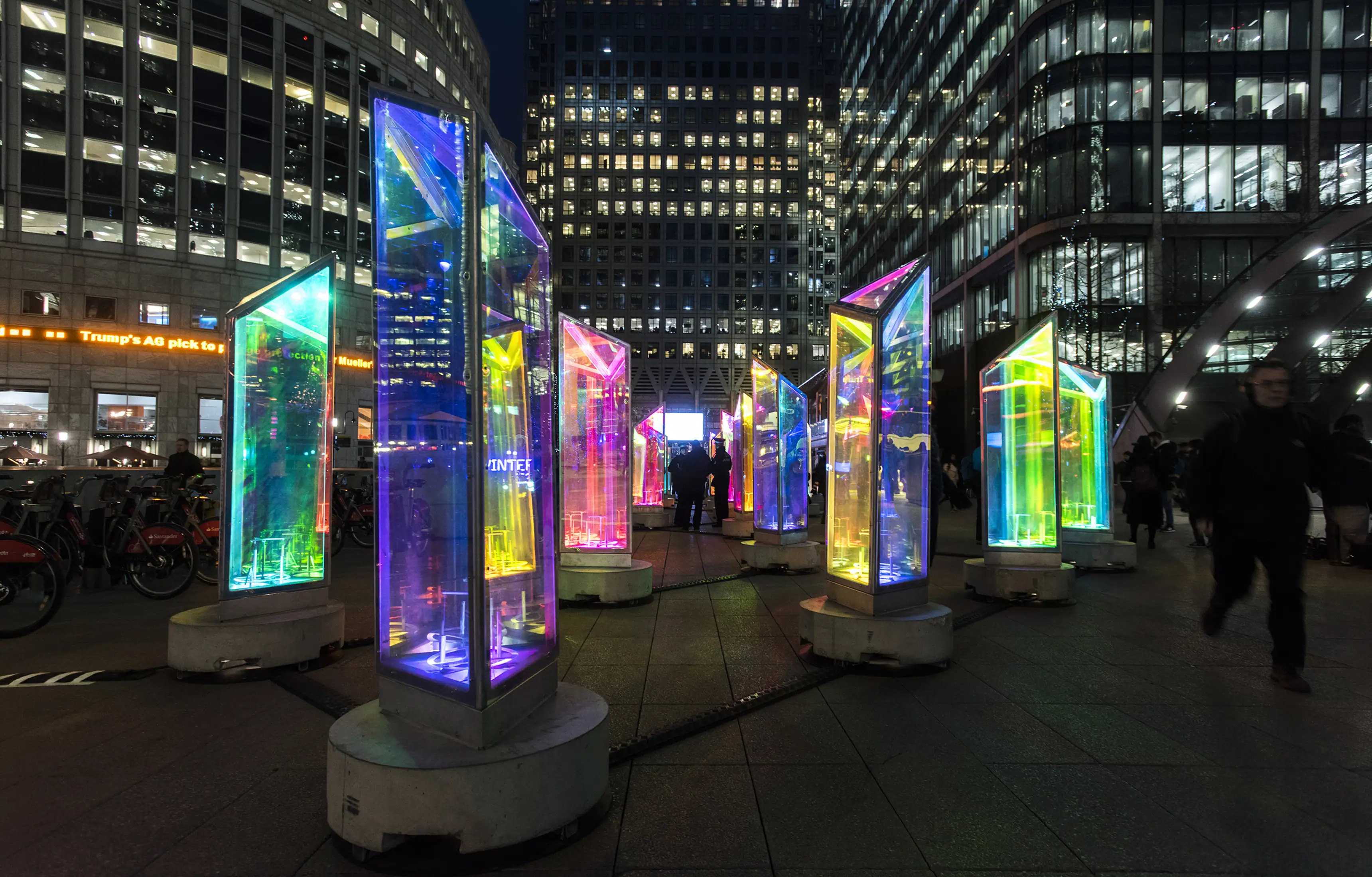
Just outside the Canary Wharf tube station, RAW Design’s Prismatica gave the festival its most consistently busy corner. Fifty large prisms, each mounted so it pivots freely, catch and scatter light onto the surrounding paving and walls as visitors spin them by hand. By day the same prisms work as pure optics, glimmering under natural light without any power at all; after dark they become the source of the colour themselves, lit from within and cast across Jubilee Plaza in overlapping fans.

RAW Design, working with fellow Montreal studio ATOMIC3, built Prismatica for the city’s Luminothérapie competition in 2014, and it has been touring internationally ever since, through Ottawa’s Parliament Hill, Washington’s Potomac riverside, Calgary and Niagara Falls before reaching London. Its appeal is structural rather than decorative: because the light output depends entirely on how visitors position the prisms, no two nights at the same installation look alike, and children tend to treat it less as an artwork and more as a piece of playground equipment that happens to throw rainbows.

Time and tide: a curatorial thread about waste
Set at Columbus Courtyard, Time & Tide by Paul & Pute took the form of a large hourglass, built substantially from recycled and biodegradable materials rather than new steel or plastic. Sand falling through an hourglass is an old shorthand for time running out; here, the same silhouette was used to talk about ocean plastic pollution and the finite window for addressing it, with the choice of materials underlining the point rather than just illustrating it.

That message did not sit in isolation. Whale Ghost, an 18 metre kinetic sculpture by the Lyon studio Pitaya, took the skeletal form of a marine mammal and set it in slow, swimming motion above the water, its reflection doubling the effect in the docks at night. Pitaya, founded by Arnaud Giroud and David Lesort after they met at design school, has built its practice around treating light as a structural material rather than a finishing touch, and Whale Ghost used that approach to prompt a quiet reflection on marine biodiversity without a single word of text. Nearby, Floating Islands by Mürüde Mehmet took organic forms made from recycled plastic bottles, built with children from local schools in Tower Hamlets, and set them afloat on Jubilee Park’s water features. Oskar Krajewski’s Recyclism, meanwhile, turned discarded toys, electronics and packaging directly into sculptural form.

Four separate works, four separate artists, one message, arranged around the same 21 hectare estate. That is a curatorial decision, not a coincidence, and Keith Watson’s own framing of the programme, that Winter Lights should keep the conversation about waste running “across all generations,” confirms it was made on purpose rather than assembled after the fact from whichever proposals arrived.

The rest of the trail
Not every piece in the programme carried an environmental brief, and the variety mattered as much as the theme. Adam Decolight, working out of Estonia, filled Westferry Circus with Sasha Trees, a stand of illuminated fir trees whose neon foliage shifts colour so gradually that most visitors only notice the change once it has already happened, which turns a piece that could have been simple decoration into something closer to a slow-motion experiment in attention. Ben Busche and the Spanish practice Brut Deluxe built the Heofon Light Maze, a triangular geometry of mirrored panels arranged so that stepping inside produces a genuine infinity-room effect, with reflections of the rainbow-spectrum lighting repeating outward until the physical boundary of the maze becomes difficult to judge by eye. Stuart Langley’s Two Hearts used the windows of one of the estate’s newer towers as pixels in their own right, lighting them to beat in slow synchrony and turning an entire building elevation into a single, legible gesture about life and energy rather than a lighting scheme applied after the fact.

Rombout Frieling Lab brought Colour Moves from the Netherlands, an immersive installation built around pigments engineered to react to specific wavelengths of light, so that the same surface shifts through a sequence of colours as the lighting sweeps across it rather than being lit a single fixed colour throughout the evening. The piece had already been shown at Baltimore’s Light City festival the year before it reached Canary Wharf, which places it alongside Prismatica among several 2019 works with an international touring history rather than a one-off commission built specifically for London.

Across the full route, Canary Wharf Group reported that the 2019 edition drew more than 500,000 visitors over its twelve nights, a figure that reflects how far the festival has moved from a decorative add-on to a genuine annual fixture on London’s January calendar, one that estate workers and visiting families now plan an evening around rather than simply walk through on the way to a train.

How the fifth edition built on four years of Winter Lights
Winter Lights began in 2015, and by its fifth edition in 2019 the programme had settled into a clear formula of its own: a piece with a genuine research pedigree in Bit.Fall, a touring international commission in Prismatica, the largest version yet of a UK collective’s flagship work in Submergence, and a deliberately connected run of new commissions addressing plastic waste. That mix, established art alongside newly commissioned work, international names alongside London-based artists, gave every visitor a reason to look closely at any single piece, not just walk the route end to end.

Final thoughts
The simplest description of Winter Lights is a January lights trail built to bring footfall to an office district in its quietest month. What the fifth edition actually did was assemble a genuine cross-section of contemporary light art, from a German media artist whose work has stood in Moscow and Hong Kong to a Lyon studio building its first chandeliers for a French festival of light little more than a decade earlier, and give all of it the same free, unticketed access as the trees on Westferry Circus.

The environmental thread running through Time & Tide, Whale Ghost, Floating Islands and Recyclism is the clearest evidence that the programme was curated with an argument in mind rather than filled from a list of available artists. And the presence of Bit.Fall, quietly running under a DLR bridge for most of the year and simply switched back on for the festival, is a reminder that Canary Wharf’s relationship with serious light art did not start or end with twelve nights in January. Winter Lights is where that relationship becomes visible to everyone walking through.

What was Winter Lights 2019 at Canary Wharf?
Winter Lights 2019 was the fifth edition of Canary Wharf’s annual light festival, staging 21 installations by international artists across the estate’s docks, plazas and public walkways.
When did Winter Lights 2019 run?
The festival ran for twelve nights, from Tuesday 15 January to Saturday 26 January 2019, with installations lit daily until 10pm.
Where was Winter Lights 2019 held?
Across the Canary Wharf estate in east London, including Montgomery Square, Jubilee Park, Westferry Circus, Columbus Courtyard and Chancellor Passage.
Who made Submergence at Winter Lights 2019?
Submergence was created by Squidsoup, a UK collective founded in 1997 by Anthony Rowe, working with over 24,000 individually suspended points of light.
How does Bit.Fall by Julius Popp work?
A bank of water valves fires individual droplets in timed sequence to spell out words drawn from a live newsfeed on the Times website, each word visible for only a second before it falls apart.
Was Winter Lights 2019 free to attend?
Yes. Every installation was free and open to the public, with no ticket required.
What was the environmental theme behind several of the 2019 works?
Time & Tide, Whale Ghost, Floating Islands and Recyclism were built from recycled and biodegradable materials and addressed ocean plastic pollution and biodiversity, a theme the festival’s curator described as keeping the conversation about waste running across generations.
How many people visited Winter Lights 2019?
Canary Wharf Group reported more than 500,000 visitors across the twelve nights of the festival.

Leave a Reply