
ART & CULTURE · VENICE
Reading time: 10 minZsófia Keresztes builds bodies out of carved polystyrene and hand-cut glass mosaic, forms that look part organ, part armour, part hook. For Hungary’s pavilion at the 2022 Venice Biennale, she filled four rooms with them, and built the whole installation on a nineteenth-century philosophical parable about porcupines and a scene from a Hungarian novel about a honeymoon that goes astray in front of a wall of mosaics. The result treats identity as something assembled from other people’s reflections, and it says so in the material itself.
Hungary’s pavilion in the Giardini della Biennale is a squat, richly worked building put up in 1909, and for the length of the 2022 Venice Biennale it held four rooms of sculpture built from carved polystyrene and hand-cut glass mosaic. The artist was Zsófia Keresztes, born in Budapest in 1985, and the exhibition was titled After Dreams: I Dare to Defy the Damage. It opened to the public on 23 April 2022, alongside the rest of Biennale Arte 2022, the edition curated by Cecilia Alemani under the theme The Milk of Dreams, and it ran until the Biennale’s close on 27 November 2022.
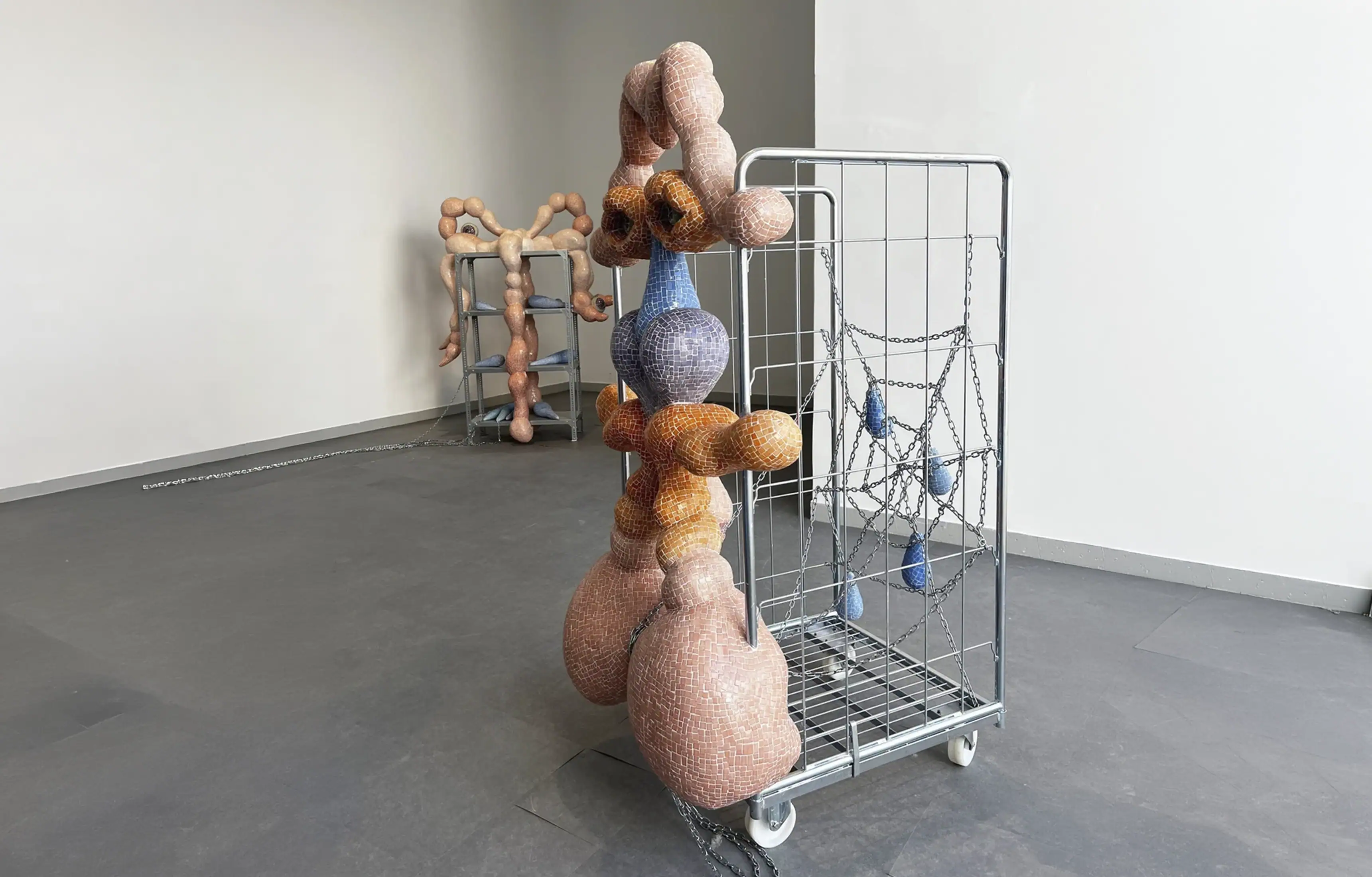
The pavilion was commissioned by Julia Fabényi, director of the Ludwig Museum in Budapest, which has overseen Hungary’s Venice selection since 2015, and curated by Mónika Zsikla, whose proposal for Keresztes was chosen in 2020. Between them they gave one artist the whole building, and Keresztes used it to install a body of work built from a single, consistent material logic: expanded polystyrene carved into curved, bulbous, faintly anatomical forms, then entirely skinned in hand-cut glass mosaic tesserae in cream, peach, turquoise and citrus tones, strung through with industrial chain.
What follows is an account of what that material actually is and does, who Keresztes is and how she arrived at it, what stood in each of the pavilion’s four rooms, and the two reference points, one classical philosophy, one Hungarian fiction, that the whole installation was built to think through.
What actually stood in the pavilion
Keresztes’s sculptures start as a carved core: blocks of expanded polystyrene cut and sanded into rounded, interlocking shapes that read as fragments of bodies rather than whole figures, somewhere between an organ, a claw, a hook and a limb. Some of the forms in Venice sat on the floor at a scale close to a visitor’s own height; others hung from chain, or perched on the fibreglass-reinforced bases that give the larger pieces their structural stability.
Over that carved surface, Keresztes applies a shell of mosaic by hand, tessera by tessera, in a technique she has described as following the flowing lines, or andamento, that Byzantine and Roman mosaicists used to guide a viewer’s eye across a curved surface rather than a flat one. Cream and pale rose dominate, interrupted by turquoise, citrus yellow and pockets of deeper colour, so that from a distance the sculptures read as smooth, glowing bodies, and only up close resolve into the grid of individual glass tiles and grout lines that made them. For the largest single sculpture in the pavilion, the mosaic application alone took roughly three weeks, and for Venice, for the first time in her career, Keresztes brought in assistants to help complete the work to the Biennale’s deadline, having scouted the pavilion’s rooms in person in February 2021 to plan where each piece would stand.
Chain runs through several of the works, linking pieces to each other or to the architecture, a detail that turns the installation into a single connected structure rather than a set of separate objects. That connective chain is doing the same job as the mosaic surface itself: nothing in the room stands alone. Each form depends on, touches, or reflects another, which is precisely the argument the exhibition was built to make.

Who Keresztes is, and how she arrived at this material
Keresztes grew up in Budapest in a household already tuned to making things: her mother worked in applied photography, her father in antiques and floristry. She studied ceramics before graduating as a painter from the Hungarian University of Fine Arts in Budapest in 2010, after a spell studying in Helsinki. Painting, and then ephemeral paper installation, were her first languages as an artist.
The shift that produced the work she is now known for came in 2016, when she began working with polystyrene. She has described the change as opening up “a more abstract, amorphous formal language” that let her get at the shaping of personality and identity in a way flat surfaces had not. Mosaic followed as the skin for that new sculptural language, chosen partly because the grid built from small, individually placed tiles let her hold real tension inside a strictly symmetrical, orderly surface, and partly because a mosaic surface behaves differently under different light, the way a screen or an information panel does.
She has stayed based in Budapest throughout, working from a studio at Art Quarter Budapest, a former brewery converted into artist studios, represented by acb Gallery in Budapest and, since 2017, by Gianni Manhattan in Vienna. By the time she was selected for the Hungarian pavilion, her sculptures had already appeared in the Lyon Biennale, the Ljubljana Biennale and the Baltic Triennial, work that reads, across all of it, as a single ongoing investigation into what a body looks like when it is built rather than born, assembled from fragments the way an identity is assembled from other people’s reactions to it.

Four rooms, four stages of the same argument
Zsikla and Keresztes organised the pavilion into four units, moving a visitor through what the exhibition’s own framing describes as the stages by which a person maps out their own identity, and the ambivalent relationship between past, present and future that runs through that process. Rather than a chronological story with a beginning and an end, the four rooms work as four related states: fragmentation, mutual dependence, reflection and, in the final room, something closer to resolution, forms that have found a way to exist alongside one another without losing their own shape.
The mosaic surface is what makes that argument physical rather than merely titled. A body built from thousands of individually placed, individually cut tiles is a body made of parts, visibly, permanently, however smooth it reads from across the room. Keresztes has spoken about valuing an artwork that carries its maker’s imprint and its own honest imperfections, and the mosaic technique guarantees exactly that: no two tesserae sit at quite the same angle, so the surface never resolves into anything mechanically uniform, however symmetrical the overall form.
Schopenhauer’s porcupines, at sculptural scale
The exhibition’s conceptual anchor is a parable the philosopher Arthur Schopenhauer set out in his 1851 collection Parerga and Paralipomena: a group of porcupines on a cold day huddle together for warmth, discover that closeness means being pierced by one another’s quills, retreat, grow cold again, and eventually settle at the one distance that lets them share enough warmth to survive without wounding each other too badly. Schopenhauer used it as a picture of human society itself, driven together by loneliness and apart again by the friction of actually being close to other people.
Keresztes’s sculptures are built as an answer to that dilemma in three dimensions. The mutually referenced body fragments across the pavilion’s four rooms are, in her own account of the work, liberated in each other’s reflection from the burden of both shared and individual experience, separate objects that nonetheless behave as one community, each attempting to reach its own final form only in relation to the others around it. That is the porcupine problem restated as sculpture: closeness and separateness held at exactly the distance where one becomes the condition for the other, rather than its opposite.

The novel behind the mosaics
The second reference point is more specific, and considerably less discussed than the philosophy. Keresztes drew the exhibition’s title and much of its emotional register from an episode in Journey by Moonlight, the 1937 novel by the Hungarian writer Antal Szerb. Its protagonist, Mihály, honeymooning in Italy with his new wife Erzsi, becomes gradually more consumed by memories of his own adolescence, and at a critical point simply wanders away from her, alone, eventually arriving in Ravenna to look at the city’s ancient mosaics. Standing in front of them, he hopes to recover something of his childhood self, and instead confirms what the whole novel has been building towards: that marriage has cured neither his loneliness nor his sense that his adult, respectable life sits over an unresolved earlier one, populated by old friends, above all the elusive Éva Ulpius, whose pull on him never fully lifts.
It is a scene about standing in front of a wall built from thousands of small, ancient fragments and looking for a whole self in it, and finding instead a reminder that identity is assembled, historically layered, and never quite finished. Keresztes took that scene as a poetic starting point rather than an illustration to reproduce, and it explains why mosaic, specifically, carries the argument in her own work: it is the one material that makes visible, in its very construction, the idea that a self is built from separate, older pieces rather than poured in one continuous form.

The building the sculptures were placed inside
One detail belongs to the pavilion itself rather than to Keresztes’s own account of the work, and it deepens the same theme by accident of history. The building was designed in 1906 and completed in 1909 by the architect Géza Maróti, working in the decorative, richly detailed idiom of Hungarian Art Nouveau architecture of that period. Only the entrance and elements of the original decoration survive from Maróti’s building today. In 1958 the architect Ágost Benkhard restored the pavilion and added a courtyard and a flat roof; between 1991 and 2000 György Csete carried out a further restoration. The structure a visitor walks into in Venice today is therefore itself a composite, a building rebuilt in stages across more than a century, with only fragments of its original fabric intact.
That is not a fact Keresztes’s own framing of the exhibition makes anything of, but it sits underneath the work regardless: a set of sculptures about identity as something assembled from surviving fragments and later additions, installed inside a pavilion that is, structurally, exactly that. The building and the work inside it were, without either party arranging it, making the same argument in two different materials.

What the installation gave a visitor moving through it
Approached in sequence, the four rooms ask a visitor to do something closer to reading than looking: to track how a form recurs, shifts colour, gains or loses a connecting chain, and to notice that no single sculpture in the pavilion is really finished on its own terms. After the Biennale closed in Venice, the exhibition travelled to the Ludwig Museum in Budapest, opening there on 16 December 2022 and running into 2023 in a different, non-symmetrical arrangement suited to the museum’s own galleries, giving Hungarian audiences who had not made the journey to Venice a second chance to walk through the same body of work in a different container.
That willingness to let the installation be reconfigured for a second building rather than treated as a fixed, singular arrangement is consistent with everything else about how the work is made: mosaic surfaces that shift under different light, chained forms that depend on their neighbours, a whole pavilion built as one interconnected argument rather than a set of discrete objects. The porcupines never do find a single correct distance. They find one that works for the room they are in.

Final thoughts
It would be easy to describe this as a pavilion full of striking, colourful sculpture and leave it there. That misses what the material is actually doing. Every one of Keresztes’s forms is built from thousands of separate, individually placed pieces, arranged so that the whole reads as one continuous body only from a certain distance, and that construction method is the argument, not a decorative choice sitting on top of it. A self, the work says, is assembled the same way: from fragments, other people’s reflections, and old material that never quite disappears, however finished the surface looks.
Schopenhauer’s porcupines and Szerb’s honeymooning Mihály arrive at the same discovery from two very different directions, one philosophical, one novelistic, and Keresztes gave both of them a third form, in glass and polystyrene, inside a Venice building that has itself been rebuilt in fragments for over a century. The pavilion did not just house the argument. It happened to be making it already.
Who is Zsófia Keresztes?
Zsófia Keresztes is a Hungarian artist, born in Budapest in 1985, known for sculptures carved from expanded polystyrene and covered entirely in hand-cut glass mosaic tesserae. She trained as a painter at the Hungarian University of Fine Arts and began working in polystyrene and mosaic in 2016.
What was Hungary’s pavilion at the 2022 Venice Biennale called?
The exhibition was titled After Dreams: I Dare to Defy the Damage, commissioned by Julia Fabényi and curated by Mónika Zsikla.
When did the exhibition run?
It opened to the public on 23 April 2022 and closed on 27 November 2022, running for the full length of Biennale Arte 2022.
What are Zsófia Keresztes’s sculptures made of?
Carved and shaped expanded polystyrene over a fibreglass-reinforced base, finished with a hand-applied mosaic skin of small glass tesserae, and in several works linked together with industrial chain.
What philosophical idea shaped the exhibition?
Arthur Schopenhauer’s porcupine dilemma, a parable in which porcupines huddle for warmth but injure one another with their quills, settling on the one distance that allows closeness without harm.
What is the connection to Antal Szerb’s novel Journey by Moonlight?
Keresztes drew on an episode in which the novel’s protagonist, on honeymoon in Italy, wanders away from his new wife to look at ancient mosaics in Ravenna, searching for an earlier version of himself and finding instead that identity is built from old, separate fragments rather than resolved in one piece.
Where is the Hungarian Pavilion, and who designed the building?
It stands in the Giardini della Biennale in Venice, designed in 1906 and completed in 1909 by the architect Géza Maróti, and later restored in stages by Ágost Benkhard and György Csete.
Did the exhibition travel after Venice?
Yes. After the Biennale closed, a reconfigured version opened at the Ludwig Museum in Budapest on 16 December 2022, arranged differently to suit the museum’s own galleries.
Leave a Reply