
ART & CULTURE · VAREDO
Reading time: 6 minVilla Bagatti Valsecchi, one of four venues for Alcova’s 2025 edition in Varedo, was built around 1880 by two brothers who were simultaneously renovating their family’s Milan townhouse into what is now a museum. Between their ownership and Alcova’s arrival stood a furniture manufacturer, which is a more direct link to April 2025’s exhibition than it first appears.
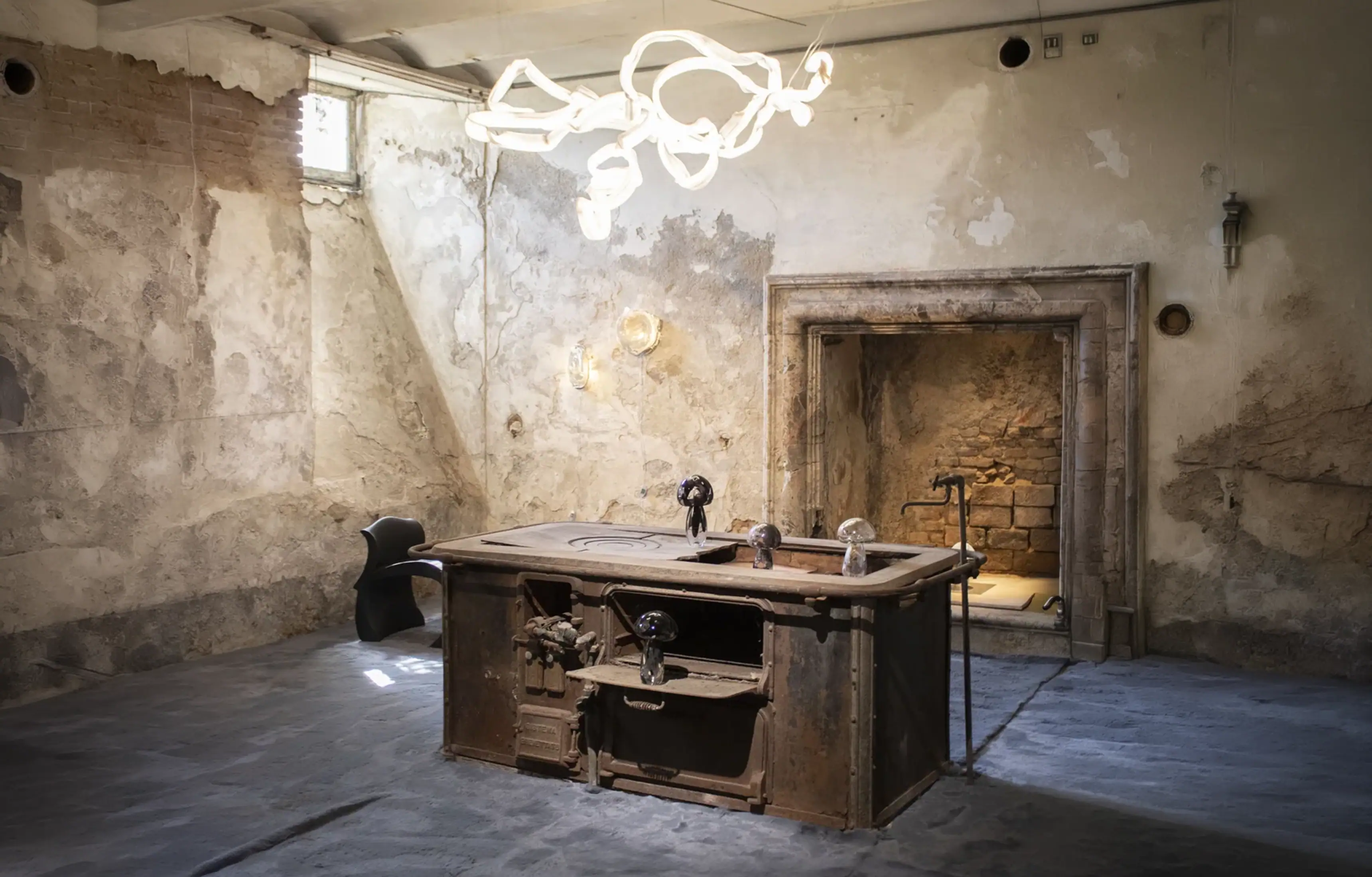
Alcova’s ninth edition, running from 7 to 13 April 2025, returned to Villa Bagatti Valsecchi as one of its four Varedo venues, alongside the neighbouring Villa Borsani and two newly added sites, the former SNIA Viscosa factory and the Pasino Glasshouses. Villa Bagatti Valsecchi had already hosted Alcova the previous year, and the 2025 edition used its faded frescoes, ivy-covered facades and layered gardens as a setting for work by, among others, the Slovenian designer Lara Bohinc and the Amsterdam studio Rive Roshan.


What most coverage of the villa’s Alcova appearances tends to skip is the building’s own ownership history, which does more to explain why this particular estate was available for a design exhibition at all than any description of its frescoes can. The short version: an aristocratic family built it, a furniture manufacturer owned it for two decades, and only then did a public foundation take it over and start opening it to events like Alcova. Each stage left its own mark on the building, and Alcova’s 2025 installations were, whether deliberately or not, responding to all three at once.


Two brothers, two houses, one design language
The Bagatti Valsecchi family had held land in Varedo since the sixteenth century, having originally settled there to escape an outbreak of plague in Milan. The villa standing today was built around 1880, replacing an earlier farmhouse on the same site, under the direction of brothers Fausto and Giuseppe Bagatti Valsecchi. The design blends an eighteenth-century-style symmetrical main house with a guesthouse connected by a continuous arcade, set within grounds that pair a formal, geometric Italian garden against a deliberately informal, densely planted English garden, two contrasting design languages held inside the same estate boundary.


The two garden styles are worth understanding as a deliberate argument rather than simple variety. An Italian garden of this period is organised around straight sightlines, clipped hedges and symmetrical planting beds, a landscape designed to be understood at a glance from a fixed vantage point, usually a terrace or a principal window. An English garden, by contrast, is built to be discovered gradually, its paths curving out of sight, its planting layered to obscure rather than reveal the full extent of the grounds at once. Placing both directly against each other at Villa Bagatti Valsecchi meant the brothers built two entirely different visitor experiences into a single estate: one legible instantly, one legible only through movement, which is not far from the choice any exhibition designer still has to make when planning how visitors move through a historic site today.


The brothers were working on a second, equally significant project at almost exactly the same time: the wholesale renovation of their family’s Milan residence, now open to the public as the Bagatti Valsecchi Museum, one of the city’s most complete surviving examples of Lombard neo-Renaissance interior design. Both projects reflect the same instinct, historical revival architecture applied with real scholarly seriousness rather than as costume, and both remain publicly accessible today for essentially the same reason: neither family fortune nor family ownership survived intact into the twenty-first century, and both properties eventually passed into institutional stewardship that opened them to the public rather than keeping them private.


A furniture company owned this villa for twenty years, which matters more than it sounds
In 1991, the Bagatti Valsecchi family sold the Varedo estate to Tecno, the Milanese furniture manufacturer founded by Osvaldo and Fulgenzio Borsani, best known for producing rigorously engineered modern seating and office systems through the second half of the twentieth century. Tecno held the property for two decades before the comune of Varedo acquired it in 2011, since when it has been managed by the La Versiera 1718 foundation, which maintains public access to the park and hosts events, Alcova among them, inside the villa itself.


That twenty-year stretch of furniture-company ownership is easy to skip past as a piece of administrative trivia, but it is a more direct thread to April 2025 than the villa’s aristocratic origins are. Long before any design fair set foot on the property, the villa already belonged to a company whose entire business was industrial furniture manufacturing, sitting immediately adjacent to Villa Borsani, itself the Borsani family’s own former residence and now another of Alcova’s returning venues. Design and this particular patch of Varedo were connected well before Alcova arrived; the fair’s presence there is a continuation of an existing local link between manufacturing families and these specific estates, not an outside curator’s discovery of an unrelated historic site.


What Alcova actually put inside it in 2025
Two installations from the 2025 edition made particularly direct use of the villa’s own layered character. Lara Bohinc, working with the French upholstery house Maison Phelippeau, presented Anima, a collection including a sofa, an armchair and an occasional chair upholstered in pure alpaca wool, alongside a mahogany Dark Woods table, developed around a visual language drawn from rolling hillsides, a landscape reference that sat naturally against the villa’s own English garden just outside. Rive Roshan, the Amsterdam-based studio run by Ruben de la Rive Box and Golnar Roshan, installed Sun Catcher directly into the garden’s fountain: a solar panel built using aesthetic photovoltaics, a technology that lets a functioning solar surface display shifting colour depending on the angle of available light, effectively placing a working piece of renewable energy infrastructure inside a nineteenth-century ornamental water feature without disguising what it actually was.


Both installations shared an instinct that suited the venue specifically: rather than treating the villa’s faded grandeur as a backdrop to photograph furniture against, both responded to something structurally present in the site itself, a garden style in Bohinc’s case, a functioning fountain in Rive Roshan’s, and built new work that needed that specific context to make sense.


Two designers who arrived at furniture from somewhere else entirely
Neither designer came to this brief through a conventional furniture training, and both arrived at Villa Bagatti Valsecchi with backgrounds that shaped how directly they were able to respond to the site’s own materials and landscape.
Bohinc trained in industrial design in her native Ljubljana before earning a master’s degree in metalwork at London’s Royal College of Art, then spent roughly a decade designing sculptural jewellery for Cartier before founding her own studio in 2016 to move into furniture and functional objects. She was appointed MBE in 2012, and her work has since entered the collections of SFMOMA and the Moco Museum; she has also completed a string of craft residencies directly relevant to a practice built on material research, including working with urushi lacquer artisans in Wajima, Japan, in 2017, with Murano glassmakers in Venice in 2018, and at a glass symposium in Bohemia in 2024. Anima’s alpaca wool and mahogany, and its landscape-derived forms, sit squarely inside that research-led, materials-first approach rather than reading as a one-off furniture commission.


Rive Roshan is the joint practice of Ruben de la Rive Box, born in the Netherlands in 1981, and Golnar Roshan, born in Australia in 1986. Both built their early careers inside established design studios, including spells with Tom Dixon, Marcel Wanders and Tord Boontje, before founding their own collaborative practice, which now works across graphic, interior and product design with a consistent interest in colour, light and raw material texture. Sun Catcher’s use of aesthetic photovoltaics, a technology that turns a functioning solar panel into a shifting field of colour, is a direct extension of that interest, applied for the first time inside a nineteenth-century fountain rather than the studio’s more usual gallery or interior settings.


Final thoughts
Villa Bagatti Valsecchi’s Alcova appearance closed with the rest of the 2025 edition on 13 April, and the villa has since returned to its normal calendar of public park access and occasional events under the La Versiera 1718 foundation’s stewardship. The building’s own history, aristocratic estate, then furniture manufacturer’s private property, then public asset, tracks closely with what has actually kept the site alive for a century and a half: a series of owners each finding a different practical use for the same rooms and grounds, of which a week-long design exhibition is simply the most recent and most public example.


None of that ownership history required Alcova’s 2025 designers to know it in order to respond well to the site, and nothing in either Anima or Sun Catcher suggests the designers were working from an archival brief. What the history does explain, for anyone wondering why a nineteenth-century aristocratic estate is available for a design fair to fill with alpaca wool sofas and solar-powered fountains at all, is the far less romantic but far more accurate answer: because a furniture company owned it first, and left it in a condition a public foundation could later take on.
Is Villa Bagatti Valsecchi open to the public outside Alcova?
Yes. The estate’s grounds are managed by the La Versiera 1718 foundation, which provides public access to the park and hosts periodic events; the villa itself is generally accessible during scheduled events rather than as a year-round museum.
Who built Villa Bagatti Valsecchi, and when?
Brothers Fausto and Giuseppe Bagatti Valsecchi built the current villa around 1880, on a site their family had held since the sixteenth century, while simultaneously renovating the family’s Milan townhouse, now the Bagatti Valsecchi Museum.
How did the villa end up hosting a design fair?
The Bagatti Valsecchi family sold the estate to the furniture manufacturer Tecno in 1991. The comune of Varedo acquired it in 2011, and it has since been managed by the La Versiera 1718 foundation, which hosts Alcova and other public events there.
What did Alcova show at Villa Bagatti Valsecchi in 2025?
Highlights included Lara Bohinc’s Anima collection, developed with Maison Phelippeau, and Rive Roshan’s Sun Catcher, a photovoltaic installation built directly into the villa’s garden fountain.
Is this the same Alcova venue as the former SNIA factory?
No. Villa Bagatti Valsecchi and the former SNIA factory were two of four separate venues for Alcova’s 2025 edition, both in Varedo but with very different histories and installations.


Leave a Reply