EXHIBITIONS · LONDON
Reading time: 8 minSome artists you admire. Anish Kapoor is one I have always found genuinely unsettling, in the best possible way. His work makes you doubt your own eyes and reach for something just beyond them. So the news that he has returned to London’s Hayward Gallery, filling the entire building and its terraces with monumental new work, is, for me, one of the cultural highlights of the year.

There are exhibitions you plan to see, and there are exhibitions you rearrange your life around. For me, Anish Kapoor at the Hayward Gallery is firmly the second kind.
Running from 16 June to 18 October 2026, it is the centrepiece of the Southbank Centre’s 75th anniversary programme, and it is a proper event: Kapoor has taken over the whole of the Hayward, its galleries and its outdoor terraces, with a mixture of major new commissions and seminal earlier pieces. I have loved his work for years, precisely because it refuses to sit still in the mind. You look at a Kapoor, and then you look again, and the second look is never quite what you expected. To have that experience at this scale, in London, is exactly the kind of thing I started writing about art for.
And there is a lovely story folded into the timing, which gives the whole occasion an extra depth of meaning.

A homecoming, 28 years in the making
The Hayward is not a neutral venue for Kapoor. It is where his British reputation began.
Back in 1998, the Hayward Gallery became the first public gallery in the UK to host a major survey of his work. Now, 28 years later, he has come back to the very same building, and this time he fills all of it. There is something quietly moving about that arc, an artist returning to the room that first took him seriously, at the height of his powers, to mark the institution’s own milestone birthday. The show is curated by Ralph Rugoff, the Hayward’s long-serving and now departing director, which makes it his farewell as well, the finale of two decades that shaped the gallery into one of the most adventurous spaces in the country. A homecoming and a send-off in one. You could hardly design a more resonant occasion.

What it is about Kapoor
Before the works themselves, it is worth saying why his art grips me the way it does, because it is not really about spectacle, even when it is spectacular.
For four decades Kapoor has circled a single, slippery preoccupation, what he calls “the space of the object.” He is interested in the gap between what we see and what is actually there: the black hole that seems to have no bottom, the mirror that will not let you trust your own reflection, the surface that turns out to be a depth. His work is designed to make you look twice, and in that second look, to feel the ground shift slightly beneath your certainties. It can be beautiful and it can be genuinely disquieting, often at the same moment. The press materials describe the show as illuminating the links between the sublime and what they call “extreme abjection,” between the spiritual and the physical, and that is exactly the tension I find so compelling in him. He takes you to the edge of wonder and the edge of unease, and shows you they are closer together than you thought.

Three monuments
At the heart of the exhibition are three enormous new works, each swallowing an entire section of the gallery, and it is these I am most impatient to stand in front of.
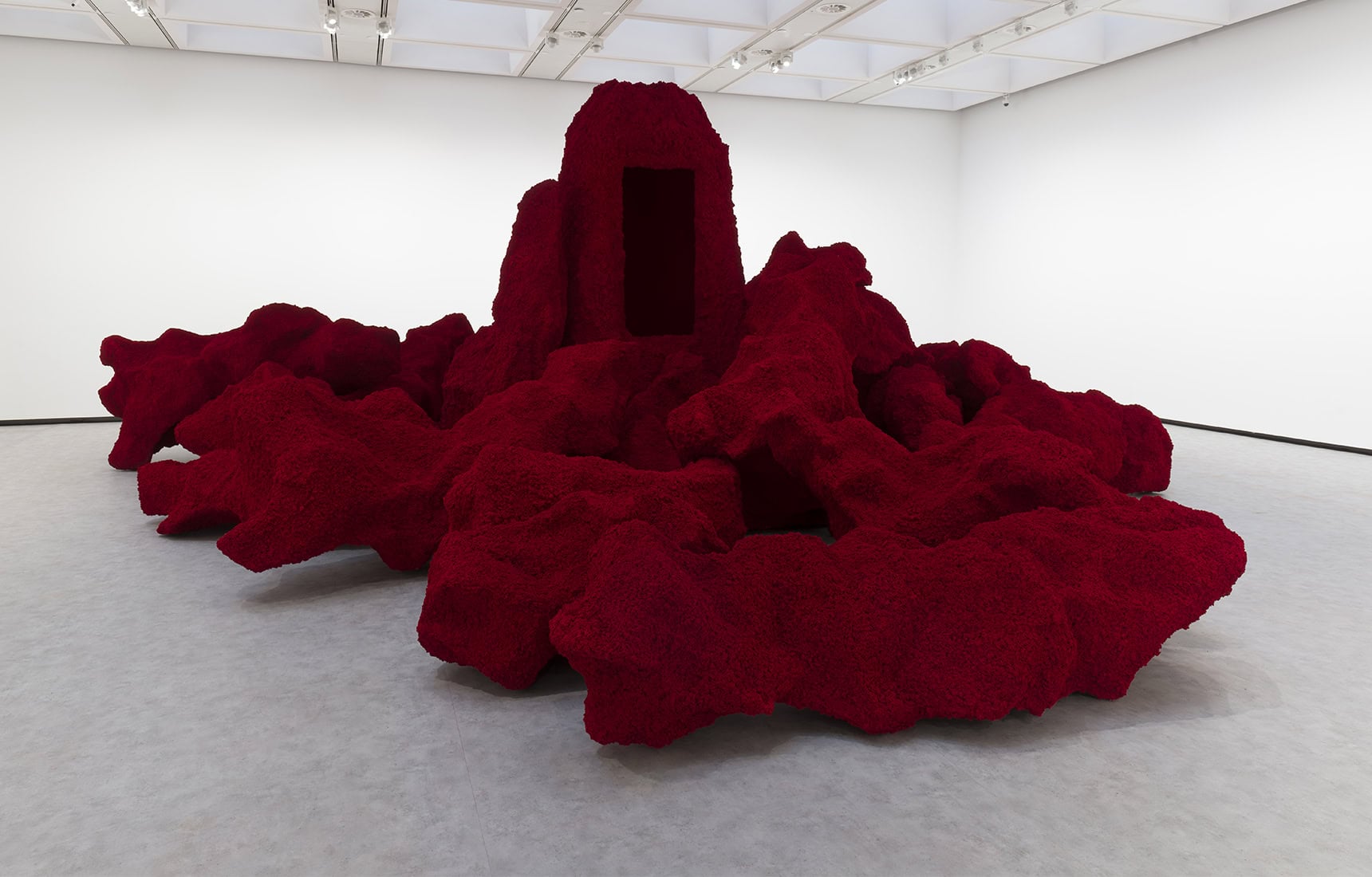
The first transforms a whole room with a colossal inflated PVC membrane that fills the six-metre-high space, pressing in on your sense of scale and of self. The second stages a dark, mountainous threshold looming over a sprawling red landscape in the upper gallery, an image that sounds closer to a vision than a sculpture. And the third is Mount Moriah at the Gate of the Ghetto (2022), a mass that descends from the ceiling and hovers just inches above the floor, defying gravity in a way that photographs cannot really prepare you for. Kapoor first unveiled that work in 2022 at Palazzo Manfrin in Venice, his own foundation’s then-unfinished palace on the Cannaregio Canal, before it travelled to the Hayward. Overwhelming in size and in feeling, these are the works where Kapoor’s lifelong fascination with the sublime becomes something you experience with your whole body rather than just your eyes.

Tricks of the eye, and the blackest black
Around those monuments sits the Kapoor I first fell for: the master of perceptual illusion.
The show includes his “void” works, sculptures that appear to have no depth at all, openings that seem to fall away into nothing. There are forms coated in Vantablack, the light-absorbing nanotechnology so profoundly black that a three-dimensional object, seen head-on, appears to flatten into a single void, a shape with no surface. It remains one of the strangest things in contemporary art, a black so complete your eyes simply cannot read it, and Kapoor is famously the artist who holds the rights to use it. Out on the Hayward’s terraces, meanwhile, large mirrored steel sculptures bend the sky, the building and you into their curved surfaces, turning a walk in the open air into an exercise in cheerful disorientation. This is the part of a Kapoor show that makes you grin and frown at once, the pure pleasure of not quite believing what you are looking at.

The body, splayed open
There is a darker, more bodily side to the exhibition too, and I am glad it has been included, because it shows how far Kapoor’s work has travelled.
Alongside the illusions are his recent paintings and sculptures, made from silicone, resin and pigment, that conjure splayed-open bodies and internal organs, visceral, red, unmistakably physical. They are not comfortable, and they are not meant to be. They ask what it means to live in an age when violent imagery is everywhere, and they push his interest in the sublime all the way into the abject, the raw stuff of the body itself. Set against the serene voids and the mirrored steel, they complete the picture of an artist who has never been content to make only beauty. The wonder and the wound, side by side.

Beyond the galleries
The exhibition spills beyond the walls, which only adds to the sense of occasion.
Across four Saturdays, a series of live musical performances called Touching the Quick, composed by Brian Elias and performed by horn player Ben Goldscheider, responds directly to specific sculptures in the show. On 8 July 2026, Kapoor himself appears in conversation with the psychoanalyst and author Darian Leader, digging into the psychological and philosophical dimensions of his work, which, given how much his art plays on the mind, should be fascinating. And on 13 August 2026, a Hayward Gallery Lates offers an after-hours viewing with a cross-artform programme of performances. There is a fully illustrated catalogue, with contributions from Julia Kristeva, Nancy Spector and Sandhini Poddar, and a limited-edition hand-signed print, The Dark (2026), drawn from one of Kapoor’s recent gouaches of the void. The whole thing also brings Jewish Culture Month to a close, a nationwide celebration of more than a hundred events.

The practical details
Anish Kapoor is at the Hayward Gallery, Southbank Centre, Belvedere Road, London SE1 8XX, from 16 June to 18 October 2026. Standard tickets are £22, with concessions available, Southbank Centre Members going free, and half-price tickets for Under-30s subscribers. The gallery is open Tuesday to Friday 10am to 6pm, Saturday 10am to 8pm, and Sunday 10am to 6pm. Full information is at southbankcentre.co.uk.

Final thoughts
I will be going more than once. That is the honest measure of how much this show means to me, and I suspect it is the right way to see it anyway, because a Kapoor exhibition is not really something you tick off. It is something you return to, to catch the light differently in the mirrored steel, to stand a little longer at the edge of a void, to let one of those enormous new works press on you until your sense of scale gives way.

What I love about his work, in the end, is that it treats looking as an active, almost physical act, and trusts you to do the imagining. It asks you to shift your attention away from the surface of things and wonder what lies beyond. To have the chance to do that, across an entire gallery, in the city I know best, feels like a genuine gift. If you take one exhibition seriously this year, I would make it this one. I will see you there, standing very still in front of something I cannot quite explain.


Project Credits
Go further from here
Read next
For her first major US institutional show, Marguerite Humeau transforms ICA Miami into a speculative landscape where sculptures of walnut, glass and silk appear to shed the soil and take…
Miami