
Exhibitions · Miami
Reading time: 4 minFor her first major institutional exhibition in the United States, French artist Marguerite Humeau turns ICA Miami into a shifting, speculative landscape — one where the soil itself learns to take flight.
There is a particular kind of quiet that settles over a room when the objects inside it seem to be mid-transformation. At the Institute of Contemporary Art, Miami, Marguerite Humeau has engineered exactly that sensation. ‘*sk*/ey-’, the artist’s first significant institutional showcase on American soil, gathers a body of newly commissioned sculptures and video work into an environment that feels less like an exhibition and more like a field study conducted somewhere on the far edge of the possible. Humeau does not so much display objects as prototype a world, and she invites the visitor to step into it while it is still forming.


Humeau has built her reputation on a practice that behaves like a laboratory. She interrogates materiality and time with an almost scientific rigour, probing the enigmas of human existence from the deep past to speculative, not-yet-arrived futures. Her research is exhaustive and rarely solitary; over the years she has worked alongside anthropologists, palaeontologists, foragers and clairvoyants, folding hard knowledge and intuition into the same act of making. The result is a body of work that generates new mythologies as readily as it recovers old ones. “I extract essences of real events and extend into ‘what if?’ scenarios,” Humeau explains. “I prototype worlds that are unseen, extinct, or parallel to our own.” Drawing on forgotten ideas and vanished species, she uses imagination as a bridge across the gaps that research alone cannot close.


A desert conjured indoors
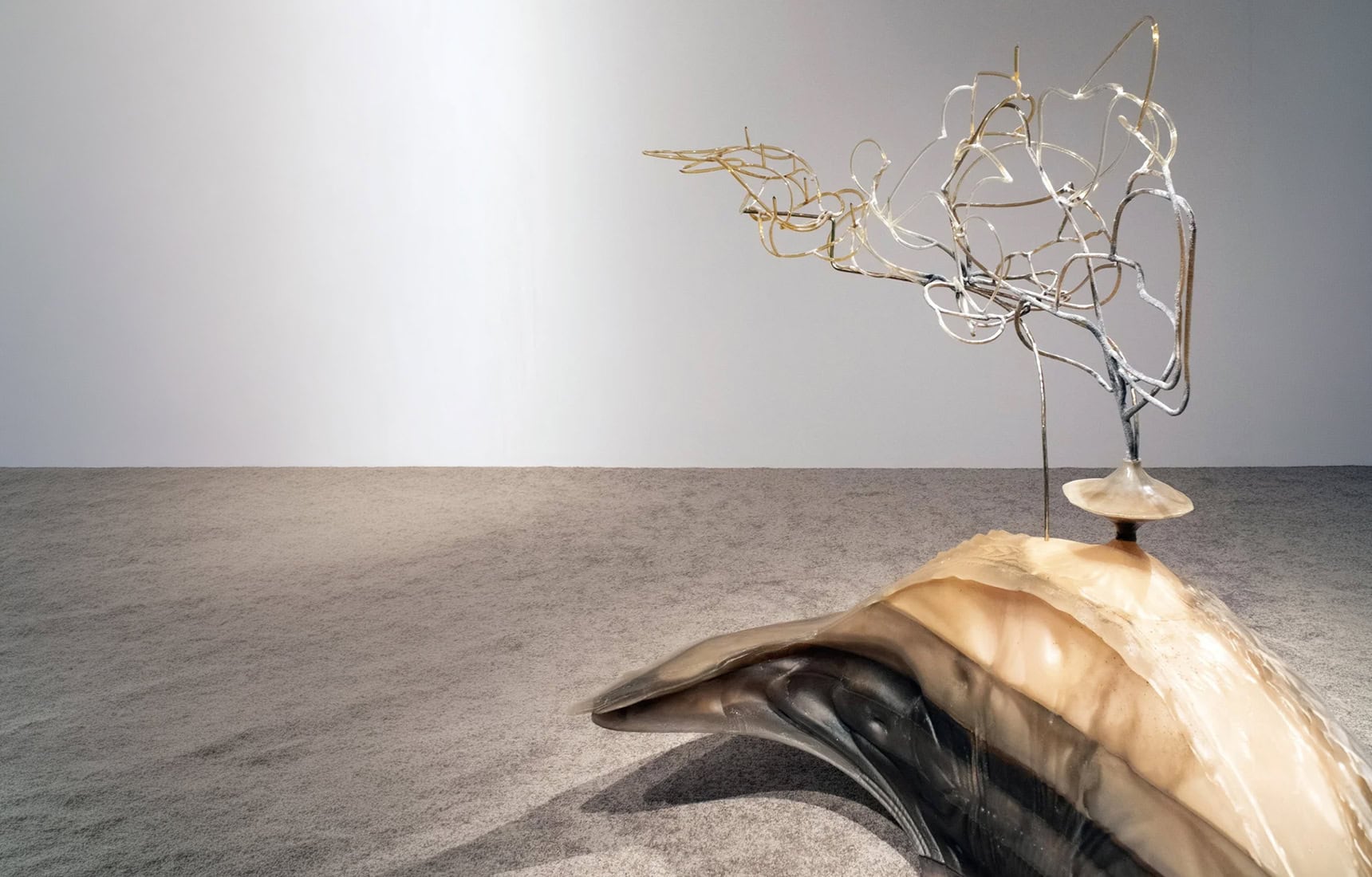
The heart of the exhibition is a major new installation in which Humeau conjures a desert. Here she reaches for a line from the art historian Petra Lange-Berndt — the observation that “the soil is full of decomposed bodies” — and takes it as the seed for three sculptures that appear to push up through the centre of the gallery, as if the ground had decided to grow something of its own accord.
These are not inert forms. Crafted from an unlikely register of organic materials — 150-year-old carved walnut, cast rubber, hand-blown glass and semi-translucent, embellished silk — their surfaces hover between mould and flesh. They read simultaneously as decay and as birth, protrusions of the earth caught in the act of becoming. The tension is deliberate. Humeau is interested in the moment where one state gives way to another, and her materials are chosen precisely because they refuse to sit still: rubber that mimics tissue, glass that suggests something wet and newly formed, silk that seems to breathe.


“I extract essences of real events and extend into ‘what if?’ scenarios. I prototype worlds that are unseen, extinct, or parallel to our own.”
Marguerite Humeau
The meaning in the title
Everything in the show orbits its title. ‘*sk*/ey-’ derives from the ancient proto-Indo-European root sk-ey, meaning to shed or to split — a small linguistic fragment that carries an enormous idea. Humeau uses it to imagine a planet in permanent flux, a place where the soil disintegrates and remakes itself as something airborne and nomadic. The exhibition opens with a newly commissioned video that narrates precisely this cosmology: a human-made eternal sun, a vast migration, and the slow metamorphosis of terrestrial beings into unmoored inhabitants of the sky.
The film is accompanied by a soundtrack that does much of the emotional work. It captures the atmosphere of a landscape in transition, its evocative passages occasionally breaking into something more visceral and rhythmic — the sound, perhaps, of matter tearing loose from itself. It sets the terms for everything that follows, priming the visitor to read the sculptures not as static artefacts but as beings arrested momentarily on their way to becoming something else.


Matriarchs poised for flight
Elsewhere in the space, a second group of sculptures appears to have already torn itself free of the ground. Their silhouettes carry the suggestion of matriarchal figures, and they seem to have completed a passage from plant-like forms into winged, feather-shaped entities. To make them, Humeau subjected blown glass, semi-translucent silk, waxed felt and raw wool to an intricate sequence of dyeing, dipping, casting and rusting. The effect is extraordinary in its specificity: surfaces that evoke mould and dried mud, melting bark, flame and the particular gold of low sunlight.
Crucially, these figures function as closed systems. Humeau describes them as “housing” themselves independently — self-contained nomadic beings that populate the exhibition from on high, perched along the upper walls as though they might lift off at any moment. There is an unsettling autonomy to them. They do not need us. They belong to a future in which the human has become peripheral, and they wait, poised, for a departure we are not invited to join.


An ecology of survival
Beneath the speculative fiction runs a distinctly present-day anxiety. Humeau conceived the sculptures in direct response to the looming threat of climate change, and they are designed — within the logic of her invented world — to pollinate, to bloom and to protect. The vision they propose is bracing rather than consoling: a potentially unavoidable mode of existence in which nomadic beings inhabit the air itself, remaining in perpetual movement because the ground can no longer be relied upon to hold them.
It is this doubling that gives ‘*sk*/ey-’ its charge. On one level it is pure invention, a mythology assembled from linguistic roots, extinct species and the artist’s own imaginative extrapolations. On another, it is a sober meditation on adaptation and loss — on what forms of life might persist when the soil that sustained them has broken apart and drifted skyward. Humeau refuses to resolve the two readings, and the exhibition is stronger for it.
What lingers, walking out of ICA Miami, is the sense of having witnessed a threshold rather than a conclusion. Humeau’s world is caught permanently in the act of shedding one skin for another, its beings suspended between earth and air, decay and flight. It is a fittingly restless proposition for an artist whose entire practice is built on the question of what comes next — and a reminder that the most affecting speculative art rarely offers answers. It simply builds the world convincingly enough that we cannot look away.


Marguerite Humeau: ‘*sk*/ey-’ is on view at the Institute of Contemporary Art, Miami. Visit the ICA Miami website for details.


Leave a Reply