
ART & CULTURE · LONDON
Reading time: 9 minSix tonnes of steel mesh rebar, twenty-seven tonnes of rolled steel, eight kilometres of coiled tubing and a room filled with nothing but earth, water and air. In 2019 the Royal Academy of Arts gave every one of its thirteen main galleries to a single living artist for the first time in years, and Antony Gormley used the space to turn a Georgian townhouse into an instrument for measuring the human body. The result argued, room by room, that the body is not a subject to be sculpted so much as a space to be built.
For ten weeks in the autumn of 2019, the Royal Academy of Arts in Piccadilly stopped being thirteen separate rooms and became one continuous experiment. Antony Gormley, the Turner Prize winning sculptor then 69 years old, filled every gallery in Burlington House’s Main Galleries with new commissions, remade works and pieces drawn from across four decades of practice, curated by Martin Caiger-Smith with Sarah Lea. The exhibition ran from 21 September to 3 December 2019.

Lost Horizon I, 2008
What made the show unusual was not simply its size. Living artists are occasionally given the whole of the Main Galleries at the Royal Academy, an institution built around eighteenth-century proportions and sequences of interconnecting rooms designed for paintings rather than six-tonne steel cages. Gormley’s exhibition set his own scales, from a single suspended body cast to a room-filling web of steel tubing, directly against those historic proportions, and asked visitors to notice their own body as the thing that made sense of the difference.
This is the story of how that argument was built, room by room, and what a reader will not find in any of the show’s original listings: exactly how the Royal Academy’s own historic fabric was tested, reinforced and, in places, quietly rewritten to carry a show this heavy.
Matrix III and the room built from rebar
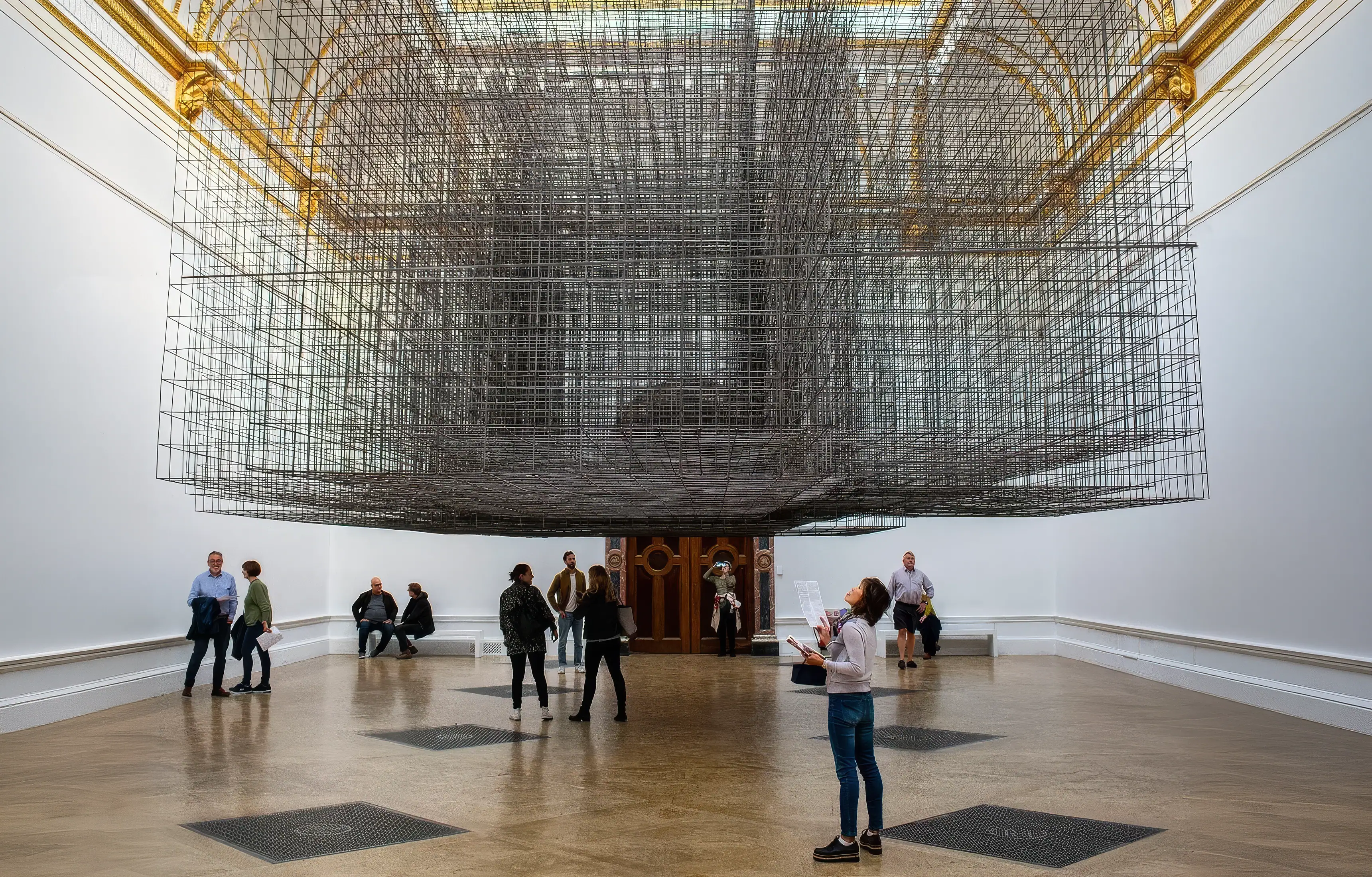
The largest of the thirteen galleries held Matrix III (2019), a work made from six tonnes of steel mesh rebar, the ordinary reinforcing material used inside concrete walls and lift shafts. Twenty-one room-sized cages, welded from that mesh, hung suspended from the gallery ceiling, their edges invading each other’s space so that no single cage stood in isolation from its neighbours. Visitors walked beneath the whole structure, looking up through layer after layer of steel lattice.

Gormley described the material choice in direct terms: rebar, he said, is “the inner skeleton of the environment we live in”, the hidden structural material that holds up almost every building a visitor had walked past to get to the gallery, made suddenly visible and suspended overhead. Matrix III was fabricated entirely in Gormley’s own studio, the most structurally complex work the studio had built in-house, and required its own engineering consultation to establish how the piece could be assembled and hung in sections without exceeding what the Royal Academy’s Victorian and Georgian ceilings could bear.

Body and Fruit, and the body cast that started it all
Beneath the dome of the Central Hall, two body forms cast from Gormley’s own figure in a curled, foetal position hung suspended on thick wires. Body and Fruit (1991/93) predates the majority of the works shown elsewhere in the exhibition by nearly three decades, and it uses the technique Gormley spent the late 1970s and 1980s developing: a direct plaster cast of his own body, built up in stages and finished in a hardened outer shell.
That method, plaster over a body sealed in cling film and Vaseline, cut from the cast once set and reinforced afterwards, is the same one Gormley used across the lead body-case works he made between 1977 and 1993, the period covered in his 2025 exhibition WITNESS at White Cube Mason’s Yard. Seeing Body and Fruit suspended at the entrance to the Royal Academy’s Main Galleries put that same foundational technique at the very start of a show that would go on to leave it behind entirely: most of the works built specifically for 2019, Matrix III, Cave and Clearing VII among them, are made from steel and tubing rather than a cast of the artist’s own body at all. The Central Hall piece worked as a kind of prologue, showing visitors where the whole practice began before the rest of the galleries demonstrated how far it had travelled since.

Cave and Host: the built environment as a second body
Two galleries took the show’s argument furthest from the body cast and closest to architecture itself. Cave (2019), built specifically for the exhibition, used twenty-seven tonnes of rolled industrial steel to construct interlocking rectangular and cuboid forms that together read, from outside, as a giant crouched human figure wedged into a corner gallery. A single hand and a single foot pressed through doorway-sized gaps, marking the only points where the piece’s interior met the rooms around it. Visitors could walk through the dark interior of Cave itself, feeling their way past intersecting steel planes, or walk the perimeter and read the crouched form from outside.
Cave makes explicit an idea Gormley has returned to across his career: that architecture is a kind of second body, the built shell every person moves through and shelters inside once they step outside their own skin. Next door, Host (2019) took the opposite approach to the same idea. The gallery was filled wall to wall with raw clay mixed with seawater, and visitors could view it only from a single threshold, never entering. There was no figure in the room at all, only the raw material a body is ultimately made from and returns to, described by Gormley as the “elemental condition of human consciousness: air, water and earth, but no form.”

Lost Horizon I and Clearing VII: gravity and the unravelling line
Lost Horizon I (2008) filled a gallery with twenty-four life-size cast iron body forms, each fixed to a wall, the ceiling or the floor at a different orientation, so that some figures appeared to stand upright on the ceiling and others lay flat across a wall as if gravity applied differently to each one. The work belongs to a family of related pieces: a hundred related iron figures stand permanently on Crosby Beach, Merseyside, facing out to sea, and thirty-one further figures from the related Event Horizon series have been installed on rooftops and skylines in London, New York, São Paulo and Hong Kong. Bringing the cast iron figures indoors and fixing them to every surface of a single room, rather than spreading them across a landscape or a city skyline, concentrated an idea usually experienced at the scale of a beach or a street into the scale of a single Georgian room, where the effect of a body standing sideways on a wall became impossible to look past.

The same logic of a body cast set against a fixed, external structure runs through Gormley’s later outdoor work, including Time Horizon, the 2024 installation of one hundred cast iron figures set at a single datum level across Houghton Hall’s three-hundred-year-old Norfolk park.
Clearing VII (2019) took the opposite material approach entirely. Roughly eight kilometres of flexible aluminium tubing, delivered to the gallery in tight coils, was allowed to unravel and spring loose across the entire room, filling it with what Gormley called a “chaotic web filling a room to create an energy field.” There was no fixed viewing point. Visitors had to step through the tangle of tubing itself, the coils pressing against legs and shoulders at different heights, to reach the far side of the gallery.

Turning the Royal Academy’s own building into part of the show
The single fact that made this exhibition possible is the one visitors were least likely to notice: three years of structural reinforcement work on the Main Galleries preceded the show’s opening, testing what the building itself could carry before a single work went on display. Burlington House’s Main Galleries were designed in the nineteenth century for hanging paintings, not for suspending twenty-one steel cages from a ceiling or filling a corner room with twenty-seven tonnes of rolled steel. The Royal Academy’s engineers and Gormley’s studio worked through each gallery in turn, effectively treating the historic building as, in the exhibition’s own description, one continuous armature for a sculptural experiment.
That engineering effort was matched by a genuinely considered approach to where the materials themselves came from. The clay used to fill Host was sourced from the Home Counties around London rather than shipped in from further afield, and the seawater that saturated it was drawn from the Dorset coast. Roughly 98 per cent of the steel used across the exhibition, including the tonnes that went into Matrix III and Cave, was recycled material, and Matrix III itself was welded together entirely within London rather than fabricated abroad and freighted in. None of this is visible to a visitor walking beneath Matrix III‘s cages or through Clearing VII‘s tangle of tubing, but it is the reason the show could be built at the scale it was inside a listed eighteenth-century building without either compromising the structure or importing its raw materials from across the world.

A rare scale of trust for a living artist
The Royal Academy does not hand its entire suite of thirteen Main Galleries to a single living artist often. David Hockney filled the space in 2012, Anselm Kiefer in 2014 and Ai Weiwei in 2015, and each of those shows sits in the same short list Gormley’s exhibition joined in 2019: a small group of artists trusted to fill the Academy’s full historic sequence of rooms at once, rather than a single gallery or a wing. What set Gormley’s version apart from those precedents was the range of scale within the show itself. A single suspended body cast in the Central Hall sat within the same exhibition as a twenty-seven tonne steel structure and an eight-kilometre tangle of tubing, so that the show argued its point about scale twice over: once between the artist’s work and the Academy’s own eighteenth-century rooms, and again between the smallest and largest pieces Gormley chose to show side by side.

Matrix III, 2019
Gormley trained first in archaeology, anthropology and art history at Trinity College, Cambridge, before studying sculpture at Central Saint Martins, Goldsmiths and the Slade School of Fine Art, a combination that shows directly in how the Royal Academy exhibition was built: an archaeologist’s attention to what a structure carries and conceals, applied at the scale of an entire historic building rather than a single cast object. He won the Turner Prize in 1994 for Field for the British Isles, tens of thousands of small clay figures made with the help of communities across several countries, and his best known public work, Angel of the North, has stood beside the A1 near Gateshead since 1998. The Royal Academy exhibition drew on the same body of ideas that produced both of those works, but did so inside a building that could not simply be added to. It had to be tested, reinforced and, ultimately, built into the work itself.

Clearing VII, 2019
Final thoughts
It would be easy to describe this exhibition as a very large retrospective in a very grand building, and move on. That undersells what actually happened across the ten weeks it ran. Gormley did not simply install work inside the Royal Academy’s Main Galleries. He tested what a two-hundred-year-old sequence of rooms could physically hold, reinforced it accordingly, and then used the resulting structure to carry ideas about the body that ranged from a single suspended cast to a twenty-seven tonne room-sized figure.
The materials tell their own version of the same story. Recycled steel, Home Counties clay, Dorset seawater and a piece welded together within the same city it was shown in, none of it visible to a visitor but all of it part of how the show came to exist at this scale inside a listed building. The Royal Academy’s own history of trusting a handful of living artists with its full Main Galleries, Hockney, Kiefer, Ai Weiwei and then Gormley, is really a history of an institution deciding, case by case, whose scale its own eighteenth-century rooms could be trusted to carry. In 2019, for ten weeks, the answer was Antony Gormley’s.
When did Antony Gormley’s Royal Academy exhibition run?
It ran from 21 September to 3 December 2019 in the Main Galleries at Burlington House, London.
How many galleries did the exhibition use?
All thirteen of the Royal Academy’s Main Galleries were given over to the show, alongside the Annenberg Courtyard, making it one of a small number of exhibitions where a single living artist has filled the entire suite of rooms.
What was Matrix III made from?
Matrix III was made from six tonnes of steel mesh rebar, the material ordinarily used to reinforce concrete, formed into twenty-one room-sized cages suspended from the gallery ceiling.
What is Cave made of, and how big is it?
Cave was built specifically for the exhibition from twenty-seven tonnes of rolled industrial steel, its interlocking rectangular forms arranged to read as a giant crouched body that visitors could walk through in the dark.
What was inside Host?
Host filled an entire gallery with raw clay sourced from the Home Counties, mixed with seawater from the Dorset coast, and had no visible figure at all. Visitors viewed it only from a single threshold.
Who curated the exhibition?
The exhibition was curated by Martin Caiger-Smith with Sarah Lea, Curator at the Royal Academy of Arts.
Is Antony Gormley’s Royal Academy exhibition still open?
No. It closed on 3 December 2019. The individual works have returned to Gormley’s studio, private collections or other venues.


Leave a Reply