
ART & CULTURE · LONDON
Reading time: 8 minAntony Gormley’s WITNESS: Early Lead Works closed at White Cube Mason’s Yard on 8 June 2025, after gathering eleven pieces made between 1977 and 1993. They are not simply his earliest sculptures. They are the works in which he built, piece by piece, the plaster-and-lead body-casting method that everything he has made since has depended on.
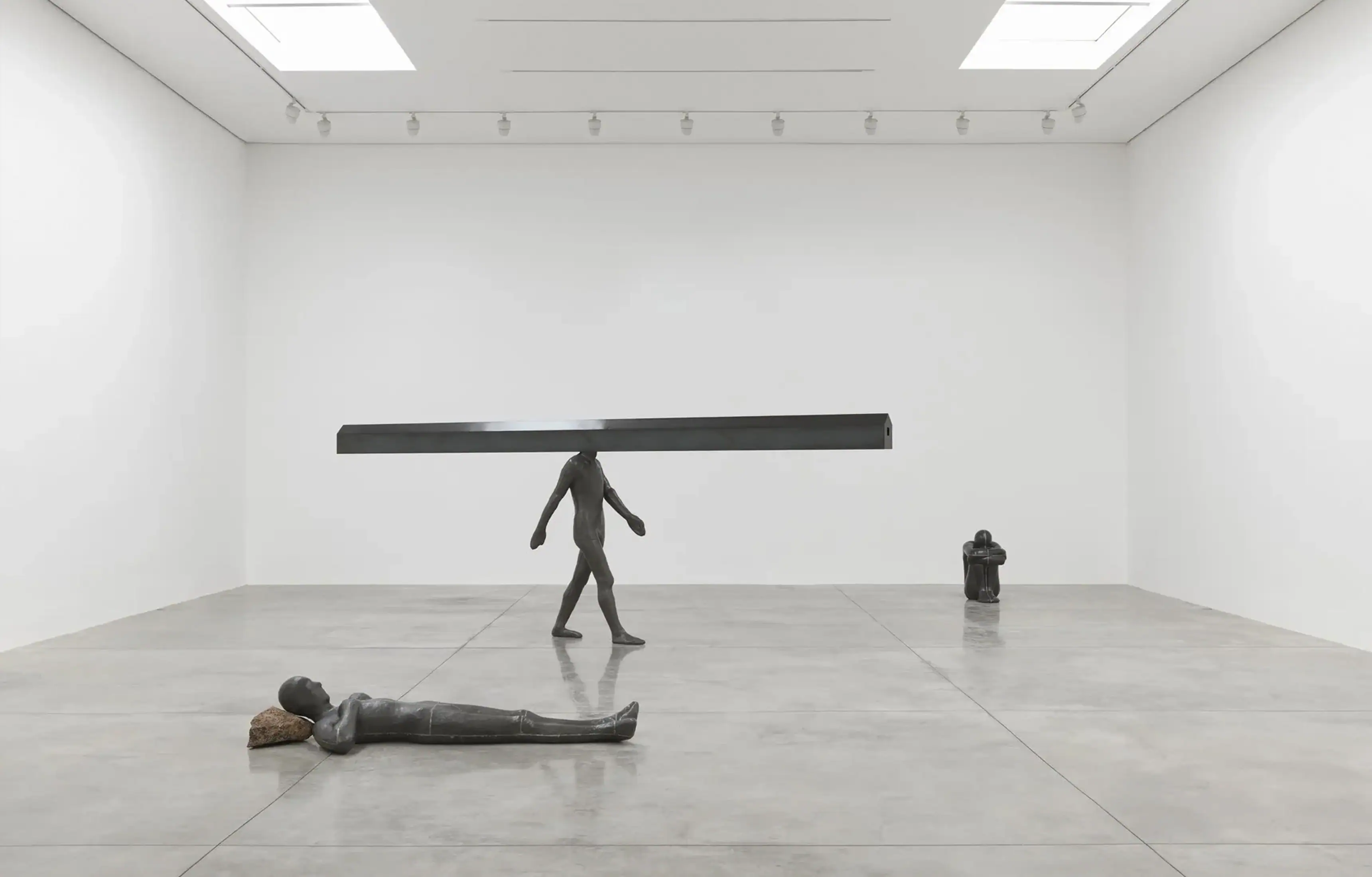
Antony Gormley: WITNESS ran at White Cube Mason’s Yard from 23 April to 8 June 2025, curated by Susan May, White Cube’s global artistic director. It brought together eleven works made across roughly sixteen years, from 1977 to 1993, split across two floors: a ground floor of object-based lead sculptures and a lower ground floor of body sculptures, the term Gormley uses for the life-size, lead-clad figures cast directly from his own body.
The exhibition has since closed, and the works have returned to wherever they are normally held. What makes them worth writing about a year on is not the show itself but what the works document. This was the period, running from Gormley’s earliest lead experiments in the late 1970s through the fully developed body-case works of the early 1990s, in which he invented the specific technique that has underpinned nearly every major body sculpture he has made in the four decades since, including work far larger and more public than anything shown at Mason’s Yard. WITNESS was, in effect, an origin story told in the artist’s own materials.

What eleven works, on two floors, actually show
The ground floor held five lead works built around found or symbolic objects rather than Gormley’s own body. Land Sea and Air I (1977 to 1979) consists of three lead-wrapped forms, each sealing a different substance, granite, water and air, inside an identical shell, so that the same enclosing material produces three entirely different weights and presences depending on what is hidden inside it. Natural Selection (1981) arranges twenty-four lead-encased objects in descending scale, a sequence that reads like a specimen case built from a material that refuses to let you see the specimens. Seeds II (1989 to 1993) assembles lead-covered ammunition into a heap that, at a distance, resembles a pile of grain, collapsing the visual difference between something sown and something fired. Shield II (1978) solders fragments of lead over a convex mirror, and Mask (1978) drapes a sheet of lead over the silhouette of a machete, turning a weapon into a hidden outline rather than a visible threat.
The lower ground floor held the body sculptures proper. Untitled (Listening Figure) (1983) is a seated form with one hand raised to its ear. Untitled (Sleeping Figure) (1983) reclines on a slab of granite. Close I (1992) is a fully enclosed prone figure, sealed rather than posed. Home and the World II (1986 to 1996), worked on across a full decade, stands as a vertical striding figure whose head has been replaced by the simplified shape of a house. Blanket Drawing I (1983) is not a sculpture at all but a white clay impression left on a hospital blanket, a direct-contact record of a body rather than a cast of one. Witness II (1993), the work that gave the exhibition its title, is a seated form built from lead, fibreglass, plaster and air, with apertures cut for ears, measuring 81 by 44 by 74 centimetres.

How a body becomes a lead vessel
The technique behind the body sculptures is exact, physically demanding, and specific enough to be worth describing properly, because it is the single most consequential thing this exhibition documents.
Gormley developed it as the Three-Part Lead Bodycase Works, a series made between 1981 and 1985 that overlaps directly with several of the pieces shown at Mason’s Yard. The process begins with Gormley covering his entire body in Vaseline, then wrapping himself in cling film punctured with breathing holes. Assistants apply plaster-soaked bandages over the film, following the body’s contours closely, while his mouth and eyes stay sealed and only his nostrils remain open to the air. After roughly ten minutes, once the plaster has set, the shell is cut into two halves and removed. That hollow plaster cast is reassembled and reinforced with fibreglass, and Gormley then applies sheets of roofing lead over the reinforced form, welding them together along the limb axes and at every joining point. He does not disguise the welded seams. They are left visible, a deliberate record of the labour that went into making the piece, rather than a flaw to be smoothed away.
Gormley has described the question behind the series in almost architectural terms: how to make bodies into vessels that both contain and occupy space. The aim, as he has put it, was to treat the body as less a thing and more a place, a site of transformation rather than an object to be represented. Witness II, Close I and Home and the World II are all direct products of this exact method, made within a few years of the Three-Part series that established it.

From Trinity College to a plaster cast
Gormley was born in London on 30 August 1950 and studied archaeology, anthropology and art history at Trinity College, Cambridge, before training as a sculptor at Central Saint Martins and the Slade School of Fine Art. Between Cambridge and art school, he travelled to India and Sri Lanka to study Buddhism, a period he has described as crucial to his decision to become an artist. The combination shows up directly in the body-casting method: an archaeologist’s interest in what a cast preserves and what it leaves out, and a meditative discipline built around stillness, applied to the genuinely uncomfortable act of standing motionless, eyes and mouth sealed, while plaster sets around him. Gormley has spoken of the casting process itself as a kind of concentrated internal event, the external form registering something felt rather than simply observed.
The body sculptures at Mason’s Yard sit early in a career that would go on to include Field for the British Isles, more than 40,000 small terracotta figures, for which Gormley won the Turner Prize in 1994. He received an OBE in 1997 and was knighted in 2014. None of that recognition changes what WITNESS actually showed: the specific, unglamorous physical process, plaster, fibreglass, welded lead sheet, that those later, larger and more celebrated works all still trace back to.
Why lead, and why this particular building
Lead is not a neutral choice of material, and White Cube’s own framing of the exhibition made the point directly: the metal carries a long history of association with protection and containment, alongside a well-known toxicity, so that safety and hazard sit inside the same substance at once. A lead-wrapped form is simultaneously a shield and something you would not want to touch unprotected for long. That tension runs through every object on the ground floor, from the sealed granite and water of Land Sea and Air I to the ammunition disguised as grain in Seeds II.
There is a second, unplanned version of the same tension built into the building itself. White Cube Mason’s Yard opened in September 2006, designed by MRJ Rundell & Associates as the first free-standing building constructed in St James’s in more than thirty years. The 1,000 square metre gallery was built on a site previously occupied by an electricity substation. Lead’s oldest practical use is as shielding, historically employed to block precisely the kind of energy that used to run through that plot of land. Nobody involved in staging WITNESS is on record making this connection, and it is not the sort of thing a gallery would build a show around deliberately. It is worth noting anyway, because it is exactly the kind of coincidence that makes a specific building the right place to see specific work, rather than an interchangeable box for hanging it in.

The technique that outlived the decade it began in
The body-casting method WITNESS traces back to its origin has not stayed confined to small, gallery-scale lead works. The same principle, Gormley’s own body used as the mould from which a cast figure is built, underlies Time Horizon, the 2024 installation of one hundred life-size cast iron figures distributed across 300 acres at Houghton Hall in Norfolk, each figure weighing around 620 kilograms and installed at a single shared datum level regardless of the ground beneath it. It does not underlie everything Gormley has made since 1993: Matrix III, Cave and Clearing VII, three of the works shown in his 2019 Royal Academy of Arts survey, are built from steel mesh, interlocking boxes and flexible steel tubing rather than a body cast at all, evidence that Gormley’s practice has expanded well beyond the method WITNESS documents rather than simply repeating it at larger scale.
What WITNESS offered was something neither of those later, larger shows could: the chance to see the body-casting method at the exact scale and in the exact material it was invented in, before it was scaled up to outdoor fields of figures or set aside in favour of entirely different techniques. It is the equivalent of seeing an architect’s first working drawing rather than the finished building.

Final thoughts
WITNESS closed more than a year ago, and the eleven works it gathered have gone back to wherever they are normally kept. What they demonstrated does not expire with the exhibition dates. Gormley spent the years covered by this show working out, physically and materially, how a cast of his own body could become something closer to a vessel than a likeness, wrapped in a metal chosen precisely because it protects and threatens at once. Everything grander that followed, the terracotta fields, the iron figures spread across a Norfolk estate, started here, in plaster, fibreglass and welded lead sheet.
When did Antony Gormley’s WITNESS exhibition run, and can I still see it?
WITNESS: Early Lead Works ran at White Cube Mason’s Yard from 23 April to 8 June 2025 and has since closed. The individual works are part of Gormley’s wider body of work and may resurface in future exhibitions.
What technique did Gormley use to make the body sculptures in WITNESS?
He cast his own body in plaster, using Vaseline and cling film to protect his skin, then reinforced the resulting hollow shell with fibreglass and clad it in welded sheets of roofing lead, a method he developed through the Three-Part Lead Bodycase Works series between 1981 and 1985.
Why did Gormley choose lead as his primary material?
Lead carries a long historical association with protection and containment, alongside genuine toxicity, so the material holds both safety and hazard at once, a tension that runs through both the object-based and body-based works in the exhibition.
Is this the same technique used in Gormley’s later, larger works?
The body-casting principle, using his own body as the mould, also underlies later works including Time Horizon at Houghton Hall. Other works from the same period, including several shown in his 2019 Royal Academy of Arts survey, use entirely different techniques such as steel mesh and interlocking boxes.
Where is White Cube Mason’s Yard, and what building does it occupy?
White Cube Mason’s Yard is at 25 to 26 Mason’s Yard, off Duke Street in St James’s, London. It opened in September 2006 in a purpose-built gallery designed by MRJ Rundell & Associates, on a site previously occupied by an electricity substation.


Leave a Reply