

I went back to Apparatus’ Hollywood gallery during Frieze week in early 2026, three years after my first visit, expecting the same de Chirico-inspired rooms I had written about before. They were gone. In their place, Gabriel Hendifar had built a three-room journey around an invented woman: a New Yorker of the 1960s who moves to Los Angeles a decade later and has to decide what of herself survives the move. The gallery does not explain any of this to a visitor. It just makes you walk through her decision.
Introduction
Apparatus reopened its Los Angeles gallery in March 2024 under the name Scene Change, and by the time I returned to it during Frieze week in February 2026, it had settled into what is now the gallery’s second real identity in the seven years since it first opened at 1021 North McCadden Place in Hollywood. The five thousand square foot former television studio is the same building I had walked through in 2023. Almost nothing else was.


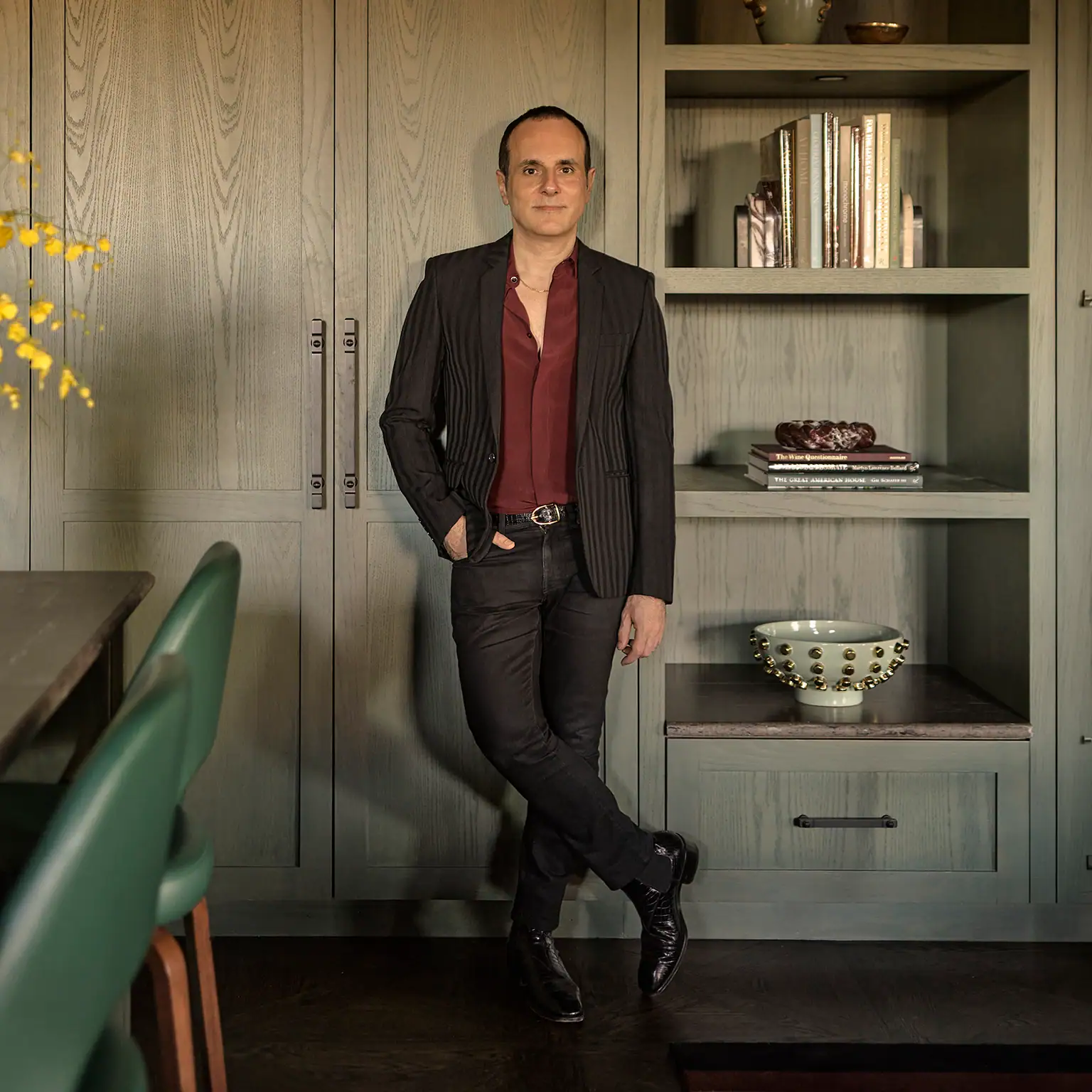
Gabriel Hendifar, the studio’s co-founder and artistic director, has described the redesign in plain terms: “It’s about feeling discovery and moving through layers.” That is a fair summary of the mechanics, three rooms, each built from a different material, each opening into the next through an archway. It undersells how specific the story behind those layers actually is, and how much of that story the gallery expects a visitor to work out for themselves.


A modernist grotto, a Renaissance coffer, and a room lined in cork
The gallery now unfolds as three connected rooms, each a genuinely different material world rather than a variation on one palette. The first is what Apparatus itself calls a modernist grotto: coarse rock aggregate walls and archways, stone-filled gaps set into the joint between floor and wall, and lighting kept low enough that the studio’s own description promises “slightly subterranean undertones.” A large circular mirror sits behind an installation of the Trapeze light, configured as a mobile, so that the room’s one reflective surface is doing the work of a chandelier rather than a mirror.


Passing through an archway into the second room changes the material entirely. The walls here are finished in silver-toned plaster, custom produced by the Los Angeles firm Kamp Studios, reflective without being a true mirror, and several Cloud chandeliers hang overhead, giving the room a lightness that reads as a deliberate release after the grounded weight of the grotto. Apparatus has compared the effect to standing inside a Renaissance coffer, the recessed, gilded panelling found in Italian palazzo ceilings, which is a specific enough reference that it is worth taking at face value rather than as a generic flourish. A coffered ceiling is built to catch and multiply light across many small angled surfaces rather than one flat one, and the silvered plaster room does something close to the same thing at human scale.


The third room closes the sequence in cork, its walls lined in cork panelling with a pronounced, visible grain, lit only by natural overhead light falling through a double height ceiling. Apparatus displays product sparsely here, among them pieces from the Reprise, Median and Lariat collections, a ceiling and pendant range, a pendant and surface-mounted range, and a sconce and pendant range respectively, rather than filling the room the way the earlier two rooms fill with atmosphere. After two rooms built to disorient gently, the third room’s restraint reads as the point where the story resolves rather than a change of mood for its own sake.


Between the three rooms, the collections doing most of the work are the same handful of names threaded through all of them rather than a different range per room. The Trapeze light in the grotto and the Cloud chandeliers in the silvered room are both lighting-first pieces built to be looked at as sculpture as much as switched on, which is consistent with how Hendifar has always talked about the studio’s work: an object is there to be noticed before it is there to illuminate anything. Seeing the same handful of collections behave differently in three different material settings, sculptural against rock, sculptural against silvered plaster, sparse against cork, is a more convincing demonstration of a lighting collection’s range than three separate rooms of three separate collections would have been.


The woman the whole gallery is built around
None of this is arbitrary, and Hendifar has been specific about the fiction underneath it. The redesign is built around an invented character: a woman from 1960s New York who relocates to Los Angeles a decade later, carrying an East Coast sense of formality into a city that runs on an entirely different, more idealistic logic. The three rooms trace her decision rather than a decade of interior design trends. The grotto is arrival, subterranean and disoriented. The silvered room is the release that comes once the disorientation lifts. The cork room, warm, natural and sparsely furnished, is where she actually settles.


I do not know how much of that character is Hendifar’s own biography folded into someone else’s outline. He has spoken elsewhere about growing up in Los Angeles before the fashion industry took him to New York, where he met Jeremy Anderson and the two of them eventually founded Apparatus in 2012. A gallery built around a fictional New Yorker’s move west, designed by a real Angeleno who made the reverse journey and then brought the business home again, is not a coincidence I found stated anywhere in the studio’s own account of the redesign. It is the connection the two facts make on their own once you know both of them, and it gives a design narrative that could easily have stayed abstract a genuinely personal spine.


That reversal is worth sitting with for a moment, because it inverts the reading I had of the same building three years earlier. In 2023 I understood the gallery as Hendifar and Anderson’s own return to the city where their partnership started, told through an atmosphere borrowed from an Italian painter neither of them had any personal connection to. The 2024 rebuild does something closer to the opposite: an invented outsider, with no connection to Hendifar at all beyond the decade and the two cities, making the same coast-to-coast move he actually made, in reverse. Both are ways of using someone else’s story to tell a version of your own without saying so directly, which turns out to be a habit of this particular gallery rather than a one-off idea either designer had once and moved on from.


A three-city studio now, not a New York studio with outposts
Apparatus operates three galleries as of this visit, New York, Los Angeles and London, and the Los Angeles space is worth placing inside that wider geography rather than treating purely as a standalone rebuild. The New York gallery, on West 30th Street, remains appointment only, functioning closer to a working studio than a public space. London, in Mayfair, keeps conventional retail hours. Los Angeles sits between the two in character: open to walk-in visitors on standard weekday hours, the way London is, but built with the immersive, no-obligation-to-buy atmosphere that the appointment-only New York space can afford to take further. Rebuilding the Los Angeles gallery around a genuinely different physical story every few years, rather than leaving it as a fixed showroom once the address was established, is the kind of investment a studio makes in a location it considers a genuine gallery rather than a regional sales office.


What survived from the gallery I visited in 2023, and what did not
The building has not moved, and the address is unchanged: still 1021 North McCadden Place, still a former television production studio, still surrounded by the same cluster of antique dealers and galleries that made Hollywood a genuine design destination years before Frieze Los Angeles ever set up a tent nearby. The de Chirico reference has not disappeared either. Apparatus’s own account of the redesign still describes the repeating archways and layered forms as indebted to the painter’s architecture, so the gallery’s underlying grammar, rooms connected by irregular archways, a deliberately unresolved sense of place, carries over from the space I described after my first visit.


What changed is everything built from that grammar. The 2018 gallery was one continuous, desaturated sunset world, gravel banked at the entrance, hand-troweled pale plaster throughout, antiques and local art integrated alongside Apparatus’s own collections so the whole thing read as a single collector’s home. The 2024 rebuild is a sequence of three distinct, self-contained material worlds, rock aggregate, silvered plaster, cork, each handed off to the next by a single archway, and staged now almost entirely around Apparatus’s own product rather than borrowed work. The earlier gallery asked a visitor to believe in one imagined place. This one asks a visitor to follow one imagined person through three of them.


Frequently asked questions
Where is Apparatus’s Los Angeles gallery?
At 1021 North McCadden Place in Hollywood, the same former television production studio the design house has occupied since November 2018.
When was the gallery redesigned?
It reopened as Scene Change in March 2024, replacing the original Giorgio de Chirico-inspired gallery that had been there since 2018. A separate piece covers that earlier version.
What is the concept behind the current design?
Three rooms, a rock aggregate grotto, a silvered plaster chamber, and a cork-lined room, tracing an invented character’s move from 1960s New York to Los Angeles a decade later.
Who designed the redesign?
Gabriel Hendifar, Apparatus’s co-founder and artistic director, who grew up in Los Angeles before relocating to New York, where he and Jeremy Anderson founded the studio in 2012.
Is the gallery open to the public?
Yes. Unlike Apparatus’s New York gallery, which operates by appointment, the Los Angeles gallery keeps standard walk-in hours, Monday to Friday.
Final thoughts
Coming back to a building I had already written about once, expecting to find it broadly the same and finding it almost entirely rebuilt, is not the usual way one of these visits goes. Most gallery redesigns amount to a repaint and a new hang. Apparatus stripped its Los Angeles space to the studs and rebuilt it around a story it never fully explains to the people walking through it, which is either a considerable act of confidence in the material itself or a genuine belief that a gallery can hold a narrative a visitor never consciously reads and still be shaped by it. Having now stood in both versions of the room, three years apart, I think it is the second one. The gravel and the desaturated plaster are gone. What is built in their place is still, unmistakably, a studio that would rather construct an entire world than simply light a chair well.
Leave a Reply