
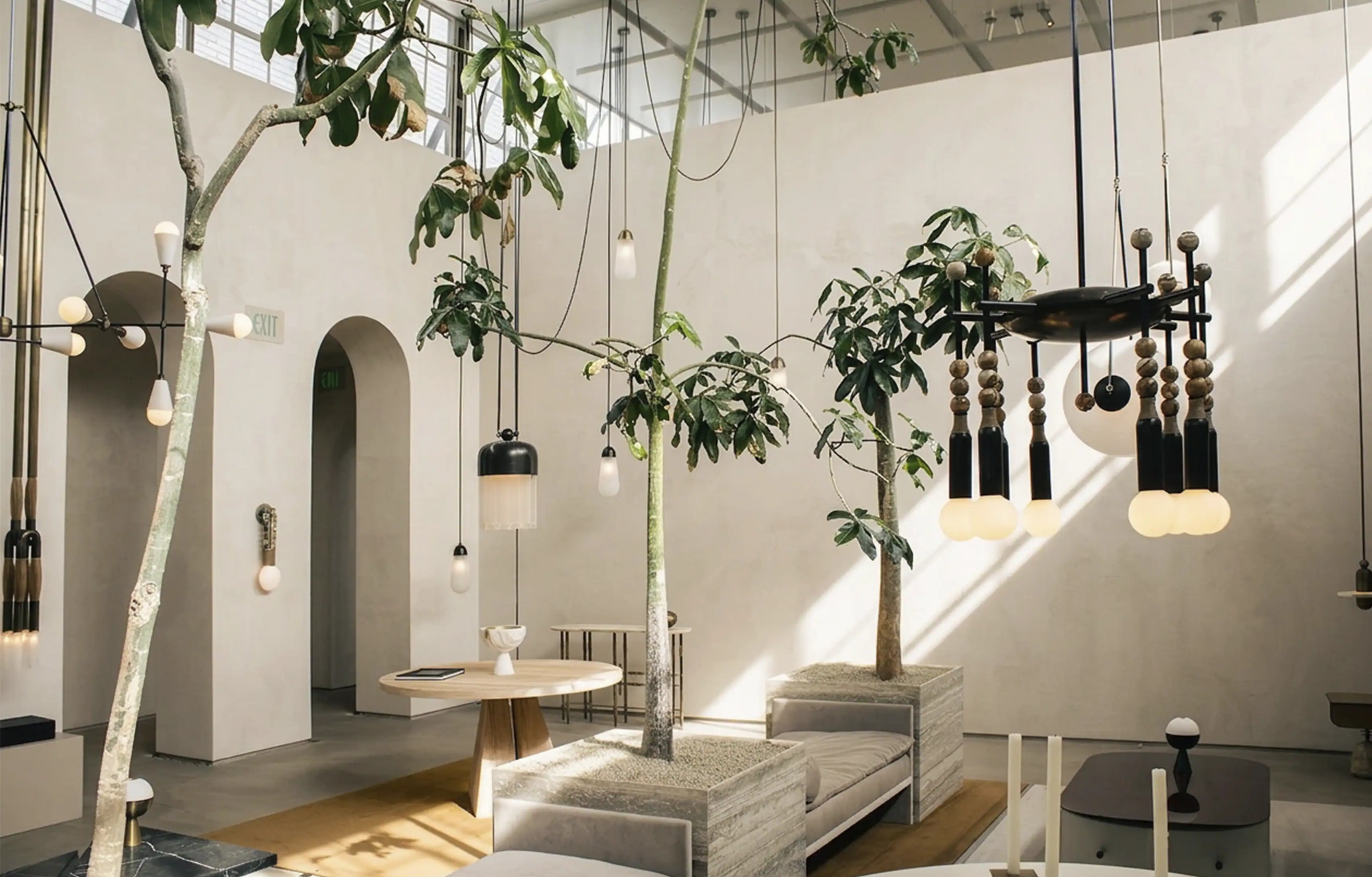
I visited Apparatus’ Los Angeles gallery during Frieze week in February 2023, three years before the studio would strip the whole thing back and start again. What I found on McCadden Place was a former television studio dressed as a Giorgio de Chirico sunset, three tonnes of gravel banked against its entrance, and a design argument built by two people returning to the city where they first met. None of it looks quite like this any more, which is exactly why it is worth writing down.
Introduction
I went to Apparatus’s Hollywood gallery during Frieze Los Angeles week in February 2023, the fair’s first year at Santa Monica Airport, in the kind of week when half the city’s design and gallery spaces put on a show for people passing through for four days and gone again. Apparatus did not need the excuse. The gallery at 1021 North McCadden Place had been open since November 2018, a five thousand square foot former television production studio the New York design house had converted into its third showroom, after New York and an earlier Milan location, and its first proper foothold on the West Coast.


I had known Apparatus’s work mostly through its New York pieces: sculptural brass lighting, furniture built from marble and horsehair and lacquer, the kind of object that photographs like a still life because it is designed to be looked at as one. What the Hollywood gallery did that a product page cannot was put that work inside a specific, deliberately unsettling atmosphere, and let me understand, standing in it, why the studio insists on building whole rooms rather than simply selling pieces.


A former television studio dressed as a Giorgio de Chirico sunset
Gabriel Hendifar, Apparatus’s co-founder and artistic director, designed the Los Angeles gallery around the paintings of Giorgio de Chirico, the Italian metaphysical painter whose empty arcades and long dramatic shadows read like a city remembered rather than a city seen. Walking in from McCadden Place meant walking through a gridded steel and glass entrance flanked by three tonnes of gravel, banked against the walls like scree, before the space opened into a sequence of hand-troweled pale plaster rooms lit to a desaturated, sunset warmth that had nothing to do with the actual daylight outside.


The plaster was not smooth. Up close it had the same fine cracking a real, aged wall develops, and the archways connecting each room varied in scale, a large opening here, a narrow arcade passage there, so that walking through the gallery felt like moving through a sequence of rooms built at different points in an imagined history rather than one continuous showroom floor. High clerestory windows threw hard shadows across the stone flooring in the middle of the day, which is the detail that made the de Chirico reference legible rather than decorative: the light itself was doing the work of the reference, not just the palette.
At the centre of the plan was an internal yard, open to the sky, with a single tree in a planter, a matching table and a velvet sofa arranged as though someone actually sat there. It was the one room in the gallery that read as inhabited rather than staged, and it did more to explain Apparatus’s whole approach than any single lit vignette elsewhere in the building.


The painter behind the reference
Giorgio de Chirico is worth naming properly rather than treating as a mood board keyword, because the specific quality of his work explains why Hendifar reached for it rather than any other painter. Born in Volos, Greece, in 1888 to Italian parents, de Chirico founded what became known as the scuola metafisica, the metaphysical school, in the years immediately before the First World War, painting Roman arcades, elongated shadows, mannequins and empty piazzas rendered in a deliberately illogical perspective. The paintings read as places remembered rather than places observed, forlorn and empty in one register and strangely charged in another, and they went on to shape the Surrealists who came after him: André Breton discovered de Chirico’s work in the early 1920s and was transfixed by it, and René Magritte later described his own first encounter with a de Chirico painting as one of the most moving moments of his life.

That is a specific, considered reference for a design gallery to build an entire architecture around, and it is not a casual one. A de Chirico painting is not simply moody. It is a place that could not exist as photographed, built from architectural fragments that do not quite resolve into a coherent building, lit by a sun that appears to be setting everywhere in the frame at once. Apparatus’s Hollywood gallery chased exactly that unresolved quality rather than a generalised sense of drama, which is why the archways varied in scale rather than repeating, and why the light was tuned to a single warm, directionless glow rather than to daylight simulating any particular hour.


Two people who met in Los Angeles before they ever built anything there
The detail that stayed with me longer than any single object was the founders’ own route back to this city. Gabriel Hendifar and Jeremy Anderson met in Los Angeles, Hendifar working in fashion and Anderson in public relations, well before either of them had designed a piece of furniture professionally. An opportunity for Anderson took the pair to New York, and it was there, making lighting for their own apartment as something closer to a weekend project than a business plan, that Apparatus began, founded in 2012 and built initially around what people admired enough to ask for themselves.


That makes the Hollywood gallery something more specific than a third showroom opened in a growing market. It is the studio returning, six years after founding itself somewhere else, to the city where its two founders actually started. Nothing in the gallery states this directly, no wall text, no plaque, and I do not think most visitors walking through the gravel entrance would have any reason to know it. But once I did know it, the choice to build the gallery as a kind of memory palace, a de Chirico-inspired world assembled from fragments of an imagined past, read less like a general design conceit and more like a studio building its own return journey out of plaster and gravel.

A world built to be inhabited, not a catalogue arranged for sale
Hendifar has described the studio’s guiding idea as a Gesamtkunstwerk, a total work of art, in which a fully realised collection presents each individual piece as an artefact of one cohesive imagined world rather than a standalone product. Every Apparatus collection is still made at the studio’s own factory in New York, in materials chosen for what Hendifar calls their sense of permanence, marble, suede, horsehair, lacquer, porcelain, and hand-patinated brass, produced through what the studio describes as a deliberate balance between mechanisation and the handmade, aiming equally at the precision of a machined edge and what it calls the beautiful irregularity of a human one.


The Los Angeles gallery made that argument physically rather than as a line of copy. Nothing in the rooms was arranged the way a shop arranges stock, by category or by price. A sculptural lounge piece stood beside furniture on loan from the antiques dealer JF Chen, one of the gallery’s own McCadden Place neighbours, alongside work by the local artists Robert Moreland and Amir Nikravan, so that the room read as one collector’s considered space rather than one studio’s product range. That is a genuinely difficult thing to fake convincingly, and the reason it worked, I think, is that Hendifar built the whole gallery around a single imagined mood first and only then decided what belonged inside it, rather than designing a neutral box and filling it with product afterwards.


The gallery’s own neighbours mattered to that argument too. McCadden Place and the surrounding blocks had become, by 2018, a genuine cluster of design and gallery spaces, JF Chen and Blackman Cruz among the antiques dealers, Ralph Pucci and Regen Projects among the galleries, which meant Apparatus was not asking Los Angeles to treat a furniture showroom as a cultural destination on its own. It was joining a street that had already made that case. By the time I visited during Frieze week in February 2023, the fair itself had just moved for the first time from Beverly Hills to a site-specific tent at Santa Monica Airport, and the whole city seemed to be treating the week as licence to send visitors into exactly this kind of gallery, a showroom with no obligation to sell anything to the person walking through it, tucked among antique dealers rather than on a retail high street.


I did not come away from the visit with a favourite object, which is unusual for a showroom trip and, I think, the point. Nothing in the gallery was staged to be the single photographable hero piece. A lounge chair, a floor lamp and a console read as three parts of one sentence rather than three separate products competing for attention, which is a harder thing to design than it sounds, and the reason a five thousand square foot room built around gravel and desaturated plaster did not feel like an exercise in scale for its own sake.

Frequently asked questions
Where is Apparatus’s Los Angeles gallery?
At 1021 North McCadden Place in Hollywood, in a former television production studio the design house converted into a gallery in November 2018.
Does the gallery still look the way it is described here?
No. This piece describes the gallery as it stood in February 2023, built around a Giorgio de Chirico-inspired sunset palette. Apparatus redesigned the space in March 2024, and a separate piece covers what replaced it.
Who founded Apparatus?
Gabriel Hendifar and Jeremy Anderson, who met in Los Angeles before relocating to New York, where they founded the studio in 2012.
What is Apparatus known for?
Sculptural lighting and furniture made from materials including marble, suede, horsehair, lacquer, porcelain and hand-patinated brass, produced at the studio’s own factory in New York.
Is the Los Angeles gallery open to the public?
Yes, unlike some design showrooms it does not require an appointment, though hours are worth checking directly before visiting.
Final thoughts
I do not know how many visitors during that Frieze week in 2023 understood the gallery as anything more than a striking backdrop for photographs, and on the evidence of the room, that would have been a perfectly reasonable way to spend twenty minutes on McCadden Place. But the founders’ own history gave the space a second reading underneath the first one, a studio that began as two people making lighting for their own apartment, in a city neither of them had left permanently, choosing to build its West Coast home as a deliberately unsettling, deliberately beautiful world rather than a shop. That gallery no longer exists in the form I walked through in February 2023. Apparatus rebuilt it entirely in 2024, and what is there now is a different, equally considered argument, which is its own story.
Leave a Reply