
Exhibitions · Miami Beach
Reading time: 7 minTwo hundred and eighty-six galleries, thirty-eight countries, and more than seventy-five thousand visitors, and alongside them a quieter number that stayed with me. Two-thirds of the galleries at Art Basel Miami Beach 2024 came from the Americas, and the booths that knew it rewarded every minute I gave them.
Returning to the Miami Beach Convention Center in December, what struck me first was the scale of the thing. The 2024 edition of Art Basel Miami Beach ran from 6 to 8 December, with VIP days on the 4th and 5th, and brought together 286 galleries from 38 countries before more than 75,000 visitors.
But it was a smaller figure that shaped how I walked it. Two-thirds of the exhibiting galleries came from the Americas— and once you notice that, the fair reorganises itself around you.

This was the first edition under director Bridget Finn, who arrived from the Detroit gallery Reyes | Finn, and who has been clear-eyed about what she inherited: the leading art fair of the Americas. She also introduced smaller, lower-cost stands to bring in emerging galleries, a structural change carrying a considerable signal.
The booths that held me longest were the ones that understood which hemisphere they were standing in. Below are the galleries and works that made this year’s fair worth the trip.
Fredric Snitzer Gallery — the home team, playing its best card
Fredric Snitzer has been operating in Miami since 1977, which means the gallery predates the fair by a quarter of a century, and predates the entire idea of Miami as an art city by rather more than that. It was among the earliest American champions of contemporary Latin American art, built a reputation on the Cuban avant-garde, and has more recently widened into the broader Caribbean diaspora.


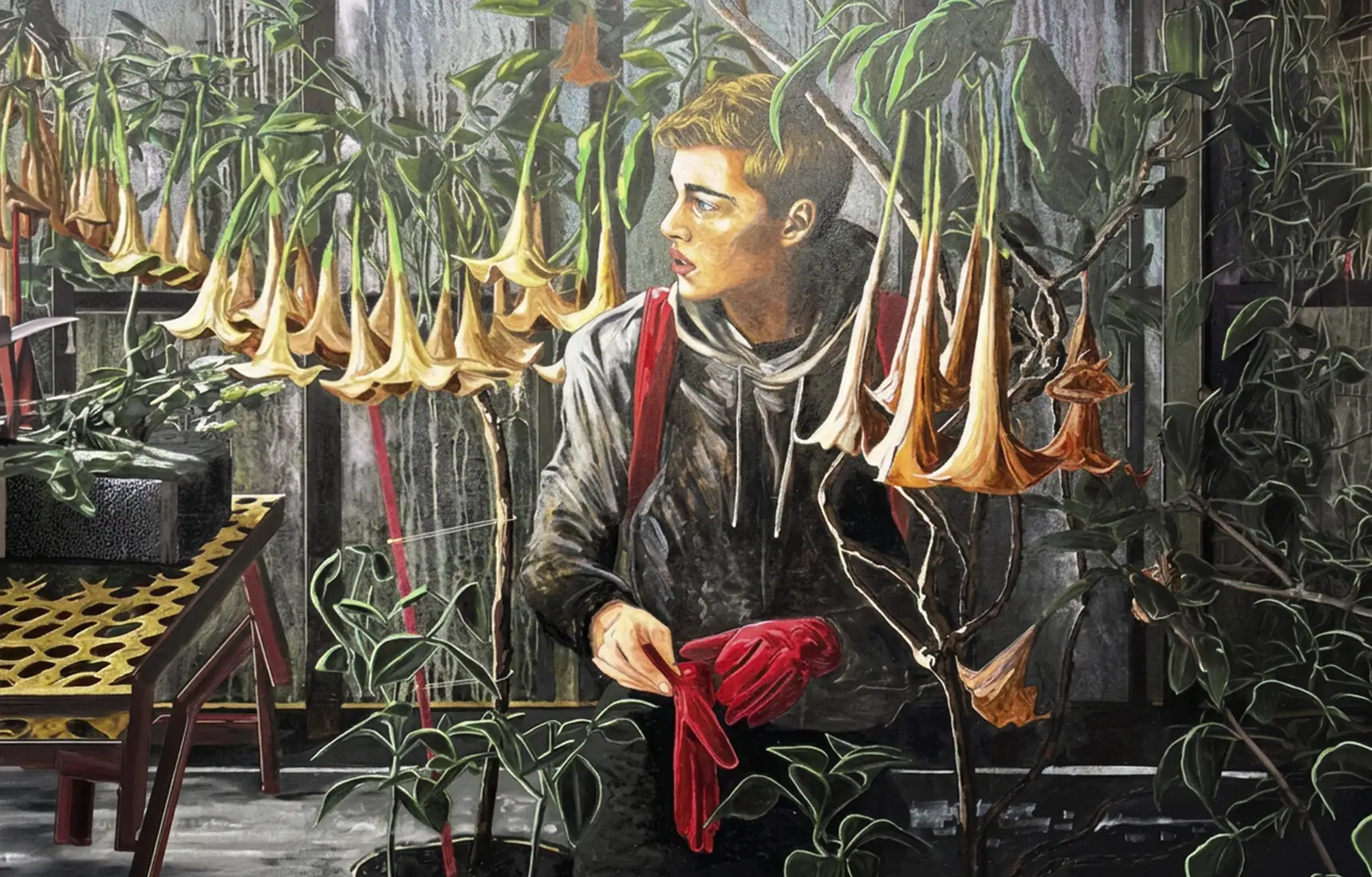
For 2024, Snitzer gave the whole booth to Hernan Bas — and the choice is not a coincidence. Bas was born in Miami, and Snitzer has represented him since he was very young. This is the gallery’s founding relationship, its house artist, its proof.
The paintings are exactly what they have always been, and better for it: androgynous young men caught between youth and adulthood, innocence and experience, in interiors and landscapes charged with something about to happen. Rituals of courtship, of love, of death, rendered with a theatrical heightening that sets the intellect against the body and lets them argue.


Bas is a painter of the moment before, and a booth of him at the largest fair in the Americas — hosted by the gallery that found him, in the city that made him — is about as pointed a statement of local confidence as anyone made all week.
Sies + Höke — 300 tonnes of pressure
The Düsseldorf gallery Sies + Höke brought the fair’s most physically astonishing object.
On the Other Other Side Board, from the OOOSB series by Julius von Bismarck, does something quietly devastating. Real animals and plants are subjected to 300 tonnes of pressure and rendered two-dimensional, flattened, fixed, and mounted with wood shavings, glue and fabric into what read, unmistakably, as altarpieces.


It is a work about what representation costs. A picture of a bird is a flattening; von Bismarck simply performs the flattening literally, with a press, and then frames the result as devotional. You cannot look at it without thinking about every other image in the building.


Alongside it, Showing Hands by the Düsseldorf duo Hedda Schattanik and Roman Szczesny: a pair of hands at first glance, and on closer approach an entire landscape of incident hiding inside them. A work that rewards the person who stops, and keeps on rewarding them.
Tanya Bonakdar — light, caught
Tanya Bonakdar Gallery has spent over twenty years building a roster of more than thirty artists and mounting ten-plus exhibitions a year, and it arrived in Miami with the depth that implies: Uta Barth, Math Bass, Monica Bonvicini, Sandra Cinto, Mark Manders, Yuko Mohri, Ernesto Neto, Lisa Oppenheim, Amalia Pica, Magali Reus, Sherrill Roland, Analia Saban, Tomás Saraceno, Lisa Williamson.


Two works held the booth together.
Olafur Eliasson’s The Self-Conscious Orbital Force — partially silvered glass spheres at varying scales, catching light and throwing the room back at itself in fragments. Eliasson has spent a career insisting that the viewer is part of the work; here you cannot avoid it, because you are in it, reflected and distorted, whether you like it or not.


And The Enchanted Garden by Nathalie Djurberg and Hans Berg: sculptural flowers with a delicate beauty and an entirely untamed internal logic. Djurberg and Berg’s work always carries a charge of strangeness beneath the surface, in the best way: sweetness with a set of teeth.
Note the roster again — Neto, Cinto, Pica, Saraceno. Even a gallery with a global remit was leaning, in Miami, into the Americas.
Nara Roesler — Brazil, weightless
The Brazilian gallery Nara Roesler represents the major Brazilian figures from the 1950s onward alongside mid-career and emerging artists in dialogue with them — which is a polite way of saying it carries the line of Brazilian Concretism and Neo-Concretism, the most consequential art movement the continent has produced.


Letters by Lucia Koch: small rectangular metal frames holding coloured filters, throwing vivid shadows onto the wall. The object is almost nothing; the projection is the work. Koch has always been interested in what light does to architecture, and the piece turns a fair wall into a participant.
And a suspended sculpture from Artur Lescher’s Asterisms — polished, precise, hanging — in which the weight of the material appears to dissolve into lightness. A heavy object pretending, convincingly, to float.


Both works are doing the same thing: taking the physical and making it behave immaterially. It is a very Brazilian preoccupation, and it has a lineage as long as the country’s modern art.
Galleria Continua — the cinema in the hill town
Of all the galleries at the fair, Galleria Continua has the best origin story, and it is worth telling because it explains the programme.
It was founded in 1990 in San Gimignano, the medieval hill town in Tuscany famous for its towers, by Mario Cristiani, Lorenzo Fiaschi and Maurizio Rigillo, in a former cinema. In a small town, deliberately away from the art centres, in a building that used to show films to locals. A choice made on purpose, and the making of the gallery.


The name is the thesis: Continua — continuing. Where the pictures used to move, the art now does.
That decision — to build a serious international gallery in a rural place — has shaped everything since. Continua works between the rural and the industrial, the local and the global, and its roster reads accordingly: Ai Weiwei, Anish Kapoor, Michelangelo Pistoletto, JR, Julio Le Parc, Carlos Cruz-Diez, Carlos Garaicoa, Yoan Capote, Nari Ward, Pascale Marthine Tayou, Adel Abdessemed, Eva Jospin, Jorge Macchi.


Read that list again and notice how much of it is Latin American and Cuban — Garaicoa, Capote, Cruz-Diez, Le Parc, Macchi. A gallery founded in a Tuscan cinema turns out to be one of the most committed champions of the hemisphere in which it was, that week, standing.
Pedro Cera — and the best thing in the building
Pedro Cera, the Lisbon gallery (with a second space in Madrid), brought the work I keep returning to.
Manuel Chavajay is a Tz’utujil Maya artist, and his series Ch’umil kaj / estrellas en la vía láctea — stars on the Milky Way — consists of vessels which, when you look down into them, reveal scenes. You have to lean over. You have to change your posture to see it. The work will not come to you.


That is the argument itself. Chavajay’s practice is rooted in Tz’utujil cosmology and in the lake and land of his people, and a work that requires you to look into rather than at is doing something precise about how knowledge is held and how it is shared.
To find it here — an Indigenous Guatemalan artist, shown by a Portuguese gallery, in a convention centre in Miami — is exactly what a fair of the Americas ought to produce.


Alongside, the pastel works of the Portuguese painter Bruno Pacheco: isolated figures in unreadable landscapes, engaged in activities the viewer is not permitted to understand. Quiet, and unsettling in the way that quiet things are.
The takeaway
What the 2024 edition made clear, more plainly than any I have walked, is what this fair actually is.
The booths that rewarded a slow pass were rooted in the hemisphere around them: a Miami gallery showing its Miami painter; a Brazilian gallery carrying a Brazilian lineage; a Tuscan gallery that has spent thirty-five years championing Cuban and Latin American artists; a Portuguese gallery bringing a Maya artist to Florida.
Art Basel Miami Beach is the week in which North and South America turn and look at one another, and under Bridget Finn it has begun to build on that with real intent. It is a richer fair for knowing exactly what it is, and I left it full of optimism.

Frequently asked questions
When was Art Basel Miami Beach 2024?
6–8 December 2024 at the Miami Beach Convention Center, with VIP days on 4 and 5 December.
How big was it?
286 galleries from 38 countries and territories, with attendance of more than 75,000 across VIP and public days. Two-thirds of the exhibiting galleries came from the Americas.
Who directs the fair?
Bridget Finn, whose first edition as director was 2024. She came from the Detroit gallery Reyes | Finn and introduced smaller, lower-cost stands to attract emerging galleries.
Which galleries stood out?
Fredric Snitzer Gallery (a Hernan Bas solo), Sies + Höke, Tanya Bonakdar, Nara Roesler, Galleria Continua and Pedro Cera.
Who is Hernan Bas?
A Miami-born painter, represented by Fredric Snitzer Gallery since he was very young, known for paintings of androgynous young men suspended between innocence and experience.
Who is Manuel Chavajay?
A Tz’utujil Maya artist from Guatemala, shown at the fair by Lisbon’s Pedro Cera. His Ch’umil kaj / estrellas en la vía láctea series presents vessels containing scenes visible only when the viewer looks down into them.
How is Art Basel Miami Beach different from Untitled Art or Design Miami?
Art Basel is the largest and most blue-chip of the Miami Art Week fairs. Untitled Art, on the sand, is oriented toward discovery and emerging galleries; Design Miami is the collectible design fair.


Leave a Reply