
Exhibitions · Miami Beach
Reading time: 5 minA table laid with wedding dresses. A fourteen-foot hologram of a body dissolving into plants. A Harlequin five metres tall, borrowed from a Belgian carnival. In the Grand Ballroom, Art Basel gives up the booth entirely — and the works get big enough to look back at you.
Everywhere else at Art Basel Miami Beach, art is shown in a booth: a three-walled room, sized so you can take it in at a glance, in which a gallery makes its case.
Meridians is what happens when the fair stops doing that.
Staged in the Grand Ballroom of the Miami Beach Convention Center — nearly 6,000 square metres of it — the sector is given over to work that simply cannot fit anywhere else: monumental installation, ambitious sculpture, expansive painting, immersive video. It is curated by Magalí Arriola, director of the Museo Tamayo in Mexico City, and it carries an explicit focus on artists and practices from the Americas.
That last detail is worth pausing on. The main fair floor argues, commercially, that Art Basel Miami Beach is the fair of the hemisphere — two-thirds of its galleries come from the Americas. Meridians makes the same argument curatorially, and it puts a Mexican museum director in charge of the biggest room in the building.
What struck me walking it in 2024 was how much the three works I kept returning to had in common. All of them are about a body being shaped by something larger than itself — and all of them needed the scale to prove it.
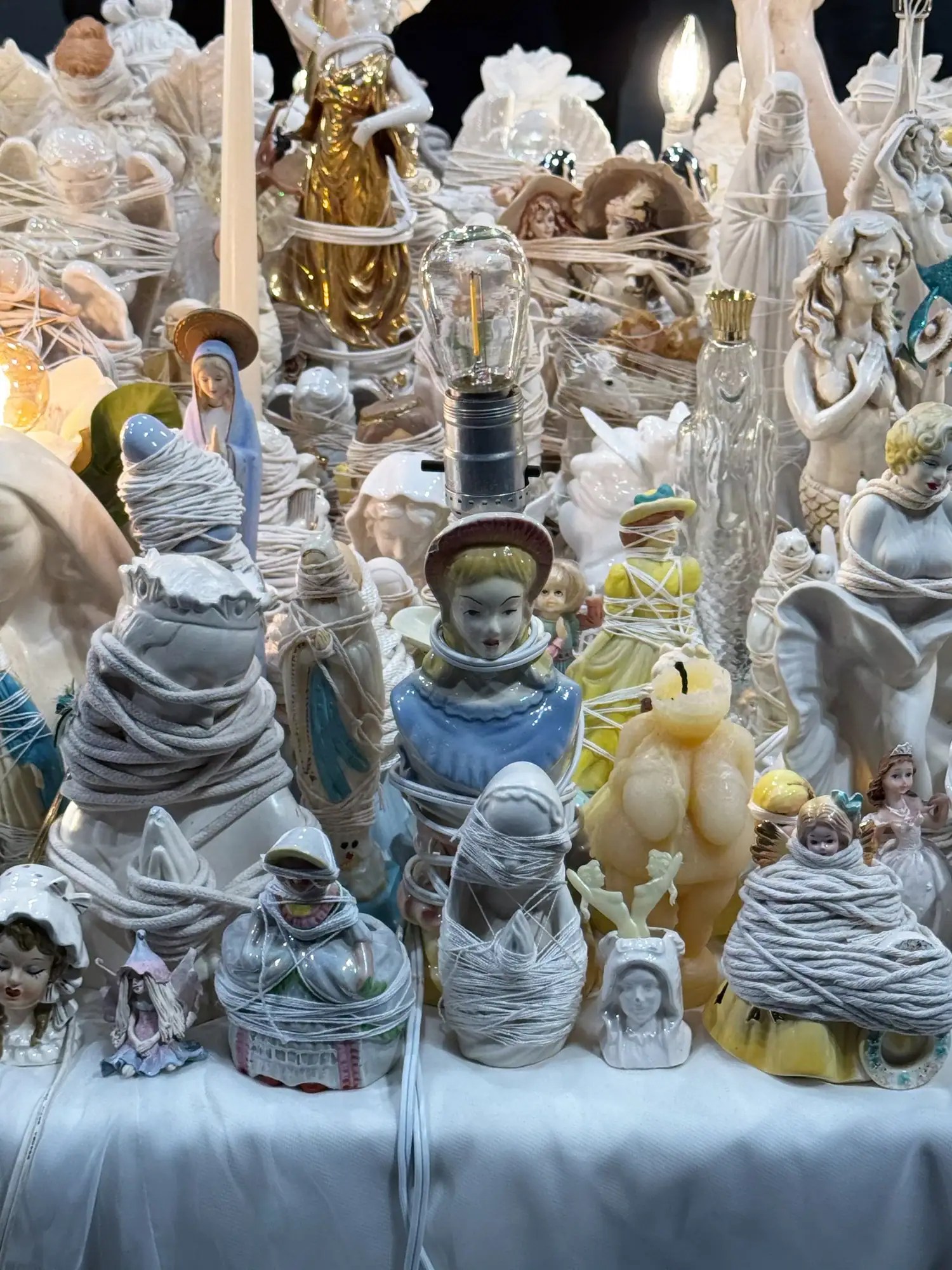
Portia Munson — Bound Angel
Portia Munson has spent a career collecting, and it is worth understanding what that means, because the collecting is the practice.
She accumulates mass-produced objects — the cheap, the plastic, the gendered, the discarded — and masses them until their quantity becomes an argument. Her room-sized installations of manufactured things (The Garden, from 1996, is the best known) work by sheer accumulation: individually each object is banal, and together they become a portrait of what a culture has been quietly telling women about themselves.
Bound Angel (2021) is that method at its most concentrated and its most uncomfortable.
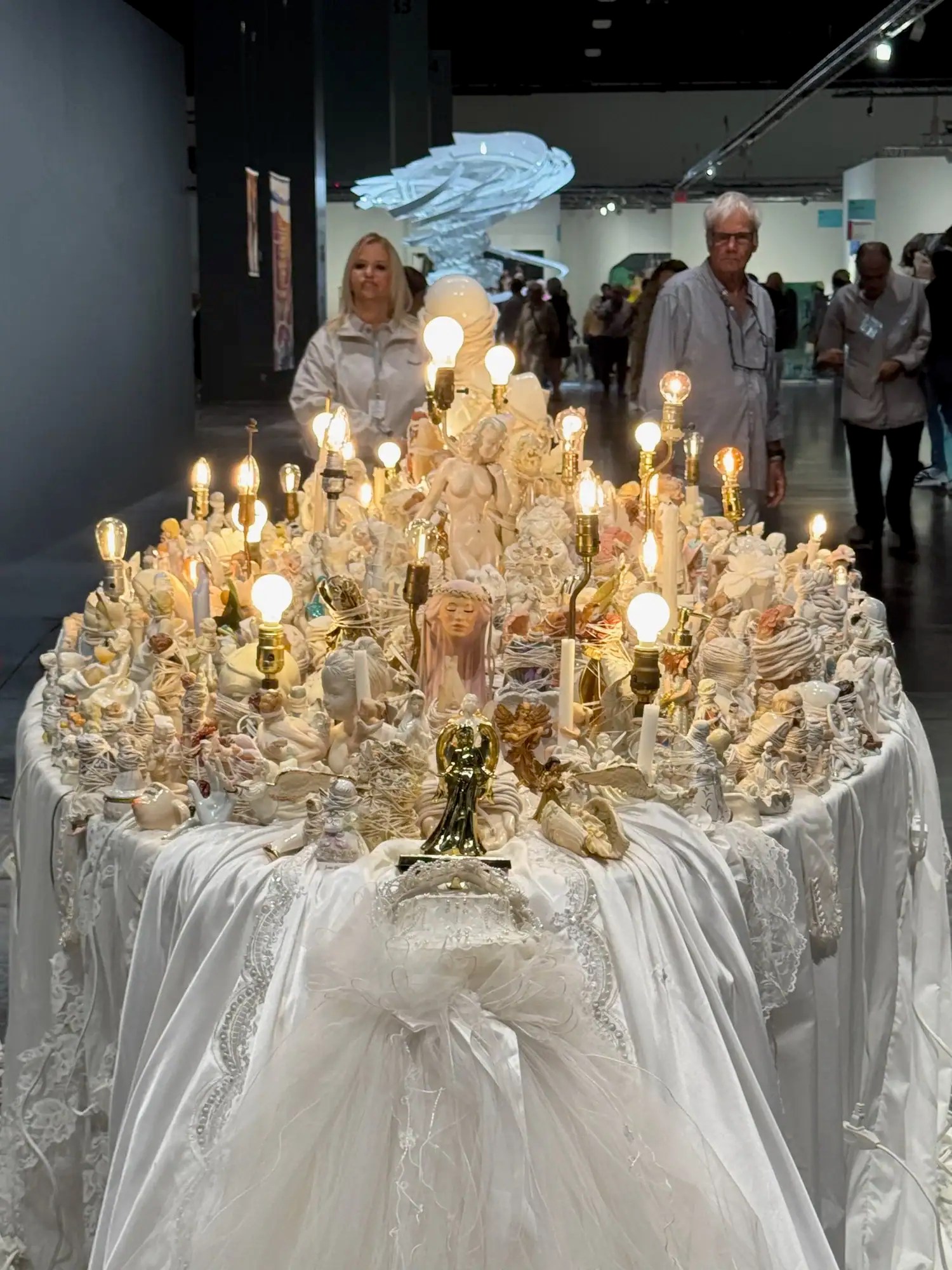
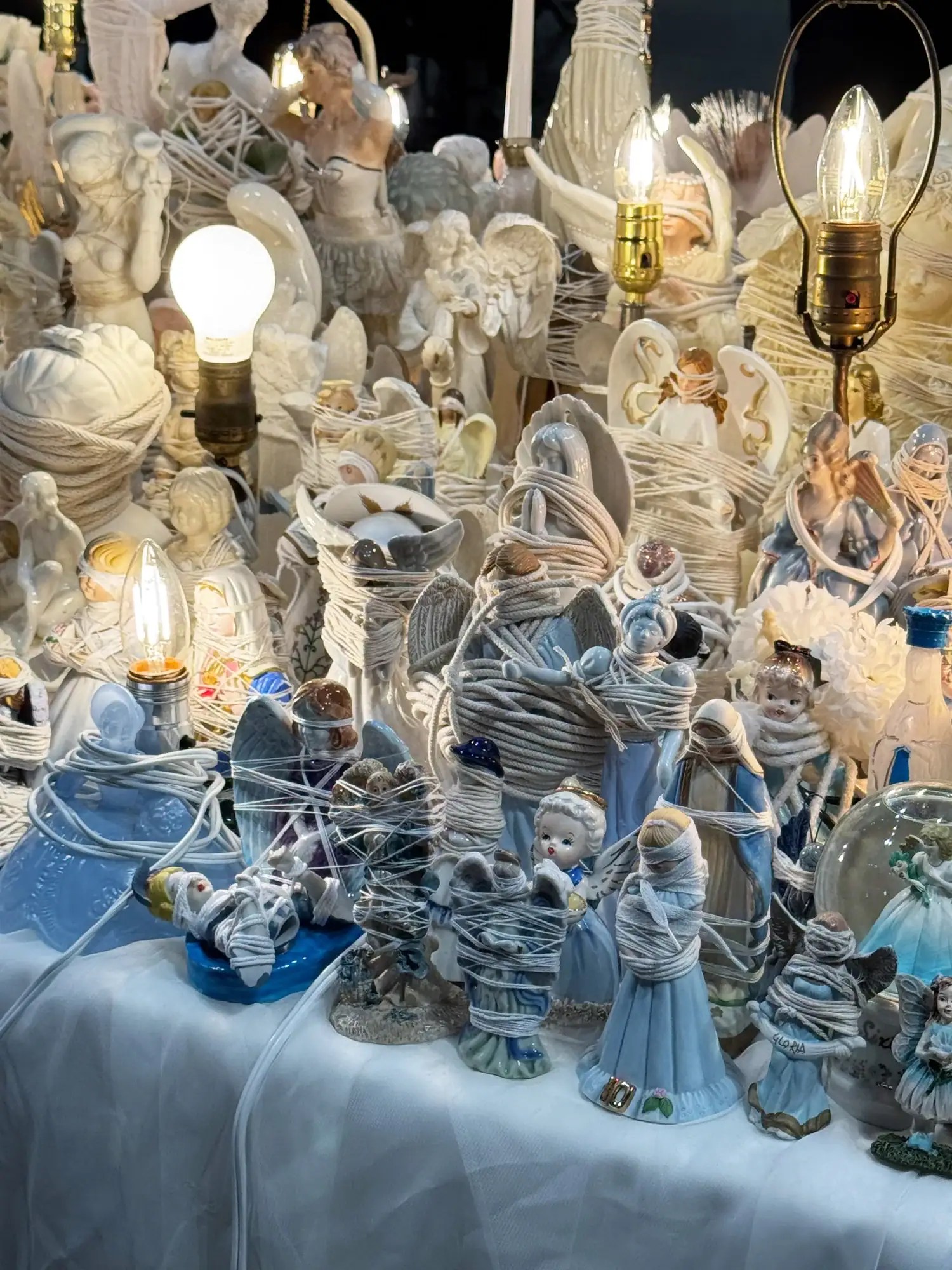
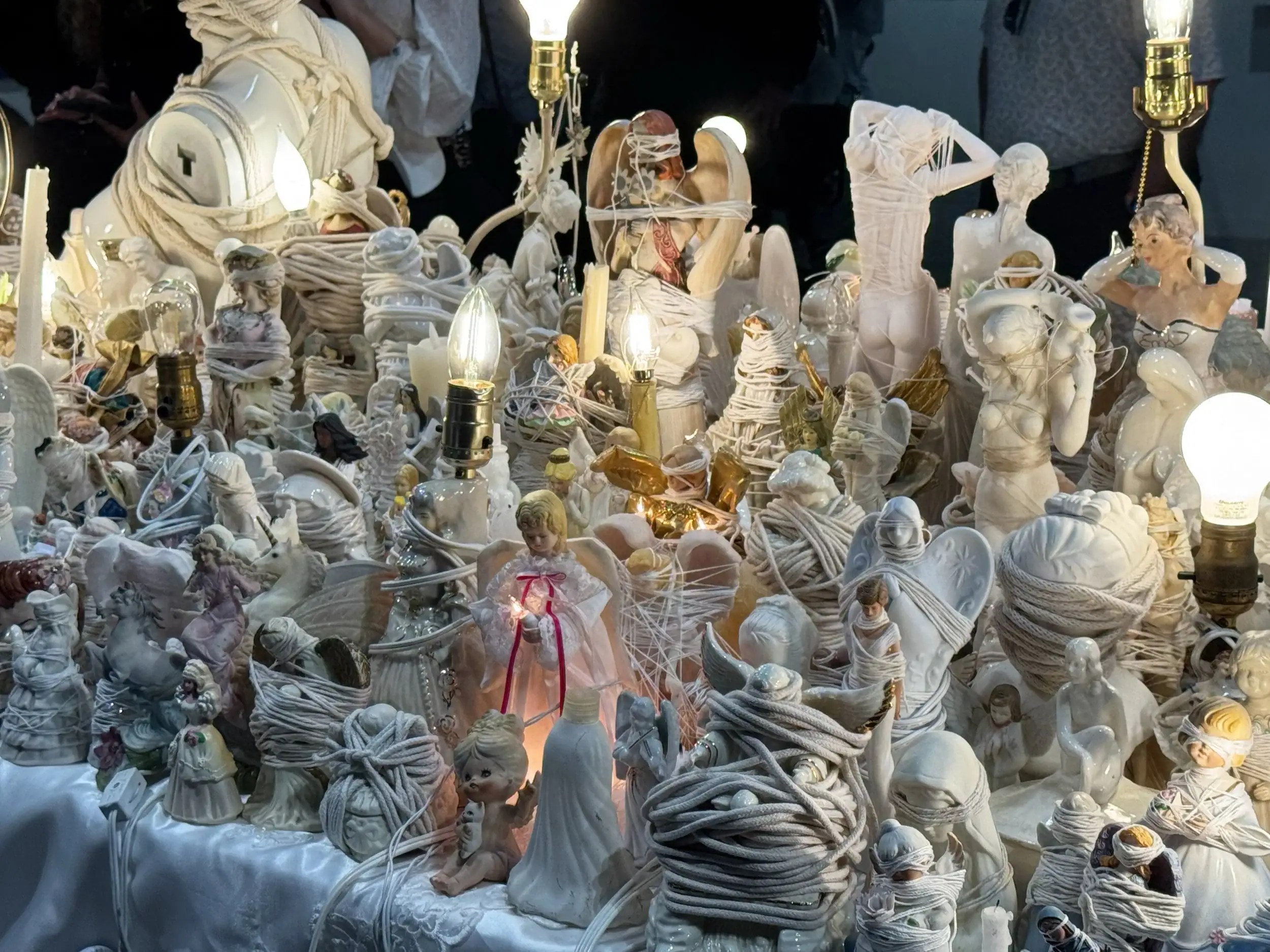
A large table, draped with a tablecloth made from wedding gowns. On it, a mannequin’s trussed torso. Around it, smaller bound assemblages.
The wedding dress is the object our culture most insists a woman should want, and Munson has turned it into a tablecloth— a surface, something laid down and served upon. The figure at its centre is bound. Munson describes her as “infused with all the information and constraints we unconsciously gather”, and the tableau lays out its subject plainly: the exhausted, persistent Madonna–whore complex, and the objects we buy and cherish that keep transmitting it.
It is a very direct work, and it earns its directness because Munson has been building this argument out of the contents of dollar stores for thirty years. The scale is not decorative. You need a table, laid, at full size, to feel it.

Sarah Meyohas — Interference #18
Shown by Marianne Boesky Gallery, Sarah Meyohas brought the sector’s most technically startling object.
Interference #18 is a multi-panel hologram, fourteen feet wide, composed of more than thirty trapezoidal panels. Across it, enlarged imagery of plant life is layered with a naked female figure — the two interleaved, fractured, flickering as you move, so that at no point can you resolve where the body ends and the botany begins.
You cannot photograph it properly, which is rather the point. A hologram exists only in relation to where you are standing.
Meyohas is long established at the intersection she is working: she is one of the genuine pioneers of art and crypto, and her practice has consistently been about how value, image and technology entangle. Which is what gives the work its authority. The claim the piece makes, that the natural world is itself a form of technology, arrives from someone who has spent a decade thinking rigorously about exactly that boundary, and it lands as a considered observation.
The body in the hologram is not being invaded by the plants, and it is not being rescued by them. It is revealed as the same kind of thing they are: a system, running.

Anastasia Bay — Maestra Lacrymae, Acte V
Anastasia Bay — born in Paris, based in Brussels — brought the work that made people stop and tilt their heads back.
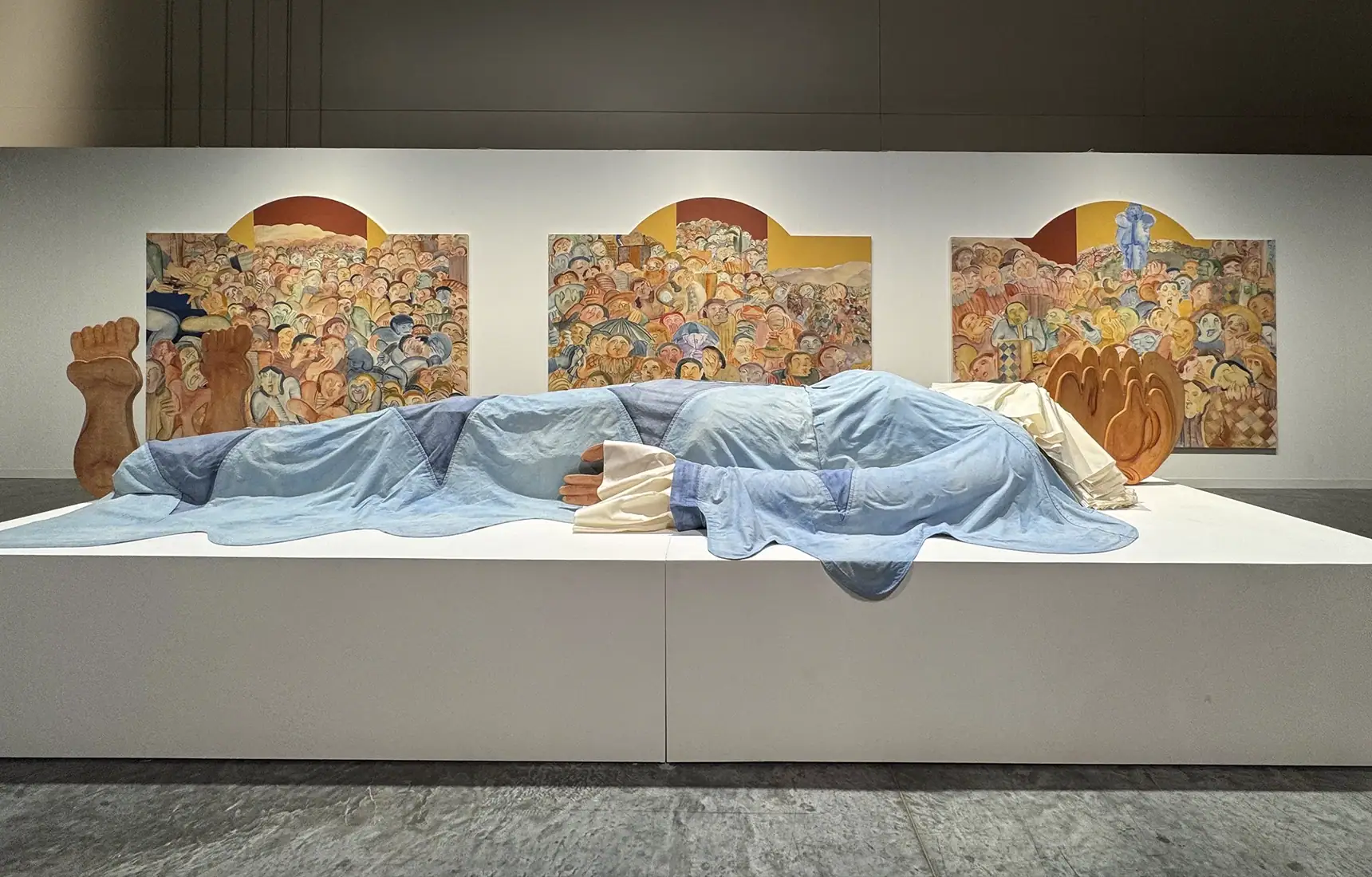
Maestra Lacrymae, Acte V extends a body of work in which she has been braiding painting, opera and historical myth. It comprises three large paintings on specially shaped panels, and, standing among them, a Harlequin puppet almost five metres tall.
The puppet is where the piece opens up. It draws on the giant processional puppets of Belgian and northern French festivals — the géants carried through the streets at carnival, figures so large they have to be borne by several people, and so old they are treated as members of the towns that own them. They are not props. They are ancestors with names.
Bay paints such figures towering over crowds, and here she builds one and puts it in the room with you. For her the Harlequin stands for transformation and resilience — the trickster who survives by changing shape, and who has been doing so since the commedia dell’arte.
There is something exactly right about a five-metre carnival giant in a convention centre in Miami. These figures were always meant to move through a crowd of people who half-believe in them. That is more or less what an art fair is.
What Meridians is actually for
Standing back, the three works share a subject.
Munson’s bound figure is shaped by the objects a culture sells her. Meyohas’s body is entangled with the plants and technologies it cannot be separated from. Bay’s Harlequin is an inherited myth, towering, that its own people carry through the street.
Each is a body being formed by a system larger than itself, and in each case the scale is the argument. In the Grand Ballroom, at this size, the work meets you at full height and holds you there. It sets the terms and you stand inside them.
That is what Meridians is for, and why it remains the part of Art Basel Miami Beach I look forward to most. It is the room where the fair becomes an exhibition, given over wholly to work at full scale, and it rewards every minute you spend in it.
Frequently asked questions
What is Meridians at Art Basel Miami Beach?
The fair’s sector for large-scale works — monumental installations, sculpture, expansive painting and immersive video — that cannot fit in a standard booth. It is staged in the Grand Ballroom of the Miami Beach Convention Center, roughly 6,000 square metres.
Who curates it?
Magalí Arriola, director of the Museo Tamayo in Mexico City. The sector carries a strong focus on artists and practices from the Americas.
What is Portia Munson’s Bound Angel?
A 2021 installation: a large table draped in a tablecloth made from wedding gowns, holding a mannequin’s bound torso, surrounded by smaller bound assemblages.
What is Sarah Meyohas’s Interference #18?
A fourteen-foot multi-panel hologram of more than thirty trapezoidal panels, layering enlarged plant imagery with a nude figure that appears to dissolve into vegetation as you move past it.
What is Anastasia Bay’s Maestra Lacrymae, Acte V?
An installation of three large shaped paintings alongside a Harlequin puppet almost five metres tall, drawing on the giant processional puppets of Belgian and northern French festivals.
Final thoughts
An art fair is a place where things are looked at in order to be bought, and that is its great strength; it is the engine that pays for everything else.
And once a year, in a ballroom, Art Basel builds a room for work on the very largest scale, where a table of wedding dresses, a flickering hologram and a five-metre carnival giant get to be exactly as big as their subjects.
It remains the best hour of the week.

Leave a Reply