
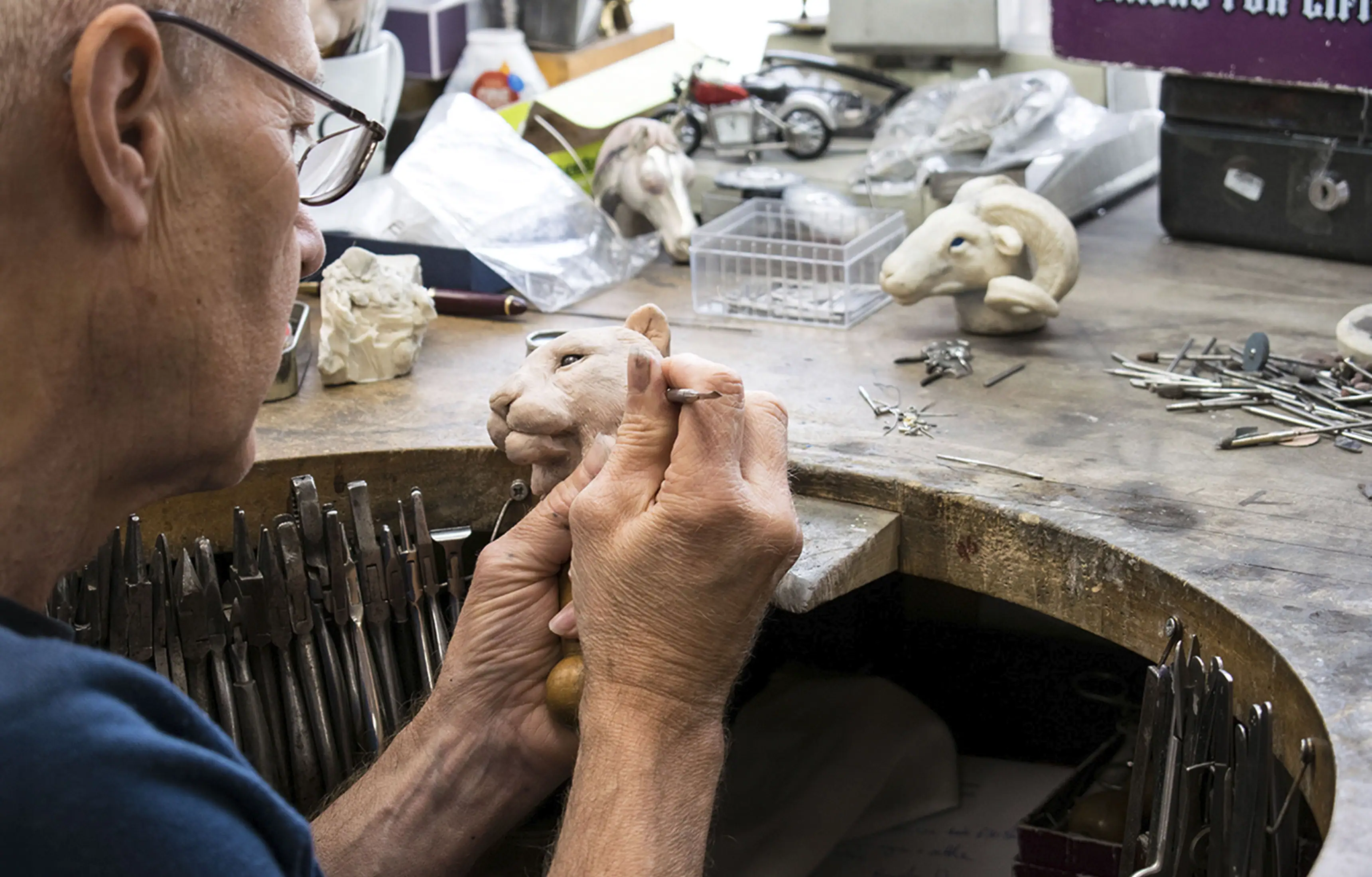
Asprey has moved twice in the last four years: its shopfront to Bruton Street in 2021, its silversmiths to a dedicated workshop in Hammersmith in 2022. What has not moved is the way the house’s master engraver works, a technique he learned as a sixteen-year-old apprentice in 1974 and has used, largely unchanged, on every trophy that has passed through his hands since.
Introduction
Asprey has been London’s silversmith and jeweller to the British royal family since Queen Victoria granted the house its first Royal Warrant in 1862, and its workshops still make, by hand, the kind of objects most customers assume come from a factory: a cocktail shaker built from a dozen separately engraved sections, a decanter modelled first in wax before a gram of silver is cast, a hip flask designed in conversation between a silversmith, a leather specialist and an engraver in the same room. Asprey’s own description of one of its more complex commissions, a pagoda-shaped cocktail shaker with a detachable, hand-enamelled roof, calls it one of the hardest pieces in the current collection to make, on account of its tapering shape, its multiple segments and the range of angles a craftsperson has to work across.
None of that complexity is designed to be seen. It is designed to disappear into an object a customer picks up, uses and puts back down without a second thought, which is exactly the point: the craft is only doing its job properly when nobody notices it.

The Surrey silk printer that became a royal silversmith
Asprey was founded in 1781, not as a jeweller but as a silk printing business, established by William Asprey in Mitcham, Surrey. William was descended from Huguenot refugees who had left France to escape religious persecution under Louis XIV, a background shared by a number of London’s early luxury trades. The business passed to his son Charles, who partnered with a Bond Street stationer in 1841 and, within a few years, moved the family firm to 167 New Bond Street, the address that would define Asprey in the public imagination for the best part of two centuries. It became known for leather dressing cases built for the new age of railway travel, and for “articles of exclusive design and high quality” aimed at buyers who wanted craftsmanship over branding.

Queen Victoria granted the house its first Royal Warrant in 1862, and Asprey has held a warrant from every reigning monarch since. The house’s nineteenth and twentieth-century roster of in-house craftsmen included Ernest Betjeman, a master silversmith and the father of the poet John Betjeman, a reminder that the workshop’s staff were, and are, specialists in their own right rather than names attached to a brand. J. Pierpont Morgan and the Maharaja of Patiala, who commissioned a set of teak travelling trunks fitted with solid silver bathing utensils, were among the clients who kept that workshop busy through the early twentieth century.

A shopfront and a workshop that no longer share an address
For most of Asprey’s history, the retail flagship and the workshop that supplied it sat under the same roof at 167 New Bond Street, craftsmen working in the rooms above the shop where their finished pieces were sold. That arrangement changed twice in quick succession. In 2021, on the house’s two hundred and fortieth anniversary, Asprey relocated its flagship to 36 Bruton Street in Mayfair, a store built around what the house calls an exhibition-style format, with a dedicated digital design studio for bespoke commissions and a private tearoom upstairs. The following year, the silversmithing workshop itself moved out of the old New Bond Street attic rooms entirely, into a purpose-built 4,900 square foot space in Hammersmith, west London.

John Rigas, Asprey’s chairman, has described it as one of the few fully operational silversmithing workshops still running in London, a fact worth taking at face value: most houses of Asprey’s size long ago moved production abroad or contracted it out. Asprey’s core silversmithing has stayed in Britain throughout, which is also why the house has become one of the more visible supporters of the Goldsmiths’ Craft & Design Council, the body responsible for getting the next generation of apprentices into workshops like this one before the current generation of specialists retires. It is the same instinct behind The Art of Welcoming, the Mayfair Design District exhibition of British makers funded by the Queen Elizabeth Scholarship Trust: a recognition that a skill this specific has to be actively kept alive, not simply inherited.
Bruton Street still keeps a craftsperson on site for client-facing work. That is where Asprey’s engraver works when a customer wants to watch a design go onto silver in person; the heavier work, casting and raising and chasing, happens across town in Hammersmith. It means a single commission, a trophy, a hip flask, a christening cup, can now pass through two workshops and two postcodes before it reaches a customer, which was never true of the New Bond Street era.

The engraver who started at sixteen
Philip Sale has been Asprey’s master engraver for more than fifty years. He began a five-year apprenticeship in 1974, aged sixteen, training under Charles Malyan, who headed the engraving department and was himself in his mid-seventies at the time, a direct hand-to-hand transfer of a skill across two generations that had already spanned most of a century between them. Sale’s early commissions were modest by the standards of what followed: trophies for Crufts and the Horse of the Year Show, the kind of work an apprentice earns before a house trusts him with anything more prestigious. What followed, over five decades, was a career spent on major sporting trophies and royal commissions, work that includes the annual re-engraving of the Premier League trophy, a single commission that runs to more than six hundred hours of craftsmanship across the wider silver workshop before it is handed back for the following season.

His technique has not meaningfully changed since 1974, as he has described in detail. Sale builds up a design first in plasticine and powdered chalk, sketching directly onto that surface with wood sticks rather than anything sharp enough to mark the metal underneath. More complex designs are drawn on paper, reduced to the size needed, then transferred onto the silver through a sheet of paper backing using a scriber. Only once a client has approved the design does he cut, working the metal by hand before sending the finished piece back to the silver workshop for polishing. The distinction between his work and a machine engraver’s is a matter of physics rather than taste: hand engraving removes a sliver of metal with every stroke, cutting a groove with a true edge, where mechanical engraving displaces the surface rather than cutting it, leaving a shallower, softer mark that reads differently under light. It is the kind of difference a customer would never articulate and would still, somehow, be able to feel.
Sale has said his own introduction to the craft came from his father’s pocket watch, an object he has described as irreplaceable to him personally, which is a fitting origin story for a trade built on the idea that some objects are made to be handed down rather than replaced.

A pagoda that takes several days and a decanter that starts as wax
Asprey’s Pagoda Cocktail Shaker is as good an example as any of what the Hammersmith workshop actually produces. Standing 34 centimetres tall and holding a litre, it is built from hallmarked sterling silver finished with red and green enamel, its stacked, tapering storeys engraved individually before the whole piece is assembled around a detachable, angled roof that lifts away like the top of the building it is modelled on. Asprey’s own account of the design calls it one of the hardest pieces in the current range to make, precisely because a tapering silhouette built from multiple segments and a wide range of angles leaves a silversmith almost nowhere to hide a mistake. A personalised order takes seven to ten working days once the design is approved, on top of whatever time the piece has already taken to make.
The house’s animal head decanters start further back still, before any silver or crystal is involved at all. Each begins as a sculpted wax model, built from a combination of drawings, reference photographs and physical measurements of the animal being depicted, refined by hand until the proportions read correctly from every angle. Only once that wax model is approved does it go forward into the moulds used for casting, which means every decanter in the range exists first as an object nobody outside the workshop will ever see, made purely so that the finished piece can be got right.

Leather cut so the spine sits exactly where it should
Asprey’s leather workshop runs on a smaller, more design-led scale than the silver side: a handful of artisans working on prototypes, bespoke commissions and personalisation rather than volume production. Exotic skins, including shagreen, are dyed and polished in-house, and a cutter will position a skin’s most distinctive marking, a shagreen spine, for instance, deliberately at the centre of a design rather than losing it to a seam. Finished pieces can be personalised with matching thread colours, hardware and monogramming, decisions made in the same conversation a client might be having about a silver clasp or an engraved plate for the same commission.
Asprey’s ready-to-wear leather collections, made in partnership with a third-generation Italian workshop rather than produced entirely in London, sit alongside that bespoke service rather than replacing it. Two of the current collections carry names that only make sense once you know the house’s own history: the 1781 bag, named for the year William Asprey started the business, and the 167 bag, named for the New Bond Street address the house occupied for nearly two hundred years and has since left behind. The workshop moved. The address is still on the products.

The sandwich that became a silver mould
Asprey’s craftsmen tell one story about a customer’s request that says more about the workshop’s standards than any product description could. A client wanted a bespoke silver sandwich set and, rather than working from a sketch or a written brief, Asprey’s team made an actual sandwich, bacon, a fried egg, toasted bread, assembled it as the client wanted it served, and took a mould directly from the finished object. It is a small anecdote and an expensive way to solve a design problem, and it is also exactly the kind of decision a workshop makes when the brief is not “build us a sandwich set” but “build us this specific sandwich, in silver, forever.”

Frequently asked questions
Where is the Asprey workshop today?
Asprey’s flagship store moved to 36 Bruton Street in Mayfair in 2021. Its main silversmithing workshop is now a purpose-built space in Hammersmith, west London, opened in 2022, having previously occupied rooms above the former flagship at 167 New Bond Street. A craftsperson still works from Bruton Street for client-facing engraving.
Who is Asprey’s master engraver?
Philip Sale has been Asprey’s master engraver for more than fifty years, having begun a five-year apprenticeship in 1974 at the age of sixteen under Charles Malyan. His commissions have included the annual re-engraving of the Premier League trophy.
When was Asprey founded?
Asprey was founded in 1781 by William Asprey as a silk printing business in Mitcham, Surrey. It moved into leather goods, silverware and jewellery over the following decades and received its first Royal Warrant from Queen Victoria in 1862.
What is the difference between hand engraving and machine engraving?
Hand engraving removes a fine sliver of metal with each cut, leaving a true, defined groove. Machine engraving displaces the metal’s surface rather than cutting it away, producing a shallower mark with a different quality of light and shadow.
How is an Asprey animal head decanter made?
Each decanter begins as a sculpted wax model, built from drawings, reference photographs and physical measurements, refined by hand before it is used to create the moulds used for casting the finished piece.
Does Asprey make its own leather goods?
Asprey’s bespoke leather commissions, including personalisation and exotic skins such as shagreen, are made by a small team in its London workshop. Its ready-to-wear leather collections are produced in partnership with a third-generation Italian workshop.

Final thoughts
Most houses with Asprey’s history would have let the story stop at 1781, a royal warrant and a famous address. What is more interesting is what has happened since the address changed: the shopfront moved to Bruton Street, the silversmiths moved to Hammersmith, and the actual skill involved, plasticine and powdered chalk, a wax model before a drop of silver is poured, a mould taken from an actual sandwich because a sketch would not have been precise enough, has not moved an inch. Philip Sale learned to engrave from a man in his seventies in 1974. Fifty years on, he is the one a sixteen-year-old apprentice would now learn from. The workshop keeps changing its postcode. The thing it makes keeps being made the same way.
Leave a Reply