Design Week · Dubai
Reading Time: 10 minutesDubai Design Week 2026 runs from 3 to 8 November at d3, and I have booked all six days. The Urban Commissions brief this year is called Atmospheres and it names light, temperature, sound, material and spatial sequence, which is a far narrower ask than a landmark. Abwab has dropped its pavilion format for a single group show about language, and most of the commissioned work is something you do rather than something you photograph. Here is what I am going to see, and why.
Dubai Design Week 2026 runs from 3 to 8 November at Dubai Design District, and I will be there for all six days. The thing that made me book it is a single word. This year’s Urban Commissions brief is called Atmospheres, and the competition asked entrants to think about light, temperature, sound, material and spatial sequence. That is a very specific list, and anyone who has read a certain thin grey book will recognise it immediately.

The brief is written in somebody else’s vocabulary, and I think that is deliberate
Peter Zumthor published Atmospheres in 2006. It is a lecture, really, about the things that make a room reach you before you have worked out why: the body of the material, the sound a space makes, the temperature of it, the way you move through it. I keep a copy within reach and I have written about it here before.
Set that against a design week brief in a city that is usually judged on its skyline, and the ask becomes interesting. A competition for a public installation at d3 could have asked for a landmark. This one asked how a place feels to stand in. Those are different questions and they produce different objects.
I am not claiming the organisers sat down with the book. I am saying that when a brief names those five things in that order, it is asking for something that cannot be settled by a render.
Three Gardens and a Room
The winning proposal is Three Gardens and a Room by NAO Architects, the Dubai practice founded by Reem Nassour. It is a set of interconnected garden environments arranged around a shared central space, worked out through vegetation, colour, shade and filtered light.

Read that against the brief and it holds. Shade is a temperature decision before it is a visual one. Planting changes the sound of a space, and it changes the air. In a courtyard at d3 in early November, filtered light is the difference between a place people cross and a place people sit down in. This is the first thing I am going to see, and I want to stand in it at two different times of day.
Abwab has quietly changed shape
The structural news this year is Abwab, and it is the part a listing will skip.
Abwab has run since the festival’s early editions as a commissioning programme for practitioners from the region and from Asia and Africa, built around individual pavilions. For 2026 it becomes a single group exhibition called In Other Words, with several practitioners examining communication through gesture, signage, symbols, oral histories, and spoken and written language.

That is a real change. A pavilion format gives each practitioner a box and a flag and asks them to represent somewhere. A group exhibition on a shared subject asks them to talk to each other instead. Given that the subject is language, the format and the theme are the same argument, which is the sort of thing I always want to find and rarely do.
Most of this year’s programme is something you do
Once I started listing the installations, a pattern turned up that nobody has said out loud.
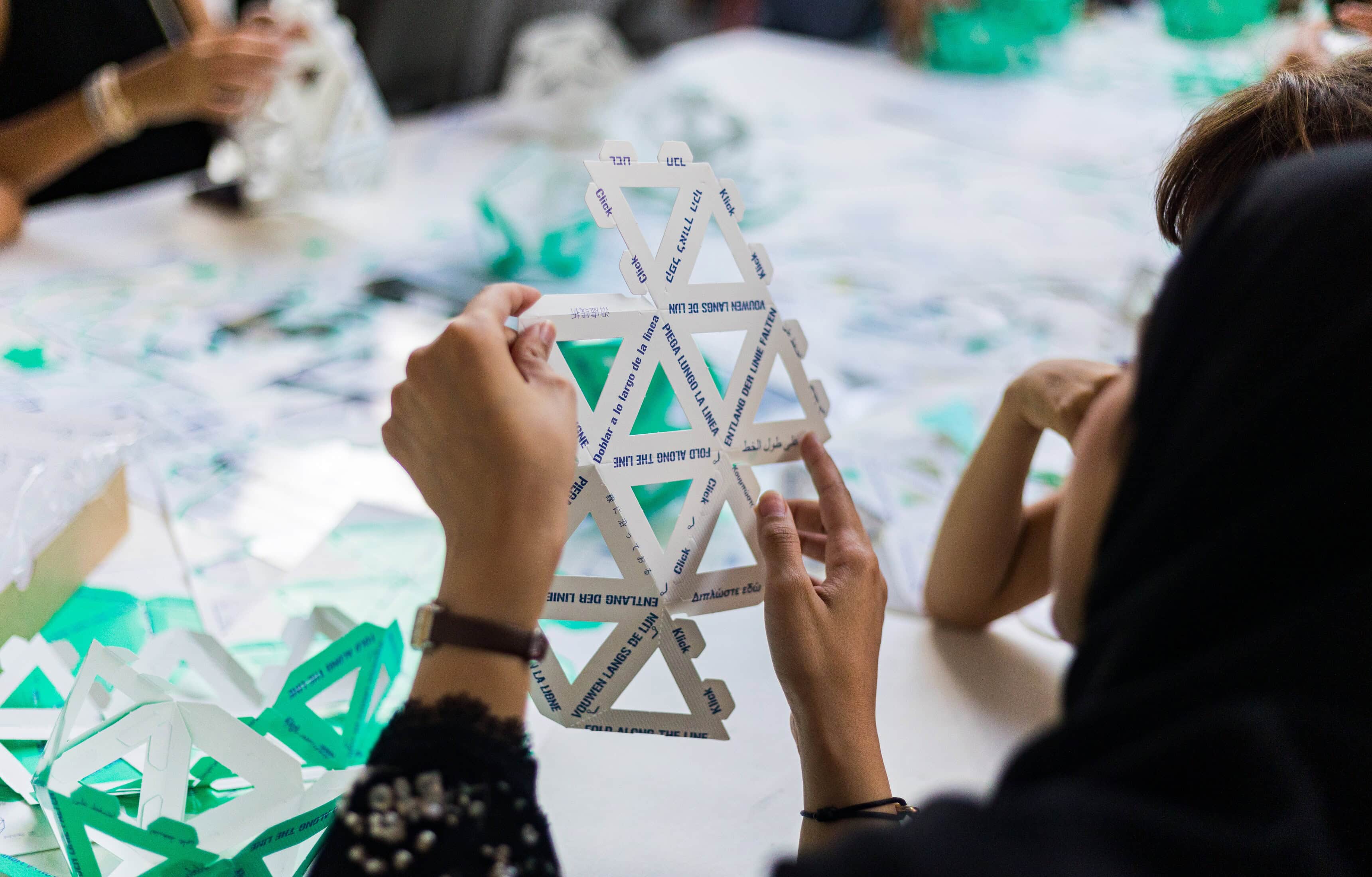
Nikken Sekkei with SOBOKUYA return with CHATAI 2.0, an expanded timber structure that is explicitly about communal making. Rasha Saffarini, the Emirati-Jordanian architect, has built Taqleem, a communal space drawn from the traditional trimming of palm trees. ALTER, from India, has rebuilt Ludo as a space for shared play. Arquitectonica‘s piece is participatory. Palm and Palazzo, from Bahrain, take on privacy and social connection in the traditional Bahraini house. The Al Jalila Cultural Centre for Children is showing ceramics by young practitioners. The Maker Space runs hands-on workshops led by professors from the University of the Arts London and SAE University College, alongside HKS Architects, Leica and independent makers.

Add them up and a majority of the commissioned work this year is a verb. You sit in it, play it, build part of it or make something inside it. For a festival in a city with a reputation for the photographable, that is a quiet and rather confident choice.
What the work is made of
The material list is the other thing worth reading closely.
ae studio, the Palestinian-Turkish practice, have made InBetween What Was and What Will Be from reclaimed concrete rubble. In a city that produces a great deal of new concrete, and where a tower like Wasl Tower can take its whole identity from one ceramic panel, rubble as a primary material is a pointed choice and I want to see how it has been handled, because broken aggregate is unforgiving at close range.
Ethr are showing The Desert Dweller, a contemporary reading of the khaima by the architect Omar Darwish, curated by Shaheer Akbar. Put that next to Taqleem and its palm trimming and you have two pieces working from the same regional material logic: shade made from what the landscape already produces. Hassan Fathy spent a career making that case for mud brick in Egypt, and it is good to see it argued here in palm. Nordic Office Architects are coming at the same problem from the opposite latitude with an installation about light and shadow, which is Tanizaki‘s argument moved about five thousand miles south.

Downtown Design, and the fair that got there first
Downtown Design runs from 4 to 8 November, and it is worth knowing that it is older than the festival around it. The fair launched in 2013, two years before the first Dubai Design Week in 2015, and it is now the commercial engine of the week. The same pattern holds across the Gulf calendar, where Frieze Abu Dhabi has just built its programme around a reconstructed ruin.

The 2026 floor has Gaggenau, Kohler in a collaboration with the Dubai-based architect and designer Agata Kurzela, Venini and Ethimo. There is a Memphis Milano exhibit, a Buccellati pop-up with the British designer Luke Edward Hall, and the Veuve Clicquot Lounge designed this year by Yinka Ilori. The Forum, the fair’s talks programme, sits in a new setting by the architecture and interior studio BONE, with the interior architect Tristan Auer among the keynotes.

The regional platforms are the part I will give proper time to: Tashkeel’s Tanween programme, the Athath Fellowship, and 1971 Design Space with SILA Collective. Tanween in particular is where a lot of the furniture I have liked in this region over the past few years actually started.

The rest of the week
The UAE Designer Exhibition, supported by Dubai Culture, is called Inherited Futures, with the architect and designer AlZaina Lootah as this year’s Design Collaborator. Woods Bagot have taken 25 years of regional work and made an exhibition of it with d3, under the title Worlds Ahead. L’ÉCOLE, School of Jewelry Arts, supported by Van Cleef and Arpels, is showing experimental archaeological research into lost goldsmithing techniques of the Second Iron Age, which is the single most unexpected line in the programme.

On the activation side, Pinterest makes its first physical appearance in the region, IQOS and Ouchhh Collective launch CURIOUS STUDIO with Karrouhat, HiFi, Cheb Moha and Abrar Zenkawi, and BMW Middle East have commissioned a design-led piece. The Marketplace, the outdoor retail weekend of UAE and regional makers, runs on 7 and 8 November.
The festival is under the patronage of Sheikha Latifa bint Mohammed bin Rashid Al Maktoum, is owned and run by Art Dubai Group with d3 and Dubai Culture, and is directed by Natasha Carella, who has described design as influencing “how we live, how our cities function and how we respond to change”. The 2022 edition drew more than 130,000 visitors, and d3 now has over 360 partner organisations on site.
How I am going to spend six days at Dubai Design Week 2026
Here is my actual plan, in case it is useful to anyone going.
Day one is the Urban Commissions piece and the outdoor installations, early, before the light goes flat and before the crowds arrive. I want Three Gardens and a Room in the morning and again at dusk, because a scheme built on shade and filtered light should read differently at both.
Day two is Abwab and the exhibitions, slowly, because In Other Words is the piece most likely to reward a second lap.
Downtown Design needs the better part of two days if you want to see the regional platforms properly rather than walking the brand stands and leaving. Tanween, Athath and 1971 are at the back of most people’s route and at the front of mine.
The Marketplace on the final weekend is the part people skip and should not. It is the clearest picture you will get of what is actually being made here, at a scale you can carry home.

I will be posting from the ground throughout, and the longer pieces will follow here afterwards.
Frequently asked questions
When is Dubai Design Week 2026?
Dubai Design Week 2026 runs from 3 to 8 November 2026 at Dubai Design District, known as d3. It is the twelfth edition. Downtown Design, the commercial fair that sits inside the week, runs from 4 to 8 November, and the outdoor Marketplace runs on 7 and 8 November.
Where is Dubai Design Week held?
At Dubai Design District, d3, which is the purpose built creative district between Business Bay and Ras Al Khor. The festival is staged across the district with installations outdoors and exhibitions, workshops and the fair in the buildings around them. d3 now has more than 360 partner organisations on site.
What is Urban Commissions and what won in 2026?
Urban Commissions is the festival’s annual competition for a piece of public space design at d3. The 2026 brief was called Atmospheres and asked entrants to consider light, temperature, sound, material and spatial sequence. The winning proposal is Three Gardens and a Room by NAO Architects, the Dubai practice founded by Reem Nassour, built from interconnected gardens around a shared central space using vegetation, colour, shade and filtered light.
What is Abwab?
Abwab is Dubai Design Week’s commissioning programme for practitioners from the region and from Asia and Africa. For 2026 it changes format, moving from individual pavilions to a single group exhibition called In Other Words, in which several practitioners look at communication through gesture, signage, symbols, oral histories, and spoken and written language.
Is Dubai Design Week free to attend?
The festival programme at d3, including the installations, exhibitions and the Marketplace, is open to the public. Downtown Design is a trade fair with its own registration. Check the festival’s own site for the current arrangements before you travel, since the detail can change between editions.
What is Downtown Design?
The commercial design fair that runs inside the week, and it is older than the festival itself, having launched in 2013 against Dubai Design Week’s first edition in 2015. The 2026 edition includes Gaggenau, Kohler with Agata Kurzela, Venini and Ethimo, a Memphis Milano exhibit, a Buccellati pop up with Luke Edward Hall, a Veuve Clicquot Lounge by Yinka Ilori, and the regional platforms Tanween, the Athath Fellowship and 1971 Design Space with SILA Collective.
Final thoughts
Every design week has a stated theme and most of them mean very little by the time the stands go up. This one has a brief that names five physical conditions and a winning scheme that answers all five with planting and shade. That is a narrower, harder ask than a landmark, and it is the reason I am going.
The second reason is Abwab. Dropping the pavilion format for a single group show about language is the sort of structural decision that changes what a programme can say, and it will either work beautifully or it will be the most interesting thing to argue about afterwards. Either way I would rather be standing in it than reading about it.
And the third is the simplest. A majority of the commissioned work this year is something you have to do rather than look at. You cannot cover that from a press image, which is the whole point.
I will be at d3 from 3 to 8 November. The reporting starts when I land.
Project Credits
Go further from here
Add to calendar
Google CalendarApple or OutlookRead next
Frieze London 2026 ran from 14 to 18 October in The Regent's Park with 172 galleries from 42 countries. My highlights from the floor: Albert Oehlen at Gagosian, Marcia Falcao…
London