Atelier Van Lieshout, Paris
Reading time: 10 minSculptures of Humanity ran at Carpenters Workshop Gallery in the Marais from 15 January to 27 March 2026. Every bronze in it was built on the same device: a rectangular frame drawn in space around a figure. Rodin spent a decade arguing that his own burghers should have no plinth at all. Atelier Van Lieshout keeps the plinth and adds a box, and the whole show turns on what that box is for.
Atelier Van Lieshout filled the Paris gallery with bronzes of a single kind. A figure, or a group of figures, modelled thin and rough and standing inside an open rectangular cage of the same metal. The show was called Sculptures of Humanity, it ran from 15 January to 27 March 2026 at Carpenters Workshop Gallery on rue de la Verrerie, and it has since closed.
The frames are the work. They are not armatures left on by accident and they are not vitrines. They are drawn, in bronze, around bodies, and they are the thing every visitor had to decide about. The gallery’s own reading is that they stand for the limits, laws and social rules that shape a society, pulling against the figures’ wish for autonomy. That is true, and it is also where the design question starts rather than ends, because sculpture already has a device for setting a body in relation to a viewer, and it has had one for two thousand years.

It is called a plinth. And the most famous argument in the history of European sculpture is about whether to use one.
What Rodin wanted for the Burghers of Calais
In 1347, after eleven months of siege, Calais surrendered to Edward III. The chronicler Jean Froissart records the terms: six of the city’s leading men were to come out bareheaded, with nooses round their necks and the keys of the town in their hands, and submit to execution. Eustache de Saint Pierre volunteered first and five others followed. Queen Philippa of Hainault is said to have asked for their lives and got them.
Calais had wanted a monument to Saint Pierre since 1845 and two earlier attempts had come to nothing. In 1884 the city approached Auguste Rodin, and he finished the group in 1889. He made two decisions that broke with everything public sculpture was then doing. He sculpted all six men rather than the one hero, and he gave them no triumph: what the faces and the hands carry is dread, exhaustion and resolve, in that order.
The third decision was the one he lost. Rodin wanted the group set directly on the ground, at pavement level, in the square in front of the town hall, so that a citizen of Calais walking past would almost collide with them. No pedestal. No distance. The point was that these were townsmen, not gods, and the monument should put them in the same space as the people who came after them. Calais installed the work in 1895 on a large pedestal in front of the Parc Richelieu. His wish was only honoured much later, when the group was moved to the town hall and set on a far lower base.
That argument is still live every time anyone puts a figure above head height, which is why the Fourth Plinth in Trafalgar Square remains such a productive commission. A plinth is not neutral furniture. It is a statement about rank, and about how close you are allowed to get.

Atelier Van Lieshout keeps the plinth and adds a frame
Burgher of Calais II takes Rodin’s six and reduces them to one. The figure stands in a long tunic, arms hanging loose and attenuated to the thickness of a reed, feet mid stride. The head is a plain rectangular block. There is no noose and there are no keys. Everything Rodin put into the faces has been taken out, and what is left is a posture.
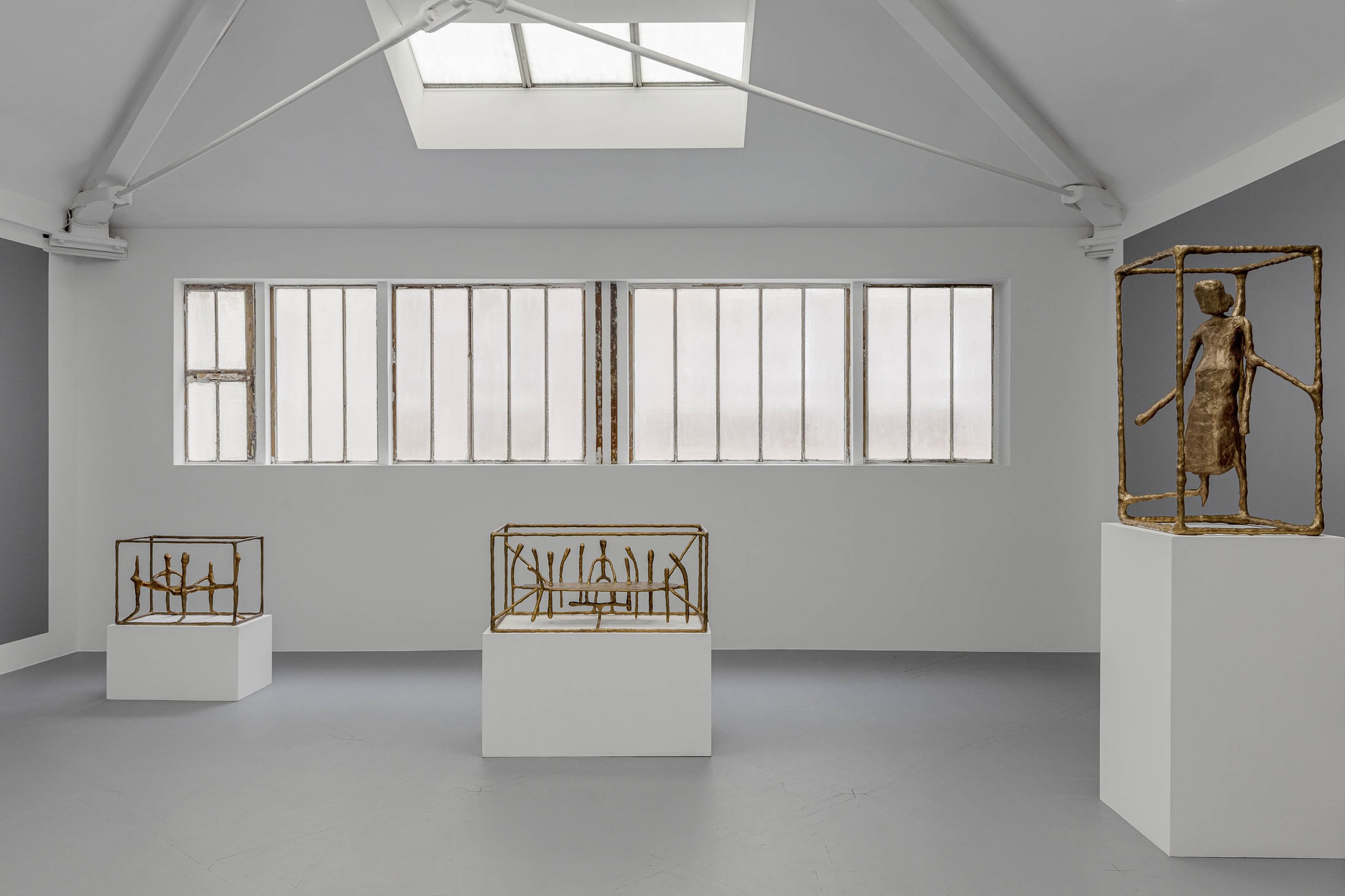
Around it stands the frame: a tall open rectangle of bronze with a single diagonal brace across one upper corner, the bars modelled by hand and left rippled and uneven, so that they read as drawn lines rather than extruded stock. The figure is not contained by it. One foot crosses the bottom bar and projects beyond the base, and one hand reaches past the right hand upright. The work sits on a white plinth at roughly chest height, so you meet it face to face through the bars.

This is the move worth noticing. Rodin’s fight was about removing the device that holds a figure away from you. Van Lieshout accepts the plinth without argument and then introduces a second device, and the second one is ambiguous in a way the first never is. A plinth only ever says above you. A frame can say kept in or it can say kept safe, and nothing in the bronze tells you which.
The scale settles it as much as the form. These are not monuments. Burgher of Calais II is a tabletop object, small enough that a hand reaching towards it fills a third of the photograph. A figure of that size inside a box is a specimen, a souvenir, a reliquary or a toy, depending entirely on how you feel about the box.

Maria’s Cloak, and a shelter made of bronze
The other named work in the show makes the ambiguity explicit, and it does so by quoting a piece of medieval iconography most people recognise without being able to name.
Maria’s Cloak is a square frame on a solid cast base. Inside it a central figure stands with arms stretched wide, head a smooth oval, hands finished as two balls. At first glance the silhouette is a crucifix. It is not. It is the Virgin of Mercy, the image the Germans call the Schutzmantelmadonna, the sheltering cloak Madonna: Mary standing with her mantle held open and a crowd of small figures gathered underneath it. The type seems to come from a vision recorded in Caesarius of Heisterbach’s Dialogus Miraculorum around 1230 and runs through European painting for three centuries, most famously in Piero della Francesca’s Madonna della Misericordia at Sansepolcro. In some versions arrows fall from above and the cloak stops them.

Van Lieshout keeps the composition and swaps the material. Two small figures stand at the base of the central form, one with an arm raised, one bent. But the cloak that should be sheltering them is not there. In its place is the frame.

The substitution is the argument of the whole exhibition in one object. A cloak is held open by a person, it moves, it can be closed, and the protection it offers is a decision somebody is making continuously. A bronze frame is fixed before you arrive and will be there after you leave. Both keep the weather off. Only one of them can change its mind.

The surface is the other half of the argument
Everything in the show was cast bronze with a warm pale patina, closer to raw gold than to the brown of a municipal statue, and nothing was polished smooth. The bars of the frames carry the thumb marks and the slight sag of whatever they were modelled in before casting. They ripple along their length. The corners are not square.
That roughness is doing real work. A frame made from milled steel section would read as a cage, full stop: industrial, impersonal, imposed from outside. A frame modelled by hand reads as something somebody drew, and that keeps the second meaning alive. The figures and their enclosures are made of exactly the same substance and finished exactly the same way, which is why the eye refuses to separate them into victim and apparatus.
The figures themselves are stripped to the minimum that still reads as a body: a bar for a spine, two thinner bars for arms, a block or an oval for a head. In The Caretakers, five standing figures hold a sixth horizontally between them at waist height, each one touching the frame at some point, one hand curled around a corner. Hands and feet are the only parts given any detail, which is the correct instinct, because they are the parts that do the carrying.

The room it was shown in
The Marais space suited the work unusually well. Carpenters Workshop Gallery opened its Paris gallery at 54 rue de la Verrerie in 2011, around six hundred square metres of former industrial building, and it has been left legible: a pitched ceiling with an exposed steel truss, a long rooflight down the ridge, and a band of original steel framed windows running across the end wall, their glazing bars still showing rust and old putty. The floor is poured grey. The walls are white.

The sculptures were set on plain white boxes of three different heights, so the room read as a sequence of eye levels rather than a row. Against painted industrial steel, the hand modelled bronze frames look like what they are: the same idea as a window, drawn freehand.
That the gallery deals in the territory between art and design rather than in either one is part of why the show landed. Carpenters was founded by Julien Lombrail and Loïc Le Gaillard, two childhood friends, and takes its name from its first space, a former carpenter’s workshop in Chelsea that opened in 2006. It now runs four galleries, at Ladbroke Hall in Notting Hill, the Marais, Fifth Avenue and West Hollywood, with its own production facility at Mitry-Mory outside Paris. A practice that has spent thirty years refusing to say whether it makes art, furniture or architecture is well placed in a gallery built on the same refusal.
The practice behind the frames
Joep van Lieshout was born in Ravenstein in 1963 and studied at the Academy of Modern Art in Rotterdam, then at Ateliers ’63 in Haarlem and Villa Arson in Nice. In 1995 he founded Atelier Van Lieshout in Rotterdam and stopped signing work in his own name, putting everything out under the studio instead, which he has described as a way of undermining the myth of the lone genius.
The work since then has been about systems, and specifically about structures that protect and constrain in the same breath. In 2001, during Rotterdam’s year as European Capital of Culture, the studio declared AVL-Ville, a free state in the city’s harbour with its own flag, its own constitution and its own currency. It was later dismantled. Domestikator, the architectural sculpture of 2015, was withdrawn from the Tuileries programme accompanying the Paris art fair in October 2017 after an objection from the president of the Louvre, and the Centre Pompidou showed it on its forecourt instead.
Read the frames against that history and they stop being a new idea. A man who built a state with a constitution, and then took it down, has a long standing interest in the point at which a structure meant to hold a community together becomes the thing holding it in place. Sculptures of Humanity simply brings the question down to the size of a table, hands it to one figure at a time, and lets you decide which way round it goes.
Frequently asked questions
When and where was Atelier Van Lieshout’s Sculptures of Humanity?
It ran from 15 January to 27 March 2026 at Carpenters Workshop Gallery, 54 rue de la Verrerie, in the Marais, Paris. The exhibition has closed.
What was in the exhibition?
An ensemble of bronzes including Burgher of Calais II, The Caretakers, Maria’s Cloak, Boxing Hares, Last Supper and The Omnipotent, each built around a figure or group of figures set inside an open rectangular bronze frame.
Who is Atelier Van Lieshout?
Atelier Van Lieshout is the Rotterdam studio founded in 1995 by the artist Joep van Lieshout, who was born in 1963 and has worked solely under the studio name ever since. The practice makes work across art, design and architecture, including the free state AVL-Ville in 2001 and the sculpture Domestikator in 2015.
How does Burgher of Calais II relate to Rodin?
Rodin’s The Burghers of Calais, commissioned in 1884 and finished in 1889, shows the six men who offered their lives to Edward III in 1347. Rodin wanted it placed on the ground with no pedestal so passers by would meet the figures at their own height. Atelier Van Lieshout reduces the six to one, removes the noose and the keys, and sets the figure inside a bronze frame.
What is Maria’s Cloak based on?
The Virgin of Mercy, known in German as the Schutzmantelmadonna, in which Mary holds her cloak open to shelter a group of small figures beneath it. The iconography dates from around 1230 and appears most famously in Piero della Francesca’s Madonna della Misericordia at Sansepolcro.
Where can you see Atelier Van Lieshout’s work now?
Carpenters Workshop Gallery represents the studio and shows it across its four spaces in London, Paris, New York and Los Angeles. Works from the studio are also held in public collections internationally.
Final thoughts
The easiest way to read Sculptures of Humanity was as a show about cages, and the gallery did not discourage that reading. Figures held inside frames, systems closing round people, the usual argument.
What the bronzes actually did was harder and better. They took a device that sculpture has always used to manage the distance between a body and a viewer, and they made it mean two opposite things at once, by the simple expedient of modelling it by hand out of the same metal as the figure inside it. Rodin went to war with the city of Calais to get rid of the plinth because he understood exactly how much a base decides. Atelier Van Lieshout keeps the base, adds a frame, and refuses to tell you whether it is a wall or a roof.
Maria’s Cloak is the one that stays with you, because the answer used to be a garment. Somebody held it open. The protection was a choice being made in real time by a person who could stop. Cast that same shelter in bronze and fix it to a base, and it will go on protecting you long after anybody has decided to.
Project Credits
Go further from here
Read next
Frieze Abu Dhabi 2026 has named 89 galleries from 37 countries. The stands to walk to first, from Ibrahim El-Salahi and Mounirah Mosly to a Kusama mirror.
Abu Dhabi