Art Fairs · The Regent’s Park
Reading time: 12 minFrieze London 2026 ran from 14 to 18 October in The Regent’s Park with 172 galleries from 42 countries. I did the main fair rather than Masters, and the thing I could not shake afterwards was how much of what stopped me was a face or a body that had been taken apart. This was a colourful, confident, abstract edition, and a surprisingly emotional one. Here is what I photographed and the galleries I would go back to.
I only did Frieze London this year, not Masters, and I came out of the tent with one thing stuck in my head. Almost everything I had stopped in front of was a face or a body, and almost none of it was a portrait. The fair had gone abstract. Not eccentric, which is how it has sometimes felt in other years, and not cool either. Abstract and full of colour and strangely emotional, which is a harder combination to pull off than it sounds.

The numbers behind the week, and why the mood felt different
Frieze London ran from 14 to 18 October 2026 in The Regent’s Park, with 172 galleries from 42 countries. Focus, the section for younger galleries, took 35 of them. There was a new section, The Code Universe, curated by Carol Yinghua Lu, built around eight artists working with popular culture and post-digital practice. Artist-to-Artist, where established artists nominate a peer, ran for a fourth year.
Eva Langret, Frieze’s director for the region, described the week afterwards as a convening moment with a record number of prizes and acquisitions. From the floor it read as confidence. London has had a few years of being told its art market is slipping, and this did not look like a fair having a difficult time. It looked busy, it sold, and the work on the walls was braver than a nervous market usually allows. Frieze Abu Dhabi has just done something comparable at the other end of the calendar, building its whole programme around a reconstructed ruin.
Colour was the first thing, and it was everywhere
I want to be specific about this because it is the thing that will date this edition when people look back.
Walk the aisles and the eye kept getting caught by saturated, unapologetic colour. Hot pink grounds with orange marigolds laid over a fine painted grid. Crimson canvases with dark discs floating in them. Violet and turquoise wall paintings taking a whole booth end. Dense little passages of pink and green worked so thickly that the surface moves as you pass it.

None of it was decorative. That is the distinction worth drawing. Colour was being used as the carrier of feeling rather than as an effect laid on top, which is why so much of it reads as warm rather than loud.


Colour at Frieze London 2026. All photographs by Martyn White.
The face was everywhere too, and almost never a likeness
This was the pattern I did not expect.
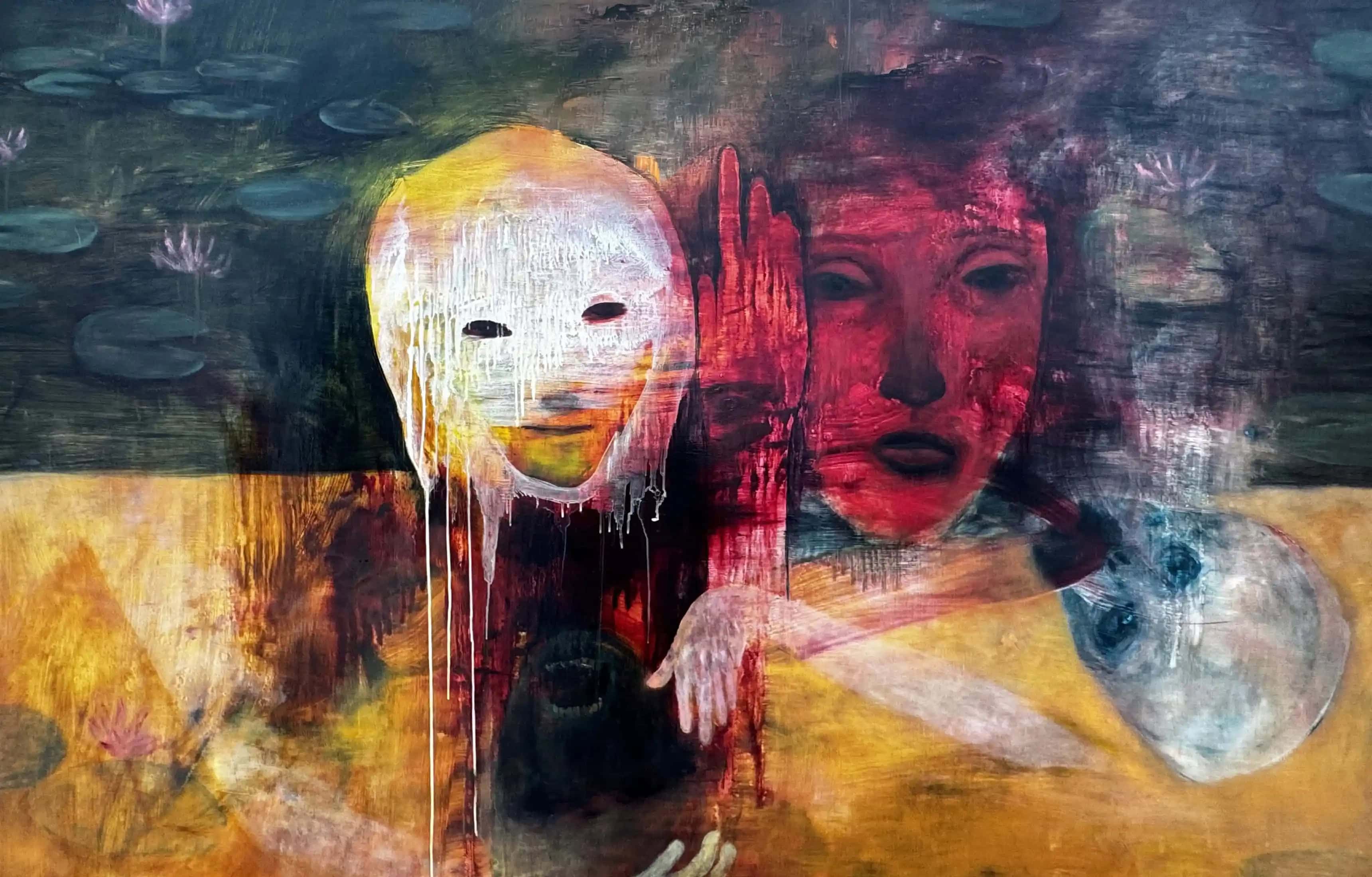
At Linseed, the Shanghai gallery, Asami Shoji‘s paintings held the Focus section for me. A white mask of a face, the paint running down from it in long drips, an ochre field below and a red face pressing in at the shoulder. It is a head and it is not a head. You read a person into it and then the paint reminds you that you did the reading, not the painting.

The same idea kept recurring across the fair. A head drawn in white outline on black. A pale figure with wide eyes dissolving into blue. A face reduced to a white mask and two marks on a huge dark ground. The outline of a body drawn in dark line over an entire wall of collaged paper.
Put them next to each other and the argument is clear enough. These are not portraits, because a portrait is about a specific person, and none of these are. They are about the experience of recognising a face, which is a different and much stranger subject. John Berger spent a whole book on the gap between what we see and what we know we are seeing, and these paintings sit squarely in it.


Faces at Frieze London 2026. All photographs by Martyn White.
The body, taken apart and put back together
Where the face was being abstracted into a mask, the body was being abstracted into volume.
Márcia Falcão‘s paintings at Fortes D’Aloia & Gabriel were the first thing I saw and they set the tone for the whole day. Heavy ochre and brown bodies, limbs assembled with real weight, a pale rounded form held above dark thighs. There is nothing coy about them. The booth sold out, which tells you I was not the only one who stopped.

Elsewhere bodies arrived as smooth interlocking curves, as two figures folded into one another and painted almost entirely in orange, as deep red lovers against a flat blue ground with a cow drifting overhead. The common thread is that the anatomy is a starting point rather than a destination.


The body at Frieze London 2026. All photographs by Martyn White.
Albert Oehlen at Gagosian, and the pleasure of a single room
Gagosian gave its stand over to a solo presentation of Albert Oehlen, and it was the booth that everyone I spoke to mentioned.
It works because it is one artist at full volume in a hall of group hangs. Huge gestural canvases in yellow, red and violet, with black sweeps dragged through them and passages that look like three paintings arguing inside one frame. After four hours of carefully balanced stands, walking into a room that is simply loud is a physical relief.

Surface, and the things that were not paintings
The other thread worth pulling is material.
A panel of pale woven ground scattered with dark purple velvet bows. Hundreds of small yellow panels hung on threads so that a diamond appears to hover in the corner of a booth. A circular wall work of radiating copper and green fibre. A folded and torn sheet of yellow sitting on the floor like something discarded by a much larger machine. Andrea Canepa at Crisis, in Focus, hung geometric panels from cords with glass drops beneath them, against a lilac wall that made the whole booth feel like a room rather than a stand.

These were the works that slowed people down, because you cannot photograph a surface and be finished with it.


Surface at Frieze London 2026. All photographs by Martyn White.
The prizes went to the places I would have pointed at
The awards announced across the week are worth reading as a map of where attention is going, and almost all of them landed in the younger end of the fair.
The inaugural Dasha Shenkman Focus Fund, a thirty thousand pound award run by the Contemporary Art Society, went to Okiki Akinfe on the Ginny on Frederick stand, for the painting Fame is a Gun together with a lightbox and a preparatory drawing, all going into the collection at Abbot Hall in Kendal. The Galleries Stand Prize went to Valentine for its presentation of Oototol. Ella Fleck, shown by Ehrlich Steinberg, took the Camden Art Centre Emerging Artist Award, and Unathi Mkonto, with Goodman Gallery, the Nicoletta Fiorucci Foundation Prize.

The institutions were buying from the same part of the fair. The Arts Council Collection acquired work by Hannah Quinlan and Rosie Hastings, Oliver Osborne, Laurie Smith and Armando D. Cosmos. Tate’s Frieze Fund took a Michaela Yearwood-Dan. There is a pattern there, and it is the same one I had been noticing on the walls all day: figuration loosened until it becomes something closer to feeling.
Focus was the strongest section, and it usually is
If you only have two hours, spend them in Focus.
Thirty-five younger galleries, mostly solo and two-person presentations, and the discipline of a small stand does something to the work. You see one artist properly rather than a sampler. Linseed, Crisis and Public all gave me more than several much larger booths did, and the three of them were showing a Japanese painter, a Peruvian artist working in textile and geometry, and a London sculptor, which is the range of the thing in a single aisle.

It is also, bluntly, where the next few years of the main section come from. The prize list above makes the same point. If you want the mechanics of how that pipeline actually works, Sarah Thornton wrote the best account of it there is.
The Frieze London 2026 stands I walked out thinking about
For anyone planning next year, these are the galleries I spent the most time in, across the main section and Focus.
In the main section: Fortes D’Aloia & Gabriel (A15), Simões de Assis (A4), Pippy Houldsworth Gallery (A21), Galerie Jocelyn Wolff (B9), The Approach (B7), blank (B2), VeneKlasen (B23), The Modern Institute (B22), Perrotin (C8), Alexander Gray Associates (C16), GRIMM (C20), Ingleby (D19), Carbon 12 and Selma Feriani (D33), Gagosian (D14), Lisson (D1), Victoria Miro (D12), Nara Roesler (D10) and Apalazzogallery (D2).
In Focus: Linseed (F16) with Asami Shoji, Crisis (F13) with Andrea Canepa, and Public (F25) with Steph Huang.
That is a Brazilian gallery, a Glaswegian one, a Cape Town one, a Shanghai one, a Peruvian and Spanish one, an Edinburgh one and a Tunisian and London one, all within a few hundred metres of each other in a tent in a royal park. The internationalism of this fair is not a line in a press statement, it is the actual experience of walking it.


Stands at Frieze London 2026, including Gagosian’s solo presentation of Albert Oehlen. All photographs by Martyn White.
What I took away
Three things.
The response to art in London is strong, and it is not polite. The aisles were busy and people were arguing about work in front of it, which is the only reliable sign that a fair is alive.
The move towards abstraction is real and it is not a retreat. Abstraction used to mean getting away from the figure. This year it meant going at the figure sideways, which produced work that was much more emotional than a room full of straightforward portraits would have been.
And the colour will be what I remember. Not one artist’s colour, but the cumulative effect of hundreds of decisions to be warm rather than cool in a year when the safe move would have been grey.
And a practical note, because it is the part people miss. Frieze Sculpture stays up in the English Gardens in The Regent’s Park after the tent comes down, free to walk, until 1 November. It is the easiest good hour in London art right now and it costs nothing. After that my diary goes to Dubai Design Week, which opens in The Regent’s Park’s near opposite, a purpose built district in the desert.


The works I kept coming back to at Frieze London 2026. All photographs by Martyn White.
Frequently asked questions
When was Frieze London 2026 and where was it held?
Frieze London 2026 ran from 14 to 18 October 2026 in The Regent’s Park, with the VIP preview on 14 and 15 October and public days from 16 to 18 October. Frieze Week across the city ran from 12 to 18 October. The fair is held in a temporary structure in the park, with Frieze Masters in a separate tent nearby.
How many galleries showed at Frieze London 2026?
172 galleries from 42 countries and regions. The Focus section, for younger galleries showing solo and two-person presentations, accounted for 35 of them. A new section called The Code Universe, curated by Carol Yinghua Lu, brought together eight artists working with popular culture and post-digital practice, and Artist-to-Artist ran for a fourth year.
What was the mood of Frieze London 2026?
Confident, colourful and markedly more abstract than recent editions. The strongest thread running through the fair was figuration loosened rather than abandoned, with faces reduced to masks and bodies rebuilt as volume and curve, carried by saturated colour rather than muted palettes. Galleries reported strong sales across the price range.
Which stands stood out at Frieze London 2026?
Gagosian’s solo presentation of Albert Oehlen was the booth most people mentioned. Fortes D’Aloia and Gabriel sold out its booth of Márcia Falcão paintings. In Focus, Linseed showed Asami Shoji, Crisis showed Andrea Canepa and Public showed Steph Huang. Pace sold out a presentation of Marina Perez Simão, Pilar Corrias sold out Rachel Rose, Sholto Blissett and Georg Wilson, and Goodman Gallery sold out Unathi Mkonto.
Who won the prizes at Frieze London 2026?
Okiki Akinfe, shown by Ginny on Frederick, won the inaugural Dasha Shenkman Focus Fund, a thirty thousand pound award run by the Contemporary Art Society. Valentine won the Galleries Stand Prize for its presentation of Oototol. Ella Fleck, with Ehrlich Steinberg, received the Camden Art Centre Emerging Artist Award, and Unathi Mkonto, with Goodman Gallery, the Nicoletta Fiorucci Foundation Prize. Theo Triantafyllidis won the Frieze Artist Award for Feral Metaverse (Spider).
Is Frieze Sculpture still open after the fair?
Yes. Frieze Sculpture remains in the English Gardens in The Regent’s Park after the fair tents come down, and it is free to visit until 1 November 2026. It is the easiest way to see part of the programme without a ticket.
Final thoughts
I went in expecting to write about one or two stands and came out with a theme I had not gone looking for. Faces that are not portraits. Bodies that are not anatomy. Colour used as feeling rather than as decoration. It was consistent enough across 172 galleries that it cannot be coincidence, and it made for a fair that was far more moving than a fair usually is.
What I keep coming back to is how much of it rewarded standing still. The surfaces in particular, the velvet bows, the hung yellow panels, the radiating fibre discs, do not give themselves up to a camera, which is a good sign in a week built almost entirely around photographs of art.
Thank you to every gallery that gave me their time on the floor. I will be back next year, and I would like to spend more of it in Focus.
Fair Credits
Go further from here
Read next
Dubai Design Week 2026 runs from 3 to 8 November at d3. The Urban Commissions brief is called Atmospheres, Abwab has dropped its pavilion format for a single group show…
Dubai