
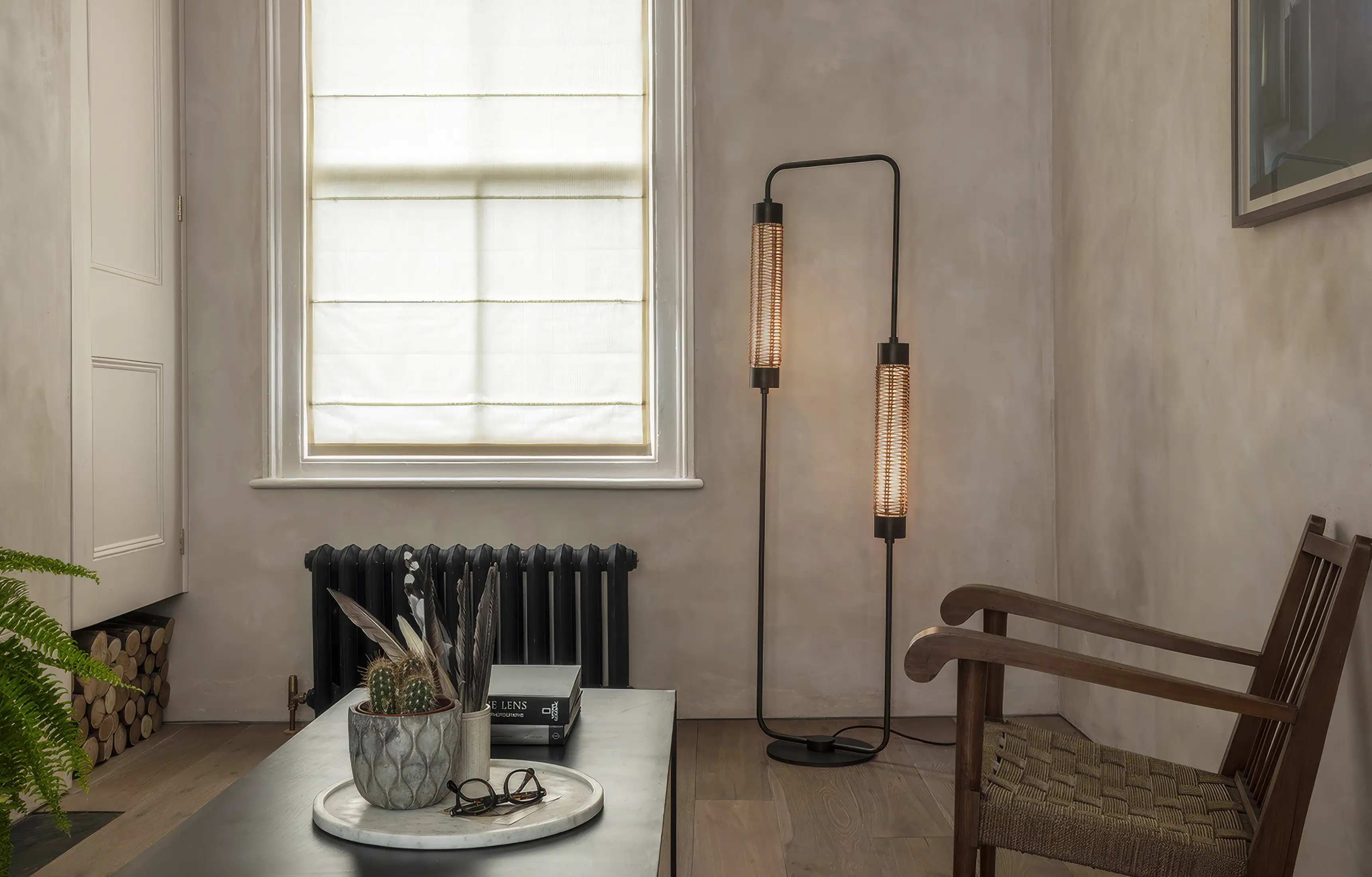
Bill Amberg Studio’s first lighting range did not begin as a lighting range. It began in 2015 as an experiment prompted by an exhibition at London’s Hayward Gallery, was tested publicly at Salone del Mobile the same year, and matured through a single private commission that used more than a kilometre and a half of braided leather cord before it ever became something a customer could simply order. The Loom Collection, launched in November 2020, is built on a rule borrowed from a Japanese industrial designer the studio has never made a leather bag for: a light has to be beautiful before it is switched on, not because of what happens when it is.
Introduction
Bill Amberg Studio, the London leatherwork practice founded by Bill Amberg in 1984, launched its first lighting range, the Loom Collection, on 5 November 2020. The range comprises four fittings, a wall light, a table light, and single and twin-arm floor lights, each built around a steel frame with an antique brass finish and a sleeve of woven or knotted leather wrapped around an LED tube. It reads, at a glance, as a studio known for bags and architectural leatherwork trying its hand at a new product category. That reading undersells what actually happened.
The Loom Collection was five years in development before it launched as a retail range, and its underlying design rule traces back to a specific outside influence the studio has been explicit about but rarely explained in any depth: Sori Yanagi, the Japanese industrial designer best known for the Butterfly Stool, whose “designing through making” philosophy Bill Amberg Studio cites as the working method behind everything it produces, lighting included. That is not a stray reference. It is the reason the Loom lights are built to look finished with the power off, which is a specific, checkable design decision rather than a marketing line.

Five years before the switch was flicked
Bill Amberg Studio’s own account of the Loom Collection’s origins starts in 2015, prompted by a light-themed exhibition at the Hayward Gallery in London. The studio began experimenting with braiding leather cord around LED tubes, testing how the weave scattered light and shadow across a room rather than simply projecting it forward. Early prototypes, finished with spun brass end caps, were shown that same year at the Wallpaper* Handmade exhibition during Salone del Mobile in Milan, a design fair that rewards exactly the kind of hand-finished experimentation the studio was testing.
The piece that turned that experiment into a real range was a private commission rather than a retail product. A long-standing client asked the studio to build a bespoke dining chandelier: 24 braided leather pendant lamps of varying length, suspended from a solid brass cruciform structure, using more than 1.5 kilometres of natural leather cord in total. That is not a small proof of concept. It is a full-scale test of whether a studio built around bags, floors and furniture upholstery could scale a weaving technique to an architectural lighting installation and have it hold together, structurally and visually, across two dozen individual pendants. Only after that commission proved the technique did the studio develop it into the four-fitting range that became the Loom Collection, launched five years after the first Hayward Gallery-inspired experiments began. Bill Amberg has described the development process directly: every light, he has said, is a little different and comes with its own set of challenges, both practical and aesthetic, which is a fair summary of what it takes to turn a one-off chandelier commission into a repeatable product line.

What the four Loom Collection fittings actually are
Each Loom fitting shares the same underlying construction: a softly curved steel frame finished in antique brass, spun base plates and lighting caps, and a woven or knotted leather sleeve wrapped around a GU10 LED source. Customers choose between two leather techniques. The first is hand-knotted vegetable-tanned leather cord, worked in a pattern that draws on nautical knotting, braided by hand in the studio’s own north London workshop. The second is a machine-woven leather sleeve, produced on traditional looms in northern Italy, giving a tighter, more uniform weave than the hand-knotted version. Both are available in a natural finish, which deepens in colour with age and handling, and a rich dark brown that stays closer to constant.
The wall light and table light are the more compact fittings, built for a single point of illumination in a study or a hallway. The single and twin floor lights scale the same construction upward, with the twin version pairing two shaded columns from a shared base, built for a room that needs a taller, more sculptural presence rather than a single accent. None of the four fittings changes the underlying logic. What changes is scale and the choice of weave, hand-knotted or machine-woven, which is as much a decision about texture and regularity as it is about price or lead time.

Designing through making, and what that phrase actually commits a lamp to
Bill Amberg Studio describes its working method as “designing through making,” a phrase it attributes directly to Sori Yanagi, the designer of the Butterfly Stool and one of postwar Japan’s most influential industrial designers. Yanagi worked in the tradition of mingei, the Japanese folk-craft movement his own father helped found, which treats an object’s usefulness and the visible trace of the hand that made it as inseparable from its beauty rather than as decoration applied afterward. For a leather studio to cite an industrial designer working in wood, aluminium and moulded plywood as its guiding influence is a slightly unusual reference, and it is worth taking seriously rather than treating as a name-drop, because it produces a specific, testable commitment in the Loom Collection: a light has to look complete and beautiful switched off, not only when illuminated.
That is a genuinely different brief from most lighting design, which treats the fitting as a housing for the real event, the light itself, and judges success mostly by the quality of the glow it produces. Bill Amberg Studio has stated the Loom principle explicitly: an important aspect of the collection is creating a light that looks equally beautiful switched off as switched on. Practically, that means the woven or knotted leather sleeve has to function as a finished object in its own right, with its own texture, pattern and presence, rather than as a translucent scrim whose only job is to soften an LED. Switch a Loom fitting off, and the leather weave is still doing the work a sculptural object would do on a shelf. Switch it on, and the same weave becomes the mechanism that scatters the light into the “mesmerising, dappled” pattern the studio has described as the range’s signature effect. The Yanagi reference is not decorative context. It explains why the studio spent five years perfecting a leather weave before deciding the range was ready to sell as a light at all.

A 30-year mission to see what leather can do structurally
The Loom Collection sits inside a longer pattern at Bill Amberg Studio, which was founded in 1984 after a commission to build a bespoke leather floor for an architecture practice, an unusual enough brief that it set the tone for four decades spent finding structural and architectural uses for a material most people only associate with bags and upholstery. Amberg grew up in Northampton, the historic centre of British shoemaking, where his architect mother gave him cobblers’ offcuts to practise leatherwork with as a child. His Rocket Bag, still in production since the 1990s, sits in the permanent collections of both the V&A in London and the Metropolitan Museum of Art in New York, and the studio has gone on to build leather lecture theatre seating for the Royal Academy and fittings for Harrods’ watch department, alongside furniture pieces such as the Rivet Stool, folded from a single sheet of leather and closed with hand-set copper rivets, entirely without stitching. More recently, the studio built a fully mechanised leather cabinet for a twinned 33-year-old Macallan whisky release, its articulated plinth raising two decanters together as the lid opens.
Read against that history, the Loom Collection is not a departure into a new material category so much as the studio’s structural-leather instinct applied to a category it had not yet tried. A floor has to hold weight. A lecture theatre seat has to hold a body, repeatedly, for years. A lighting fixture has to hold its shape around a heat source and scatter light predictably through a weave, which is a different structural problem again, but the same instinct, testing how far a material most people treat as soft and decorative can be pushed into genuine structural and optical work, runs through all three. The designer Faye Toogood, who has collaborated with the studio on a separate digitally printed leather collection, has called Amberg one of the most important and exciting people working in British craft today, a judgement the Loom Collection’s five-year development timeline does a reasonable job of justifying on its own.

Frequently asked questions
What is Bill Amberg Studio’s Loom Collection?
A range of four lighting fittings, a wall light, a table light, and single and twin floor lights, built from steel frames with antique brass finishes wrapped in hand-knotted or machine-woven leather. It was launched on 5 November 2020 as the studio’s first dedicated lighting range.
When did the Loom Collection launch, and how long was it in development?
The range launched on 5 November 2020, but the underlying weaving technique had been in development since 2015, including a bespoke 24-pendant leather chandelier commission that helped prove the method could scale before the retail range was finalised.
Who is Sori Yanagi, and why does Bill Amberg Studio reference him?
Sori Yanagi was a Japanese industrial designer, best known for the Butterfly Stool, associated with the mingei folk-craft movement. Bill Amberg Studio credits him as the source of its \u0022designing through making\u0022 philosophy, which shapes the Loom Collection’s requirement that each light look complete switched off as well as illuminated.
What are the two leather options on the Loom Collection?
Hand-knotted vegetable-tanned leather cord, braided in the studio’s north London workshop using a technique drawn from nautical knotting, or a machine-woven leather sleeve produced on traditional looms in northern Italy. Both are available in a natural finish that darkens with age, or a fixed dark brown.
Who founded Bill Amberg Studio, and when?
Bill Amberg founded the studio in 1984, after a commission to build a bespoke leather floor for an architecture practice. The studio has since worked across bags, furniture and architectural leatherwork, including projects for the Royal Academy and Harrods.
Does Bill Amberg Studio make other lighting or furniture beyond the Loom Collection?
Yes. The studio’s wider output includes the Rivet Stool, folded and riveted from a single leather sheet without stitching, and a separate digitally printed leather collection developed with designers including Faye Toogood, Yinka Ilori and Bethan Gray.

Final thoughts
It would be easy to read the Loom Collection as a leather studio’s first attempt at lighting, a reasonable enough side-step for a business built on bags and bespoke interiors. What actually happened took considerably longer than a single product launch suggests. Five years of experimentation, a full-scale chandelier commission using over a kilometre and a half of cord, and a design principle borrowed deliberately from a Japanese furniture designer the studio has no other obvious connection to, all sit behind four fittings that look, on a shop page, like a straightforward seasonal launch.
The Yanagi reference is what makes the collection more than a well-made lamp. It commits the studio to a specific, checkable standard, that the leather weave has to work as an object in its own right before it is ever allowed to work as a light source, and the five-year gap between the first experiments and the finished range is what it actually took to meet that standard. Switched off, a Loom fitting has to earn its place on a table the same way a piece of sculpture would. Switched on, it does that and produces the dappled, woven light it was built for. Both readings were designed in from the start, not discovered afterward.
Leave a Reply