Design · Global
Reading time: 6 minBocci designs processes, not objects — systems that guarantee no two pieces come out the same. Aesop builds shops that share no architect. When they made a lamp together, the only surprise was that it took so long.
Some brand collaborations arrive with a whole argument already inside them: two names, one object, a shared conviction. The Bocci x Aesop 14p is one of the rare ones where the two parties turn out to have been arguing the same point all along.
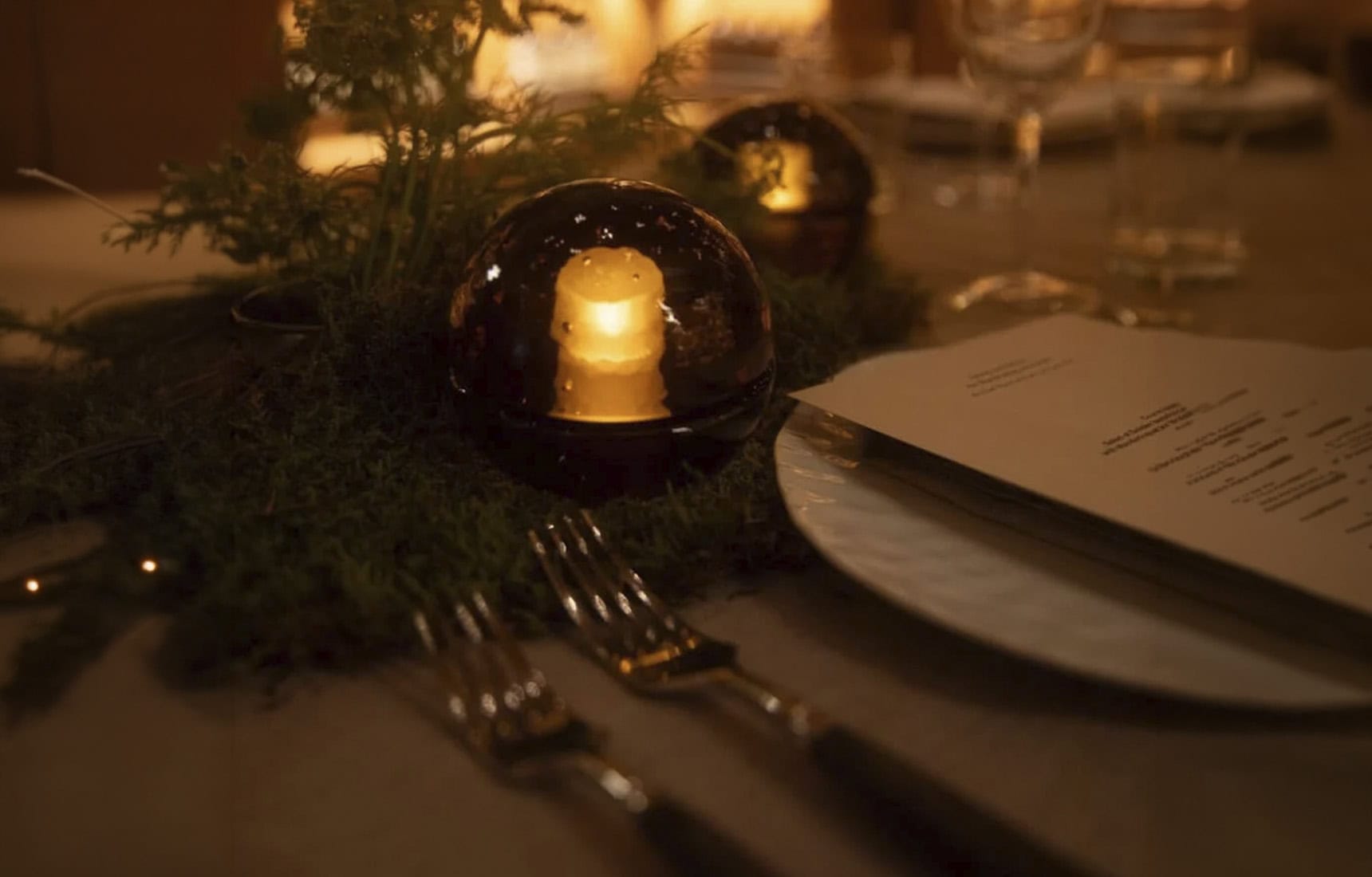
The object itself is modest — a portable, rechargeable table light, roughly the size of a large orange, made of two hand-poured glass hemispheres joined at a rough equator and lit from within. It glows amber, like a candle, or like an Aesop bottle. It costs around $360.
What makes it genuinely worth dwelling on is the principle underneath it, which both companies hold with unusual conviction: that a thing being unrepeatable is a feature, not a defect.

Bocci, and the man who designs processes
Bocci was founded in Vancouver in 2005 by the designer Omer Arbel and the entrepreneur Randy Bishop. The origin story is almost too good: they met at New York Design Week, where Arbel was exhibiting an early prototype of a cast-glass pendant called 14 — and Bishop was attending a candy convention on the floor above.
That prototype became the 14 Series, Bocci’s first product and still its most recognisable: two cast-glass hemispheres forming a solid sphere, distinguished by a visibly textured equator where they meet. Twenty years on, it remains the piece the studio is known for.
Arbel’s method is the thing to understand, and it is genuinely unorthodox. He does not design objects so much as design the conditions under which objects occur. Rather than forcing material into a predetermined geometry, Bocci builds what it calls open-ended fabrication systems — processes that let molten glass, ceramic and metal respond to their own physical properties and, to a meaningful degree, decide their own final form.
In practice this means Arbel is drawn to precisely the phenomena a conventional manufacturer spends its life eliminating: improvised implosions, mismatched expansion coefficients, blended melting points. Glass and metal subjected to heat, fire and electricity in something closer to a laboratory than a factory. The variation is not tolerated. It is commissioned.
The 14’s rough equator is not a flaw the process failed to remove. It is the signature of a maker filling a mould by hand with liquid glass, and the air bubbles suspended in the material are the fingerprints of that moment.

Aesop, and the shop that is never the same shop
Aesop arrives at the same position from the opposite direction.
Founded in Melbourne in 1987, the brand has built one of the most disciplined identities in retail — and the central plank of it is that no two Aesop stores are alike. Each is developed with a different architect or studio, responding to its own building, city and material context. There is no rollout template. A brand that could trivially have standardised, and would have saved a fortune doing so, has instead spent three decades commissioning individual buildings.
And then the bottle: that amber-brown glass, the most recognisable object in contemporary skincare, chosen originally because dark glass protects volatile botanical ingredients from light degradation — a functional decision that became an identity.
So: a lighting studio whose products cannot be made twice, and a retailer whose spaces are never repeated, meeting over a material — glass — that both have spent their existence thinking about, in a colour one of them already owns.
The 14p is less a collaboration than a recognition.
The object
Each 14p is composed of two hand-poured glass hemispheres, joined to encase the light source at the centre. The amber tone deliberately echoes Aesop’s bottles. The glass carries the tiny suspended air bubbles and imprecise edges characteristic of Bocci’s process — which is to say, no two lights are the same, exactly as no two Aesop stores are.
It is wireless and rechargeable via USB-C. A full charge takes about 45 minutes, and delivers roughly 8 hours at the brightest of its three settings, extending to as much as 80 hours at the lowest.
That 80-hour figure is worth dwelling on, because it tells you what the object is actually for. At its lowest setting the 14p is not lighting a room. It is doing something more particular than that. It produces a glow at roughly the intensity of a candle, and it will do so for three and a half days.
It is, in the phrase Disegno used of it, close to a non-light light, an object whose purpose is atmospheric rather than functional, which is precisely the point if you have ever loved what a candle does to a room. Bocci has essentially engineered a candle that does not burn down, and made it beautiful.
The candle comparison is not incidental. Take away the flame and what a candle actually delivers is a small, warm, unreliable pool of light that makes people lower their voices. The 14p delivers that on demand, portably, for eighty hours.

Why it is worth it
It is worth being clear about what you are actually buying here, because this is the kind of object that rewards a close look.
At $360, the 14p is a piece of collectible design with a battery in it, and it is priced as one. You are buying Arbel’s process, Aesop’s colour, and the fact that yours has a bubble in it that no one else’s has. Nobody involved pretends otherwise, and that candour is part of its charm.
The value sits in how much you prize variation, and that is what makes the object such a clear window onto the whole collectible-design proposition. Industrial manufacturing exists to eliminate difference; every unit identical, every defect removed. Bocci built a business on inverting that, and a generation of collectors has agreed to pay for the inversion.
There is a further dimension worth naming. Aesop’s entire brand grammar is artisanal, considered, un-corporate, and Aesop was acquired by L’Oréal, the largest beauty company in the world, in 2023. The 14p is as beautiful as ever, and it is quietly impressive that a lamp whose selling proposition is unrepeatability is being made and sold with this much conviction inside a group of that reach.
What carries the 14p, in my view, is that the craft is real. The bubbles are really in the glass. The hemispheres really were poured by hand. Whatever the ownership structure above it, the object tells the truth about what it is.
Frequently asked questions
What is the Bocci x Aesop 14p?
A limited-edition portable table light: two hand-poured glass hemispheres in Aesop’s signature amber, enclosing an internal light source. Wireless, rechargeable via USB-C, with three brightness settings.
Who designed it?
Omer Arbel, Bocci’s co-founder and creative director. It adapts his 14 Series, Bocci’s first and best-known design, originally shown in 2005.
How long does the battery last?
Roughly 8 hours at the brightest setting and up to 80 hours at the lowest. A full charge takes about 45 minutes.
How much does it cost?
Around $360.
Why is each one different?
Bocci’s process deliberately lets molten glass behave according to its own properties rather than forcing it into an exact form. Air bubbles and irregular edges are inherent to it — which means no two lights are identical, mirroring Aesop’s principle that no two of its stores are alike.
Is it still available?
The collaboration has run through several limited releases via Aesop stores, most recently across Canada. Availability is limited and changes — check with Aesop directly.

Final thoughts
The 14p is a small object making a large claim: that the most valuable thing a manufacturer can offer is the one thing manufacturing was invented to abolish.
Whether or not you buy the lamp, that is a proposition worth sitting with — ideally by its light, at the lowest setting, for as long as eighty hours will allow.
Project Credits
Read next
Lee Broom's Alchemist collection turns lighting into sculpture — Mythos, Gemini, Solstice and the crown-like King chandelier, where alchemy, mythology and British craftsmanship meet.


