
Automotive Design · Miami
Reading time: 6 minUnveiled at Miami Art Week, Jaguar‘s Type 00 concept is less a car than a manifesto — the boldest statement yet of a brand tearing itself down to the studs and rebuilding as something entirely, unapologetically new.
Few legacy marques have ever attempted a reinvention as total as the one Jaguar is now staging, and fewer still have had the nerve to introduce it with an object as confident and deliberate as Type 00. Making its world premiere at Miami Art Week, while South Florida spent six days as the centre of gravity for the global art world, the design concept offers the clearest preview yet of where Jaguar intends to go. Pronounced “Type Zero Zero,” it is the physical embodiment of the brand’s new artistic vision, a philosophy Jaguar has christened Exuberant Modernism, and it arrives hot on the heels of a new visual identity that commanded attention from the moment it appeared.
That attention is, in a sense, the point. In returning to the “Copy Nothing” ethos of its founder, Sir William Lyons, Jaguar has chosen conviction and clarity of purpose. The brand is completing its transformation into an exclusively electric maker of luxury vehicles, and Type 00 makes plain that this is not a matter of swapping powertrains and carrying on. It is a comprehensive reimagining: of the product, the identity, and the relationship between the marque and the people who buy into it.


A clean-sheet architecture
The engineering underpinning the statement is as new as the surfaces above it. Type 00 serves as a precursor to a coming generation of Jaguars, and its design journey began from scratch on an all-new platform known as JEA, or Jaguar Electric Architecture. This dedicated technology base is what allows the car’s proportions to be so dramatic; it is also, Jaguar promises, the foundation for an engaging drive, responsive handling and the kind of ride comfort the brand has always traded on. In other words, the theatre of the exterior is not skin-deep — it is enabled by a structure conceived expressly to carry it.
“For a marque with this much history to draw on, the refusal to copy anything is the most valuable position of all.”


The face of a new Jaguar
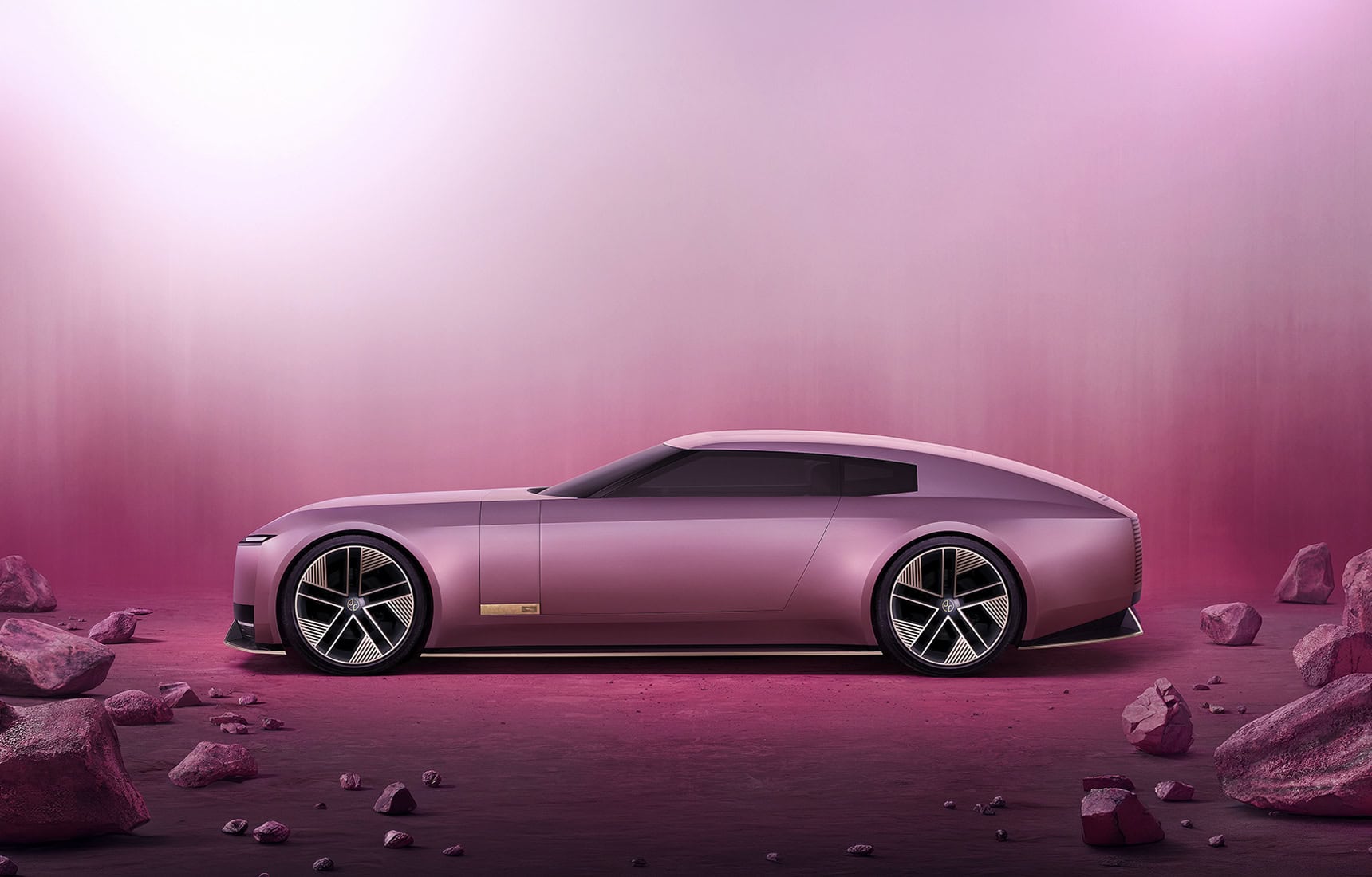
The front of the car sets the tone. Upright surfaces integrate seamlessly with the new Jaguar emblem at their centre, while a distinctive lighting signature draws attention to the corners, emphasising the car’s width and sense of planted stability. It is the side profile, though, that rewards closer attention. Here the proportions turn genuinely dominant, and the famous Jaguar “leaper” appears not as a badge but as a hand-finished brass ingot, laser-etched into each flank — a piece of quiet craftsmanship that doubles as engineering, artfully concealing rear-facing cameras. Those cameras, along with the charging ports and front air intakes, stay hidden until the moment they are needed, a discipline of concealment that runs right through the design.
That long hood, the sweeping roofline, the 23-inch alloy wheels, the fastback silhouette and the boat-tail all conspire to expand the conventions of what an electric car can look like. Type 00 insists on drama in its own right, bold gestures rendered in refined, modern surfaces, and it gives the electric era a shape with genuine presence.


Craft over convention inside
If the exterior is a provocation, the interior is a seduction. Soothing travertine stone forms the base for the floating seats and central spine, and it sets the rich, layered tonal palette that governs the whole cabin. Craftsmanship is foregrounded rather than hidden: woven textiles and a tactile wool blend, drawn from the language of handcrafted yarns, wrap the seats, the sound bar and the flooring. It is a material world closer to a considered interior scheme than to a conventional car cabin, and it signals precisely the crossover between design disciplines that Jaguar is chasing.
The car is conceived as a sensory experience. A harmonised glazed roof subtly projects patterns onto the interior materials, so that textures shift and change character across the course of a day — the cabin is never quite the same twice. Jaguar’s designers have gone further still with personalisation, introducing a purpose-built Prism case that lets passengers tune the cabin’s ambience and, in doing so, deepen their interaction with the vehicle. Stored discreetly behind a beautifully engineered powered door on the car’s side, it houses three totems made from natural materials: brass, travertine and alabaster. Overhead and along the length of the cabin run three elegantly crafted brass lines, culminating in a central 3.2-metre brass spine that divides a pair of floating instrument panels — a piece of architecture as much as of automotive design.


Reading the name
Even the name is a designed object. The “Type” prefix reaches back into Jaguar’s heritage, an echo of icons like the pioneering E-type. The first zero denotes zero tailpipe emissions; the second signals that this is the inaugural model in an entirely new lineage. It is a neat piece of shorthand for the whole endeavour — one foot in the marque’s storied past, the other planted firmly in an all-electric future.
That future is expressed through a creative philosophy built on three core principles, one intended to inform every brand element and every interaction, from the new visual identity down to the manner in which Jaguar engages its clients. Type 00 is the most vivid articulation of it so far, but the ambition is clearly for the thinking to extend well beyond a single concept car.


A statement, front to back
The rear resolves the argument the front begins. A glassless tailgate paired with the panoramic, harmonised glazed roof gives the car a genuinely sculptural quality, while distinctive horizontal “Strikethrough” graphics conceal dramatic, full-width taillights and underscore the sheer scale of the thing. Open the dramatic butterfly doors and the “pantograph” tailgate, and the modernist interior reveals itself in full — its exuberant proportions echoing the exterior, its brass detailing tying the whole composition together.
Type 00 previews the thinking behind a coming generation of Jaguars. As a concept, it exists to communicate intent, and on that measure it succeeds emphatically. This is a brand committing wholeheartedly to distinctiveness, and for a marque with this much history to draw on, the refusal to copy anything is the most valuable position of all. Sir William Lyons would, one suspects, recognise the instinct entirely.
Type 00 made its world debut at Miami Art Week. Visit the Jaguar website for more on the brand’s new direction.


Leave a Reply