
ART & CULTURE · PARIS
Reading time: 9 minA lamp Serge Mouille built in 1963 hung in the same Paris rooms as a desk Shaha Raphael finished in 2025, sixty-two years of craft placed in direct conversation. Radical Making was Carpenters Workshop Gallery’s clearest statement yet of an argument its four galleries have been making since a converted carpenter’s workshop in Chelsea in 2006: that furniture can carry the same weight as sculpture, whichever decade made it. The gallery that staged the show was founded, in part, to represent one of the artists standing inside it.
Introduction
Radical Making, subtitled Pursuit of Form, ran at Carpenters Workshop Gallery’s Paris space, 54 Rue de la Verrerie in Le Marais, from 20 October 2025 to 27 March 2026. It was a group exhibition rather than a curated survey with a single named curator, drawing on the gallery’s own roster and its historic holdings to bring together more than twenty artists and designers across roughly a century of practice.
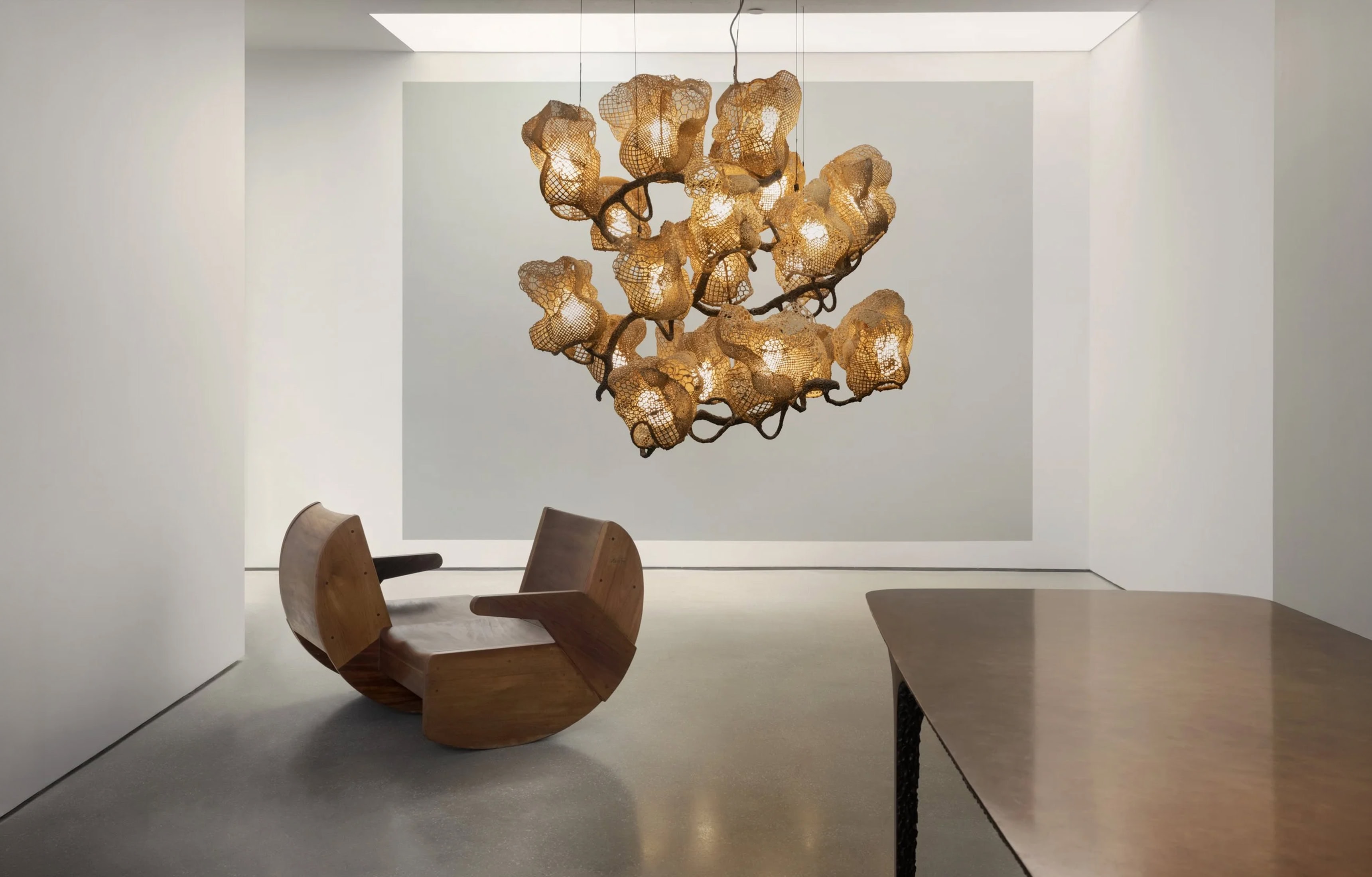
The range ran from Charlotte Perriand, Jean Prouvé and Pierre Jeanneret, the modernist trio whose furniture set the terms for twentieth-century French design, to Shaha Raphael, whose Articulation01 Desk was finished the same year the show opened. In between sat Serge Mouille’s Large Lamp with Six Rotating Arms (1963), Nendo’s Scatter Shelf (2011), Wendell Castle’s Double Trouble Settee (2014), David Adjaye’s Yaawa T1 Table (2020) and Nacho Carbonell’s Big Round Chandelier (2021), alongside work by Ingrid Donat, Roger Herman, Vincenzo De Cotiis, Maarten Baas, DRIFT and others.
Carpenters Workshop Gallery framed the works as a single continuous statement rather than a chronology, describing each piece as one that “can be read as both an object and a sentence in an ongoing conversation about design as thought: an exchange across decades, materials, and minds.” Bronze, marble, volcanic stone and mica ran through the rooms as recurring material, treated less as surface than as evidence of process.
That framing is worth taking seriously rather than repeating. The more useful way into Radical Making is to look at what the gallery actually put in the same room, what it took to make those objects, and why the gallery staging the argument has a more personal stake in it than most exhibition text ever says outright.

Sixty-two years, argued through dated work
Most group shows about “craft” or “process” gesture at the idea in wall text and leave the objects to make a quieter, vaguer case. Radical Making did it with dates. Mouille’s six-armed lamp, designed in 1963 during the period that established him as one of postwar France’s defining lighting designers, sat within the same sequence of rooms as Raphael’s desk, completed in 2025. Between them ran Nendo’s 2011 shelf, Castle’s 2014 settee, Adjaye’s 2020 table and Carbonell’s 2021 chandelier, each a different decade’s answer to the same underlying question: what a functional object can be made to do beyond its function.
That is a specific curatorial device, not a generic one. A show that wanted only to display craftsmanship could have grouped by material or by era. Radical Making instead let a 1963 lamp and a 2025 desk occupy the same visual field, which forces a viewer to compare technique across sixty-two years rather than admire each period in isolation. The materials reinforced the point: bronze that has been cast and worked for millennia sitting near volcanic stone and mica, materials with almost no design history at all until relatively recently, handled with the same physical attention.

The historic half: modernism as proof of concept
The show’s older material did real argumentative work rather than serving as decorative counterpoint. Perriand, Prouvé and Jeanneret represent the moment French furniture design first insisted on being taken as seriously as architecture, a position each of the three spent a career defending in different ways: Prouvé as an engineer-turned-designer who treated a chair like a structural problem, Perriand as the collaborator who pushed Le Corbusier’s studio toward furniture that ordinary interiors could actually use, Jeanneret as the architect who carried that same rigour into the furniture built for Chandigarh.
Alongside them sat a wider mid-century range: José Zanine Caldas and Joaquim Tenreiro, two of the figures who built a specifically Brazilian modernism out of native hardwoods rather than imported European material; Carlo Hauner and Martin Eisler, whose Móveis Artesanal studio did the same from a different angle in São Paulo; the ceramicist Georges Jouve; and Gino Sarfatti, the Italian lighting designer whose fixtures for his own company Arteluce shaped how an entire generation of European interiors were lit. None of this is filler. It is the evidence Radical Making needed to argue that treating furniture as art is not a contemporary marketing position but a continuation of an argument these designers were already making seventy years ago.

The living half: the artists carrying it forward
The contemporary side of the show ran just as wide. Vincenzo De Cotiis, Maarten Baas, Frederik Molenschot, Robert Stadler, Kendell Geers, Giacomo Ravagli, Marc Quinn and the Beirut-based duo David/Nicolas each contributed work that extended, rather than illustrated, the historic half’s argument. DRIFT, the Dutch duo Lonneke Gordijn and Ralph Nauta, brought the kind of kinetic, technology-driven sculpture that has made their studio one of the most closely watched in the field. Nacho Carbonell’s chandelier and David Adjaye’s table did the same from architecture and product design respectively, two practices better known for buildings and structures than for gallery objects.
Two names in that contemporary group carry more weight than the wall text let on, and both point toward the part of this story the show’s own materials never mention.
The founder who represents his own mother
Ingrid Donat’s work appeared in Radical Making as one entry among more than twenty. What the show’s own framing does not say, because a gallery rarely explains its own history inside its own exhibition text, is that Carpenters Workshop Gallery exists in large part because of her.
Donat is a French sculptor known for bronze furniture finished with a signature scarification technique, marks cut and engraved into the surface that read as history rather than decoration. She worked in private for two decades before launching a professional career in 1998, at the age of forty, and built an international reputation through a collaboration with the dealer Barry Friedman from 2003. In 2006, her son, Julien Lombrail, co-founded Carpenters Workshop Gallery with his childhood friend Loïc Le Gaillard, whose own father ran a gallery in Paris, specifically to represent her work. The gallery’s first premises occupied a converted carpenter’s workshop in London’s Chelsea, which is where the name comes from; a second London location followed in Mayfair in 2008, and the gallery’s London home now sits within Ladbroke Hall, the Notting Hill arts complex.
That origin matters for how Radical Making should be read. A gallery built to represent one sculptor’s private, decades-long practice, then expanded to argue that functional objects generally deserve gallery-level seriousness, is not applying a marketing thesis to unrelated artists. It is generalising a case the founders had already made once, about someone they knew personally, before they ever opened to the public. Donat’s presence in Radical Making is not one artist among many so much as the show’s original premise, still standing in the room nineteen years later.

The Workshop at Mitry-Mory, where the making happens
A show built around the word “making” invites a fair question: made where, and by whom. Carpenters Workshop Gallery’s answer is The Workshop, an 8,000 square metre research and production facility outside Paris where the gallery’s artists work alongside master artisans rather than handing finished designs to an outside manufacturer. That is an unusual amount of infrastructure for a gallery to own outright, and it is the reason the work the gallery shows so consistently sits on the line between furniture and sculpture rather than falling cleanly into either category.
It also satisfies the test any craft claim should have to pass: naming the hands. Radical Making’s bronze, marble, volcanic stone and mica were not simply sourced and assembled. They were worked at a facility the gallery built specifically so that an artist’s idea and the physical skill needed to realise it could sit in the same building, which is a considerably more specific claim than the word “craftsmanship” usually gets to make on its own.

Four cities, one continuum
The gallery’s own expansion has followed the same logic as the exhibition’s hang: each stage builds directly on the one before it rather than starting again. Chelsea in 2006, in the original converted workshop. Mayfair in 2008, a second London space, which hosted the Campana Brothers’ first solo show for the gallery, Hybridism, in 2019, a body of cast bronze and pirarucu leather furniture built around a Noah’s Ark motif. Paris in 2011, in Le Marais, the location that would go on to stage Radical Making. New York in November 2015, occupying the nineteenth and twentieth floors of the Takashimaya Building on Fifth Avenue. Los Angeles in 2021, at 7070 Santa Monica Boulevard in West Hollywood, where the gallery’s first solo show for the painter and ceramicist Roger Herman opened in 2026.
That last detail closes a loop the Paris show left open. Herman’s work appeared in Radical Making as part of the group hang; in the same year, the gallery gave him a full solo exhibition, California Poppies, on the other side of the Atlantic. A single artist moving from a group show in Paris to a solo show in Los Angeles within the same gallery’s programme, in the same year, is exactly the kind of continuity Radical Making argued for in the abstract. Carpenters Workshop Gallery does not appear to have needed convincing.
The Ginori thread, and the family the gallery was built on
That family connection extends further than Radical Making itself. Julien Lombrail’s mother has kept working since the gallery he built to represent her opened: Ingrid Donat’s first porcelain collection, made with Ginori 1735, launched in October 2025, the same month Radical Making opened. Donat’s scarification technique, developed across four decades in bronze, moved into an entirely different material within weeks of appearing in her son’s gallery in its historic form. Read together, the two projects show the same practice tested in two directions at once: one show placing her established bronze work inside a deliberately long historical span, one collaboration pushing her technique into a material she had never worked in before.

Frequently asked questions
What was Radical Making at Carpenters Workshop Gallery?
A group exhibition, subtitled Pursuit of Form, that ran at Carpenters Workshop Gallery’s Paris space from 20 October 2025 to 27 March 2026, bringing together more than twenty artists and designers spanning roughly a century, from Charlotte Perriand and Jean Prouvé to contemporary makers including Ingrid Donat, Roger Herman and Shaha Raphael.
Where did Radical Making take place?
At Carpenters Workshop Gallery, 54 Rue de la Verrerie, 75004 Paris, in the Le Marais district.
Is Radical Making still on view?
No. The exhibition closed on 27 March 2026. Carpenters Workshop Gallery continues to run a rotating exhibition programme across its Paris, London, New York and Los Angeles spaces.
Who founded Carpenters Workshop Gallery?
Julien Lombrail and Loïc Le Gaillard, childhood friends, founded the gallery in 2006, initially to represent the work of Lombrail’s mother, the sculptor Ingrid Donat.
Why is it called Carpenters Workshop Gallery?
Its first premises, opened in 2006, occupied a converted carpenter’s workshop in London’s Chelsea.
Where does Carpenters Workshop Gallery produce its work?
At The Workshop, an 8,000 square metre research and production facility outside Paris, where the gallery’s artists work directly alongside master artisans.
What materials featured in Radical Making?
Bronze, marble, volcanic stone, mica and other organic and mineral material, spanning work dated from 1963 to 2025.
Where does Carpenters Workshop Gallery have galleries?
Four locations: Paris (Le Marais), London (Ladbroke Hall, Notting Hill), New York (Fifth Avenue) and Los Angeles (West Hollywood), alongside its production facility outside Paris.
Final thoughts
It would be easy to read Radical Making as a well-produced version of a claim most collectible design galleries make in some form: that what they sell is art, not furniture. The dates on the wall labels make a more specific case than that. A 1963 lamp and a 2025 desk sharing a room is not a statement about status. It is a demonstration that the physical problem, how to make an object that holds up as both idea and structure, has not changed as much in sixty-two years as the materials used to solve it have.
The gallery staging that argument turns out to have tested it once already, in private, before it ever became an exhibition thesis. Julien Lombrail did not learn that furniture could be art from a market trend. He learned it from his mother’s studio, two decades before Carpenters Workshop Gallery existed to say so publicly. Radical Making generalised a conviction the gallery’s founders already held about one specific person to the more than twenty artists and designers who filled its Paris rooms for five months.
What the show leaves behind, now that it has closed, is less a checklist of names than a working method: build the production capacity as well as represent the artists, keep expanding city by city on the same terms rather than diluting them, and let one show’s closing argument, that craft is thinking made visible, become the next city’s opening premise. Roger Herman’s move from the Paris group hang to a solo room in West Hollywood, in the same year, is that method already in motion.


Leave a Reply